
What is the Namibia digital nomad visa?
Namibia launched its dedicated digital nomad visa on 17 October 2022 through the Ministry of Home Affairs, Immigration, Safety and Security. The program made Namibia one of the first African countries to offer a formal remote work visa, joining Cape Verde, Mauritius, and the Seychelles (with Kenya's newer and less formalised program added in 2024). Despite the early-mover status, Namibia's visa has flown largely under the radar of mainstream nomad media, which still leans heavily toward European and Southeast Asian destinations.
The visa is a 6-month residence permit for remote workers earning at least USD 2,000 per month from foreign sources. It is renewable for another 6 months in country, giving a maximum continuous stay of 12 months per application cycle. The fee is approximately USD 62 per person on arrival, one of the lowest of any nomad visa globally. Processing is fast (typically 2 weeks via email notification), and the documentation requirements are pragmatic. Spouses and children are explicitly accommodated with modest income uplifts.
Namibia's pitch to nomads is genuinely unique among African destinations. The country offers world-class natural landscapes (Sossusvlei dunes, Etosha National Park, the Skeleton Coast, Fish River Canyon), English as the official language, low crime rates by African standards, very low cost of living, and zero local tax on foreign-earned income. Compare with our Mauritius Premium Visa (if applicable), our Mexico Temporary Resident guide for a similar low-tax structure, and our South Africa hub for the neighbouring African base.
Requirements and income threshold
Namibia's income threshold is USD 2,000 per month for the primary applicant, with explicit uplifts of USD 1,000 per month for a spouse and USD 500 per month for each child. A family of four would therefore need to demonstrate roughly USD 4,000 per month in total foreign income. The income must come from foreign sources (overseas employment, freelance work for foreign clients, or remote work for a non-Namibian employer).
| Requirement | Detail |
|---|---|
| Income (primary) | USD 2,000 per month from foreign sources |
| Income uplift (spouse) | +USD 1,000 per month |
| Income uplift (per child) | +USD 500 per month |
| Eligibility | Open to most nationalities. Standard background checks apply. |
| Health insurance | Valid international health insurance covering Namibia for the full visa period |
| Criminal background | Clean police clearance from country of residence required |
| Remote work proof | Employment contract with foreign employer, OR freelance client contracts, OR business registration showing foreign clients |
| Fee | Approximately USD 62 per person, paid on arrival |
| Other | Valid passport (6+ months remaining), passport photos, application form, proof of accommodation |
The application is filed online via the Namibia Investment Promotion and Development Board (NIPDB) portal, with payment of the per-person fee occurring on arrival in Namibia. Processing is typically 2 weeks, with the approval notification sent by email. The remote work documentation requirement is flexible: employment contracts, recent invoices, and bank statements showing foreign-source income have all been accepted. Namibian immigration officials have a reputation for pragmatism and English-language ease of communication.
Tax treatment
Namibia operates a source-based tax system. Only Namibian-source income is taxable in Namibia, regardless of residency status. This means foreign-source remote work income earned by digital nomad visa holders is NOT taxed in Namibia, even for nomads who stay the full 12 months and become Namibian tax residents under standard residency tests. This is a major structural advantage compared to most European destinations and even many Asian programs.
Namibian tax residency is determined by physical presence (typically 91+ days in the current year plus 915+ days across the previous 5 years). However, because Namibia only taxes Namibian-source income for residents, the residency question is largely academic for digital nomads working exclusively for foreign clients. Even if you become a Namibian tax resident on paper, your foreign salary or freelance income is not subject to Namibian Personal Income Tax.
Namibia has 11 double tax treaties including with the UK, Germany, France, India, South Africa, Botswana, Sweden, Romania, Malaysia, Mauritius, and Russia. There is no current US-Namibia tax treaty. US citizens still owe US federal filings on worldwide income regardless of Namibian residence, but the Foreign Earned Income Exclusion (currently USD 126,500 for 2024) typically covers most remote-worker income. UK citizens generally lose UK residency once they spend extended time in Namibia.
How to apply - step by step
Namibia's digital nomad visa is one of the simplest in the world to apply for. The application is online via the NIPDB portal, payment is on arrival, and processing is typically 2 weeks. There is no in-person interview requirement.
- Confirm your nationality is eligible. The program is open to most nationalities; only a short list of restricted countries is excluded.
- Gather income documentation showing at least USD 2,000 per month (primary) plus uplifts for spouse and children. Acceptable evidence includes employment contracts, freelance client contracts, and 3 to 6 months of bank statements showing inbound income.
- Obtain a police clearance certificate from your country of residence (FBI Identity History Summary for US, ACRO for UK, equivalent for other countries).
- Purchase international health insurance covering Namibia for the full visa period. SafetyWing, Cigna Global, IMG Global, and equivalents are accepted.
- Book initial accommodation in Namibia (Airbnb, hotel, or guesthouse for at least the first 2 weeks).
- Complete the digital nomad visa application on the NIPDB portal (Namibia Investment Promotion and Development Board). Upload all supporting documents.
- Wait approximately 2 weeks for the email approval notification. The approval letter is attached as a PDF.
- Travel to Namibia. On arrival at Windhoek (Hosea Kutako International Airport) or another port of entry, present the approval letter and pay the per-person fee (approximately USD 62) to receive the visa endorsement in your passport. The 6-month clock starts on entry.
Renewal for the additional 6 months is processed at the Ministry of Home Affairs in Windhoek before the initial visa expires. The renewal fee is similar to the initial fee. After the full 12 months, you must leave Namibia for at least a short period before reapplying for a new digital nomad visa.
Cost breakdown
Namibia has one of the lowest total setup costs of any digital nomad visa globally, primarily because the visa fee itself is just USD 62 per person and there are no apostille or sworn translation requirements.
| Item | Cost (USD) |
|---|---|
| Digital nomad visa fee (per person, on arrival) | $62 |
| Police clearance certificate | $20 - $80 |
| International health insurance (12 months) | $500 - $1,200 |
| Document courier and notarisation | $30 - $80 |
| First month accommodation (Windhoek 1br) | $400 - $800 |
| Accommodation deposit (typically 1-2 months rent) | $400 - $1,600 |
| Flights to Windhoek (often via Johannesburg or Frankfurt) | $900 - $2,200 |
| Local SIM card and initial top-up | $10 - $25 |
| Renewal fee (after first 6 months) | $62 |
| Total first-year setup | $2,384 - $6,109 |
Ongoing monthly costs in Namibia are competitive with Sri Lanka, Mexico, or Georgia. Most full-time DN visa holders report comfortable monthly spending of USD 1,200 to 2,000 in Windhoek and USD 1,000 to 1,800 in Swakopmund. The biggest variable cost is car rental or purchase: Namibia is enormous and public transport between cities is limited, so most long-stay nomads rent or buy a vehicle (USD 400 to 900 per month for a basic rental, less if you buy a used 4x4).
Cost of living
Windhoek is the most expensive city but still substantially cheaper than Cape Town or any European capital. Swakopmund offers a coastal alternative with German colonial architecture and a slower pace.
| Item | Windhoek | Swakopmund |
|---|---|---|
| Rent (1 bedroom, central) | $400 - $800 | $350 - $700 |
| Groceries and home food | $250 - $400 | $250 - $400 |
| Restaurants and casual dining | $200 - $400 | $180 - $350 |
| Local transport and fuel | $150 - $350 | $100 - $250 |
| Coworking membership | $120 - $220 | $80 - $160 |
| Mobile and home internet (fibre 50-100 Mbps) | $50 - $90 | $50 - $90 |
| Health insurance (international, monthly) | $50 - $100 | $50 - $100 |
| Total estimated monthly | $1,220 - $2,360 | $1,060 - $2,050 |
Namibian food is a fusion of South African, German, and traditional Owambo influences. Restaurant dining is good value (a hearty meal at a mid-range restaurant runs USD 8 to 18). Supermarkets stock a wide range of international goods at South African pricing (Pick n Pay, Checkers, and Spar are major chains). Internet is decent in Windhoek and Swakopmund (50 to 100 Mbps fibre) but drops to 4G LTE or slower in remote areas. The hidden cost is fuel: petrol and diesel are essential for any meaningful exploration of the country.
Family and dependents
Namibia's digital nomad visa is explicitly family-friendly. Spouses and dependent children can be included on the same application, with income uplifts of USD 1,000 per month for the spouse and USD 500 per month for each child. The per-person fee of approximately USD 62 applies to each family member, making the total fee for a family of four around USD 248.
Each family member needs their own passport, photo, and (for adults) a police clearance certificate. International schools are concentrated in Windhoek, with options including Windhoek International School (IB curriculum), the German Higher Private School (DHPS), and the British-curriculum St Paul's College. Costs range from USD 6,000 to 18,000 per year, substantially cheaper than most international school options in Cape Town or Johannesburg.
Spouses on the dependent visa can do remote work for foreign clients without restriction. Taking Namibian local employment would require a separate work permit through the Ministry of Labour, with employer sponsorship. The family-friendly elements also work well for travel: Namibia is one of the safest African countries for self-drive family safaris, with well-maintained roads to the major national parks and a strong tourism infrastructure.
Path to residency
The Namibia digital nomad visa does not provide a direct path to Namibian permanent residency. The standard routes to Namibian permanent residency are the Permanent Residence Permit (typically requiring 5 years of continuous lawful residence on a long-term work permit or marriage to a Namibian citizen) or the Domicile by Birth provisions. Time spent on the digital nomad visa does not formally count toward the 5-year continuous residence requirement.
However, the 6-month visa is renewable in country for another 6 months, giving up to 12 months of continuous stay per application cycle. After that you must leave Namibia briefly before reapplying. In practice, this works well for nomads who want to use Namibia as a multi-year rotation base without seeking permanent settlement. If your long-term goal is African permanent residency, the South African Critical Skills Visa or Mauritius Premium Visa may be more appropriate intermediate steps.
Most DN visa holders treat Namibia as a 6 to 12 month base, often combined with a regional rotation through South Africa, Botswana, and Zambia. Compare with the residency tracks in our Portugal and Mexico guides if permanent residency is your priority.
Best cities for digital nomads
Namibia has only two cities that work for a sustained digital nomad base: Windhoek (the capital) and Swakopmund (the coastal alternative). Both have reliable fibre, coworking spaces, and good amenities. Beyond these two, internet quality drops sharply, although the landscape rewards anyone willing to combine remote work with extensive in-country travel.
- Windhoek (capital, 430K). The administrative, business, and tech hub. Klein Windhoek, Eros, and Olympia are popular nomad neighbourhoods with modern apartments and good restaurants. Coworking: Namibia Business Innovation Institute (NBII), The Village, and several cafe-coworking hybrid spaces. Rent USD 400 to 800 for a modern 1br. Internet 50 to 100 Mbps fibre standard. Trade-off: it is a small capital (you will recognise faces after 3 months) and the social scene is modest.
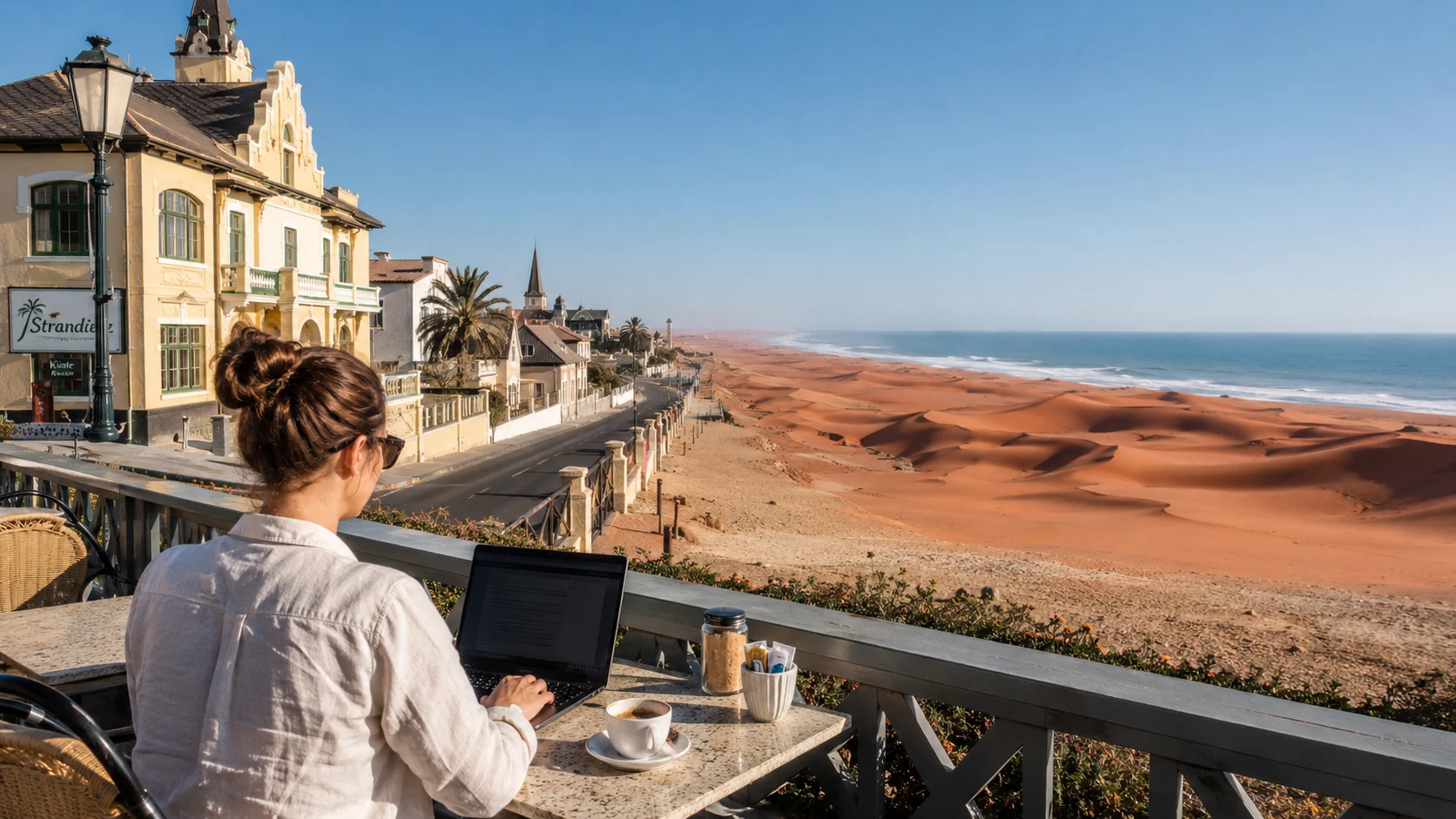
- Swakopmund (coastal, 45K). The German colonial coastal town. Cooler climate year-round (Atlantic Ocean influence), beautiful preserved architecture, slower pace. Excellent base for the Skeleton Coast and the dune landscapes around Walvis Bay. Coworking: The Hub Swakopmund. Rent USD 350 to 700 for a 1br. Internet 50 to 100 Mbps fibre in central areas. Best for nomads who want a slower lifestyle and outdoor activities (sandboarding, kayaking, quad biking).
- Walvis Bay (coastal, 100K, 30 km from Swakopmund). The country's main port. More industrial and less scenic than Swakopmund but lower rents. Best as a value-conscious alternative for nomads who want coastal access at lower cost.
Pros and cons
Namibia is one of the most genuinely underrated digital nomad destinations on earth, but the trade-offs around city options, internet outside the main cities, and travel logistics are real.
- Pro: Zero Namibian tax on foreign-earned income (source-based tax system)
- Pro: One of the lowest visa fees globally (approximately USD 62 per person)
- Pro: English official language; no language barrier in admin or business
- Pro: One of Africa's safest countries with low violent crime
- Pro: World-class natural landscapes (Sossusvlei, Etosha, Fish River Canyon, Skeleton Coast)
- Pro: Family-friendly with explicit income uplifts for spouse and children
- Pro: Decent fibre internet in Windhoek and Swakopmund (50-100 Mbps)
- Pro: Under-covered by mainstream nomad media (less crowded community)
- Con: Only 2 cities (Windhoek, Swakopmund) work for sustained digital nomad bases
- Con: Internet drops to 4G LTE or slower outside major cities
- Con: 12-month maximum continuous stay (6 + 6 renewal)
- Con: No direct path to Namibian permanent residency
- Con: Flights are expensive (often routed via Johannesburg or Frankfurt)
- Con: Small social and nomad community compared to Cape Town or Lisbon
- Con: Long driving distances (Windhoek to Sossusvlei is 5+ hours, to Etosha 5+ hours)
Frequently asked questions
When did Namibia launch its digital nomad visa?
Namibia launched its dedicated digital nomad visa on 17 October 2022 through the Ministry of Home Affairs, Immigration, Safety and Security. This made Namibia one of the first African countries to offer a formal remote work visa, joining Cape Verde, Mauritius, and the Seychelles. Despite the early launch the program remains under-covered by mainstream nomad media.
What is the income requirement?
USD 2,000 per month from foreign sources for the primary applicant, plus uplifts of USD 1,000 per month for a spouse and USD 500 per month for each child. A family of four would therefore need to demonstrate roughly USD 4,000 per month in total foreign income.
Do I have to pay Namibian tax on my foreign income?
No. Namibia operates a source-based tax system, meaning only Namibian-source income is taxed in Namibia. Foreign-source remote work income earned by digital nomad visa holders is not taxed in Namibia, regardless of how long you stay. This is one of the cleanest tax structures for digital nomads anywhere in the world.
How long can I stay on the digital nomad visa?
6 months on the initial visa, renewable for another 6 months in country, giving a maximum continuous stay of 12 months. After that you must leave Namibia briefly before reapplying for a new digital nomad visa.
How much does the visa cost?
Approximately USD 62 per person, paid on arrival in Namibia. This is one of the lowest visa fees globally. The fee applies separately to each family member, so a family of four pays around USD 248 in total. Renewal for the additional 6 months costs a similar amount.
How long does processing take?
Typically 2 weeks from online submission via the NIPDB (Namibia Investment Promotion and Development Board) portal. The approval is sent by email as a PDF letter, which you present at the port of entry to receive the visa endorsement in your passport. This is one of the faster processing timelines globally.
What is the internet like?
Decent in Windhoek and Swakopmund (50 to 100 Mbps fibre is standard in modern apartments and coworking spaces). Internet drops sharply outside these two cities, with 4G LTE coverage available along major roads but residential fibre patchy or unavailable. Plan to base yourself in Windhoek or Swakopmund for the bulk of your remote work time.
How does Namibia compare to other African DN visas?
Namibia is the most under-covered of the African DN visas and offers strong fundamentals: English official language, source-based tax system (zero on foreign income), excellent safety, world-class landscapes. Mauritius is more tropical and has a stronger banking sector but is pricier. Cape Verde is good for Atlantic island lifestyle but smaller. Seychelles is the most expensive. Kenya has a newer and less formalised program. For a value-conscious, safe, landscape-focused base, Namibia is hard to beat.
Related articles
Use our free tools
Free calculators for Canada CRS, Australia points, UK skilled worker, Germany Opportunity Card, and 34-country salary thresholds.
See all tools