
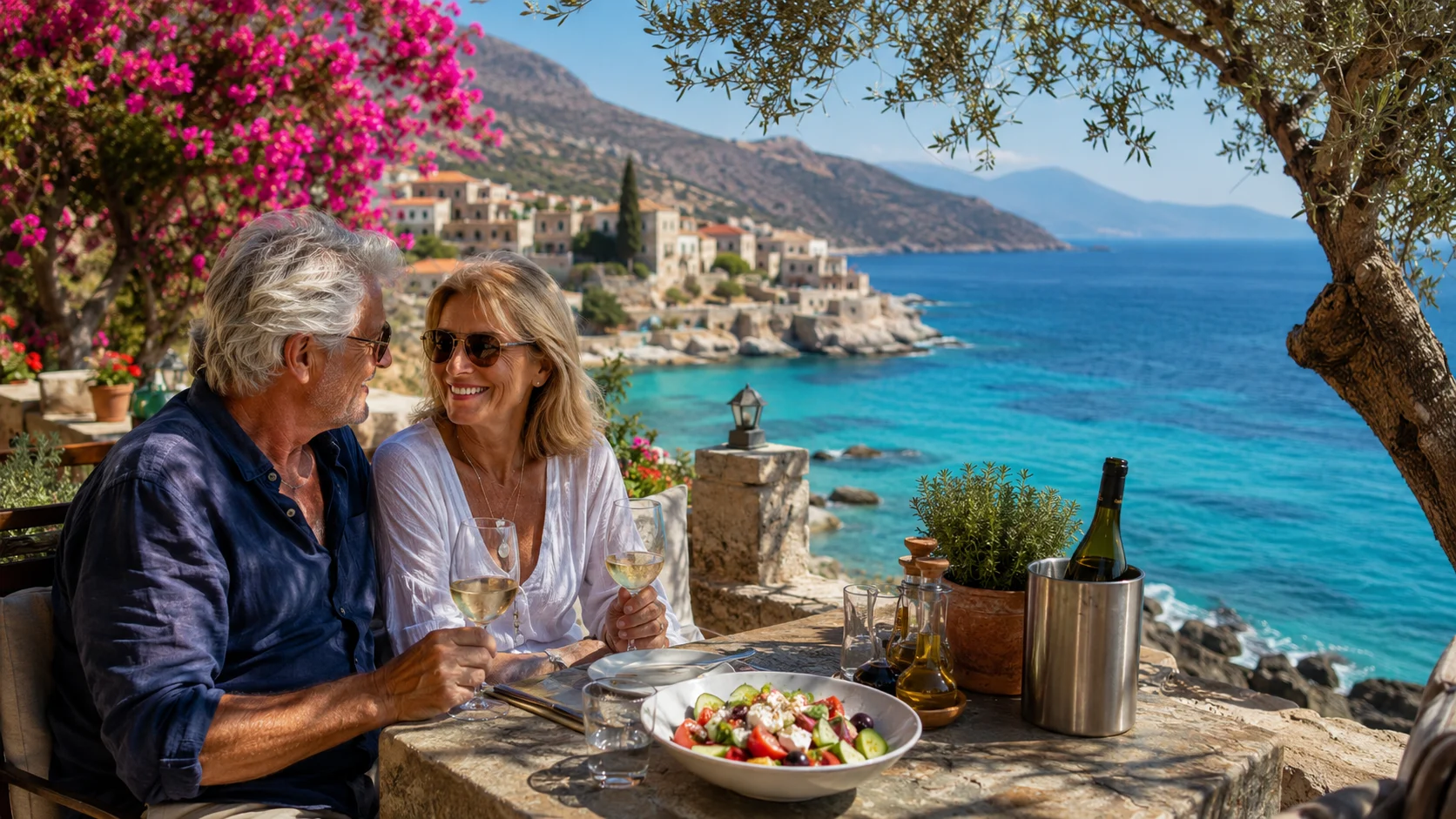
What is the Greece retirement visa?
Greece does not have a single visa category labelled a retirement visa. Instead, the country offers the Financially Independent Person (FIP) residence permit under Law 4251/2014, which is the primary route used by non-EU retirees and financially independent individuals who wish to reside in Greece without taking up local employment. The FIP permit is renewable annually for the first five years, after which holders become eligible for long-term EU resident status. It is worth reading our full retirement visa hub for a broader comparison of European programs before committing.
The FIP route is distinct from the Golden Visa (which requires property investment of at least EUR 800,000 in high-demand areas as of recent reforms) and from the digital nomad visa (Type D visa for remote workers, covered in our Greece digital nomad visa guide). The FIP permit is designed specifically for people who live on passive income, pensions, investment returns, or overseas rental income and do not need to earn money locally.
What elevates Greece above many competitors is the combination of the FIP permit with the Article 5B tax incentive regime, commonly known as the 7% flat tax program. Introduced in 2020, this regime allows qualifying foreign retirees to pay a flat 7% tax on all foreign-source income for a period of up to 15 consecutive years. No progressive tax brackets, no local wealth taxes on overseas assets, and a fixed annual fee option for those who prefer simplicity. Greece topped the International Living Global Retirement Index for 2026, and this tax regime is a central reason why.
Greece sits inside the European Union and the Schengen Area, which means FIP permit holders enjoy free movement across 26 Schengen countries for short stays, access to one of the world's best public healthcare systems, and a lifestyle infrastructure built around food, culture, and outdoor living. The cost of living outside of Mykonos and Santorini remains well below Western European averages, making the combination of tax incentives and affordability genuinely compelling.
Requirements and income threshold
The FIP residence permit requires applicants to demonstrate sufficient stable income from sources outside Greece to support themselves without working locally. The Greek immigration authorities do not publish a single statutory minimum income figure in the same way that Portugal or Italy do, but official guidance and standard practice among immigration lawyers points to EUR 2,000 per month as the widely accepted benchmark for a single applicant. For couples, expect to demonstrate approximately EUR 2,400 to 2,800 per month combined. Some authorities and legal advisors cite official FIP guidance that references figures closer to EUR 3,500 per month; applicants should prepare documentation comfortably above the minimum to avoid requests for additional evidence.
| Requirement | Detail | Notes |
|---|---|---|
| Nationality | Non-EU/EEA citizens | EU/EEA nationals use EU freedom of movement rules |
| Income - single applicant | EUR 2,000/mo suggested | Some advisors cite EUR 3,500/mo in official guidance; show a clear surplus |
| Income - couple | EUR 2,400 to 2,800/mo combined | Income must be stable and verifiable |
| Income sources accepted | Pension, dividends, rental income, investments | Must be foreign-source; no Greek employment income |
| Criminal record check | Required from home country and any country of prior residence | Must be apostille-certified |
| Health insurance | Comprehensive private health cover required initially | Until enrolled in EOPYY public system |
| Accommodation proof | Rental contract or property deed in Greece | Must show a genuine base of residence |
| Biometrics | Required in person at local immigration authority (KEP) | Appointment needed; initial visa obtained from Greek embassy |
| Visa type needed first | National Type D visa from Greek embassy abroad | Applied before entering Greece |
| Permit duration | 1 year, renewable | After 5 years: long-term EU resident status |
All supporting documents issued outside Greece must be translated into Greek by a certified translator and, where applicable, apostilled under the Hague Convention. Bank statements covering the previous three to six months are the most common way to demonstrate income, supplemented by pension award letters, investment account statements, or rental income declarations. Authorities look for consistency and reliability rather than a single large deposit.
Tax treatment for retirees
Greece introduced Article 5B of the Income Tax Code in 2020, creating a special tax regime for foreign pensioners and financially independent individuals who transfer their tax residency to Greece. Under this regime, qualifying individuals pay a flat rate of 7% on all foreign-source income regardless of the amount, for a period of up to 15 years. This covers pension payments, dividends, interest, capital gains realized abroad, overseas rental income, and distributions from foreign investment vehicles. The rate does not increase as income grows, and there are no additional local surcharges or solidarity levies on foreign income under the regime.
To qualify, you must not have been a Greek tax resident for at least five of the six years immediately preceding the application year, and you must transfer your tax residency to Greece. The application is filed with the Greek Tax Authority (AADE) at the start of the tax year in which you want the regime to apply. There is an annual lump-sum option for some categories, but the standard route is simply declaring all foreign income and paying 7%. Family members can be included in the same application for a flat annual fee of EUR 1,000 per person, which is extraordinarily low compared to any progressive tax system.
Income generated from Greek sources (local rental income, Greek bank interest, Greek employment) is taxed under the standard Greek progressive scale, which runs from 9% to 44% on earned income. The 7% regime applies only to foreign-source income, so retirees with a clean separation between overseas passive income and any local Greek earnings will benefit most. The 15-year time cap is the longest of any flat-tax regime in Europe for retirees, surpassing Italy (10 years, EUR 100,000 flat fee) and Portugal's now-modified NHR program.
For most non-US retirees, the combination of 7% flat tax plus Greece's network of double-taxation agreements with over 55 countries means that foreign pension income is either taxed only once (in Greece at 7%) or enjoys a further reduced effective rate after treaty credits. UK nationals, for example, should review the UK-Greece double tax convention to understand whether UK-source pension income is exclusively taxable in the UK or can be credited against the Greek 7% flat tax. In practice, many British retirees find the net effective rate on combined UK pension and investment income is substantially lower after moving tax residency to Greece.
Healthcare access
Greece operates a national health system (ESY) that provides public healthcare to residents, and access for FIP permit holders has improved significantly following administrative reforms. Once you have held legal residence for a period and register with EOPYY (the National Organisation for Healthcare Services Provision), you gain access to public hospitals, specialist consultations, and subsidised prescriptions at rates broadly comparable to other EU public health systems. Registration requires proof of residence, your permit, an AFM tax number, and a completed enrollment form at a local EOPYY office.
During the initial phase before EOPYY registration, the FIP permit application requires applicants to hold a comprehensive private health insurance policy valid in Greece. International health insurers familiar with the Greek market include Cigna Global, Allianz Care, and Axa Global Healthcare. Annual premiums for a healthy retiree in their 60s typically range from EUR 1,800 to EUR 3,500 depending on coverage levels, deductibles, and pre-existing conditions. Once enrolled in EOPYY, many retirees keep a supplementary private policy for faster access to private clinics and dental coverage, which is not fully covered under the public system.
Greece's major cities and islands have well-developed private hospital networks. In Athens, facilities such as Hygeia Hospital, Metropolitan Hospital, and Henry Dunant Medical Center offer international-standard care with English-speaking staff. Crete has strong medical infrastructure in Heraklion and Chania, including the University Hospital of Heraklion (PAGNI), which is one of the largest in Greece. On smaller islands, care may require a short ferry or flight to a regional center for anything beyond primary care, which is a practical consideration for retirees with ongoing medical needs.
How to apply - step by step
The application process for the FIP residence permit involves two main phases: obtaining the entry visa from a Greek embassy or consulate in your home country, and then converting that visa into a residence permit inside Greece. The full process typically takes three to six months from document preparation to permit issuance, though timelines vary by consulate and regional immigration office.
- Prepare your financial documentation. Gather six months of bank statements, pension award letters, dividend statements, or rental income records. Confirm that your monthly income consistently meets or exceeds the EUR 2,000 suggested threshold. Have all documents apostilled and certified Greek translations arranged.
- Obtain a criminal record check. Request an official background check from your home country national police or equivalent authority and from any country where you have lived for more than six months in the past five years. These must be apostilled and translated into Greek.
- Secure accommodation in Greece. You need either a signed rental agreement or proof of property ownership. A minimum 12-month rental contract is standard. Your address in Greece determines which regional immigration office (Aliens Bureau or KEP) handles your application.
- Purchase comprehensive health insurance. Arrange an international health policy that explicitly states coverage inside Greece. Keep the policy active throughout the visa and initial permit phase.
- Apply for a National Type D visa at the Greek embassy or consulate in your home country. Submit the complete dossier: application form, photos, financial evidence, criminal record, accommodation proof, and health insurance certificate. Visa processing typically takes four to eight weeks. The Type D visa allows a stay of up to one year and is the legal gateway to applying for the FIP permit inside Greece.
- Arrive in Greece and register your address with the local municipality (Dimarcheio). Obtain an AFM (tax identification number) from the local AADE tax office. This is essential for all subsequent steps, including opening a Greek bank account and applying for the Article 5B tax regime.
- File your Article 5B flat tax application with AADE if you wish to benefit from the 7% regime. This should be done before or at the start of the tax year in which you want the regime to take effect. You will need your AFM, proof of prior non-residency in Greece (five of the past six years), and evidence of foreign-source income.
- Submit your FIP residence permit application at the competent local immigration office (Aliens Bureau or KEP depending on your region). You will need to attend in person for biometric data collection. The permit application window opens after arrival on the Type D visa. Processing times range from two to four months.
- Receive your biometric residence permit card. This card is valid for one year and must be renewed annually. At each renewal, you resubmit proof of continued income and valid insurance.
- After five years of continuous legal residence, apply for long-term EU resident status (permanent residency). This triggers a change in permit type and removes the annual renewal burden. After seven years, you may apply for Greek citizenship, which carries full EU citizenship rights.
Cost of living for retirees
Greece offers a meaningfully lower cost of living than most of Western Europe while delivering a quality of life that ranks among the highest in the world for retirees. The main variables are location (Athens and tourist hotspots are pricier), lifestyle (dining out daily versus cooking at home), and accommodation choices (city center versus quiet village). A retired couple can live comfortably on EUR 1,500 to EUR 2,200 per month outside of central Athens and the most touristed islands, with significant room to scale up or down based on preferences.
| Expense category | Crete (Chania/Heraklion) | Athens (central) |
|---|---|---|
| 2-bed apartment rent | EUR 550 to 800/mo | EUR 800 to 1,400/mo |
| Utilities (electricity, water, internet) | EUR 100 to 160/mo | EUR 130 to 200/mo |
| Groceries (couple) | EUR 300 to 450/mo | EUR 350 to 500/mo |
| Dining out (mid-range restaurant, 2 pax) | EUR 25 to 45 per meal | EUR 35 to 60 per meal |
| Local transport (bus/taxi) | EUR 50 to 100/mo | EUR 80 to 150/mo |
| Private health insurance supplement | EUR 150 to 300/mo | EUR 150 to 300/mo |
| Entertainment and leisure | EUR 100 to 200/mo | EUR 150 to 300/mo |
| Total estimate (couple) | EUR 1,400 to 2,000/mo | EUR 1,750 to 2,700/mo |
Food is the area where Greece delivers the most dramatic value relative to quality. A full taverna meal of fresh fish, salad, wine, and dessert for two can cost EUR 30 to EUR 50 in most non-tourist areas of Crete or the Peloponnese. Local markets (laiki agora) sell seasonal fruits, vegetables, olives, and cheeses at a fraction of supermarket prices. Couples who cook at home primarily and eat out two or three times a week routinely keep total food costs under EUR 500 per month.
Utilities in Greece are higher than in some Southern European countries due to air conditioning costs during summer months (July through September can require significant electricity use) and heating costs in northern regions and higher-altitude areas in winter. Apartments with good insulation, double glazing, and solar water heaters - increasingly standard in newer builds - help mitigate these costs substantially. The Peloponnese, Crete, and the Dodecanese islands have milder winters than Athens or Thessaloniki, reducing annual heating bills.
Property ownership
Foreign nationals can purchase property in Greece with no restrictions in most of the country. Certain border regions (designated sensitive zones near Turkey, Bulgaria, and some northern areas) require special ministerial approval for non-EU buyers, but these restrictions do not affect the vast majority of retirement destinations including Crete, the Ionian Islands, the Cyclades, Athens, and the Peloponnese. The property purchase process involves a notary, a lawyer, an AFM tax number, a Greek bank account, and payment of transfer tax.
Property transfer tax (FMA) in Greece is currently 3.09% of the assessed taxable value (the objective value used by the tax authority, which is often lower than the market price). Additional transaction costs include notary fees (approximately 1% to 1.5%), lawyer fees (1% to 2%), and land registry fees (0.5%). Stamp duty and related costs typically bring total transaction costs to around 7% to 10% of the purchase price. Buyers should budget for these on top of the agreed sale price.
Greece does not automatically grant residence rights through property purchase alone below the Golden Visa threshold. The Golden Visa, which does confer residence rights, requires minimum property investment of EUR 800,000 in high-demand zones (greater Athens, Thessaloniki, Mykonos, Santorini, and other areas) or EUR 400,000 in lower-demand regions as of 2024 reforms. For most retirees entering through the FIP route, property ownership is not a requirement for the permit - renting is equally valid - but many choose to buy after establishing residence and gaining familiarity with the local market.
Path to permanent residency and citizenship
Greece offers one of the clearest and most rewarding pathways to EU permanent residency in Southern Europe. FIP permit holders who maintain continuous legal residence for five years are eligible to apply for the EU long-term resident permit under Directive 2003/109/EC. This permit is indefinitely renewable, grants the right to reside without annual income renewals, and confers the right to reside in other EU member states for extended periods under certain conditions. Continuous residence means spending no more than six consecutive months or ten months total outside Greece per five-year period.
After seven years of legal residence, foreign nationals may apply for Greek citizenship through naturalization. The requirements include basic Greek language proficiency (A2 level for some pathways, B1 level for the standard naturalization exam), demonstrated integration in Greek society, and a clean criminal record. Greek citizenship carries full EU citizenship, including the right to live and work freely in all 27 EU member states, consular protection from any EU embassy worldwide, and a passport that provides visa-free access to over 180 countries including the United States under the Visa Waiver Program.
Greece does not recognize dual citizenship as a general rule under Greek law, but in practice, Greece does allow Greek citizens to hold foreign nationality, and many naturalized Greeks retain their original passport without issue. The more relevant question is whether your home country permits dual nationality - for example, the United Kingdom, Canada, Australia, and most EU states allow it, while some others have restrictions. Retirees who are serious about the seven-year citizenship pathway should verify their home country's dual-nationality rules before committing.
Best cities and regions for retirees
Crete is consistently the top choice for foreign retirees in Greece. The island combines a year-round Mediterranean climate (warm, dry summers and mild winters), some of the best food in Europe, world-class beaches, a robust expat infrastructure, and relatively affordable costs by Greek standards. Chania is the most popular retiree destination on the island - the Venetian harbor, the covered market, the laid-back old town atmosphere, and the mix of nationalities create a very livable base. Heraklion, the island capital, offers more urban conveniences, a larger international airport, and access to the island's main university hospital for retirees who prioritize medical access.
Athens surprises many retirees who expect only chaos and crowds. The city has undergone substantial regeneration since 2010, particularly in neighborhoods such as Koukaki, Pagrati, Mets, and Exarchia. These areas offer walkable urban living, excellent restaurants and cafes at reasonable prices, world-class museums and cultural institutions, and strong transport links. Athens also has the largest international airport in Greece (Eleftherios Venizelos) with direct flights to North America, the Middle East, and across Europe, which matters enormously for retirees who travel frequently or have family abroad.
The Peloponnese, specifically the town of Nafplio, has quietly become one of Greece's most beloved retirement destinations. Nafplio is a beautifully preserved neoclassical port town with a castle, a charming old town, excellent tavernas, and a slow pace of life that contrasts sharply with Athens despite being only two hours by road. Property and rental prices here are substantially lower than in Athens or Crete. Thessaloniki, Greece's second city in the north, appeals to retirees who want a metropolitan lifestyle with strong cultural credentials, a renowned food scene, and lower costs than Athens, though winters are colder and wetter.
Corfu is particularly popular with British retirees due to its long historical connection with the UK and the presence of an established English-speaking community. The island has a lush green landscape (unusual for Greece), a charming UNESCO-listed old town, and a range of rental and property options from rural villas to apartment living. The Ionian Islands generally have more rainfall than the Aegean, which keeps them greener year-round - a feature some retirees find more familiar and comfortable than the stark dry heat of the Cyclades.
Pros and cons
Greece offers one of the most complete retirement packages in Europe when you weigh tax incentives, lifestyle, healthcare access, EU residency rights, and cost of living together. No system is perfect, and a clear-eyed view of the trade-offs will help you decide whether it suits your specific situation.
- [+] 7% flat tax on all foreign-source income for up to 15 years - the most generous flat-tax regime for retirees in Europe by duration
- [+] EU permanent residency after just 5 years of continuous legal residence, with full EU citizen rights
- [+] EU citizenship pathway at 7 years, granting a passport with access to all 27 EU member states and Schengen travel
- [+] Outstanding Mediterranean climate, particularly on Crete and the Ionian Islands with mild winters
- [+] Cost of living well below Western European averages - couples can live comfortably on EUR 1,500 to 2,200/mo in most regions
- [+] Food culture that is globally recognized for quality, freshness, and affordability at local markets and tavernas
- [+] International Living 2026 top-ranked retirement destination, reflecting broad quality-of-life strengths
- [+] Family members included in the 7% flat tax regime for just EUR 1,000 per person per year
- [+] No requirement to invest in property - rental is fully accepted for FIP permit purposes
- [-] Bureaucracy can be slow and inconsistent across different regional offices; an experienced immigration lawyer is near-essential
- [-] Annual permit renewal required for the first 5 years, with income documentation submitted each time
- [-] Language barrier: Greek is a distinct script and relatively difficult to learn; day-to-day bureaucracy is mostly in Greek
- [-] Healthcare quality outside of major cities can be variable; smaller islands may require travel for specialist care
- [-] Hot, dry summers with temperatures exceeding 38 degrees Celsius are intense, especially for retirees unaccustomed to the heat
- [-] Property purchase process is complex and requires trusted local legal support; transaction costs reach 7% to 10%
- [-] US citizens face no reduction in their US federal tax obligations; the 7% rate layers on top of (or alongside) US worldwide taxation
Get personalized visa guidance
Every visa situation is different. Tell us about yours and our vetted consultants will review your case within 24 hours.
Frequently asked questions
How much income do I need to qualify for the Greece FIP retirement visa?
The widely cited benchmark is EUR 2,000 per month for a single applicant, based on standard practice among Greek immigration lawyers and consular guidance. Some official FIP documentation references figures closer to EUR 3,500 per month. To be safe, applicants should demonstrate consistent income comfortably above EUR 2,000 per month and ideally EUR 2,500 or more, with six months of bank statements showing regular deposits from pension, investment, or rental income sources.
Does the 7% flat tax apply to my pension from my home country?
Yes, in most cases the 7% flat tax applies to foreign pension income once you transfer your tax residency to Greece and qualify for the Article 5B regime. However, the actual tax treatment also depends on the double-taxation agreement between Greece and your home country. Some bilateral treaties assign exclusive taxing rights to the source country (your home country) for government pensions, meaning those pensions may not be taxable in Greece at all. Private and occupational pensions are more typically covered by the 7% regime. Always verify your specific situation with a qualified tax advisor familiar with both Greek tax law and your home country's treaty obligations.
Can I include my spouse or partner in the FIP permit application?
Yes. A spouse or registered partner can be included as a dependent family member in the FIP permit application. The income requirement may be adjusted upward to account for the additional family member, though there is no fixed statutory rule. Dependent children under 18 can also be included. For the Article 5B tax regime specifically, family members can be added for a flat annual fee of EUR 1,000 per person, making it extremely cost-effective to bring a spouse under the same favorable tax treatment.
How long is the FIP permit valid, and do I need to renew it every year?
The FIP residence permit is initially issued for one year and must be renewed annually. Each renewal requires you to resubmit proof of sufficient income, valid health insurance, and continued residency in Greece. After five years of continuous annual renewals, you become eligible to apply for EU long-term resident status, which replaces the annual cycle with an indefinitely renewable permit. The five-year clock requires you to spend no more than six consecutive months or ten months total per period outside Greece.
Do I need to buy property in Greece to get the FIP residence permit?
No. The FIP residence permit does not require property ownership. A valid rental agreement in your name is fully acceptable as proof of accommodation. Many retirees rent for their first one to three years to explore different regions before deciding whether and where to buy. Property ownership does not accelerate your pathway to permanent residency or citizenship either - the five-year and seven-year clocks are based on legal residence, not property investment.
What is the difference between the FIP visa and the Greece Golden Visa?
The FIP (Financially Independent Person) permit is designed for people living on passive income such as pensions, dividends, or overseas rentals. It requires demonstrated monthly income but no minimum property investment. The Golden Visa is an investment-based residence permit that requires a minimum real estate purchase starting at EUR 400,000 in lower-demand areas and EUR 800,000 in prime areas such as central Athens, Thessaloniki, Mykonos, and Santorini. The Golden Visa grants residency without requiring you to actually live in Greece, while the FIP permit requires genuine residence. Both eventually lead to permanent residency after five years.
Can I work or run a business in Greece on the FIP permit?
No. The FIP permit explicitly prohibits working for a Greek employer or operating a business with Greek-source income. It is designed for financially independent individuals who live on foreign-source income only. If you want to work remotely for a non-Greek employer or run a non-Greek business online, this activity may fall outside the strict prohibition in practice, but it creates tax complexity and is an area where legal advice is strongly recommended. The Greece digital nomad visa is a better fit for those who earn active remote income and want explicit legal cover for working while residing in Greece.
How long does the whole application process take from start to residence permit in hand?
From the start of document preparation to the point of receiving your biometric residence permit card inside Greece, the total timeline is typically four to eight months. Document preparation and apostilling in your home country takes four to eight weeks. The Type D visa from the Greek embassy typically takes four to eight weeks to process. Once you arrive in Greece, the in-country application processing for the residence permit takes an additional two to four months. Working with an experienced Greek immigration lawyer and ensuring your documents are complete and correctly certified at every stage is the single most effective way to avoid delays.
Related articles
Use our free tools
Free calculators for Canada CRS, Australia points, UK skilled worker, Germany Opportunity Card, and 34-country salary thresholds.
See all tools