
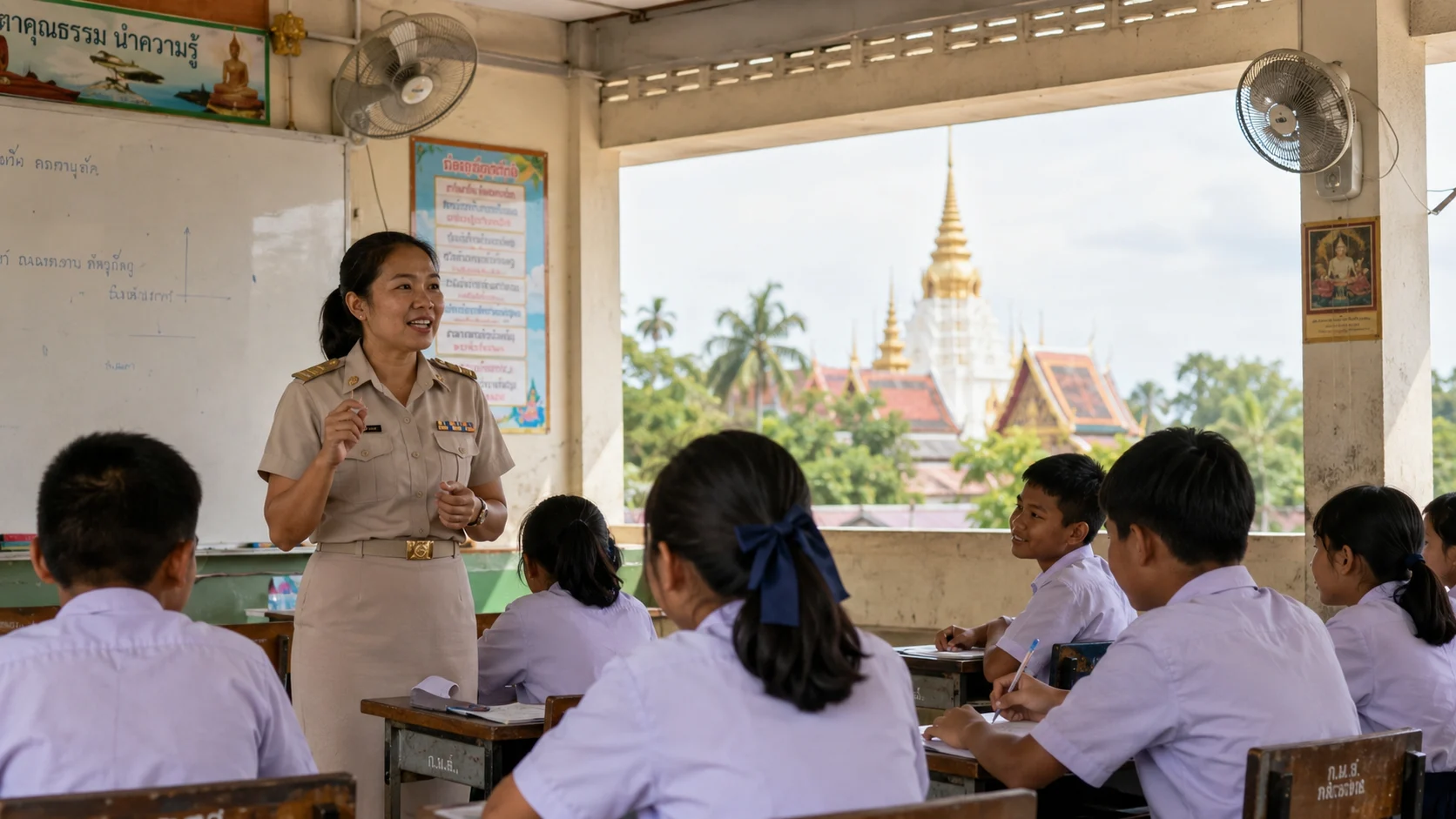
Non-Immigrant B visa + work permit (two separate processes)
Thailand splits the legal-to-work process into two documents that many first-time teachers conflate. The Non-Immigrant B visa is issued by Thai embassies and consulates outside Thailand. It lets you enter the country for the purpose of work. The work permit (called wai bai anu yat tham ngan in Thai) is issued separately by the Ministry of Labour inside Thailand, after you arrive. You need BOTH. Holding only the Non-B does not legally permit you to teach; holding only a work permit without a valid visa is impossible because the work permit application requires a valid visa.
Process at a glance: school in Thailand issues WP3 paperwork, you take it to the Thai embassy in your home country, you receive a 90-day single-entry Non-B, you fly to Thailand, the school accompanies you to the Department of Employment, you apply for the work permit, you receive it in 7-14 days, you start teaching. With the work permit in hand, you go back to immigration and extend your visa to a one-year multi-entry status. Renewal happens annually.
Compared with Korea's E-2 (one combined document, sponsored end-to-end) or Japan's COE-led process (employer-driven), Thailand's split structure feels bureaucratic, but it gives you more flexibility: if you change employers, you only need to update the work permit; the visa endorsement gets transferred. Many teachers find the process eases significantly after the first year.
Degree NOT always required
Thai education law (specifically the Teacher's Council of Thailand regulations) technically requires a Bachelor's degree for any teacher of record at a registered school. In practice, enforcement varies dramatically by sector. International schools enforce strictly because they are accredited by Western bodies and need credentialed teachers. Government schools (especially primary and rural) often hire without a degree if you have a TEFL, are a native English speaker, and pass the interview. Private language schools are the most flexible and frequently hire degreed and non-degreed teachers side by side.
The Ministry of Labour will still issue you a work permit without a degree if your school is willing to file the paperwork and certify your role. Where a degree becomes legally hard to avoid is the teacher's license (waiver) renewal cycle: after your initial two-year teaching waiver, you typically need to enrol in a graduate diploma in education programme in Thailand or hold a Bachelor's to continue legally. Many non-degreed teachers either upgrade to a degree by year three, or rotate between language schools and tutoring centres which sit outside the formal teacher's licensing system.
Salary by region
| Region | Monthly THB | Monthly USD | Notes |
|---|---|---|---|
| Bangkok | THB 35,000-60,000 | USD 980-1,680 | Highest pay, highest cost of living, most jobs |
| Chiang Mai | THB 30,000-45,000 | USD 840-1,260 | Popular lifestyle city, lower pay but cheap |
| Phuket / Krabi / Koh Samui | THB 30,000-50,000 | USD 840-1,400 | Island jobs, seasonal demand, often higher accommodation costs |
| Isaan (NE Thailand) | THB 25,000-35,000 | USD 700-980 | Rural, lowest cost, low pay, often govt school |
| International schools (any region) | THB 80,000-200,000 | USD 2,240-5,600 | Requires teaching license + 2 yr experience |
Take-home savings in Thailand are modest by Asia standards. A teacher on THB 40,000 in Bangkok typically saves THB 8,000-15,000 per month after rent, food, and modest spending. But the lifestyle premium is real: a 40,000-baht life in Thailand often feels equivalent to a 70,000-baht life in Seoul, with weekend beach trips, scooter ownership, and dining out as standard. If maximising savings is the priority, look at Korea or China. If lifestyle, climate, and a workable salary are the priorities, Thailand wins.
Step-by-step process
- Secure a job offer in Thailand. Apply through Ajarn.com, Teach Away, recruiters, or directly to schools.
- School issues WP3 form (the work permit pre-approval) plus a letter of acceptance, copies of school registration, and tax documents. They mail this packet to you.
- Apply at the nearest Thai embassy or consulate in your country for the Non-Immigrant B visa. You submit the WP3 packet, your passport, application form, photo (Thai specifications here), and visa fee (about USD 80).
- Non-B issued in 3-10 working days. It is a single-entry, 90-day visa.
- Enter Thailand. The 90-day countdown starts on your arrival date.
- School accompanies you to the Department of Employment (or files for you) for the work permit. Submit: degree (if you have one), passport, TM30 address registration, school documents, and pay the work permit fee (THB 3,100 for one year).
- Work permit issued in 7-14 working days. You now legally teach.
- Before your 90-day Non-B visa expires, visit immigration to extend it to a one-year multi-entry status. This requires the work permit, the school's tax filings, and a re-entry permit (THB 1,000 single, THB 3,800 multiple).
- Annual renewal of work permit + visa extension each year. Renewal is typically simpler than the initial process.
90-day reporting requirement
Every foreigner on a long-term Thai visa must report their address to immigration every 90 days. This is not a re-application; it is a notification that you still live where you said you live. Reporting is free, can be done in person at the local immigration office, by mail, or online via the Immigration Bureau's e-reporting system at extranet.immigration.go.th.
Online reporting is the easiest option and works for the second 90-day report onwards (the first must usually be in person to establish your record). Missing the 90-day window triggers a THB 2,000 fine. If you leave Thailand and re-enter, the 90-day counter resets. If you simply stay in country and forget to report, the fine grows the longer you delay.
Separately, your landlord or hotel must file a TM30 within 24 hours of you arriving at the address. This is the landlord's legal duty but many landlords ignore it, leaving the tenant to face fines at immigration when they renew. Confirm before signing a lease that the landlord will file the TM30 promptly, and keep a copy of the receipt.
TEFL preference
TEFL certification is not legally required for the Thailand Non-B visa or work permit. But about 80 percent of teaching job listings ask for it, and the schools that do not ask in writing usually prefer it in the interview. A 120-hour online TEFL from a recognised provider (i-to-i, ITTT, The TEFL Academy, Premier TEFL) costs USD 200-400 and meets the standard requirement. In-person TEFL courses in Chiang Mai or Bangkok cost USD 1,200-1,800 and include observed teaching practice, which is genuinely useful for new teachers.
If you plan to apply for the Teacher's Council of Thailand teaching license eventually (required after your initial 2-year waiver expires), the 120-hour TEFL is mandatory for that application, so it is worth getting upfront.
Teaching at international vs Thai schools
The Thai teaching market splits into two largely separate worlds. International schools (Bangkok Patana, NIST, ISB, Harrow International, Brighton College, KIS) follow British, American, or IB curricula in English. They hire credentialed teachers (a teaching license from your home country plus 2 years experience) and pay THB 80,000-200,000 per month plus housing, flights, medical insurance, and 8-12 weeks paid vacation. The hiring cycle is January to April for August starts, much like the international school market globally.
Thai government schools, Thai bilingual private schools, and language schools sit in the other tier. Pay is THB 30,000-50,000 per month, vacation is 4-6 weeks, benefits are basic (some health coverage, occasional housing allowance, sometimes nothing). The work is often more energy-intensive (40 students per class, less prep time, mixed-ability), but the experience is more immersive in Thai culture and the visa requirements are softer.
Online teaching as a side hustle is grey-zone legal under a Non-B work permit (which is technically tied to your school employer). Many teachers do it, few are caught, and the rules are not actively enforced for small-scale tutoring. Reserve significant online teaching income for after you transition off the Non-B (such as onto a Long Term Resident or marriage-based visa).
Teacher's License and the 2-year waiver cycle
Thailand's Teacher's Council (Khurusapha) requires every teacher at a registered school to hold a Thai teaching license (bai anu yat prakob wichachip kru). For foreigners, this rule is administered through a system of temporary teaching permits called teaching waivers. When you join a registered school, the school files for a waiver that lets you teach legally for up to two years without the full license. After two years, you must either upgrade to a full teaching license (which requires a Thai-language education exam, plus completion of a recognised teacher education programme) or rotate out of the formal school system into a language centre.
The full teaching license path involves enrolling in a Postgraduate Diploma in Teaching Profession (P.G. Dip. in Teaching) at a Thai university, which takes one year of part-time study and costs THB 80,000-150,000 (USD 2,200-4,200). It is a meaningful commitment but opens long-term career options. Alternatively, if you already hold a teaching license from your home country, Khurusapha may recognise it and issue a full Thai license with reduced requirements. Check your specific credential against the current Khurusapha guidelines.
Language centres (private after-school English schools) sit outside the Khurusapha waiver cycle. Wall Street English, EF, ECC Thailand, and similar businesses are not registered as schools under the Ministry of Education and therefore do not require teaching licenses for their staff. Many career teachers rotate between language centre roles and formal school roles to balance freedom with stability.
Tax, savings, and the realistic monthly budget
Thai income tax for foreign teachers is progressive but starts low: zero on the first THB 150,000 per year, 5 percent on the next THB 150,000, then climbing to 35 percent at the top bracket. A teacher on THB 40,000 monthly pays roughly THB 1,500-2,500 in monthly income tax, plus social security of THB 750 (capped). Net take-home is therefore around THB 36,500-37,500 from a THB 40,000 gross. International school teachers in higher brackets pay more, but employers often gross-up packages to absorb the higher tax.
| Item | Bangkok (monthly THB) | Chiang Mai (monthly THB) |
|---|---|---|
| Rent (1BR, decent area) | THB 10,000-18,000 (USD 280-500) | THB 6,000-12,000 (USD 170-335) |
| Utilities + internet | THB 1,500-2,500 | THB 1,200-2,000 |
| Food (mix of street + restaurant) | THB 8,000-12,000 | THB 6,000-10,000 |
| Scooter or public transport | THB 1,500-3,500 | THB 1,500-2,500 |
| Entertainment + travel | THB 5,000-10,000 | THB 3,500-7,000 |
| Realistic savings on THB 40k salary | THB 5,000-12,000 | THB 12,000-18,000 |
Bangkok teachers tell you the city is expensive; Chiang Mai teachers tell you the same salary saves twice as much. Both are right. The choice between them rarely comes down to money and more often to lifestyle: Bangkok for the urban energy, networking density, and faster career progression; Chiang Mai for the slower pace, mountains, expat scene, and dramatically lower cost. Phuket and Koh Samui sit between them in cost and have a strong seasonal tourism flavour.
Renewal, switching employers, and the LTR option
Thai Non-B visa and work permit renewals happen annually for most teachers. The school files the work permit renewal at the Department of Employment 30-60 days before expiry, then you visit immigration with the renewed work permit to extend your visa. Total cost: roughly THB 5,000 in government fees per year. Skipping the renewal window triggers overstay fines of THB 500 per day capped at THB 20,000. Switching employers within Thailand requires the new school to apply for a fresh work permit, with the visa transferring automatically.
The Long Term Resident (LTR) visa launched in 2022 offers 10-year validity, multi-entry rights, no 90-day reporting (only 1-year reporting), and reduced personal income tax for highly skilled professionals. Eligibility requires USD 80,000+ annual income or USD 40,000+ income with a Master's degree in a targeted field plus 5 years experience. Most language centre teachers do not qualify, but international school teachers with senior roles and Master's degrees sometimes do. The LTR is administered by the Board of Investment rather than immigration, and the application process is paperwork-intensive but doable.
For teachers who stay 3+ years and consider Thailand a long-term home, the path of choice is usually: complete the teaching waiver cycle, upgrade to a full teacher's license through a P.G. Dip., consolidate at one school for a stable Non-B renewal pattern, and either marry a Thai national (which opens the Non-O Marriage visa with permanent-resident-like benefits) or save toward Thailand's elite visa or LTR pathways.
School life: holidays, dress code, and the wai culture
Thai school culture is famously warm but more formal than Western teachers expect. Greeting senior staff with a wai (the palms-together bow) is expected. Dress code is conservative: shirt and tie for men in most schools, modest professional dress for women, closed-toe shoes always. Tattoos should be covered. Many government schools require Monday-morning flag ceremonies where all teachers and students gather to sing the national anthem and observe a moment of silence for the king. Foreign teachers are expected to stand respectfully even if not participating actively.
School holidays in Thailand follow the academic calendar with a long break in October (between semesters) and a longer break in March-April (between school years). National holidays add roughly 16 days off including Songkran (Thai New Year, April 13-15, with effective shutdown of 3-5 days due to water festival), Loy Krathong, the King's Birthday (July 28), the late king's memorial day (October 13), Constitution Day (December 10), and New Year. Buddhist holidays shift annually based on the lunar calendar.
Class sizes vary widely: international schools cap at 18-22, Thai government schools often run 40-45 students per class, language centres average 10-15. The pace at government schools is exam-driven; at language centres it is communicative and activity-based. Pick the school type that fits your teaching philosophy. The Teach Abroad master guide has a detailed breakdown of teaching environments across Southeast Asia.
Frequently asked questions
Can I teach in Thailand without a degree?
Yes, in practice, though it limits your options. Government schools (especially rural and tier-2 city primary schools) and many private language schools hire without a degree if you have TEFL, native English, and a clean background. International schools and high-paying Bangkok jobs require a degree.
How much can I realistically save in Thailand?
USD 200-600 per month at a typical THB 40,000 salary in Bangkok or Chiang Mai. Modest by Asia standards. International school teachers on THB 100,000+ can save USD 2,000-3,000/month easily. Thailand is a lifestyle destination, not a savings destination, for most teachers.
What is the difference between Non-B and Non-ED visa?
Non-B is for working. Non-ED is for studying (e.g. enrolled at a Thai language school or university). Some teachers mistakenly try to teach on a Non-ED, which is illegal. The Non-ED does not permit any paid work.
Are there scams to watch for?
Avoid schools that tell you to enter on a tourist visa and 'sort the work permit later' - this means they have not properly registered you and is likely illegal. Avoid agencies that charge teachers upfront fees. Avoid 'visa runs' as a permanent strategy (border-bouncing for tourist re-entries is now restricted).
What is the timeline from job offer to teaching legally?
About 6-10 weeks total. WP3 paperwork from school: 1-2 weeks. Non-B visa at embassy: 1-2 weeks. Fly to Thailand. Work permit issuance in Thailand: 2-3 weeks. Annual visa extension: 1 week. Total: 5-8 weeks of paperwork over a 6-10 week clock.
Can I bring my partner or spouse?
Spouses can get a Non-O dependent visa, which lets them live in Thailand but does not include work rights. To work, they need their own Non-B with an employer. Unmarried partners cannot get a dependent visa; they would need their own visa basis.
What about the LTR (Long Term Resident) visa for teachers?
The LTR is designed for skilled professionals earning USD 80,000+ per year or holding senior expertise. Most English teachers do not earn enough to qualify. International school teachers with masters and high salaries occasionally use LTR for its 10-year validity and reduced reporting burden.
What recourse do I have if a school treats me badly?
Thailand's Department of Employment handles work permit disputes, and the Labour Court hears unfair dismissal cases. In practice, recovery of unpaid wages takes months and English-speaking labour lawyers are expensive. The realistic path is to leave the school cleanly, write reviews on Ajarn.com and Reddit r/Thailand, and move to a better employer.
Related articles
Use our free tools
Free calculators for Canada CRS, Australia points, UK skilled worker, Germany Opportunity Card, and 34-country salary thresholds.
See all tools