
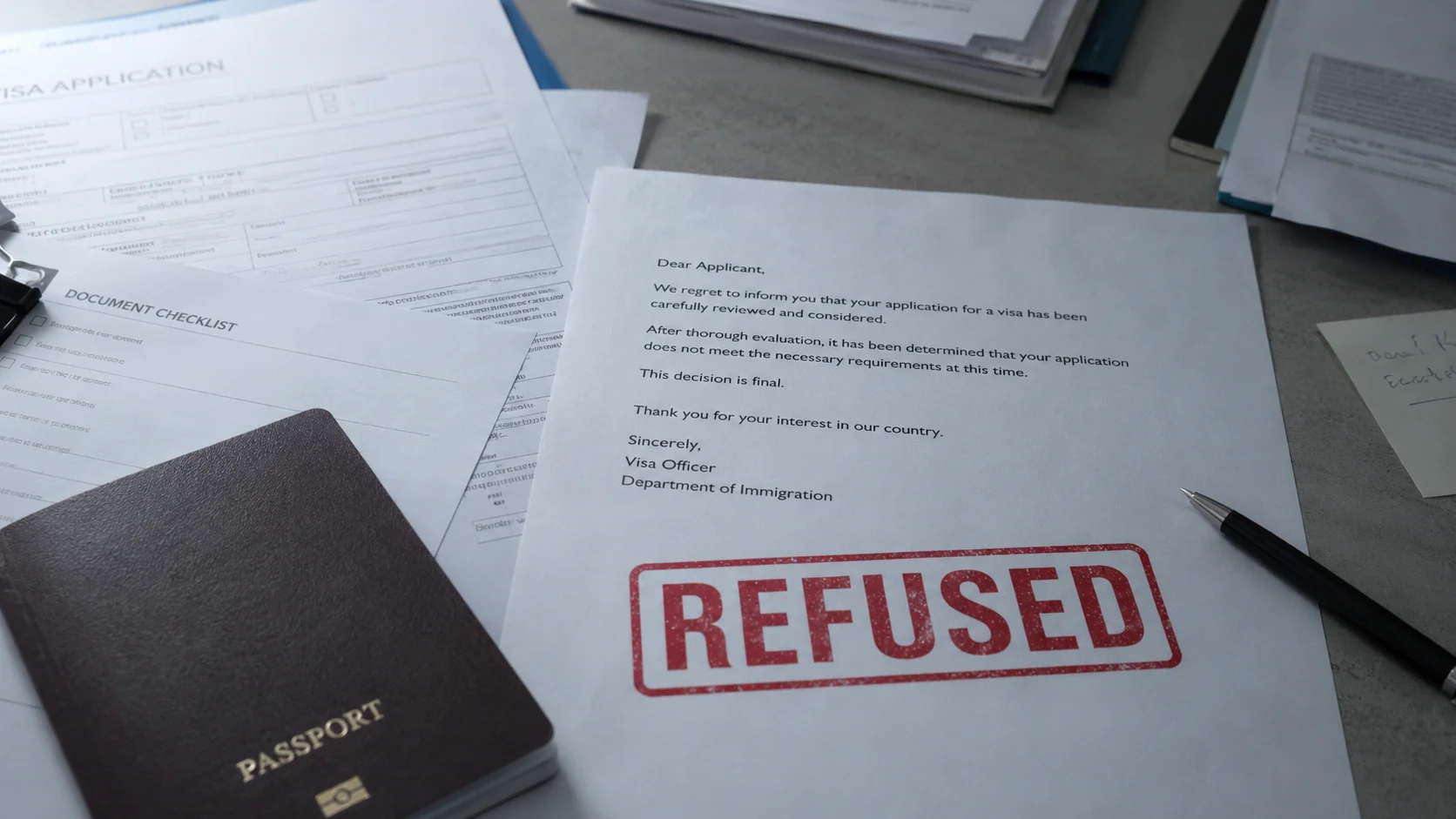
Schengen refusal codes - Article 32(1) decoded
Every Schengen short-stay visa refusal uses the standard form Annex VI of the Visa Code, which lists each refusal ground as a tick-box reference to Article 32(1) of the EU Visa Code. Your letter will have one or more boxes ticked. The codes are identical across all 27 Schengen states; the consequence and remedy depend on which boxes were ticked. The table below covers every Article 32(1) ground.
| Code | Official Meaning | What It Really Means | What To Fix |
|---|---|---|---|
| 32(1)(a)(i) | False/counterfeit travel document | Passport is suspected fake or altered | Obtain a fresh passport from your home authority and provide chain-of-custody documentation |
| 32(1)(a)(ii) | Purpose of stay not justified | Itinerary, invitation, or stated reason is too vague or inconsistent with documents | Detailed day-by-day itinerary, confirmed bookings, formal invitation letter, cover letter |
| 32(1)(a)(iii) | Insufficient means of subsistence | Bank balance or income too low for the planned trip duration or country | 6+ months of stable bank statements, recent payslips, sponsor letter if applicable |
| 32(1)(a)(iv) | Already stayed 90 days in 180 | You have used your 90-in-180 allowance and are too soon to return | Wait until your 90-in-180 window resets before reapplying |
| 32(1)(a)(v) | SIS alert | Schengen Information System lists you as inadmissible (usually previous overstay or deportation) | Request your SIS data and pursue alert removal through the issuing member state |
| 32(1)(a)(vi) | Threat to public policy/security/health | Security concern, criminal record, or public-health flag | Police clearance, court documents, medical certificates as applicable - legal advice recommended |
| 32(1)(a)(vii) | No adequate travel insurance | Insurance missing, expired, or below EUR 30,000 medical coverage | Obtain Schengen-compliant insurance with EUR 30,000+ medical coverage for the full stay |
| 32(1)(b) | Reasonable doubts about reliability of statements or intention to leave | The catch-all 'we don't believe you will return' clause | Strong return ties: employment, property, family, prior travel history |
Article 32(1)(b) is the most commonly ticked single box and the most frustrating because the officer is not required to specify what triggered the doubt. The remedy is broad: stronger employment evidence, stronger property evidence, stronger family ties, and ideally a recent successful trip to another developed country. See our Schengen Article 32 deep dive for ground-by-ground reapplication strategies.
UK refusal paragraphs decoded
UK refusal letters cite paragraph numbers from HC 395, the consolidated Immigration Rules. The most common references are Section 320 (general grounds for refusal applicable to almost any visa category), Appendix V (visitor visa rules, with V3 covering genuineness and V4 covering financial requirements), Appendix FM (family migration), and the Skilled Worker Appendix. Each cited paragraph maps to a specific legal test. The table below covers the paragraphs you are most likely to see in a UK refusal letter.
| Paragraph | Plain Meaning | What To Fix |
|---|---|---|
| 320(7A) | Deception in current or past application | Serious finding - legal advice required. Usually triggers 10-year ban |
| 320(11) | Previous immigration breach (overstay, illegal entry) | Wait out the cooling-off period and provide detailed explanation of past breach |
| V3.1 | Visit is not genuine | Stronger purpose, invitation, itinerary, and return-ties documentation |
| V3.2 | Financial requirements not met | Bank statements showing sufficient and stable funds for full stay |
| V3.6 | Officer not satisfied on balance of probabilities | The 'weight of evidence' catch-all - rebuild the file holistically |
| V4.2 | Insufficient funds to maintain self during visit | 6+ months of bank statements with consistent balance |
| Appendix FM ECP.2.1 | English language requirement not met | Submit valid SELT certificate from approved provider |
| Skilled Worker SW 6.1 | Salary below minimum threshold | Confirm CoS salary meets current threshold (GBP 38,700 as of 2024) |
| Skilled Worker SW 14.1 | Sponsor licence issue | Confirm sponsor is licensed and CoS is valid - employer needs to fix |
Paragraph 320(7A) is by far the most serious and triggers an automatic ban of up to 10 years from any future UK visa. Never reapply on a 320(7A) refusal without immigration legal advice; doing so risks worsening the finding. See our UK refusal reasons deep dive for paragraph-by-paragraph remediation strategies and template appeal letters.
US refusal codes decoded
US visa refusals cite sections of the Immigration and Nationality Act (INA). The most common codes for non-immigrant visas are 214(b), 221(g), and various 212(a) inadmissibility grounds. Each has very different consequences and remedies. The table below covers what you are most likely to see in a US refusal letter or stapled to your returned passport.
| Code | Visa Type | Meaning | Fix |
|---|---|---|---|
| 214(b) | All non-immigrant (B1/B2, F-1, J-1, H, L, etc.) | Failed to overcome presumption of immigrant intent | Reapply with stronger ties to home country - no appeal possible |
| 221(g) | Any visa | Administrative processing - NOT a denial, application paused | Provide requested documents or wait for security check to clear |
| 212(a)(2) | Any visa | Criminal grounds of inadmissibility | Possible I-601 waiver depending on offence - legal advice required |
| 212(a)(4) | Immigrant + some non-immigrant | Public charge - likely to become dependent on US public benefits | Stronger financial documentation, I-864 affidavit of support |
| 212(a)(6)(C) | Any visa | Fraud or willful misrepresentation | Permanent ban unless I-601 waiver granted - serious finding |
| 212(a)(9)(B) | Any visa | Unlawful presence bar (3 or 10 year) | Wait out the bar period or seek I-601A provisional waiver |
| 214(c) | Employer-sponsored (H-1B, L-1, O-1, etc.) | Petition denied or revoked | Employer must file new petition or amend - employer-driven fix |
| 207(c) | Refugee/asylum | Refugee inadmissibility finding | Legal counsel required |
Code 221(g) is often misread as a refusal when it is actually a pause. The applicant is asked to submit additional documents or wait for security clearance, after which the visa may be issued. Most 221(g) cases resolve to approval within 60 days, though some can run 6 months or more. Code 214(b) by contrast is a hard refusal with no appeal route. See our 214(b) deep dive for the full reapplication strategy and our USCIS case status decoder for petition-level status codes for H-1B and L-1 applicants.
Canada IRCC refusal reasons decoded
IRCC refusal letters use plain English rather than statutory codes, but each common phrase has a precise meaning tied to officer training notes and operational manuals. The phrases below appear on virtually every TRV, study permit, and work permit refusal, and each one corresponds to a specific fix.
| Phrase | What It Means | What To Fix |
|---|---|---|
| Purpose of visit | Officer doubts your stated reason for travel | Detailed itinerary, invitation letter, conference registration, hotel bookings |
| Travel history | Too little prior international travel or recent overstay/refusal | Build travel history with easier destinations first (Caribbean, Asia) |
| Personal assets and financial status | Finances insufficient or not credible | 12 months of bank statements, employment letter, tax returns |
| Family ties in Canada and country of residence | Ties to Canada too strong vs ties at home country | Reduce focus on Canadian family in cover letter; emphasise home ties |
| Significant family ties in Canada | Immigration intent flag - spouse/parents/siblings in Canada | Acknowledge ties honestly but document strong return reasons |
| Current employment situation | Job too weak to ensure return | Employer letter with explicit return obligation and approved leave |
| Length of proposed stay | Stay too long for stated purpose | Shorter trip duration matching documented purpose |
| Provisions of the Immigration and Refugee Protection Act | Generic catch-all - usually combined with other reasons | Address every other cited reason; this one alone is rarely substantive |
The phrase 'significant family ties in Canada' is the silent killer of many TRV applications. If you have a sibling, parent, child, or spouse who is a Canadian PR or citizen, the officer will weight this as immigration intent unless you proactively document strong return reasons. The fix is not to hide the family connection (which would be misrepresentation) but to lead with your own employment, property, and family obligations in your home country. See our Canada refusal deep dive for GCMS notes guidance, which reveals the officer's full reasoning rather than the brief letter.
Australia visa refusal codes (PIC + cl)
Australian visa refusals cite Public Interest Criteria (PIC) numbers and clause-based criteria for specific visa subclasses. Schedule 3 criteria apply to partner visas. The table below covers the most commonly cited refusal grounds.
| Code | Meaning | What To Fix |
|---|---|---|
| PIC 4001 | Character (criminal record, security concern) | Police clearance, court documents, character declarations |
| PIC 4007 | Health (significant cost or threat to public health) | Medical examination, treatment plan, health undertaking |
| PIC 4013/4014 | Risk to public order | Legal advice required - serious ground |
| PIC 4020 | Bogus documents or false information | Permanent 3 to 10 year ban - legal advice essential |
| cl 600.211 | Visitor genuine intention (subclass 600) | Documented ties to home country, return-trip evidence |
| cl 500.211 | Student genuine temporary entrant (subclass 500) | Strong GTE statement, course relevance to career |
| Schedule 3 | Partner visa unlawful presence at time of application | Compelling reasons or wait until lawful |
PIC 4020 is the most serious commonly cited ground and triggers an automatic ban of 3 years (or 10 years for repeated offences) on any subsequent Australian visa application. Never respond to a PIC 4020 notice without immigration legal advice, because the response shapes the duration and severity of the ban.
What the refusal letter doesn't tell you
Every jurisdiction's standard refusal letter is shorter than the officer's actual reasoning. The standard letter is essentially a checklist of statutory grounds, while the officer's notes (where they exist) contain the specific concerns that drove the decision. Accessing those notes is the most underrated step in deciding how to reapply or appeal.
- Canada: file an ATIP (Access to Information and Privacy) request for GCMS notes. Cost CAD 5. Turnaround 30 to 90 days. Reveals the officer's full reasoning including red-flag entries from previous applications. Essentially mandatory before any Canadian reapplication.
- UK: Administrative Review documentation reveals the officer's specific reasoning if AR is filed. Subject Access Request to UKVI under UK GDPR can also reveal officer notes. Cost free.
- Schengen: formal appeal can compel disclosure of the visa file under most member state procedural rules. Subject Access Request to the consulate under EU GDPR may also work for limited data.
- US: nothing reveals the consular officer's reasoning. The doctrine of consular nonreviewability means the State Department is not obliged to disclose the basis for a 214(b) refusal beyond the standard letter.
- Australia: Freedom of Information request to Home Affairs can reveal officer notes for refused applications. Cost AUD 30. Turnaround 30 to 90 days.
For applicants tracking VFS or other application centre status, decoding the status updates themselves is also useful. See our VFS application status decoder for what each VFS status code means. For Canadian applicants, see our how to get GCMS notes walkthrough for the full ATIP request process.
Next steps after decoding your letter
Once you have decoded every code and phrase in your refusal letter, the path forward is usually clear. Follow this sequence to maximise your odds on the next attempt.
- Confirm every code and paragraph number cited in the letter. List them out so you can address each one independently.
- Read each cited paragraph in the original immigration rules. For Schengen, the Visa Code is publicly available on EUR-Lex. For UK, HC 395 is on gov.uk. For US, the INA is on uscis.gov. For Canada, IRPA and the regulations are on justice.gc.ca.
- Match each code to one of the common rejection reasons. Most refusals map to two or three of: insufficient ties, financial documentation, purpose of visit, prior immigration history.
- Decide between appeal and reapply. Appeal if there is a clear procedural error or factual mistake. Reapply if the issue is fixable documentary weakness.
- If reapplying, build a fresh file addressing every cited ground specifically. Do not simply resubmit the previous application with minor tweaks.
- Check visa fees before reapplication to budget correctly.
Read our rejection hub for the full list of common refusal patterns and our appeal guide to weigh the appeal-vs-reapply decision systematically. Check current visa fees before budgeting the reapplication.
Rejected? Get expert help
A visa rejection is not the end. Our consultants specialize in strengthening reapplications. Share your situation and we will match you with the right expert within 24 hours.
Frequently asked questions
My refusal letter has multiple codes. Which do I address first?
Address every cited code in your reapplication, but lead with the most substantive one. Schengen 32(1)(b) (doubts about intent to leave) is the most common heavy-hitter and should drive the bulk of your new evidence. UK V3.6 (weight of evidence) similarly requires holistic rebuilding. Lower-tier codes like 'insufficient means' are usually fixable with stronger bank statements alone. If 320(7A) or 212(a)(6)(C) (fraud/deception) is cited, do NOT reapply without legal advice; these carry multi-year bans.
Can I get the officer's actual notes?
Canada: yes, file an ATIP request for GCMS notes (CAD 5, 30 to 90 day turnaround). Australia: yes, file an FOI request to Home Affairs (AUD 30). UK: partial, via AR documentation or Subject Access Request. Schengen: partial, via appeal or GDPR request to the consulate. US: no, consular officer reasoning is not disclosed beyond the standard refusal letter due to the consular nonreviewability doctrine.
What if the letter is generic with no specific reason?
Most refusal letters use boilerplate text even when the underlying reasoning is specific. Schengen refusals tick boxes from a fixed list of 8 grounds. Canadian refusals select from a dropdown of standard phrases. A generic-looking letter usually still cites at least one specific ground - look for the paragraph reference or ticked box. If you genuinely cannot identify any specific ground, file the appropriate disclosure request (ATIP for Canada, AR or SAR for UK, appeal for Schengen).
Why are refusal letters so brief?
Officers process hundreds of applications per week and the standard form ensures consistency, defensibility, and speed. A brief letter is also harder to overturn because there is less reasoning to attack. The brevity is procedural, not a sign of officer laziness. The officer's actual decision-making is usually documented in internal notes that the applicant does not see by default but can sometimes access through formal disclosure requests.
Can I ask the consulate for clarification?
Generally no for most consulates. Officers will not discuss refused decisions by email, phone, or in person. Some honorary consulates and smaller posts will respond informally to clarification requests, but the response is rarely substantive. The formal route is to file an appeal or disclosure request through the channel specified in the refusal letter. Calling the consulate directly almost never produces useful information.
What about 221(g) requests?
A 221(g) is not a refusal; it is an administrative processing pause. The accompanying letter will specify what is needed - usually additional documents (employer letter, financial records, police clearance) or a wait for security clearance. Provide what is requested within the deadline (usually 1 year) and the application resumes processing. Most 221(g) cases resolve to approval within 60 days. If you cannot provide what is requested or the case stalls beyond 6 months, mandamus may be an option to force a decision.
My letter cites HC 395 paragraph X. Where do I read it?
HC 395 (UK Immigration Rules) is published on gov.uk and updated frequently. Search 'Immigration Rules HC 395' to find the current consolidated version. The Rules are organised by Section (general) and Appendix (visa category). Your refusal letter will cite the paragraph number, which maps directly to a section in the document. Read both the cited paragraph and the surrounding context to understand the full requirement.
Where can I find all the official refusal codes online?
Schengen: EU Visa Code (Regulation 810/2009) on EUR-Lex, with Annex VI listing the standard refusal grounds. UK: HC 395 Immigration Rules on gov.uk plus the Appendices. US: Immigration and Nationality Act (INA) on uscis.gov, plus the Foreign Affairs Manual (FAM) volume 9 for consular practice. Canada: IRPA and IRPR on justice.gc.ca, plus operational manuals (OPs) on canada.ca. Australia: Migration Act and Migration Regulations on legislation.gov.au.
Related articles
Use our free tools
Free calculators for Canada CRS, Australia points, UK skilled worker, Germany Opportunity Card, and 34-country salary thresholds.
See all tools