
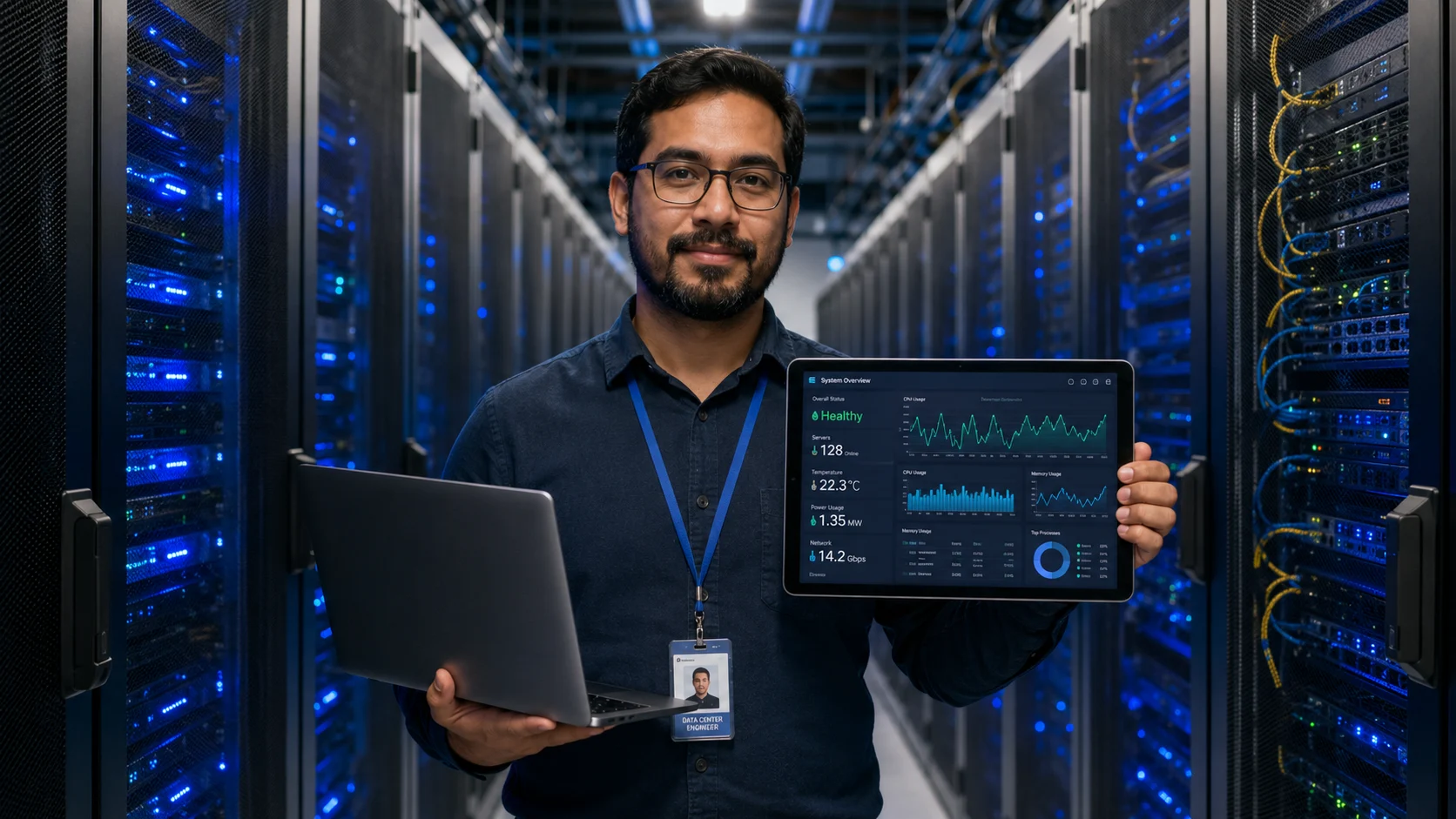
Data center engineering roles
The data center industry is not a single job but a collection of distinct engineering disciplines, each with its own visa considerations and salary ceiling. Understanding which role you fill matters because USCIS evaluates specialty occupation status based on your specific duties, not a generic job title. The six core engineering tracks are power engineering, electrical engineering, network engineering, mechanical engineering, commissioning engineering, and controls or building management systems (BMS) engineering. Together they cover everything from the moment utility power enters a campus to the moment a packet leaves a server rack.
Power engineers and power electronics specialists sit at the top of the salary range. Their work covers medium-voltage switchgear, uninterruptible power supplies, power distribution units, and increasingly the custom silicon power systems that hyperscalers like Meta, Microsoft, and Google deploy to serve AI training clusters. A power electronics engineer designing 48V direct-current rack architectures for a 500-megawatt campus is doing work that requires deep electrical engineering knowledge - the kind that USCIS recognizes as a specialty occupation without much debate. Salaries for experienced power electronics specialists frequently clear $200K in Northern Virginia or Phoenix, with total compensation packages at Meta or Microsoft reaching $250K or more.
Electrical engineers at the facility level handle high-voltage distribution, generator systems, automatic transfer switches, and the National Electrical Code compliance work that keeps a campus legal and insurable. Network engineers design and operate the spine-leaf fabrics, optical interconnects, and wide-area routing that tie a data center to the internet and to other campuses. Companies like Amazon Web Services and Oracle require network engineers to hold a bachelor's degree in electrical engineering, computer science, or a related field - a requirement that goes directly to H-1B eligibility.
Mechanical engineers focus on cooling infrastructure: chilled water plants, computer room air handlers, evaporative cooling towers, and the liquid cooling manifolds now standard in AI GPU clusters. Commissioning engineers, sometimes called Cx engineers, test and verify that every system performs to design specification before a facility goes live - a role that blends electrical, mechanical, and controls knowledge and typically requires a four-year engineering degree plus field certification. Controls and BMS engineers write the software logic that governs how all these physical systems respond to load, temperature, and fault conditions. BMS work increasingly overlaps with industrial IoT and machine learning for predictive maintenance, which further strengthens the specialty occupation argument for visa purposes.
AI infrastructure investment is driving extraordinary demand across all six tracks. OpenAI, Google, Microsoft, and Amazon collectively announced over $300 billion in data center capital expenditure for 2025 and 2026 combined. Each gigawatt of new capacity requires dozens of engineers across disciplines. For foreign-born engineers, that hiring pressure translates into more sponsors, better salaries, and more leverage in the H-1B and green card process. See the broader AI infrastructure jobs hub for context across all AI-adjacent roles.
H-1B and the FY2027 wage-weighted change
The H-1B nonimmigrant visa is the primary work authorization pathway for data center engineers. It requires the position to qualify as a specialty occupation - defined as one that normally requires a theoretical and practical application of a body of highly specialized knowledge and a minimum of a bachelor's degree or its equivalent in the specific specialty. Power engineering, electrical engineering, network engineering, mechanical engineering, commissioning engineering, and controls engineering all meet this standard when the employer documents that the role genuinely requires degree-level knowledge. USCIS has approved H-1B petitions for all six tracks at major data center operators including Equinix, Digital Realty, Amazon, Microsoft, and Google.
The annual H-1B cap is 65,000 visas for bachelor's-level beneficiaries plus 20,000 for US master's or higher holders. For most fiscal years since 2014 the number of registrations has exceeded the cap substantially, requiring a lottery. The FY2025 cycle received approximately 470,000 registrations for 85,000 slots. For FY2026 the number dropped to around 340,000 after USCIS introduced a $10 registration fee and tightened duplicate-registration rules, but the pool still required a lottery. The system has always been frustrating because salary and qualification were irrelevant to selection - a $90K software tester had the same odds as a $220K power electronics engineer.
For data center engineers the wage-weighted system is genuinely good news. A senior power engineer in Northern Virginia earning $180K to $220K will be filed at Wage Level III or IV under the Department of Labor's Standard Occupational Classification for electrical engineers or computer hardware engineers. Those filings move to the front of the selection queue. An engineer earning $240K at a hyperscaler who was previously subject to the same random odds as every other registrant now benefits from prioritized selection. Employers sponsoring these roles have strong incentive to file at accurate, competitive wage levels rather than minimizing the LCA wage declaration.
Once selected, the employer files a full H-1B petition (Form I-129) with supporting documentation: the LCA, degree evaluation, job description demonstrating specialty occupation, and evidence of the employer's ability to pay. Engineers whose degrees are from non-US universities must obtain a credential evaluation from a NACES-member organization such as World Education Services (WES). Processing takes three to five months in regular service; premium processing (Form I-907) guarantees a decision within 15 business days for an additional $2,805 fee. Engineers already in the US on F-1 OPT or another H-1B can change employers via a portability transfer once the new petition is filed. For everything about the process, see the H-1B visa hub.
One important nuance: technician-level roles that do not require a four-year engineering degree - substation technicians, structured cabling installers, generator maintenance technicians - do not qualify for H-1B. If your role sits in that tier, the right path is EB-3 or H-2B. See the section below on EB-3 and the companion article on semiconductor fab jobs for comparison with another degree-intensive industry.
EB-2 NIW - self-petition without an employer
The EB-2 National Interest Waiver is one of the most powerful green card tools for senior engineers because it allows self-petition: you do not need a job offer, an employer sponsor, or PERM labor certification. USCIS uses the Dhanasar three-prong framework to evaluate NIW petitions. You must show that your proposed endeavor has substantial merit and national importance, that you are well-positioned to advance that endeavor, and that waiving the normal job offer and labor certification requirements benefits the United States on balance. All three prongs must be met.
Data center engineering is an unusually strong NIW field right now. The US government has explicitly identified AI infrastructure, grid resilience, and domestic semiconductor manufacturing as national priorities. An engineer whose work directly supports those priorities - designing power distribution for an AI training cluster, optimizing cooling for a 200-megawatt hyperscale campus, or developing BMS control systems that reduce grid demand - can make a compelling Dhanasar argument. USCIS has approved NIW petitions for engineers at companies including Google, Meta, and Amazon where the petitioner demonstrated that their specialized expertise advanced national energy or technology goals.
To qualify for EB-2 you must first establish either an advanced degree (master's or higher, or a bachelor's plus five years of progressive experience) or exceptional ability in your field. Most senior data center engineers qualify on the advanced degree prong. Exceptional ability requires meeting at least three of six regulatory criteria: a degree in the field, a letter from a current or former employer documenting at least ten years of full-time experience, a professional license, a high salary relative to others in the field, membership in professional associations, or recognition by peers or government entities for contributions. Engineers with significant industry experience who lack a graduate degree often build their exceptional ability case on salary, professional association memberships (IEEE, ASHRAE, BICSI, AFCOM), and employer letters.
Supporting evidence matters enormously. Patents filed with the USPTO carry significant weight - power electronics engineers who have patented new conversion topologies or thermal management systems have a direct, documented contribution to national technology competitiveness. Publications in IEEE Transactions, ASHRAE journals, or conference proceedings at venues like the International Symposium on Power Electronics demonstrate scholarly recognition. Peer review invitations, expert witness roles, and invited speaking appearances at events like Data Center World or 7x24 Exchange also support the recognition prong. The NIW petition itself is filed on Form I-140, takes six to twelve months in standard service (or four to six months in premium processing), and does not require the employer's involvement at all.
- Advanced degree required: master's degree in engineering, or bachelor's plus five years of progressive full-time experience in the field.
- No employer sponsor needed: you file Form I-140 yourself, through an immigration attorney, with no job offer required.
- No PERM labor certification: the NIW waiver bypasses the lengthy and expensive PERM recruitment process.
- Priority date matters: EB-2 for most nationalities is current or near-current; Indian nationals face a long backlog and may prefer to file EB-2 NIW concurrently with an H-1B to preserve the priority date.
- Premium processing available for I-140: speeds the petition to a decision within 15 business days, allowing faster planning.
O-1A and EB-1 for top engineers
Engineers who have reached the top of their field - those with patents, major industry awards, leadership of large technical teams, or published research cited widely across the industry - may qualify for O-1A nonimmigrant status or the EB-1A immigrant visa. Both categories require evidence of extraordinary ability in the sciences or engineering, meaning you are among the small percentage at the very top of your field. Neither category is subject to the H-1B annual cap, which makes them extremely attractive for candidates who have been unlucky in the H-1B lottery or who need immediate work authorization.
O-1A is a nonimmigrant visa valid for three years with unlimited one-year extensions, sponsored by an employer or agent. USCIS evaluates O-1A using eight evidentiary criteria, of which you must meet at least three: prizes or awards for excellence, membership in associations requiring outstanding achievement, published material about you in major media, judging the work of others in the field, original scientific or scholarly contributions of major significance, authorship of scholarly articles, employment in a critical or essential capacity at a distinguished organization, or high salary relative to peers. A principal engineer at Equinix or Digital Realty who leads a 200-person organization and has been quoted in industry publications as a leading voice on power efficiency is a strong O-1A candidate.
EB-1A is the immigrant equivalent of O-1A - it leads directly to a green card with no employer sponsor, no PERM, and no NIW argument required. It uses the same eight criteria. EB-1A is harder to win than NIW for most engineers because the extraordinary ability standard is genuinely high, but for engineers with multiple patents, IEEE Fellow designation, or major industry recognition (such as the Uptime Institute Awards or AFCOM Data Center Manager of the Year), it is viable. Because EB-1A is in the first employment-based preference category, it has no backlog for most nationalities - a meaningful advantage over EB-2 and EB-3 for Indian and Chinese nationals who face multi-year or multi-decade waits in those categories.
EB-1B (Outstanding Researcher or Professor) is technically available to engineers at companies that maintain a research department with at least three full-time researchers, but most data center engineering roles do not meet that threshold. EB-1B is more relevant to engineers at Google DeepMind, Microsoft Research, or Meta AI where dedicated research units are easily documented. For the vast majority of data center engineers, the realistic extraordinary ability path is EB-1A or O-1A rather than EB-1B.
EB-3 for technician-level roles
Not every data center role requires a four-year degree. Substation technicians, structured cabling specialists, data center operations technicians, generator technicians, and UPS maintenance specialists perform essential work that keeps campuses running - but these positions are classified as skilled trades rather than engineering specialty occupations. For those roles, EB-3 Skilled Worker is the permanent residence pathway. EB-3 requires at least two years of training or experience, a permanent full-time job offer from a US employer, and an approved PERM labor certification showing that no qualified US worker was available for the position.
The PERM process requires the employer to conduct a supervised recruitment campaign, document that no qualified US worker applied and was rejected unlawfully, and file Form 9089 with the Department of Labor. PERM currently takes eight to fourteen months to adjudicate in standard service. Once PERM is approved, the employer files Form I-140, and the beneficiary waits for a priority date to become current before filing Form I-485 for adjustment of status (if already in the US) or an immigrant visa at a US consulate abroad. For most nationalities other than India and China, EB-3 wait times are manageable. For a detailed walkthrough of the EB-3 process specific to skilled trades, see the EB-3 skilled trades guide.
Salary by role and seniority
Salary data for data center engineers draws on Bureau of Labor Statistics Occupational Employment and Wage Statistics, published employer LCA wage disclosures from the Department of Labor's Foreign Labor Certification Data Center, and compensation surveys from AFCOM, 7x24 Exchange, and Uptime Institute. The ranges below reflect total base compensation excluding bonus and equity; total compensation at hyperscalers typically runs 30 percent to 60 percent higher due to restricted stock unit grants.
| Role | Entry Level | Mid-Career | Senior | Principal / Staff |
|---|---|---|---|---|
| Power Engineer | $95K | $130K | $175K | $220K to $240K |
| Power Electronics Specialist | $110K | $155K | $200K | $230K to $250K |
| Electrical Engineer (Facility) | $84K | $115K | $155K | $185K to $210K |
| Network Engineer | $90K | $125K | $165K | $195K to $220K |
| Mechanical Engineer (Cooling) | $88K | $120K | $158K | $185K to $205K |
| Commissioning Engineer | $95K | $130K | $165K | $190K to $215K |
| Controls / BMS Engineer | $92K | $128K | $162K | $195K to $218K |
The power electronics premium is real and significant. As hyperscalers move to 48V and 800V direct-current rack architectures to reduce conversion losses in AI training environments, engineers who can design custom voltage regulator modules, bus converters, and DC-DC power stages are commanding salaries that rival software engineers at the same companies. Microsoft, Google, Meta, and Amazon have all built internal power hardware teams that offer compensation packages competitive with their software engineering pay bands. An engineer transitioning from power conversion IC design at an analog semiconductor company to a hyperscaler power systems role can expect an immediate 20 percent to 40 percent total compensation increase.
Geography affects wages significantly. Northern Virginia, the world's largest data center market by total capacity, pays a premium of roughly 15 percent to 20 percent above the national median for all six role types. The Phoenix metro, driven by Microsoft and Google campus expansions, has seen rapid wage growth since 2023 and now pays near-parity with Northern Virginia for senior roles. Columbus, Ohio has become a major Microsoft and Amazon hyperscale destination and pays somewhat below both coasts but offers significantly lower cost of living. Texas campuses in Abilene, San Antonio, and the Dallas Metroplex pay competitive wages with the advantage of no state income tax.
Where the jobs are
Northern Virginia - specifically Loudoun County and Prince William County in the I-95 corridor - remains the dominant data center market in the United States and the world. The region hosts campuses for Amazon Web Services, Microsoft Azure, Google Cloud, Oracle, Equinix, Digital Realty, CyrusOne, and dozens of colocation providers. The concentration of campuses creates a deep labor market where engineers can change employers without relocating, which creates healthy wage competition. Tysons Corner and Reston serve as office hubs for engineering teams that operate campuses throughout the corridor. Northern Virginia is consistently the highest-wage geography for data center engineering outside of the San Francisco Bay Area.
Texas has emerged as the second-largest US market by new capacity under construction. Microsoft's massive Abilene campus - reportedly over 1,000 acres - is one of the largest single data center developments ever undertaken. The Dallas-Fort Worth Metroplex hosts significant campuses for Google, Meta, and several large colocations. San Antonio and Austin are also active. The Texas grid has faced scrutiny after the 2021 winter storm, but data centers are investing heavily in on-site generation and resilience, which creates additional demand for power and electrical engineers skilled in backup generation systems.
Arizona, particularly the Phoenix metro, has been a hyperscale destination since Microsoft and Google first broke ground there in the mid-2010s. More recently Meta has built large campuses in Goodyear and Avondale. Power and water availability have become constrained as growth has accelerated, creating premium demand for engineers who specialize in water-efficient cooling systems and grid interconnection. Ohio's Columbus area has attracted massive investment from Amazon, Microsoft, and Google in part because AEP Ohio offers competitive power rates and the state has approved large renewable energy projects that allow hyperscalers to claim carbon neutrality on their electricity supply.
Georgia, particularly the Atlanta area and surrounding counties, is a fast-growing market that benefits from Georgia Power's infrastructure investment, a large existing colocation ecosystem anchored by QTS and Switch, and a strong pipeline of engineering graduates from Georgia Tech. The CHIPS Act has also spurred adjacent demand: Intel's planned fab in New Albany, Ohio and TSMC's campuses in Phoenix are in the same geographic clusters as major data center buildouts, which creates demand for engineers who can work across both sectors. For a comparison of visa pathways in semiconductor manufacturing, see the guide on semiconductor fab jobs.
How to apply - step by step
The H-1B process follows a fixed annual calendar tied to USCIS's fiscal year, which starts October 1. Understanding the timeline is critical because missing the registration window by even one day means waiting a full additional year. For EB-2 NIW and EB-1A self-petitions there is no annual calendar - you can file any time - but green card adjustment of status still depends on priority date availability in the Visa Bulletin. The steps below cover the H-1B path as the primary route for most data center engineers.
- Secure a job offer from a US employer that is registered with USCIS as an H-1B sponsor. Most large data center operators and hyperscalers are already registered. Ask your recruiter early in the process whether the company sponsors H-1B for your specific role category.
- Confirm specialty occupation qualification. Work with the employer's immigration counsel to document that your specific role requires at least a bachelor's degree in electrical engineering, computer science, mechanical engineering, or a related field. Bring your degree transcripts and a credential evaluation (WES or equivalent) if your degree is from outside the United States.
- Register during the H-1B registration window in late February 2026 for FY2027 cap. The employer registers you through the myUSCIS portal for a $215 fee. Under the new wage-weighted system, the employer simultaneously selects the prevailing wage level (I through IV) from the LCA - higher levels improve selection odds. Wait for selection notification in late March.
- If selected, the employer files Form I-129 (Petition for Nonimmigrant Worker) with supporting documents: the certified LCA, specialty occupation evidence, degree documentation, employer support letter, and ability-to-pay evidence. File by the June 30 deadline.
- Choose standard or premium processing. Standard processing takes three to five months. Premium processing (Form I-907, $2,805 fee) guarantees a decision within 15 business days. For engineers currently on OPT whose work authorization expires before October 1, premium processing is usually necessary.
- Respond promptly to any Request for Evidence (RFE). USCIS may issue an RFE for specialty occupation documentation, especially for commissioning or BMS roles where the degree requirement is less universally established. Your attorney should respond comprehensively within the 87-day response window.
- After approval, the H-1B becomes effective October 1. If you are outside the US, schedule a consular interview at a US Embassy or Consulate in your home country. Bring the I-797 approval notice, DS-160 confirmation, valid passport, and all supporting documents.
- Begin parallel green card process. As soon as you have an H-1B approval, discuss with your employer and immigration attorney whether to file an EB-2 or EB-3 PERM labor certification concurrently. The earlier you establish a priority date, the better - especially for Indian and Chinese nationals who face long preference backlogs.
Engineers pursuing the EB-2 NIW self-petition path follow a different sequence. You can file Form I-140 at any time, independently of your current nonimmigrant status. An immigration attorney familiar with engineering NIW cases will help you compile the petition package: personal statement, expert recommendation letters (typically three to five from senior engineers or professors who can attest to your contributions), evidence of patents, publications, industry awards, and an employer letter documenting your salary relative to peers. Premium processing on I-140 is available for $2,805 and returns a decision in 15 business days. Once the I-140 is approved, you use it as the basis for adjustment of status or consular processing when your priority date becomes current.
lead.heading
lead.description
Sık sorulan sorular
Does a data center engineer need a degree to get an H-1B visa?
Yes. H-1B requires the position to qualify as a specialty occupation, which means the role normally requires at least a bachelor's degree in a specific technical field. Power engineers, electrical engineers, network engineers, mechanical engineers, commissioning engineers, and BMS engineers all qualify when the employer documents that degree-level knowledge is required. Technician-level roles that do not require a four-year degree do not qualify for H-1B and should pursue EB-3 instead.
How does the FY2027 wage-weighted H-1B lottery benefit data center engineers?
Under the FY2027 rule, USCIS selects H-1B registrations in order of the prevailing wage level declared on the Labor Condition Application: Level IV (highest wages) first, then Level III, Level II, and Level I. Senior data center engineers earning $150K to $240K are typically filed at Level III or IV, which means their registrations are prioritized over lower-wage filings. This is a meaningful improvement over the previous pure random lottery where salary had no effect on selection odds.
Can a data center engineer self-petition for a green card without an employer sponsor?
Yes, through EB-2 National Interest Waiver (NIW). The NIW waives the normal requirement for a job offer and PERM labor certification. You need either an advanced degree or exceptional ability in your field, and you must show that your work has substantial merit and national importance, that you are well-positioned to advance it, and that waiving the standard requirements benefits the US. Senior data center engineers with patents, publications, or work directly supporting AI infrastructure or grid resilience have strong NIW arguments under current USCIS guidance.
What is the salary range for data center engineers on H-1B in the US?
Salaries range from approximately $84K at entry level for facility electrical engineers up to $240K or more for principal-level power engineers at hyperscalers. Power electronics specialists command the highest wages, with mid-career salaries of $155K and senior salaries reaching $200K to $250K including equity. Northern Virginia, Phoenix, and Columbus are the top markets. Total compensation at companies like Microsoft, Meta, and Amazon is typically 30 percent to 60 percent above base salary due to restricted stock unit grants.
Does a data center engineer need the O-1A visa instead of H-1B?
O-1A is an option for engineers with extraordinary ability - those with patents, major industry awards, significant media recognition, or critical leadership roles at distinguished organizations. O-1A has no annual cap and no lottery, making it appealing for engineers who have been unlucky in the H-1B lottery or who need fast work authorization. However, most data center engineers at the start or middle of their careers will not meet the extraordinary ability threshold and should focus on H-1B or EB-2 NIW.
How long does the H-1B process take for a data center engineering role?
The timeline is driven by the annual cap calendar. Registration opens in late February, selection notifications arrive in late March, and petitions must be filed by June 30 for an October 1 start date. Standard petition processing takes three to five months; premium processing guarantees a decision in 15 business days. Engineers already in the US on F-1 OPT can use cap-gap provisions to bridge work authorization from OPT expiration to October 1. Engineers outside the US receive their visa after consular processing, which adds two to four weeks.
What regions in the US have the most data center engineering jobs?
Northern Virginia (Loudoun and Prince William counties) accounts for roughly 35 percent of US data center engineering job postings and offers the highest wages outside the Bay Area. Texas (Dallas-Fort Worth, Abilene, San Antonio) is the second-largest market and offers no state income tax. Phoenix, Arizona has grown rapidly due to Microsoft and Meta campuses. Columbus, Ohio is a major Amazon and Microsoft destination. Atlanta, Georgia rounds out the top five, supported by QTS, Switch, and growing hyperscale investment.
Can I get an H-1B as a data center commissioning engineer?
Yes, commissioning engineers can qualify for H-1B, but the petition requires careful documentation because the role blends electrical, mechanical, and controls disciplines in ways that USCIS may scrutinize. The employer must show that the commissioning engineer role normally requires a four-year degree in electrical engineering, mechanical engineering, or a closely related field, and that the candidate's specific duties require applying that theoretical knowledge. Engineers holding professional engineer (PE) licensure or ASHRAE/AABC certification strengthen the specialty occupation argument significantly.
İlgili makaleler
Ücretsiz araçlarımızı kullanın
Kanada CRS, Avustralya puanları, İngiltere skilled worker, Almanya Fırsat Kartı ve 34 ülke maaş eşikleri için ücretsiz hesaplayıcılar.
Tüm araçları gör