
What the SSW visa is and why Japan created it
The Specified Skilled Worker visa (Specified Skilled Worker / tokutei ginou) was created in April 2019 to let Japan recruit foreign nationals for jobs that need real working skills but not a university degree. It was a deliberate break from the past, when Japan officially had no general visa for so-called mid-skilled labour and instead relied heavily on the Technical Intern Training Program (TITP) and on student part-time work to fill gaps on farms, in factories, and in care homes. The SSW status was designed to be honest about what it is - a work visa - rather than a training scheme.
The driver is demographic. Japan's population is both shrinking and ageing faster than almost any other major economy, which leaves entire sectors short of staff every single year. To respond, the government set a target of admitting up to 820,000 SSW workers across the five years to 2029, a sharp increase over the original 2019-2024 plan. As of early 2026 there were roughly 370,000 SSW holders in Japan, meaning the programme had filled about 45 percent of that target with several years still to run.
The SSW visa now sits at the centre of a wider reshaping of Japan's foreign-labour system. The old TITP is being wound down and replaced by a new framework called Employment for Skill Development (ESD), which is intended to feed more naturally into SSW status rather than treating foreign workers as temporary trainees. In practice, many people will enter through ESD, build experience, then move into SSW Type 1 and, in eligible fields, on to Type 2. Treat the figures and timelines in this guide as accurate as of 2026 and confirm the latest position with the Immigration Services Agency of Japan.
SSW Type 1 vs Type 2 - the distinction that matters most
The single most important thing to understand about this visa is that "SSW" is really two separate statuses. SSW Type 1 (tokutei ginou ichi-gou) is the entry level that most foreign workers hold. SSW Type 2 (tokutei ginou ni-gou) is a senior status for people in supervisory or highly skilled roles. They differ on the points that affect your whole life in Japan: how long you can stay, whether your family can join you, and whether the visa can ever lead to permanent residence.
SSW Type 1 has a hard ceiling of five years of total stay, renewed in shorter increments along the way, and it does not allow you to bring dependants. To qualify you must pass a sector-specific skills test and a Japanese-language test - either the Japan Foundation Test for Basic Japanese (JFT-Basic), pitched at roughly A2, or the Japanese-Language Proficiency Test (JLPT) at level N4 or above. SSW Type 2 removes almost all of those limits: renewals are effectively indefinite, your spouse and children can come with you, there is no separate language test to upgrade, and time spent on Type 2 counts toward permanent residence.
| Feature | SSW Type 1 | SSW Type 2 |
|---|---|---|
| Maximum stay | 5 years total | Indefinite renewals |
| Bring family (spouse/children) | No | Yes |
| Skills test required | Yes | Yes (higher, supervisory level) |
| Language test required | Yes (JLPT N4 / JFT-Basic A2) | No separate test |
| Path to permanent residence | No (time does not count) | Yes (time counts toward PR) |
| Number of eligible fields | All current SSW sectors | 11 fields |
| Typical holder | Frontline worker | Team leader / experienced specialist |
Type 2 is available in 11 of the SSW fields, and you generally reach it by working in Type 1, gaining experience, and passing the tougher Type 2 skills examination. Because Type 1 time does not count toward permanent residence and is capped at five years, your long-term future in Japan depends on whether your sector offers a Type 2 route and whether you can step up to it. For a wider comparison of how different countries structure their skilled routes, see our overview of countries facing worker shortages.
Nursing Care under SSW vs the separate "Care" (Kaigo) status
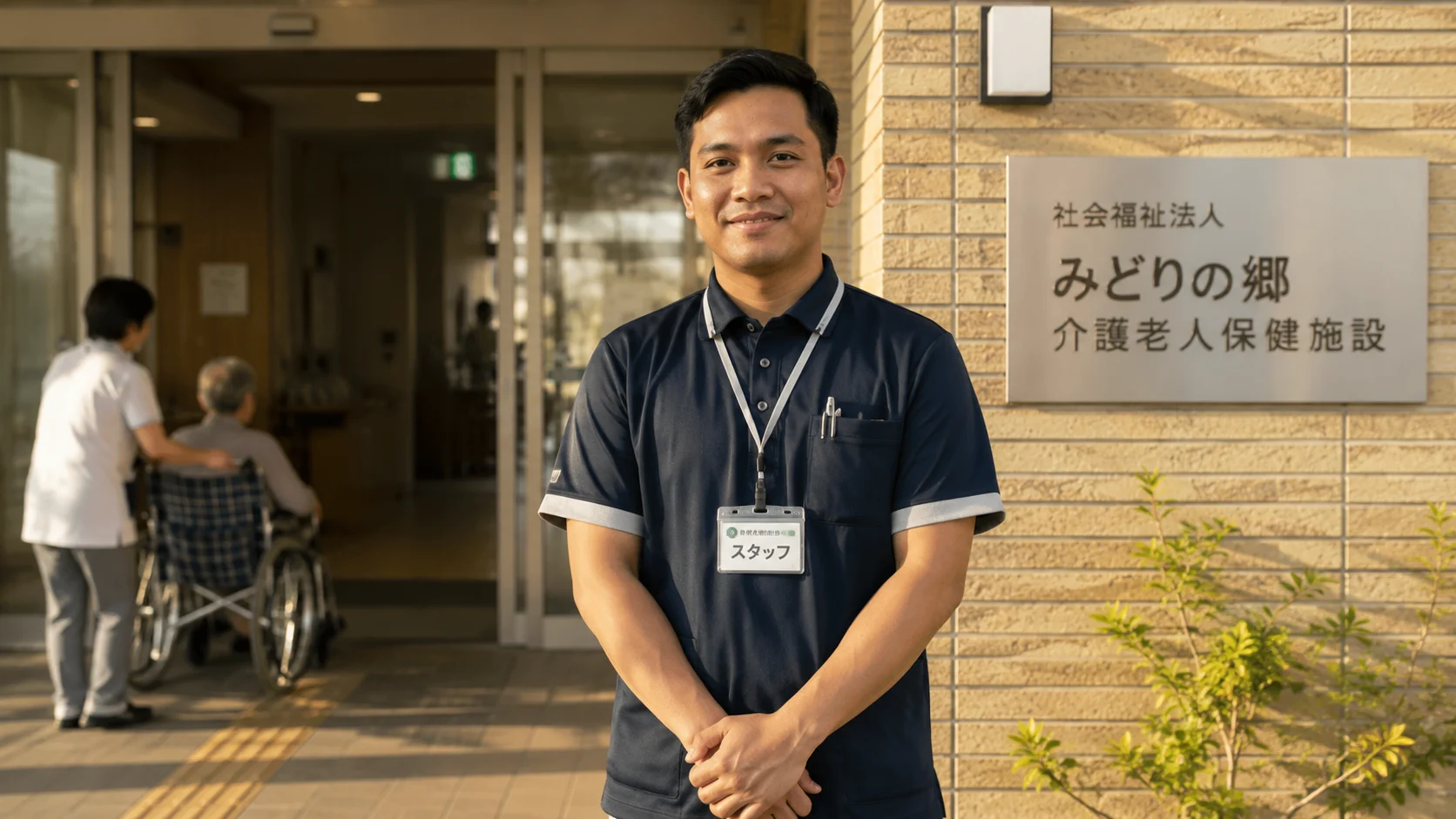
Caregiving is where applicants most often go wrong, because Japan runs two parallel routes for the same kind of work and they are easy to confuse. The first is the SSW "Nursing Care" field, which is part of the Specified Skilled Worker system. The second is the standalone "Care" residence status, usually called Kaigo, which is a completely separate visa category and is not part of SSW at all. Mixing them up can lead you to chase the wrong test and the wrong long-term plan.
The SSW Nursing Care field is Type 1 only. That means it carries the five-year ceiling, requires the care skills test plus the language test (JLPT N4 or JFT-Basic A2), and does not by itself let you bring family or build toward permanent residence. It is a fast, practical way to start working in a Japanese care home or hospital, but it is capped. By contrast, the Care (Kaigo) status is built for the long term: it is aimed at people who train and qualify as a certified care worker (kaigo fukushishi), it allows indefinite renewal, it permits family to join, and it counts toward permanent residence.
| Aspect | SSW Nursing Care (Type 1) | "Care" / Kaigo status |
|---|---|---|
| System | Part of SSW | Separate residence status (not SSW) |
| Maximum stay | 5 years total | Indefinite renewals |
| Qualification needed | Skills test + language test | Certified Care Worker (kaigo fukushishi) |
| Bring family | No | Yes |
| Path to permanent residence | No | Yes |
| Best for | Starting quickly in care work | A long-term career and settlement in care |
A common, realistic path is to enter Japan on SSW Nursing Care, work and study while improving your Japanese, gain the qualification needed to become a certified care worker, and then switch to the Care (Kaigo) status to secure an indefinite future with your family. If your goal is to settle in Japan as a caregiver, the Kaigo status - not SSW alone - is the route that gets you there. For how this compares to caregiver pathways elsewhere, see our worldwide caregiver visa guide.
Every SSW sector in 2026
SSW now covers more than 16 fields, expanded since launch to add transport, forestry, and timber industries to the original list. Each field has its own skills test, and not every field offers a Type 2 status. The table below lists the current sectors and notes which ones are limited to Type 1. Sector lists and test availability change, so confirm the current list with the Immigration Services Agency of Japan before committing to a particular field.
| Sector | Type 1 | Type 2 available |
|---|---|---|
| Nursing care (caregiving) | Yes | No (Type 1 only) |
| Building cleaning | Yes | Yes |
| Construction | Yes | Yes |
| Machine parts & tooling | Yes | Yes |
| Industrial machinery | Yes | Yes |
| Electric, electronics & information | Yes | Yes |
| Shipbuilding & ship machinery | Yes | Yes |
| Automobile maintenance | Yes | Yes |
| Aviation | Yes | Yes |
| Accommodation (hospitality) | Yes | Yes |
| Agriculture | Yes | Yes |
| Fishery & aquaculture | Yes | Yes |
| Food & beverage manufacturing | Yes | Yes |
| Food service (restaurants) | Paused for new Type 1 COEs from ~13 Apr 2026 | Yes |
| Automobile transportation (newer field) | Yes | Yes |
| Railway (newer field) | Yes | Yes |
| Forestry (newer field) | Yes | Yes |
| Timber industry (newer field) | Yes | Yes |
The newer fields - automobile transportation, railway, forestry, and the timber industry - were added to spread SSW into sectors that are also struggling to recruit, and they show how the programme keeps widening rather than shrinking. Manufacturing-related fields such as machine parts and tooling, industrial machinery, and electric/electronics/information are sometimes grouped together in official materials, so the exact field names you see on a test page may be worded slightly differently from the table above. The practical point is that demand is broad and not limited to care and construction.
Who applies and where SSW workers come from
SSW workers come overwhelmingly from a handful of countries in South-East and South Asia. As of 2026 the largest source is Vietnam at roughly 44 percent of all SSW holders, followed by Indonesia at about 21 percent, with the Philippines and Myanmar each contributing roughly 10 percent. Together these four countries account for the large majority of the entire SSW population, which shapes everything from the languages spoken in dormitories to which embassies process the most visas.
| Source country | Approx. share of SSW holders (2026) |
|---|---|
| Vietnam | ~44% |
| Indonesia | ~21% |
| Philippines | ~10% |
| Myanmar | ~10% |
| All other countries | Remainder |
These shares are not random. Many of the top source countries have bilateral arrangements and a strong existing pipeline of workers who first came through the old training programme, and they host frequent skills and language tests on Japan's behalf. Filipino workers in particular are well represented across care and hospitality, building on a long history of overseas labour migration - we cover the wider picture for that nation in our Philippines visa and migration overview. Visa issuance volumes for SSW are released in periodic blocks rather than continuously, so reported totals can jump when a new batch of certificates and visas is processed.
If you are weighing Japan against other options, note that the country also offers a youth-focused working holiday visa for nationals of partner countries, which is a different track aimed at travel plus incidental work rather than skilled employment. SSW is the serious, longer-term work route; the working holiday is short-term and age-limited.
Salary, conditions, and what to expect
SSW pay is regulated to match what a Japanese national would earn in the same role, but in practice most frontline SSW jobs sit in a monthly range of about JPY 160,000 to JPY 300,000 before tax and deductions. Where you land in that band depends on your sector, region, hours, and overtime - construction and shipbuilding often pay toward the higher end, while entry-level care and food work can start lower. Employers must follow Japanese labour law on working hours, social insurance, and overtime, and SSW workers are entitled to the same protections as local staff.
Cost of living matters as much as the headline number. Housing is often arranged or subsidised by the employer, and deductions for accommodation, utilities, social insurance, and pension reduce take-home pay significantly. Workers from lower-wage countries still typically send meaningful remittances home, which is a major reason demand for SSW places stays high in the top source countries. Always read the employment contract carefully and confirm what is deducted before you accept an offer.
Because SSW replaced Japan's earlier dependence on the Technical Intern Training Program, conditions are generally better defined than they were under the old trainee model, where abuses were widely reported. The shift to SSW, and now to the incoming Employment for Skill Development (ESD) system, is partly an attempt to fix those problems by treating foreign staff as workers with mobility and rights rather than as trainees tied to a single employer. SSW workers can, within rules, change employers inside the same field, which is a meaningful improvement on the old system.
How to apply for the SSW visa step by step
The SSW process has a fixed order: you qualify by passing tests, you secure a job, your employer files for a Certificate of Eligibility (COE), and only then do you apply for the actual visa at a Japanese embassy or consulate. Skipping ahead does not work - without a passing skills test and an employer, there is no application to make. The steps below assume you are applying from outside Japan.
- Pass the sector skills test for your chosen field and pass the Japanese-language test (JLPT N4 or above, or JFT-Basic at roughly A2). Both are required for SSW Type 1.
- Find an employer in Japan that is registered to hire SSW workers in your field and receive a job offer with a written employment contract.
- Your employer (or their supporting agency) applies to the regional immigration bureau for your Certificate of Eligibility (COE), proving the job and your eligibility.
- Once the COE is issued, take it with your passport and supporting documents to a Japanese embassy or consulate and apply for the visa itself.
- After the visa is granted, enter Japan, complete residence registration, and begin work under your SSW status.
The COE is the pivotal document - it is issued in Japan by immigration and effectively pre-approves your case, which makes the embassy step that follows largely a formality if everything is in order. The most common failure points are a weak or missing language result, an employer that is not properly registered for SSW, or paperwork errors in the COE application. To reduce your risk, read our guide to the most common visa rejection reasons and make sure your documents are consistent and complete.
Does SSW lead to permanent residence?
Whether SSW leads to permanent residence depends entirely on which type you hold. Time spent on SSW Type 1 does not count toward permanent residence, and because Type 1 is capped at five years, holding only Type 1 will never, on its own, get you to PR. This is a deliberate design choice: Type 1 is meant to be temporary mid-skilled labour, not a settlement track.
SSW Type 2 is the opposite. Time on Type 2 does count toward permanent residence, renewals are indefinite, and you can bring your family, which together make it a genuine settlement pathway. The realistic route to PR through SSW is therefore: enter on Type 1, gain experience, pass the tougher Type 2 skills examination in one of the 11 eligible fields, move to Type 2, and accumulate the required years of residence. In caregiving, where there is no Type 2, the equivalent long-term route runs through the separate Care (Kaigo) status instead, which also counts toward PR.
Permanent residence in Japan generally requires a long, continuous period of lawful residence and a clean record on taxes and social insurance, so plan early if settlement is your goal. Keep evidence of every contract, payslip, and tax payment from day one, because PR applications are document-heavy and look back across your whole stay. Confirm the current PR criteria with the Immigration Services Agency of Japan, as residence-period requirements are periodically reviewed.
lead.heading
lead.description
Sık sorulan sorular
What is the difference between SSW Type 1 and Type 2?
SSW Type 1 is the entry-level Specified Skilled Worker status: it is capped at five years total, does not allow you to bring family, requires both a skills test and a Japanese-language test (JLPT N4 or JFT-Basic A2), and does not count toward permanent residence. SSW Type 2 is the senior status: it allows indefinite renewals, lets your spouse and children join you, requires no separate language test, counts toward permanent residence, and is available in 11 fields. Type 2 is reached by gaining experience in Type 1 and passing a tougher supervisory-level skills exam.
Can I bring my family on the SSW visa?
It depends on the type. On SSW Type 1 you cannot bring dependants - no spouse or children may accompany you. On SSW Type 2 you can bring your spouse and children. So if living with your family in Japan matters to you, your long-term goal should be to move from Type 1 to Type 2 in an eligible field, or, for caregivers, to switch to the separate Care (Kaigo) status, which also allows family.
Do I need to speak Japanese for SSW?
For SSW Type 1, yes. You must pass a Japanese-language test - either the JLPT at level N4 or above, or the JFT-Basic test at roughly A2 level - in addition to a sector skills test. There is no separate language test to move up to SSW Type 2. Even though N4 is a lower-intermediate level, you should expect to keep improving your Japanese on the job, especially in care and hospitality roles where communication is central.
Does SSW lead to permanent residence?
Only through Type 2. Time spent on SSW Type 1 does not count toward permanent residence and Type 1 is capped at five years, so Type 1 alone cannot get you to PR. SSW Type 2, available in 11 fields, allows indefinite renewals and counts toward permanent residence. In caregiving there is no Type 2, so the long-term, PR-eligible route there is the separate Care (Kaigo) residence status rather than SSW.
Which sectors hire SSW workers?
More than 16 fields, including nursing care, building cleaning, construction, machine parts and tooling, industrial machinery, electric/electronics/information, shipbuilding, automobile maintenance, aviation, accommodation/hospitality, agriculture, fishery, food and beverage manufacturing, food service, plus newer additions such as automobile transportation, railway, forestry, and the timber industry. Note that the food service field paused new Type 1 Certificates of Eligibility from around 13 April 2026, so confirm its current status before applying.
Is SSW nursing care the same as the Kaigo visa?
No. SSW "Nursing Care" is a Type 1 field within the Specified Skilled Worker system - it is capped at five years, has no family rights, and does not lead to permanent residence. The "Care" (Kaigo) status is a completely separate residence status, not part of SSW. Kaigo is aimed at people who qualify as certified care workers, allows indefinite renewal and family, and counts toward permanent residence. Many caregivers start on SSW Nursing Care and later switch to Kaigo for the long term.
How much do SSW workers earn in Japan?
Most frontline SSW jobs pay roughly JPY 160,000 to JPY 300,000 per month before tax and deductions, with the exact figure depending on sector, region, hours, and overtime. Construction and shipbuilding tend to pay toward the higher end, while entry-level care and food roles can start lower. SSW pay must match what a Japanese national would earn in the same role, but housing, utilities, social insurance, and pension deductions reduce take-home pay, so always check the contract details.
How do I apply for the SSW visa and how does it relate to TITP?
The order is: pass your sector skills test and the Japanese-language test, find a registered SSW employer, have that employer apply for your Certificate of Eligibility (COE) at immigration in Japan, then apply for the visa at a Japanese embassy or consulate, and finally enter Japan. SSW replaced Japan's earlier reliance on the Technical Intern Training Program (TITP); the TITP itself is being replaced by the new Employment for Skill Development (ESD) system, which is designed to feed into SSW more smoothly. Verify current steps and fees with the Immigration Services Agency of Japan.
İlgili makaleler
Ücretsiz araçlarımızı kullanın
Kanada CRS, Avustralya puanları, İngiltere skilled worker, Almanya Fırsat Kartı ve 34 ülke maaş eşikleri için ücretsiz hesaplayıcılar.
Tüm araçları gör