
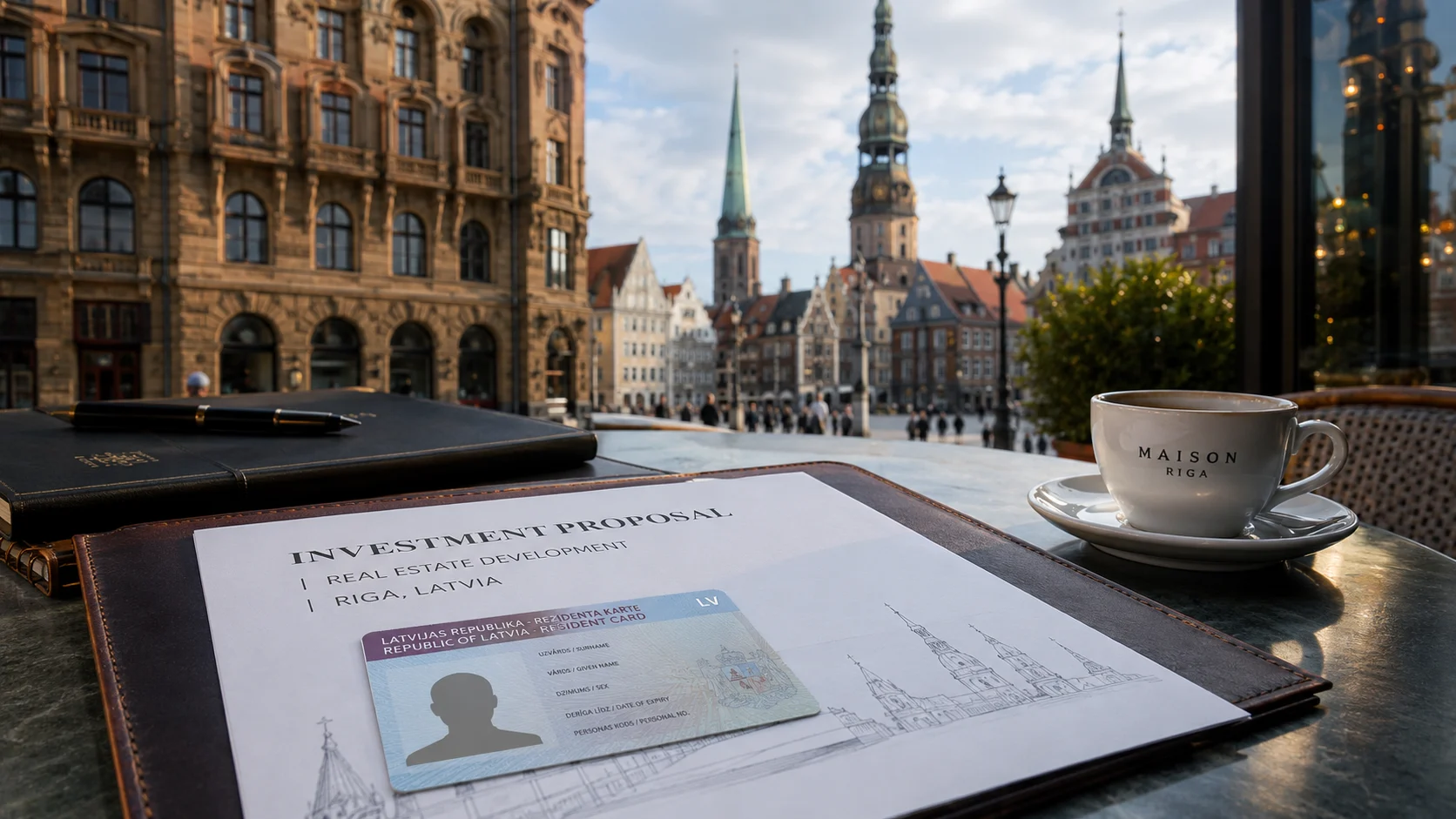
What is the Latvia golden visa?
As of 2026, the Latvia golden visa, formally a temporary residence permit by investment, is the lowest-cost residency-by-investment program anywhere in the European Union. While most golden visa headlines quote figures of EUR 250,000 or more, Latvia's flagship business route starts at just EUR 50,000 invested into the equity capital of a qualifying Latvian company. That single fact has made Latvia the standout budget option for investors who want a legal foothold in the eurozone and the Schengen Area without the six-figure outlay that Greece, Portugal, or Spain historically required.
It is important to be precise about what this program is and is not. Latvia grants residency, not citizenship. This is a golden visa (residence by investment) and not a citizenship-by-investment (CBI) scheme like those once offered by certain Caribbean states. You receive the right to live in Latvia, travel freely across the Schengen Area, and renew your permit, but a Latvian passport remains a long and demanding journey away. For the vast majority of applicants, the value here is the Schengen access and EU residency, not a fast second passport. You can compare it against every other live program in the golden visa hub.
The permit is issued by the Office of Citizenship and Migration Affairs (OCMA, or PMLP in Latvian). It is granted for up to five years in most routes, with annual registration or renewal steps depending on the investment type. Crucially, Latvia imposes no minimum physical stay requirement: you only need to enter the country and complete a short registration roughly once a year to keep the permit alive. That makes it especially attractive to investors who want optionality and Schengen mobility rather than a place they must physically inhabit for half the year.
Investment routes and exact thresholds
Latvia offers four principal investment routes as of 2026. The headline EUR 50,000 business route is the cheapest, but it carries conditions about the size and activity of the company. The real estate and bank deposit routes are simpler to qualify for but require considerably more capital. The table below summarises the core thresholds. All figures are as of 2026 and the associated state fees are covered separately in the costs section.
| Route | Investment | Plus state fee | Capital returned? |
|---|---|---|---|
| Business equity (SME) | EUR 50K | ~EUR 10K one-time | No (equity stake) |
| Real estate | EUR 250K | ~5% duty (~EUR 12.5K) | On sale of property |
| Bank deposit / subordinated capital | ~EUR 280K | ~EUR 25K | Yes, after 5 years |
| Government bonds | EUR 250K | Fee applies | On maturity |
The business equity route is the one that earns Latvia its 'cheapest in Europe' reputation. You invest EUR 50,000 into the equity capital of a small or medium-sized Latvian enterprise that employs local staff and pays taxes into the Latvian budget. The company must be a genuine, operating business rather than a dormant shell, and the state expects evidence of economic substance. A one-time state fee of roughly EUR 10,000 applies to this route, which still makes the all-in cost a fraction of competing programs.
The real estate route requires the purchase of qualifying property worth at least EUR 250,000, accompanied by a state duty of around 5% of the property value (approximately EUR 12,500). The bank deposit route, sometimes structured as subordinated capital placed with a Latvian credit institution, requires roughly EUR 280,000 held for five years. The defining feature of the deposit route is that the money is returned to you at the end of the holding period - it is a deposit, not a sunk cost. The government bond route requires EUR 250,000 in qualifying Latvian government securities, which are redeemed at maturity. Each route ultimately leads to the same temporary residence permit and the same Schengen rights.
The bank deposit route: your money comes back
Among Latvia's routes, the bank deposit (or subordinated capital) option deserves special attention because it changes the entire economics of obtaining residency. Under this route you place approximately EUR 280,000 with a Latvian bank as a deposit or subordinated capital instrument, held for a five-year term. At the end of that term the principal is returned to you. Unlike a property purchase, where your capital is tied up in an asset whose value can fall, or the business route, where your equity is genuinely at risk, the deposit route is closest to parking your money rather than spending it.
In practical terms this means the true cost of the deposit route is not EUR 280,000 but rather the state fee (around EUR 25,000) plus the opportunity cost of having that capital locked up for five years and any difference between the deposit's interest rate and what you could earn elsewhere. For an investor who already holds a large cash position and wants Schengen residency without permanently parting with capital, this is often the most rational choice despite its higher upfront figure. The headline number looks expensive, but the net cost over five years can undercut a property purchase once transaction taxes, maintenance, and resale risk are factored in.
Eligibility and requirements
The Latvia golden visa is open to non-EU and non-EEA nationals. Beyond making the qualifying investment, applicants must meet a standard set of conditions designed to confirm they are of good standing and pose no security concern. These requirements are not onerous compared with other programs, but the due diligence on source of funds has tightened across Europe in recent years and Latvia is no exception.
- Be a non-EU/EEA national aged 18 or over with a valid passport
- Make and maintain one of the qualifying investments (business, real estate, deposit, or bonds)
- Provide a clean criminal record certificate from your country of citizenship and residence
- Demonstrate a legitimate, documented source of the invested funds
- Hold valid health insurance covering your stay in Latvia
- Pay the applicable state fees for the chosen route and for each family member
- Pass the OCMA security and background screening
Family inclusion is permitted: a spouse and minor children can be added to the application, each subject to additional state fees but without a separate investment requirement. Source-of-funds documentation is the area where applications most often stall, so investors should prepare a clear paper trail showing how the capital was earned and accumulated. The reasons applications get refused across European residency programs are broadly consistent, and reviewing common visa rejection reasons before you apply can save months of delay and lost fees.
How to apply: step by step
The Latvia golden visa process is comparatively fast, with total processing often completing within one to three months once a clean application is submitted. The steps below outline the typical sequence. Most investors engage a licensed Latvian immigration lawyer or a regulated agent to handle the local filings and bank introductions.
- Choose your route. Decide between the EUR 50,000 business equity investment, the EUR 250,000 real estate purchase, the approximately EUR 280,000 bank deposit, or the EUR 250,000 government bond route based on your budget and whether you want your capital returned.
- Engage a licensed advisor and assemble documents. Gather your passport, criminal record certificate, proof of source of funds, and health insurance. Foreign documents typically require translation into Latvian and legalisation or apostille.
- Make the qualifying investment. Transfer the funds into the company equity, complete the property purchase before a notary, place the bank deposit, or acquire the government bonds, depending on your chosen route. Keep full evidence of the transaction.
- Pay the state fee. Settle the one-time fee tied to your route - around EUR 10,000 for the business route, the roughly 5% duty for real estate, or around EUR 25,000 for the deposit route - plus per-person fees for any family members.
- Submit the residence permit application to OCMA (PMLP). File the complete application with all supporting evidence. The office conducts security screening and verifies the investment and source of funds.
- Receive your temporary residence permit. On approval, you collect your permit, which is issued for up to five years in most routes. Register your address and complete biometrics in Latvia.
- Maintain and renew. Keep the investment in place, hold valid health insurance, and complete the annual registration or renewal step. You must enter Latvia at least once a year to keep the permit valid.
Because there is no minimum stay obligation, many investors complete the in-person steps in a single short trip and return only for the brief annual registration. This light-touch maintenance is one of the program's biggest practical advantages over residency schemes that demand 183 days a year on the ground.
Costs and fees
The total cost of a Latvia golden visa is the qualifying investment plus the route-specific state fee, plus professional, translation, and per-family-member charges. The table below sets out indicative all-in figures as of 2026. Note that on the deposit and bond routes the bulk of the headline figure is recoverable capital, so the genuine spend is far lower than the totals suggest.
| Cost item | Business route | Real estate route | Deposit route |
|---|---|---|---|
| Qualifying investment | EUR 50K | EUR 250K | ~EUR 280K |
| State fee / duty | ~EUR 10K | ~EUR 12.5K (5%) | ~EUR 25K |
| Recoverable capital | No | On resale | Yes, after 5 years |
| Legal / agent fees | EUR 3K to 8K | EUR 3K to 8K | EUR 3K to 8K |
| Health insurance (annual) | EUR 300 to 800 | EUR 300 to 800 | EUR 300 to 800 |
| Family member fees | Per person | Per person | Per person |
For a single applicant choosing the business route, the realistic non-recoverable spend - the EUR 10,000 state fee plus legal and ancillary costs - can land in the region of EUR 15,000 to EUR 20,000 on top of the EUR 50,000 equity stake, and even that stake remains an investment in a real company rather than a pure fee. This is why Latvia consistently ranks as the most affordable EU golden visa. By contrast, on the real estate route the 5% state duty alone (around EUR 12,500) is a genuine cost, with the EUR 250,000 property value recoverable only when and if you sell. Always confirm the current fee schedule with OCMA or your advisor, as these figures are periodically revised.
Tax treatment
Holding a Latvian residence permit does not by itself make you a Latvian tax resident. Tax residency in Latvia is generally triggered by spending more than 183 days in the country within a 12-month period or by having your declared place of residence there. Because the golden visa carries no minimum stay obligation, many investors never become Latvian tax residents and therefore are not subject to Latvian tax on their worldwide income simply by holding the permit. This separation between immigration status and tax status is a key planning point.
If you do become a Latvian tax resident, Latvia operates a progressive personal income tax with rates that have been reformed in recent years, alongside specific treatment of capital gains and dividends. Latvia maintains an extensive network of double-tax treaties that can prevent the same income being taxed twice. Anyone considering spending significant time in Latvia should obtain a tailored assessment, because the interaction between Latvian rules and your home country's treaty can materially change the outcome.
Residency to citizenship timeline
This is where expectations must be managed carefully. Latvia is a residency product, not a fast track to an EU passport. Naturalisation generally requires around ten years of lawful residence, and critically that residence must be genuine: the years you accumulate while never actually living in Latvia do not count toward citizenship in the same way they count toward keeping the permit alive. An investor who only visits once a year to register is building Schengen access, not a citizenship clock.
Latvian naturalisation also requires passing a Latvian language examination as well as tests on the constitution and history, and Latvia has historically been restrictive about dual citizenship for naturalised applicants from many countries. For these reasons, you should evaluate the Latvia golden visa purely on its residency and mobility merits. If a second EU passport is your primary objective, other programs and pathways are better suited, and the honest framing across the cluster is that Latvia competes on price and Schengen access, not on a passport timeline.
This positions Latvia alongside other budget-friendly eastern and southern EU options. It is worth comparing it directly with the Hungary golden visa, which is another lower-cost route into the EU, as well as the Cyprus and Bulgaria golden visa landscape and the long-established Greece golden visa. Each balances cost, stay rules, and citizenship prospects differently, and the right choice depends on whether you prioritise the lowest entry price, a path to citizenship, or a lifestyle base.
Pros and cons
Latvia's golden visa is a sharp tool for a specific job: cheap, low-maintenance EU residency with Schengen mobility. It is less suited to investors chasing a quick passport or a place to physically relocate with deep public services. The summary below weighs the main trade-offs as of 2026.
- [+] Cheapest golden visa in the EU - business route from just EUR 50,000
- [+] No minimum stay requirement - only an annual entry and registration needed
- [+] Full Schengen Area travel access and eurozone membership
- [+] Fast processing, often within one to three months
- [+] Bank deposit route returns your principal after five years
- [+] Family inclusion for spouse and minor children without separate investments
- [+] Holding the permit alone need not trigger Latvian tax residency
- [-] No fast or easy citizenship - naturalisation takes around 10 years with a language exam
- [-] Citizenship requires genuine residence, which annual-visit investors will not accumulate
- [-] Real estate route carries a non-recoverable 5% state duty
- [-] Source-of-funds due diligence is strict and can delay or block applications
- [-] Latvia's dual-citizenship rules are restrictive for many naturalised applicants
- [-] US citizens retain full worldwide US tax and reporting obligations
2026 changes and what is new
The golden visa landscape across Europe has shifted dramatically between 2023 and 2026, and Latvia's relative position has improved as competitors have closed or tightened their programs. Portugal removed the residential real estate route, Spain announced the end of its golden visa, Ireland closed its program, and several other states have either ended schemes or sharply raised thresholds. Against that backdrop, Latvia keeping a EUR 50,000 entry point open has made it one of the very few genuinely low-cost EU residency-by-investment options still available as of 2026.
At the same time, the broader European trend toward stricter scrutiny applies to Latvia too. Source-of-funds checks, security screening, and the requirement that business investments support real, tax-paying companies have all become more rigorous. Investors should expect more documentation than the program demanded a decade ago, and should budget time for due diligence. The direction of travel across the continent is fewer, cleaner, better-policed programs, which you can track in the broader golden visa hub and in coverage of countries that ended golden visas.
The practical takeaway for 2026 is that Latvia is a window of opportunity rather than a permanent fixture. Programs that look secure can be revised or suspended with limited notice, as recent history across the EU has shown. If the low-cost EU residency Latvia offers fits your goals, it is worth acting while the EUR 50,000 route and the no-stay rules remain in place, while always confirming the latest figures with a licensed advisor before committing funds.
lead.heading
lead.description
Sık sorulan sorular
What is the cheapest golden visa in Europe?
As of 2026, Latvia offers the cheapest golden visa in the European Union through its business equity route, which starts at just EUR 50,000 invested into a qualifying Latvian company, plus a one-time state fee of around EUR 10,000. No other EU residency-by-investment program currently matches this entry point, with most competitors requiring EUR 250,000 or more. Several previously cheaper or comparable programs in other countries have closed or raised their thresholds, which has reinforced Latvia's position as the budget option. The catch is that this is residency, not citizenship, and the business route requires a genuine operating company rather than a passive investment. Always verify the current threshold and fee with a licensed Latvian advisor before committing.
Do I get the Latvia bank deposit back?
Yes. Under the bank deposit (or subordinated capital) route, you place approximately EUR 280,000 with a Latvian bank for a five-year holding period, and your principal is returned to you at the end of that term. This is the defining advantage of the deposit route: the money is locked rather than spent. The genuine cost of this route is the state fee of around EUR 25,000 plus the opportunity cost of having the capital tied up for five years, not the full deposit amount. For investors with a large cash position, this often works out cheaper in net terms than a property purchase once transaction taxes and resale risk are considered. Confirm the exact term, interest treatment, and fee with the bank and your advisor before placing funds.
Is there a minimum stay requirement for the Latvia golden visa?
No. Latvia imposes no minimum physical stay requirement to maintain the golden visa residence permit. You generally only need to enter Latvia and complete a short registration or renewal step roughly once a year to keep the permit valid. This makes it one of the most flexible residency programs in the EU, ideal for investors who want Schengen mobility and EU residency without having to relocate. However, this same flexibility means the years spent away do not build toward citizenship, which requires genuine residence. The no-stay rule is excellent for mobility but is not a shortcut to a passport.
Does the Latvia golden visa give Schengen access?
Yes. Latvia is a full member of both the Schengen Area and the eurozone, so a Latvian residence permit allows you to travel freely across all Schengen countries for short stays without internal border checks. This Schengen mobility is one of the program's primary attractions, particularly for investors from countries whose passports otherwise face restrictive visa requirements for Europe. The permit grants the right to reside in Latvia and to move freely within Schengen, but it does not grant the right to live or work permanently in other EU member states. For that, you would need citizenship or a separate national permit from the country concerned.
How long does the Latvia golden visa take to process?
Processing is comparatively fast, typically completing within one to three months once a complete and clean application is submitted to the Office of Citizenship and Migration Affairs (OCMA). The timeline depends heavily on how quickly you can assemble documents, make the qualifying investment, and clear source-of-funds verification. Applications that stall almost always do so because of incomplete documentation or unclear evidence of how the invested capital was earned. Engaging a licensed Latvian immigration advisor early helps keep the process within the expected window. Plan for additional time to gather, translate, and legalise foreign documents before filing.
Can I include my family in the Latvia golden visa application?
Yes. The main applicant can include a spouse and minor children in the application. Family members do not need to make a separate qualifying investment, but additional state fees apply for each person added. The included family members share the residency status and the same Schengen mobility rights as the main applicant. You will need to provide documentation proving the relationship, such as a marriage certificate and birth certificates, typically translated into Latvian and legalised. Confirm the current per-person fees and any age limits for dependent children with your advisor, as these details can change.
Will I become a Latvian tax resident by holding the golden visa?
Not automatically. Holding a Latvian residence permit does not by itself make you a Latvian tax resident. Tax residency is generally triggered by spending more than 183 days in Latvia within a 12-month period or by registering your place of residence there. Because the golden visa carries no minimum stay requirement, many investors never become Latvian tax residents and so are not taxed on their worldwide income merely by holding the permit. If you do spend significant time in Latvia, you should obtain a tailored tax assessment, as Latvian rules and double-tax treaties interact in ways specific to your circumstances. US citizens remain subject to US worldwide taxation regardless of their Latvian status.
Can the Latvia golden visa lead to citizenship?
In principle yes, but it is a long and demanding route that most golden visa investors will never complete. Naturalisation in Latvia generally requires around ten years of genuine, lawful residence, plus passing a Latvian language exam and tests on the constitution and history. Critically, the years accumulated while only visiting once a year to register do not build genuine residence for citizenship purposes. Latvia has also historically been restrictive about dual citizenship for naturalised applicants from many countries. For these reasons, the Latvia golden visa should be evaluated as a residency and Schengen-access product rather than a path to an EU passport.
İlgili makaleler
Ücretsiz araçlarımızı kullanın
Kanada CRS, Avustralya puanları, İngiltere skilled worker, Almanya Fırsat Kartı ve 34 ülke maaş eşikleri için ücretsiz hesaplayıcılar.
Tüm araçları gör