
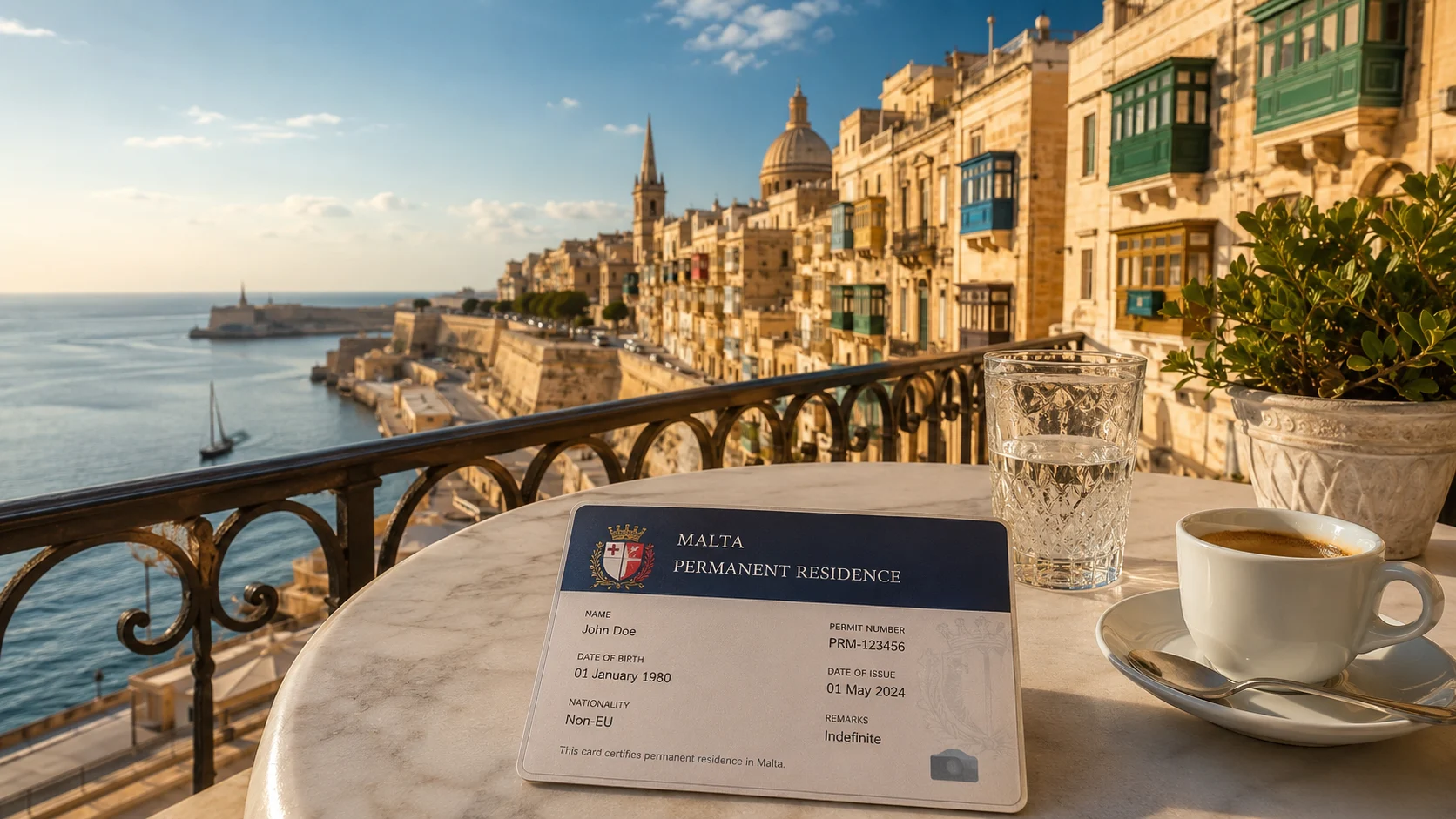
What the Malta golden visa is
As of 2026, the Malta golden visa is delivered through the Malta Permanent Residence Programme (MPRP), a government scheme that grants qualifying non-EU, non-EEA, and non-Swiss nationals the right to settle in Malta on a permanent basis. Unlike most European golden visas, which issue a temporary residence permit that must be renewed every one to five years, the MPRP confers permanent residency from the outset. That single feature is what sets Malta apart in the investment migration market and explains why it remains popular despite a total cost that runs well into six figures. You can compare it against every other open program on the Golden Visa hub.
It is important to draw the distinction between residency-by-investment and citizenship-by-investment (CBI). A golden visa, including the MPRP, gives you a residence permit - the right to live in the country and, in Malta's case, to travel visa-free within the Schengen Area. It does not give you a passport. Citizenship-by-investment, by contrast, sells nationality directly. Malta operated both kinds of program until recently, but as of 2026 only the residency route survives. The CBI route was terminated following a 2025 European Court of Justice judgment, which we cover in detail below. Anyone who reads older guides promising a Maltese passport in twelve to thirty-six months should treat that information as out of date.
The MPRP is administered by the Residency Malta Agency. Approved applicants and their families receive a Maltese residence card that is valid for five years and renewable thereafter, provided the qualifying conditions (chiefly holding the property) continue to be met. Because the status is permanent rather than temporary, there is no annual income test or renewal investment after the initial commitment. For families seeking a stable EU base with minimal physical presence requirements, this is a meaningful advantage over programs that demand continuous residence.
Investment options and thresholds
The MPRP is built around a qualifying property plus a set of government payments. As of 2026 there are two property routes - renting or buying - and the government contribution differs depending on which you choose. The property must be held for a minimum of five years from the issue of the residence certificate. The figures below are approximate and were revised in recent program updates, so confirm the current schedule with the Residency Malta Agency or a licensed agent before transferring funds.
| Component | Rental route | Purchase route |
|---|---|---|
| Qualifying property | Rent from EUR 14K/yr | Buy from EUR 375K (EUR 270K-300K in South Malta / Gozo) |
| Government contribution | ~EUR 60K | ~EUR 30K |
| Administrative fee | ~EUR 50K | ~EUR 50K |
| NGO donation | EUR 10K | EUR 10K |
| Minimum holding period | 5 years | 5 years |
On the rental side, the qualifying lease starts from about EUR 14,000 per year. Over a typical five-year commitment, the rental obligation combined with the higher government contribution pushes the effective property-related outlay toward the EUR 169,000 mark frequently quoted for the rental route, which is why that figure appears in summaries of the program. On the purchase side, the headline threshold is from around EUR 375,000, with a lower band of roughly EUR 270,000 to EUR 300,000 applying to property located in the South of Malta or on the island of Gozo. The purchase route carries a lower government contribution (around EUR 30,000) because the buyer is committing more capital to Maltese real estate.
Layered on top of the property and contribution are an administrative fee of approximately EUR 50,000 and a mandatory donation of EUR 10,000 to a registered Maltese non-governmental organisation focused on philanthropy, culture, sport, science, animal welfare, or the arts. When you add the government contribution, administrative fee, and NGO donation together, the non-property program cost typically lands at EUR 150,000 or more, before you account for rent or the purchase price itself. These thresholds were revised in recent years and remain subject to change, so treat them as a 2026 snapshot rather than a permanent schedule.
Eligibility and requirements
The MPRP is open to non-EU, non-EEA, and non-Swiss nationals who are at least 18 years old, in good standing, and able to satisfy the financial thresholds and four-tier due diligence checks run by the Residency Malta Agency. Citizens of countries subject to Maltese or international sanctions, and applicants who pose a reputational or security risk, are excluded. Because Malta sits inside the EU and the Schengen Area, its due diligence is among the most rigorous in the investment migration sector, and a meaningful share of applications are refused at the vetting stage. Understanding why applications fail is worth your time - see our guide to common visa rejection reasons before you file.
The main applicant must demonstrate the required capital assets, provide a clean criminal record from every country of citizenship and long-term residence, hold valid health insurance covering Malta, and commit to the qualifying property for the five-year holding period. Source-of-funds and source-of-wealth documentation is mandatory and is examined closely; vague or undocumented wealth is one of the most common reasons for refusal in EU programs of this kind.
The MPRP is notably family-friendly. A single application can include the main applicant's spouse or partner, dependent children (including, in many cases, adult dependent children who are financially reliant on the applicant), and dependent parents and grandparents of both the main applicant and the spouse. This multi-generational scope is one of the program's strongest selling points for families who want to bring elderly relatives under a single EU residency umbrella. Each additional dependent beyond the core family may attract an extra fee, so confirm the per-dependent schedule with your agent.
- Main applicant aged 18 or over, non-EU/EEA/Swiss
- Documented capital assets (commonly around EUR 500,000 net worth)
- Clean criminal record and successful four-tier due diligence
- Qualifying property rented or purchased and held for 5 years
- Valid health insurance covering Malta
- Spouse, dependent children (including adult dependents), parents and grandparents may be included
How to apply, step by step
The MPRP must be filed through a licensed agent or accredited agent registered with the Residency Malta Agency; individuals cannot apply directly. The end-to-end timeline runs roughly twelve months, broken into an approval-in-principle stage of about four to six months followed by completion. The sequence below outlines the typical path as of 2026.
- Engage a licensed Maltese agent. The agent conducts a preliminary assessment of your eligibility, source of funds, and family composition, and prepares the application file. Direct applications are not accepted.
- Compile due diligence documentation. This includes passports, birth and marriage certificates, police clearance certificates from every relevant jurisdiction, bank references, proof of capital assets, and detailed source-of-wealth evidence. Documents in other languages must be officially translated.
- Submit the formal application and pay the initial portion of the administrative fee. The Residency Malta Agency begins its four-tier due diligence review at this point.
- Receive approval-in-principle. If the vetting is successful, the agency issues a letter of approval-in-principle, typically within four to six months. This confirms you may proceed to the investment stage.
- Complete the qualifying investment. Secure the property (sign the lease or complete the purchase), pay the government contribution, settle the balance of the administrative fee, and make the EUR 10,000 NGO donation within the deadlines set in the approval letter.
- Submit biometrics and final documents. You and your included family members provide biometric data and any outstanding paperwork to finalise the residence certificates.
- Receive the residence cards. Once the investment and formalities are confirmed, the agency issues Maltese residence cards valid for five years, granting permanent residency status and Schengen travel rights.
- Maintain the qualifying conditions. Hold the property for the full five-year period and keep health insurance in place. After five years the property condition relaxes, and cards are renewed on confirmation of continued compliance.
Physical presence requirements are minimal. The MPRP does not impose a meaningful stay obligation - in practice applicants need only visit Malta (for example, to provide biometrics), and there is no annual day-count test to maintain the permanent residency. This lack of a residence requirement is a deliberate design feature aimed at internationally mobile investors, and it contrasts sharply with retirement or work visas that require you to live in the country.
Costs and fees
The true cost of the MPRP depends heavily on whether you rent or buy and on how many dependents you include. The table below sets out the principal line items as of 2026. All figures are approximate and were revised in recent program updates.
| Cost item | Rental route | Purchase route |
|---|---|---|
| Government contribution | ~EUR 60K | ~EUR 30K |
| Administrative fee | ~EUR 50K | ~EUR 50K |
| NGO donation | EUR 10K | EUR 10K |
| Property | From EUR 14K/yr rent | From EUR 375K purchase |
| Capital assets to evidence | ~EUR 500K net worth | ~EUR 500K net worth |
| Indicative non-property total | EUR 120K+ | EUR 90K+ |
Beyond the headline figures, budget for professional and ancillary costs: licensed agent fees, legal fees, document translation and apostille, health insurance premiums, and per-dependent charges for larger family applications. Agent and legal fees commonly add tens of thousands of euros. When everything is combined, the program cost for the rental route typically exceeds EUR 150,000 on top of the rent paid over five years, while the purchase route ties up the property capital (from EUR 375,000, or the lower South Malta and Gozo band) but recovers some of it through eventual resale, subject to market conditions and the five-year holding rule.
Because the purchase route locks up far more capital but carries a lower government contribution, the choice between renting and buying comes down to your appetite for owning Maltese real estate versus paying a higher cash contribution to avoid it. Investors who expect to keep a Maltese base long term often favour buying; those who want the residency with the least capital permanently committed lean toward renting. A licensed agent can model both scenarios against your circumstances.
Tax treatment
Holding Maltese permanent residency through the MPRP does not, by itself, make you tax resident in Malta. Tax residency is determined separately, generally by where you are physically present and where your life is centred. Because the MPRP imposes no real stay requirement, many holders never become Maltese tax residents at all and continue to be taxed in their home or other country of residence. If you do become tax resident in Malta, the country's distinctive non-domiciled regime becomes relevant.
Malta operates a remittance basis of taxation for individuals who are resident but not domiciled in Malta. Under this regime, a non-domiciled resident is taxed on Maltese-source income and on foreign income only to the extent that it is remitted (brought into) Malta. Foreign income that is kept outside Malta is generally not taxed there, and foreign capital gains are typically outside the Maltese tax net even if remitted. A minimum tax applies to non-domiciled residents who benefit from the remittance basis, so the regime is not a zero-tax outcome. This treatment only applies if you are actually tax resident in Malta; it confers no benefit on MPRP holders who remain tax resident elsewhere.
Malta has an extensive network of double-tax treaties, which can reduce or eliminate double taxation for residents of treaty countries. However, the interaction between Malta's non-domiciled rules, your home country's exit and residency rules, and any applicable treaty is complex and highly fact-specific. Do not assume the remittance basis will apply to you, and do not relocate on tax grounds alone without a tailored professional opinion. For a sense of how Malta compares to other PR-by-investment programs on tax and cost, see our overview of the Cyprus and Bulgaria golden visa programs.
Residency to citizenship: what changed in 2025
This is the single most important section for anyone evaluating Malta in 2026. For years, Malta marketed two distinct routes: the MPRP for permanent residency, and a separate citizenship-by-investment program that sold a Maltese (and therefore EU) passport in exchange for a large contribution, a property commitment, and a residency period. In April 2025, the Court of Justice of the European Union ruled in Commission v Malta that Malta's citizenship-by-investment scheme was incompatible with EU law. The Court held that granting nationality - and with it EU citizenship - in exchange for predetermined payments, without a genuine link to the country, breached Malta's obligations under the EU treaties.
The practical effect is that Malta's cash-for-passport route is effectively dead as of 2026. Malta can no longer run a citizenship-by-investment program in the form the ECJ condemned, and prospective investors should disregard any marketing that still promises a Maltese passport through investment. Naturalisation in Malta now follows ordinary rules, which require genuine, long-term residence and integration rather than a qualifying investment. This ruling is part of a broader European retreat from investment migration, which we track in our piece on countries that ended their golden visas.
So where does that leave the MPRP? It remains a genuine permanent residency program. It gives you the right to live in Malta indefinitely and to travel within Schengen, and it includes your family across multiple generations. What it does not give you, and never claimed to give you, is citizenship. If an EU passport is your goal, Malta is no longer the shortcut it once was; you would need to pursue ordinary naturalisation through years of real residence, or consider other strategies entirely. If permanent EU residency with minimal presence requirements is your goal, the MPRP still delivers that as of 2026. For a sibling program that also offers residency rather than a quick passport, compare the Italy golden visa.
Pros and cons
The MPRP suits a specific profile: a family with substantial liquid wealth that wants a stable EU residency base, values minimal physical presence requirements, and is comfortable that the program delivers residency rather than citizenship. The summary below weighs the main considerations as of 2026.
- [+] Immediate permanent residency, not a renewable temporary permit - rare among EU golden visas
- [+] No meaningful physical presence or annual day-count requirement to maintain status
- [+] Schengen Area travel rights for the holder and included family members
- [+] Multi-generational family inclusion: spouse, children including adult dependents, parents and grandparents
- [+] English is an official language of Malta, easing administration and daily life
- [+] Possible non-domiciled remittance-basis tax treatment if you become Maltese tax resident
- [-] High total cost: government contribution, EUR 50,000 administrative fee, EUR 10,000 NGO donation, plus property, typically EUR 150,000+ on top of property
- [-] No path to citizenship through investment - the ECJ struck down Malta's CBI scheme in April 2025
- [-] Rigorous four-tier due diligence with a real refusal rate; thin source-of-wealth files fail
- [-] Five-year property holding requirement ties up capital or commits you to ongoing rent
- [-] Thresholds were revised recently and may change again, creating planning uncertainty
- [-] Must apply through a licensed agent; you cannot file directly, adding fees
2026 changes and what is new
The defining development of the past two years is the April 2025 ECJ ruling that ended Malta's citizenship-by-investment program. This is the headline reason older guides are now unreliable: any source written before mid-2025 that frames Malta as a passport-by-investment destination is describing a route that no longer exists. As of 2026 the only Malta investment migration product on the table is the MPRP, and it delivers permanent residency, full stop.
Beyond the citizenship ruling, the MPRP itself has seen threshold and fee revisions in recent years, including adjustments to the rental and purchase property bands, the split government contribution (lower for buyers, higher for renters), and the structure of the administrative fee and NGO donation. The South Malta and Gozo discount on the purchase route - the roughly EUR 270,000 to EUR 300,000 lower band - remains a useful lever for buyers willing to invest outside the most expensive central and northern districts. Because these figures have moved more than once, anyone planning a 2026 application should obtain the current official schedule rather than relying on any single published number, including those in this guide.
The broader context is a continent-wide tightening of investment migration. Several EU states have ended, restricted, or repriced their golden visas in response to political pressure and EU-level scrutiny, and the ECJ's Malta judgment signals that the Commission will keep pushing back hard against citizenship-for-sale specifically. Residency-by-investment programs like the MPRP are on firmer legal ground than CBI, but they are not immune to change. Before committing, confirm the program is still open on the current terms, run your due diligence early, and read about why applications get refused in our guide to visa rejection reasons. You can also benchmark Malta against every other live option on the Golden Visa hub.
lead.heading
lead.description
Sık sorulan sorular
Does the Malta golden visa give citizenship?
No. As of 2026 the Malta golden visa (the MPRP) grants permanent residency only, not citizenship and not a passport. Malta's separate citizenship-by-investment scheme was struck down by the European Court of Justice in April 2025 in Commission v Malta, which held that selling EU citizenship without a genuine link to the country breaches EU law. As a result the cash-for-passport route is effectively dead. Naturalisation as a Maltese citizen is now possible only through ordinary rules requiring years of genuine residence and integration, not through investment. Treat any 2026 offer of a Maltese passport in exchange for investment as out of date or unreliable.
How much does the Malta Permanent Residence Programme cost?
The cost depends on whether you rent or buy property. On the rental route you pay a government contribution of about EUR 60,000, an administrative fee of around EUR 50,000, a EUR 10,000 NGO donation, and rent from about EUR 14,000 per year for five years. On the purchase route the government contribution drops to about EUR 30,000 because you commit more capital, with the same EUR 50,000 administrative fee and EUR 10,000 donation, plus a property purchase from around EUR 375,000 (or EUR 270,000 to EUR 300,000 in South Malta or Gozo). Across both routes the non-property program cost typically lands at EUR 150,000 or more once professional and per-dependent fees are added. All figures are approximate as of 2026 and have been revised in recent years, so confirm the current schedule with a licensed agent.
Do I have to live in Malta to keep my MPRP residency?
No. The MPRP has no meaningful physical presence requirement. In practice you need only visit Malta, for example to provide biometric data, and there is no annual day-count test to maintain the permanent residency status. The main ongoing condition is holding the qualifying property for the five-year minimum period and keeping valid health insurance. This minimal-presence design is one of the program's main attractions for internationally mobile investors. It also means that, by itself, the MPRP does not make you tax resident in Malta.
Can I include my family in the Malta golden visa application?
Yes, and the MPRP is unusually generous on family inclusion. A single application can cover the main applicant's spouse or partner, dependent children including, in many cases, adult dependent children who are financially reliant on the applicant, and dependent parents and grandparents of both the main applicant and the spouse. This multi-generational scope lets families bring elderly relatives under one EU residency umbrella. Each additional dependent beyond the core family may attract an extra fee, so confirm the per-dependent charges with your licensed agent. All included family members receive Maltese residence cards and Schengen travel rights.
What is the difference between renting and buying property under the MPRP?
Both satisfy the property requirement, but they balance cash and capital differently. Renting starts from about EUR 14,000 per year and pairs with a higher government contribution of around EUR 60,000, so you commit less capital but pay more in cash contribution and never own an asset. Buying starts from around EUR 375,000 (or EUR 270,000 to EUR 300,000 in South Malta or Gozo) and pairs with a lower government contribution of around EUR 30,000, locking up far more capital but giving you an asset you may eventually resell after the five-year holding period. Investors planning a long-term Maltese base often prefer buying, while those wanting the least capital permanently committed lean toward renting. A licensed agent can model both against your circumstances.
How long does the Malta golden visa take to process?
The full process takes roughly twelve months from start to finish. It is split into two phases: an approval-in-principle stage that typically takes four to six months while the Residency Malta Agency completes its four-tier due diligence, followed by a completion stage where you finalise the investment, provide biometrics, and receive your residence cards. The timeline can extend if your source-of-wealth documentation needs clarification or if the application covers a large family. You must apply through a licensed or accredited agent, as direct applications are not accepted. Starting your due diligence file early is the best way to avoid delays.
Will I pay tax in Malta if I get the MPRP?
Not automatically. Holding MPRP permanent residency does not by itself make you tax resident in Malta; tax residency is determined separately, mainly by where you are physically present and where your life is centred. Because the program has no real stay requirement, many holders never become Maltese tax residents and continue to be taxed where they actually live. If you do become tax resident in Malta and are non-domiciled there, Malta's remittance basis can apply, meaning foreign income is taxed only if brought into Malta, subject to a minimum tax. US citizens and Green Card holders remain taxed by the United States on worldwide income regardless of Maltese residency. Always get a tailored cross-border tax opinion before relocating.
Is the Malta golden visa worth it in 2026 now that citizenship is off the table?
It depends entirely on your goal. If you wanted a fast EU passport, Malta is no longer the answer, because the ECJ struck down its citizenship-by-investment scheme in April 2025 and the MPRP has never offered citizenship. If, however, you want immediate and permanent EU residency with Schengen travel rights, broad multi-generational family inclusion, and almost no physical presence requirement, the MPRP still delivers that as of 2026. The trade-off is a high total cost, typically EUR 150,000 or more on top of property, and a rigorous due diligence process. Compare it on the WorkVisa Guide golden visa hub against other open residency programs before deciding, and verify the current terms with a licensed advisor.
İlgili makaleler
Ücretsiz araçlarımızı kullanın
Kanada CRS, Avustralya puanları, İngiltere skilled worker, Almanya Fırsat Kartı ve 34 ülke maaş eşikleri için ücretsiz hesaplayıcılar.
Tüm araçları gör