
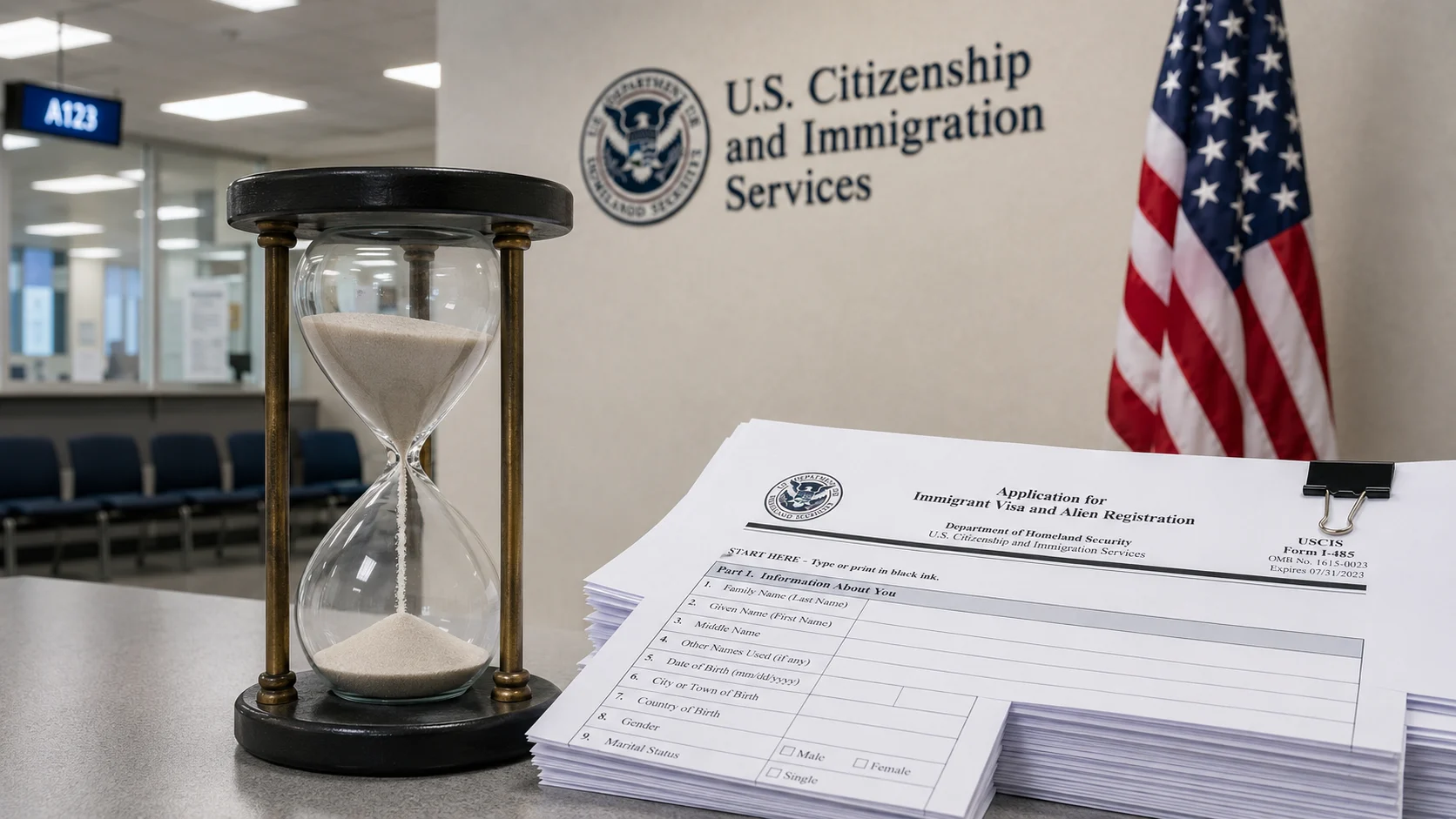
The 2026 USCIS backlog - scale of the crisis
USCIS ended FY 2025 with 11.6 million pending cases - a 23 percent increase over the FY 2024 close. Within that number, 6.28 million cases are classified as backlogged, meaning they have been pending longer than the agency's own published processing-time goal. The frontlog of unopened mail tripled from 60,000 to 250,000 cases between FY 2024 and FY 2025.
- Pending cases at end of FY 2025: 11.6 million.
- Backlogged cases within agency control: 6.28 million.
- Frontlog of unopened cases: roughly 250,000, up from 60,000 the year before.
- Q4 FY 2025 case completions: 2.5 million, 22 percent fewer than Q4 FY 2024.
- Net backlog growth in Q4 alone: more than 800,000 cases.
The headline number is simple. The system is processing fewer cases while receiving more. The backlog is growing, not shrinking, and that trend has now held for four consecutive quarters.
I-485 - Adjustment of Status processing times
Form I-485 is the application by which a person already inside the United States adjusts their status to lawful permanent resident. There is no Premium Processing for I-485 - applicants cannot pay for a faster decision.
| Category | Median time | Range | Premium? |
|---|---|---|---|
| Family-based (immediate relative) | 8-12 months | 6-18 | No |
| Family-based (F2A/F2B) | 12-24 months | 10-36 | No |
| Employment-based (EB-1) | 8-14 months | 6-20 | No |
| Employment-based (EB-2) | 10-16 months | 8-24 | No |
| Employment-based (EB-3) | 12-18 months | 10-30 | No |
| Asylum-based | 24+ months | 18-48 | No |
By service center the picture varies widely:
| Service center | Family-based | Employment-based | Notes |
|---|---|---|---|
| National Benefits Center (NBC) | 10 months | 12 months | Largest volume |
| Texas Service Center | 14 months | 16 months | Slowest |
| Nebraska Service Center | 8 months | 10 months | Fastest |
After May 22, 2026, USCIS treats adjustment of status as 'extraordinary relief' under a new policy memo. Many applicants may be redirected to consular processing abroad. The detail is in our end of adjustment of status guide, and the partial H-1B walk-back is covered in our USCIS H-1B clarification.
I-765 - EAD work permit processing times
Form I-765 is the application for an Employment Authorization Document. As of June 2025 there were 1.8 million EADs pending - the highest backlog in three years. Most categories now process in 2 to 5 months, with significant variation by eligibility code.
| EAD category | Code | Processing time |
|---|---|---|
| Adjustment of Status | (c)(9) | 2-4 months |
| H-4 Dependent | (c)(26) | 3-5 months |
| L-2 Dependent | (a)(18) | 2-4 months |
| OPT (F-1 Student) | (c)(3)(B) | 1-3 months |
| STEM OPT Extension | (c)(3)(C) | 2-4 months |
| Asylum Pending | (c)(8) | 5-12 months |
If an EAD expires while the renewal is pending, the 180-day automatic extension keeps you working - but only if you filed the renewal before the expiration date. If you did not, you cannot work until the new EAD arrives. File renewals at least six months before expiration to protect against agency delay.
I-140 - Immigrant Worker Petition processing times
Form I-140 is the employer-filed or self-filed immigrant petition that establishes eligibility for an employment-based green card. Premium Processing is available across all categories.
| Category | Regular | Premium |
|---|---|---|
| EB-1A Extraordinary Ability | 8-16 months | 15 business days ($2,965) |
| EB-1B Outstanding Researcher | 8-16 months | 15 business days |
| EB-1C Multinational Manager | 8-16 months | 15 business days |
| EB-2 with PERM | 6-12 months | 45 business days |
| EB-2 NIW | 12-24 months | 45 business days ($2,965) |
| EB-3 Skilled Worker | 6-12 months | 45 business days |
For the underlying eligibility standards see our EB-2 NIW guide and our EB-1A extraordinary ability guide. For per-country backlog detail see the green card backlog report.
I-130 - Family Petition processing times
Form I-130 is the family-based immigrant petition filed by US citizens and lawful permanent residents for qualifying relatives. Immediate-relative petitions filed by US citizens process in approximately 10 to 14 months. Preference-category petitions run 12 to 24 months or longer, with significant variation by relationship type.
Family-based petitions account for roughly 53 percent of all green cards issued each year. The May 2026 adjustment-of-status policy change hits this category hardest, since most I-130 beneficiaries inside the US planned to adjust rather than consular-process.
PERM Labor Certification - DOL processing times
PERM is the labor certification step required for most EB-2 and EB-3 green cards. It is processed by the Department of Labor, not USCIS, and runs on its own backlog. As of mid-2026 the average PERM decision takes approximately 501 days, an improvement from the 512-day peak in February 2026.
PERM is the step that EB-2 NIW and EB-1A petitioners skip entirely. For most other EB-2 and EB-3 applicants, the 501-day PERM wait sits on top of the I-140 and I-485 timelines, adding more than a year to the H-1B-to-green-card pipeline.
I-129 - H-1B and L-1 petition processing times
| Petition type | Regular | Premium |
|---|---|---|
| H-1B initial / extension | 3-6 months | 15 business days ($2,805) |
| L-1 intracompany transferee | 4-8 months | 15 business days |
| O-1 extraordinary ability | 2-4 months | 15 business days |
| TN (NAFTA / USMCA) | 2-3 months | 15 business days |
How to check your case status
- Go to egov.uscis.gov/casestatus.
- Enter your 13-character receipt number, which starts with three letters (EAC, IOE, LIN, MSC, NBC, SRC, WAC, YSC).
- View the current status message and the date the status last changed.
The most common status messages mean the following:
- Case Was Received - USCIS has logged your filing into the case management system.
- Case Is Being Actively Reviewed - your case has been assigned to an adjudicator.
- Request for Evidence Was Sent - USCIS needs more documents; respond within the deadline.
- Case Was Approved - the petition has been approved.
- Case Was Denied - the petition has been denied; appeal options may apply.
- Card Is Being Produced - your green card or EAD is being printed.
- Card Was Mailed to Me - the physical card is in the mail.
What to do if your case is delayed
- Check the official processing times on egov.uscis.gov/processingtimes for your form, category, and service center.
- If your case is outside normal processing time, submit a free e-Request through the USCIS website.
- Call the USCIS Contact Center at 1-800-375-5283 to request a service inquiry.
- Request a Congressional inquiry through your US Senator or Representative - surprisingly effective for stuck cases.
- File a complaint with the USCIS Ombudsman at the Department of Homeland Security.
- As a last resort, consider a mandamus lawsuit in federal district court; attorney fees typically run $3,000 to $8,000.
Do not file a mandamus lawsuit as your first step. Try the free options first. Congressional inquiries are surprisingly effective at unsticking cases that have been pending for months past the published processing time.
Sık sorulan sorular
What is the current USCIS backlog in 2026?
USCIS ended FY 2025 with 11.6 million pending cases - a 23 percent increase over FY 2024. Within that figure, approximately 6.28 million cases are classified as backlogged. The frontlog of unopened cases reached approximately 250,000.
How long does I-485 take in 2026?
Employment-based I-485 applications run approximately 8 to 16 months. Family-based applications run 8 to 24 months depending on the relationship category. Processing varies materially by service center, with Nebraska currently the fastest and Texas the slowest among major centers.
Can I get Premium Processing for I-485?
No. There is no Premium Processing for I-485. Applicants cannot pay for faster adjudication. The only available speedups are e-Requests, USCIS Contact Center service inquiries, Congressional inquiries, Ombudsman complaints, and as a last resort, mandamus lawsuits in federal district court.
How long is EAD processing in 2026?
Most EAD categories process in 2 to 5 months in 2026. Asylum-based EADs run longer, typically 5 to 12 months. If you file a renewal before your current EAD expires, a 180-day automatic extension keeps you working while the renewal is pending.
How long is I-140 Premium Processing?
Premium Processing returns an I-140 decision in 15 business days for EB-1 categories and in 45 business days for EB-2 (including NIW) and EB-3. The Premium Processing fee is $2,965 across all I-140 categories.
What is the current PERM processing time?
The Department of Labor is processing PERM applications in approximately 501 days as of mid-2026, down from the 512-day peak in February 2026. PERM is not a USCIS step - it is a Department of Labor labor certification that precedes most EB-2 and EB-3 I-140 filings.
Can I sue USCIS for a delayed case?
Yes - a mandamus action in federal district court is the last-resort tool to compel USCIS to act on a case pending unreasonably long past the published processing time. Attorney fees typically run $3,000 to $8,000. Try free options first: e-Requests, Congressional inquiries, and Ombudsman complaints.
Why is USCIS so slow in 2026?
Three reinforcing factors. Filings have continued to rise, especially in family-based and EAD categories. Case completions fell 22 percent in Q4 FY 2025 compared with the same quarter the year before. Policy changes, including the May 22 adjustment-of-status memo, have added new complexity to many adjudications.
How do I check my USCIS case status?
Go to egov.uscis.gov/casestatus and enter your 13-character receipt number. The receipt number starts with a three-letter service center prefix - EAC, IOE, LIN, MSC, NBC, SRC, WAC, or YSC - followed by 10 digits.
Should I file Premium Processing in 2026?
For I-140 and I-129 petitions, Premium Processing is almost always worth the $2,965 (or $2,805) fee in 2026, given the gap between premium and regular timelines. For NIW filers specifically, with approval rates near one in three, knowing the answer in 45 business days rather than 12 to 24 months is strategically valuable.
İlgili makaleler
Ücretsiz araçlarımızı kullanın
Kanada CRS, Avustralya puanları, İngiltere skilled worker, Almanya Fırsat Kartı ve 34 ülke maaş eşikleri için ücretsiz hesaplayıcılar.
Tüm araçları gör