
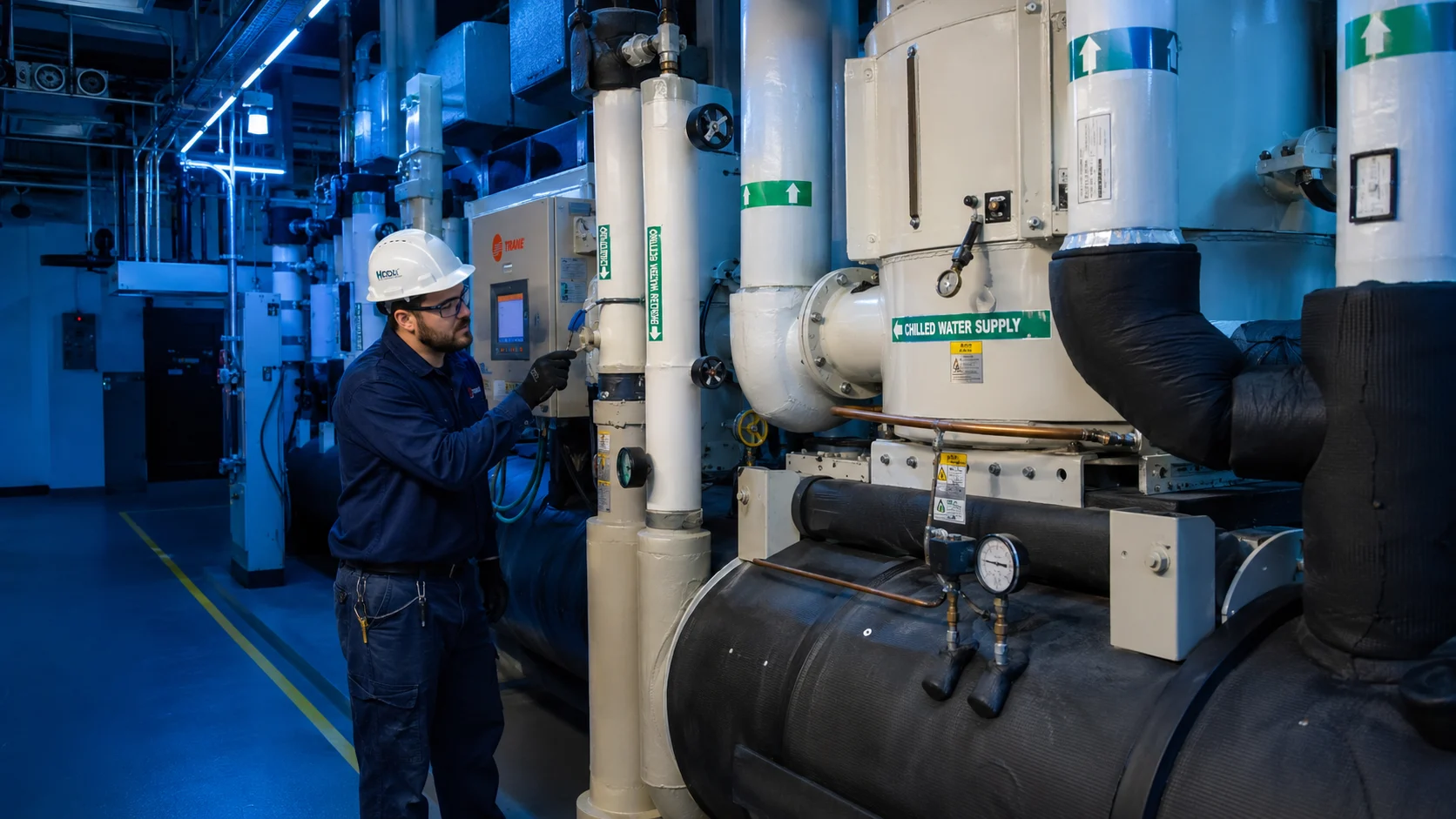
Why data center cooling is mission-critical
A single hyperscale data center can draw 50 to 100 megawatts of power and generate heat equivalent to hundreds of thousands of residential HVAC systems running simultaneously. That heat is not an inconvenience - it is an existential threat to the hardware inside. When a CRAC (computer room air conditioning) unit fails or a chilled-water loop loses pressure, server inlet temperatures can spike above safe thresholds within minutes, triggering automatic shutdown and costing operators thousands of dollars per minute in lost compute revenue. For a company like Meta or Google running inference workloads at scale, downtime during a major product launch can translate to tens of millions of dollars in losses.
Traditional data center cooling relies on a layered architecture. CRAC and CRAH (computer room air handler) units circulate cold air through raised floors or overhead ducts. Hot/cold aisle containment systems use physical barriers to separate cooled intake air from hot exhaust air, dramatically improving efficiency. Chilled water plants - often running dozens of large tonnage chillers - provide the thermal mass to handle peak loads. The metric that ties it all together is PUE, or Power Usage Effectiveness: a PUE of 1.0 would mean all power goes to computing; every tenth of a point above 1.0 represents cooling and electrical overhead. Top-tier facilities now target PUEs below 1.2, which demands near-perfect mechanical plant operation.
AI workloads have fundamentally changed the heat density problem. A rack of NVIDIA H100 or Blackwell GPUs can draw 60 to 80 kilowatts - compared to 5 to 10 kilowatts for a standard server rack. That density overwhelms conventional air cooling. The industry is rapidly shifting toward direct-to-chip liquid cooling, where coolant flows through cold plates bolted directly to processor packages, and immersion cooling, where entire servers are submerged in dielectric fluid. Both technologies require HVAC technicians who understand not just air systems but also heat exchangers, manifold distribution units, leak detection, and coolant chemistry. This skills gap is driving aggressive hiring and premium wages for technicians who have hands-on liquid cooling experience. You can read more about the broader hiring wave in the AI infrastructure jobs hub.
- CRAC/CRAH units: precision air conditioning systems sized for 24/7 operation, variable speed fans, and remote monitoring integration.
- Chilled water systems: central plant chillers, cooling towers, condenser water loops, and the chemical treatment programs that keep them from scaling or corroding.
- Hot/cold aisle containment: physical or virtual barriers, blanking panels, and airflow management that can cut cooling energy by 20 to 40 percent.
- PUE monitoring: sensor networks, BMS (building management system) integration, and the mechanical tuning required to hit aggressive efficiency targets.
- Direct-to-chip liquid cooling: cold plate installation, manifold routing, leak detection system commissioning, and coolant loop maintenance.
- Immersion cooling: tank installation, fluid management, server removal procedures, and the specialized safety protocols for working with dielectric fluids.
The US data center construction pipeline is enormous. According to industry trackers, over 40 gigawatts of new data center capacity is planned or under construction in the United States through 2028, with the largest clusters in Northern Virginia, Central Texas, Phoenix, Columbus Ohio, and suburban Atlanta. Every one of those facilities will need qualified HVAC technicians not just to commission the cooling plant but to maintain it for decades. The structural shortage of experienced technicians - particularly those familiar with high-density and liquid cooling - is one reason employers are increasingly willing to sponsor immigration for the right candidates.
Visa pathways for HVAC technicians
International HVAC technicians have two realistic visa pathways into the United States: the EB-3 Skilled Worker green card for permanent employment and the H-2B temporary nonimmigrant visa for seasonal or peak-load project work. A third route exists in theory - the TN visa for Canadian and Mexican nationals under the USMCA agreement - but HVAC technicians rarely qualify because TN requires a specific listed profession and HVAC is not on the approved list. Understanding why the H-1B is not an option is important before you begin your job search, because scammers and uninformed recruiters sometimes claim otherwise.
| Visa | Type | Duration | Degree required? | Employer sponsor? | Path to green card? |
|---|---|---|---|---|---|
| EB-3 Skilled Worker | Immigrant (green card) | Permanent | No | Yes - full PERM process | Yes - IS the green card |
| H-2B | Temporary nonimmigrant | Up to 3 years | No | Yes - DOL certification | No - must convert or re-enter |
| H-1B | Temporary nonimmigrant | 3 to 6 years | Yes - bachelor's degree | Yes | Yes - via I-140 |
| TN (Canada/Mexico) | Nonimmigrant | 3 years renewable | Depends on profession | Job offer required | No direct path |
For most international HVAC technicians, EB-3 is the goal. It offers permanent residence, the right to change employers after porting, and eventually a path to US citizenship. The H-2B visa can be a foot in the door - getting initial US work experience and employer relationships - but it has annual numerical caps and does not automatically convert to a green card. Some employers use H-2B for project-based commissioning work (standing up cooling systems in a new facility) and then file EB-3 for technicians they want to retain permanently. The EB-3 skilled trades guide covers the full timeline and requirements across all trade categories.
The H-2B route is worth understanding even if EB-3 is your ultimate goal. H-2B requires the employer to demonstrate that the need is temporary or seasonal - data center commissioning projects, emergency cooling plant upgrades, or peak construction phases can qualify. The employer must also attest to a temporary need and obtain Department of Labor certification. Annual H-2B caps (66,000 per fiscal year, with supplemental allocations in recent years) mean there is real competition for slots, and the process works on an April-October seasonal cycle that does not always align with data center construction timelines. Still, for technicians who want to get US experience before committing to the longer EB-3 process, H-2B is a legitimate option. The H-2B visa for skilled trades article has a detailed breakdown of the application process.
The EB-3 green card path
The EB-3 Skilled Worker category is the primary immigration route for HVAC technicians seeking permanent residence in the United States. Unlike the EB-1 and EB-2 categories, which require extraordinary ability or advanced degrees, EB-3 Skilled Worker simply requires that the job offer be for a permanent full-time position that requires at least two years of training or experience, and that no qualified US workers are available. The two-year threshold is easily met by any journeyman-level HVAC technician with a verifiable work history. No US bachelor's degree is required. The trade-off is time: the full EB-3 process from first contact with an employer to green card in hand typically takes 2.5 to 5 years depending on nationality, visa bulletin backlog, and how efficiently the employer manages the PERM process.
The PERM (Program Electronic Review Management) labor certification is the foundation of every EB-3 Skilled Worker petition. PERM is filed by the employer with the Department of Labor and serves to prove that the company conducted a genuine recruitment effort, found no qualified and willing US workers for the specific role, and is offering at least the prevailing wage as determined by the DOL for the relevant occupation and geographic area. The prevailing wage survey matters to HVAC technicians because it determines the minimum the employer must pay - and for data center environments with liquid cooling skills, the prevailing wage for an HVAC mechanic in Northern Virginia or Phoenix is typically $30 to $45 per hour. The PERM process itself takes 8 to 14 months under normal conditions, and employers must retain detailed recruitment records for five years.
- Step 1 - Prevailing wage determination: employer submits a PWD request to the DOL National Prevailing Wage Center; currently taking 3 to 6 months.
- Step 2 - Recruitment: employer runs mandatory job ads (Sunday newspaper, job boards, in-house posting) for a specific period and documents all applicants considered.
- Step 3 - PERM filing: employer submits ETA Form 9089 to DOL; processing is 8 to 14 months for standard cases, longer if selected for audit.
- Step 4 - I-140 petition: once PERM is certified, employer files I-140 (Immigrant Petition for Alien Workers) with USCIS, which takes 6 to 8 months standard or as few as 15 days with premium processing.
- Step 5 - Priority date and backlog: the I-140 approval date becomes the priority date; workers from oversubscribed countries (India, China) may wait years in the backlog; workers from most other countries can often proceed quickly.
- Step 6 - Consular processing or adjustment of status: once a visa number is available, the worker either applies at a US consulate abroad (DS-260) or files I-485 to adjust status if already in the US on a valid nonimmigrant visa.
Backlog is the single biggest variable in EB-3 timelines. Workers born in most countries - including the Philippines, Nigeria, Mexico (for the most part), and the vast majority of African and Middle Eastern countries - face relatively modest waits because their birth countries are not oversubscribed. Filipino nationals in particular have seen wait times for the EB-3 category extend to 2 to 3 years as demand from that country has risen, but the situation remains far better than for Indian-born workers, who may wait a decade or more. Before investing time in the EB-3 process, check the current Department of State Visa Bulletin to understand approximately where your priority date would land. An important practical note: once an I-140 has been approved and the priority date is more than 180 days old, the worker gains some protection under AC21 portability, which allows them to change employers to a similar role without losing their place in line.
One nuance that surprises many candidates is the prevailing wage distinction between Level I and Level II workers. DOL wage surveys define Level I as entry-level and Level II as qualified technicians. Employers sponsoring an experienced data center HVAC tech will almost always be required to use Level II wages in the PERM, which at the moment run $75,000 to $95,000 per year for HVAC mechanics in high-cost data center markets. This is actually a benefit for the worker - it prevents employers from using immigration sponsorship as a way to underpay - but it means employers must be genuinely committed to the hire and willing to budget accordingly. The data center electrician visa guide covers a parallel EB-3 process for a comparable trade role and is worth reading alongside this article for context.
Certification and licensing
The EPA Section 608 certification is the single non-negotiable credential for any HVAC technician working in the United States. Federal law requires it for anyone who purchases or handles refrigerants used in stationary appliances. For data center cooling systems - which predominantly use refrigerant-based direct expansion units, chilled water systems with refrigerant chillers, and in some cases economizer-enhanced DX systems - technicians must hold the Universal certification level, which covers all equipment types. The exam is administered by EPA-approved organizations including ESCO Group, ICE (the International Code Council), and NATE. The Universal exam is not trivial: it covers core knowledge, high-pressure refrigerants (R-410A, R-448A, R-32), and low-pressure refrigerants (R-134a, R-1234ze). Budget two to four weeks of study time.
Beyond EPA 608, NATE (North American Technician Excellence) certification is the most widely recognized voluntary credential in the US HVAC industry and is explicitly preferred by many data center mechanical contractors. The NATE Commercial Refrigeration and NATE Air Distribution exams are the most relevant for data center work. NATE certification signals to employers that a technician has been tested against a standardized national benchmark, which matters when hiring from overseas because it provides a credential that translates across regional licensing differences. NATE exams require passing both a core knowledge test and a specialty test; technicians with strong backgrounds typically pass on the first attempt after a targeted review.
- EPA 608 Universal: required by federal law to handle refrigerants; covers all equipment types; must hold before starting work.
- NATE certification: voluntary but highly preferred; Commercial Refrigeration and Air Distribution exams most relevant to data centers.
- State HVAC/mechanical license: most US states require a state-issued license to work as a journeyman or master HVAC technician; requirements vary (typically 4 to 5 years experience plus exam); employers usually sponsor license exam prep for sponsored workers.
- OSHA 30 (Construction or General Industry): the 30-hour safety certification is required on most commercial and industrial job sites; takes two to four days to complete.
- Manufacturer certifications: Liebert (Vertiv), Schneider Electric, Stulz, and Airedale all offer product-specific training for their precision cooling systems; these are paid training programs often covered by the employer.
- Liquid cooling specialist training: programs from Asetek, Iceotope, GRC, and LiquidCool Solutions cover direct-to-chip and immersion systems; currently the rarest and most valuable credential in data center HVAC.
- BICSI DCDC (Data Center Design Consultant): optional but differentiating credential that covers data center infrastructure including cooling architecture; useful for technicians interested in senior or supervisory roles.
State licensing is one area that catches international applicants off guard. Unlike EPA 608, which is a federal credential, HVAC contractor and journeyman licenses are issued by individual states. Virginia, Texas, Arizona, and Georgia all have different experience documentation requirements, different exams, and different rules about whether foreign experience counts toward the qualification hours. The practical implication is that when an employer sponsors you under EB-3, they will typically start you on a path toward the relevant state license, and your EPA 608 and NATE credentials serve as the bridge during the interim period. Some states issue a provisional or reciprocal license if you hold a valid license from another state, but that requires first getting licensed somewhere. Most major mechanical contractors who regularly sponsor international workers have an established process for walking new hires through state licensing in their home state.
Liquid cooling - the AI skills premium
The transition from air cooling to liquid cooling in high-density AI compute clusters is not a gradual evolution - it is a structural shift happening over a three-to-five year window. Companies including Meta, Microsoft, Google, and Amazon have all publicly committed to deploying direct-to-chip liquid cooling across new GPU clusters. Oracle is building AI infrastructure campuses that are liquid-cooled from the ground up. The hardware vendors are leading the same direction: NVIDIA's next-generation server platforms are designed with liquid cooling as the default, not an option. For HVAC technicians, this shift creates a genuine skills premium for anyone who can demonstrate hands-on experience with these systems.
Direct-to-chip (D2C) liquid cooling involves routing chilled water or a secondary coolant loop through cold plates that are mounted directly on CPUs, GPUs, and other high-heat-density components. The HVAC technician's role in D2C systems involves maintaining the facility-side cooling distribution unit (CDU), managing supply and return water temperatures, performing leak detection on manifold systems, and commissioning new rack deployments. The margin for error is low: a slow leak in a D2C manifold can destroy several hundred thousand dollars of GPU hardware before it is detected by automated sensors. Technicians who can demonstrate they understand leak detection protocols, have worked with quick-disconnect fittings, and know how to pressure-test manifold circuits are in extremely high demand.
Immersion cooling is the more specialized end of the spectrum. Single-phase immersion cooling (used by companies like GRC and LiquidCool Solutions) submerges servers in engineered dielectric fluids that are non-conductive and non-flammable. Two-phase immersion cooling (used by Iceotope and others) uses fluids that boil at low temperatures to carry heat away via phase change. Both systems require HVAC technicians who understand fluid management, vapor recovery (in two-phase systems), heat exchanger maintenance, and the highly specific safety procedures for working inside immersion tanks while avoiding fluid spills and contamination. Technicians who already have experience with industrial process cooling, chilled water systems, or secondary refrigerant loops have the closest transferable skills. The upskilling path for an experienced HVAC tech typically involves manufacturer training (two to five days on-site or at a training center) plus supervised commissioning experience.
For international technicians who want to maximize their attractiveness to sponsoring employers before arriving in the US, the most valuable investment is any hands-on liquid cooling exposure available in their home country. Data center hyperscalers and colocation providers in Singapore, the UAE, South Africa, and the Philippines are all deploying high-density liquid-cooled infrastructure, often using the same equipment brands (Vertiv, Schneider, Rittal, CoolIT) as US operators. Certifications or verifiable project experience from those deployments - even a single major liquid cooling commissioning project - can move a candidate from a standard EB-3 applicant to a priority hire, and may also qualify them for a higher prevailing wage level, which protects their long-term earnings.
Salary and best regions
Data center HVAC technician salaries vary significantly by region, driven by the density of data center construction, prevailing labor market conditions, and whether the local market has a shortage of qualified mechanical technicians. The BLS Occupational Employment Survey (OES) classifies most data center HVAC roles under SOC code 49-9021 (HVAC Mechanics and Installers), but top-end data center technicians frequently earn wages that are well above the OES median because of the 24/7 operations requirement, critical systems experience premium, and current shortage of liquid cooling-qualified workers. The figures below reflect data center-specific market rates in mid-2026, not the broader HVAC labor market.
| Region | Key operators | Median hourly wage | Senior/liquid cooling | Annual salary range |
|---|---|---|---|---|
| Northern Virginia (Ashburn) | Amazon, Microsoft, Google, Equinix, QTS | $34 to $42/hr | $45 to $58/hr | $70K to $120K |
| Central Texas (Abilene, San Antonio, Austin) | Meta, Apple, Microsoft, Aligned | $30 to $38/hr | $42 to $55/hr | $62K to $114K |
| Phoenix, Arizona | Google, Microsoft, Switch, CyrusOne | $29 to $37/hr | $40 to $52/hr | $60K to $108K |
| Columbus, Ohio | Amazon, Google, Facebook, Expedient | $28 to $35/hr | $38 to $50/hr | $58K to $104K |
| Atlanta, Georgia | Microsoft, Google, Sungard, QTS | $28 to $36/hr | $39 to $51/hr | $58K to $106K |
| Chicago, Illinois | Microsoft, Equinix, CyrusOne, Lumen | $32 to $40/hr | $43 to $56/hr | $66K to $116K |
Northern Virginia dominates the US data center market in terms of total installed capacity - the Loudoun County corridor alone accounts for more than 20 percent of all US data center power capacity. The concentration of hyperscalers and colocation operators there creates intense competition for qualified mechanical technicians, which drives wages above $40 per hour for experienced candidates. The trade-off is cost of living: housing in the Northern Virginia suburbs of Washington DC is among the most expensive in the country, which effectively reduces real purchasing power relative to the Phoenix or Columbus markets.
Texas has emerged as the second-largest data center market in the US, with massive campuses around Abilene (where Meta has built one of the world's largest single-site data centers), San Antonio, and the Austin suburbs. Texas has no state income tax, lower housing costs than the DC metro area, and an active labor market for HVAC technicians. For EB-3 sponsored workers, the prevailing wage in Texas is generally 10 to 15 percent lower than in Northern Virginia, but the after-tax, after-housing take-home often works out similarly. Phoenix and Columbus are similar stories: lower nominal wages offset by significantly lower cost of living and strong demand driven by Google and Amazon build-outs.
Who sponsors
Direct employment by a hyperscaler (Amazon, Google, Meta, Microsoft, Oracle) is the gold standard for data center HVAC technicians, offering the highest wages, strong benefits, and a well-resourced EB-3 sponsorship process. However, these companies hire the majority of their HVAC staff through mechanical contractors and facilities management firms that operate the physical plant on long-term service contracts. This means the most common sponsor in practice is not Amazon itself but rather the mechanical contractor who holds the Amazon facilities management contract. Understanding this distinction matters because the sponsoring employer - the one who files the PERM - must be the entity that will actually employ the worker, which is typically the contractor.
- Mechanical contractors: EMCOR Group, ABM Industries, Comfort Systems USA, ACCO Brands (mechanical division), and regional contractors with data center specializations are the most active EB-3 sponsors for HVAC in this sector.
- Data center GCs and facility operators: companies like Iron Mountain, Equinix, Digital Realty, and CyrusOne sometimes hire HVAC technicians directly for their operations and maintenance staff and sponsor EB-3 for critical roles.
- Cooling system OEM service divisions: Vertiv (formerly Liebert), Schneider Electric, and Stulz all operate global service divisions that hire and sometimes sponsor technicians for long-term facility contracts.
- Staffing and workforce partners: agencies that specialize in critical facilities workforce (like Talent Orb or Critical Facilities Staffing) sometimes operate as the legal employer of record for sponsored workers on long-term data center contracts.
Finding a sponsor requires a targeted approach. Generic job boards are unlikely to surface EB-3 sponsorship opportunities directly, because most job postings do not mention visa sponsorship in the title. The most effective strategies are: (1) identify mechanical contractors with active data center maintenance contracts in your target region by searching SEC filings, press releases, and LinkedIn company pages; (2) look for contract award announcements - when a data center operator announces a new 100 megawatt campus, search for the mechanical contractor who won the MEP (mechanical, electrical, plumbing) contract; (3) connect directly with international recruitment firms that specialize in the construction and critical facilities trades, as these firms have established relationships with contractors who have used EB-3 before and understand the process. Contractors who have sponsored once almost always sponsor again - the learning curve for the PERM process is steep, and once a company has an immigration attorney relationship and a process established, they are much more likely to use it for the next qualified candidate.
How to apply - step by step
The overall process from first contact to green card in hand involves several parallel tracks: building your credentials, finding and securing the employer relationship, and then navigating the government processing queues. The steps below assume you are outside the United States and seeking an EB-3 sponsored position that will ultimately allow you to immigrate. If you are already in the US on a valid visa, some steps (specifically Step 9) change to an I-485 adjustment of status application rather than consular processing.
- Obtain EPA 608 Universal certification if you do not already hold it. This can be done through ESCO Group or NATE-approved testing centers in many countries outside the US, or by scheduling the exam during a short US visit. Without this credential, US data center employers will not consider your application.
- Document your work history with specificity. Gather employment letters, payslips, project records, and any documentation that demonstrates at least two years of experience with commercial or industrial HVAC systems. Translate all documents into English with certified translations.
- Pursue NATE certification if possible. Contact NATE directly to confirm whether testing is available in your country or region. If not, prioritize this as one of the first actions after arriving in the US on any valid visa.
- Research target employers and regions. Use the salary table in this article and your personal network to identify which regions and which mechanical contractors are most actively hiring in data center cooling. Northern Virginia, Texas, and Phoenix should be your first three targets.
- Make direct employer contact. Reach out to the HR or workforce development teams at mechanical contractors (EMCOR, ABM, Comfort Systems) with a concise cover letter that highlights your EPA 608 status, years of experience, any liquid cooling exposure, and your awareness that you will need EB-3 sponsorship. Being upfront about immigration status saves time on both sides.
- Negotiate and sign an employment agreement. Once a contractor expresses interest, confirm that the agreement is for a permanent full-time role (required for PERM eligibility) and that the company is willing to retain an immigration attorney to begin the sponsorship process.
- Monitor PERM and I-140 progress. Ask your employer's immigration attorney for regular updates on the prevailing wage determination, PERM filing date, and I-140 status. Note your priority date when the I-140 is approved - this date determines your place in the visa queue.
- Check the Visa Bulletin monthly. Once your I-140 is approved, monitor the Department of State Visa Bulletin to track when your priority date will become current. For most nationalities, this will happen within 1 to 2 years of I-140 approval.
- Complete DS-260 (consular processing). When your priority date is current and a visa number is available, the National Visa Center will contact you to submit immigrant visa forms, gather medical exam results, and schedule a consulate interview in your home country.
- Attend the consulate interview and receive your immigrant visa. Travel to the US on that visa within the stated validity period. Once you enter, you are a lawful permanent resident. Your physical green card will arrive by mail within 6 to 8 weeks.
احصل على إرشادات تأشيرة شخصية
كل حالة تأشيرة مختلفة. أخبرنا عن حالتك وسيقوم مستشارونا المعتمدون بمراجعة قضيتك خلال 24 ساعة.
الأسئلة الشائعة
Can an HVAC technician get an H-1B visa for data center work?
No. H-1B is reserved for specialty occupations that require at least a bachelor's degree in a specific academic field. HVAC mechanics and refrigeration technicians are classified as skilled trades under USCIS guidance and do not qualify as specialty occupations. Anyone offering H-1B sponsorship for an HVAC role is either misinformed or running a scam. The correct visa pathways are EB-3 Skilled Worker (for permanent immigration) and H-2B (for temporary project-based work).
Do I need a US degree to qualify for EB-3 as an HVAC technician?
No. The EB-3 Skilled Worker category does not require a college degree. It requires that the job offer be for a position that requires at least two years of training or experience, and that you meet that requirement. For data center HVAC roles, documented hands-on experience with commercial or industrial cooling systems - combined with EPA 608 certification - is typically sufficient to satisfy the qualifying criteria.
How long does the EB-3 process take for an HVAC technician?
From the employer's initial decision to sponsor through to green card issuance typically takes 2.5 to 5 years. The PERM labor certification alone takes 8 to 14 months. After that, I-140 adjudication takes another 6 to 8 months (or as few as 15 days with premium processing). The remaining time depends on your country of birth and the current visa bulletin backlog. Workers from most countries outside India and China can generally proceed to consular processing within 1 to 2 years of I-140 approval.
What is the EPA 608 certification and is it required?
EPA Section 608 is a federal certification required by US law for anyone who purchases or handles refrigerants in stationary HVAC and refrigeration systems. For data center HVAC technicians, the Universal level (which covers all refrigerant types and equipment) is required. Without it you cannot legally work on the refrigerant circuits of precision cooling equipment. The exam is administered by ESCO Group, NATE, and other EPA-approved organizations and can sometimes be taken outside the US.
Why is liquid cooling experience so valuable for data center HVAC jobs?
AI GPU clusters generate heat densities (up to 80 kilowatts per rack) that conventional air cooling cannot handle. The industry is rapidly adopting direct-to-chip and immersion cooling, but very few technicians have hands-on experience with these systems. That scarcity creates a strong wage premium - typically 20 to 30 percent above standard HVAC rates - and makes technicians with liquid cooling skills significantly more attractive to employers who are actively deploying these systems. It also strengthens an EB-3 sponsorship case because the employer can more easily demonstrate that no qualified US workers are available with that specific skill set.
Which US states have the most data center HVAC job openings?
Virginia (particularly Loudoun County in the Northern Virginia corridor) has the highest concentration of data center HVAC jobs in the country. Texas (Abilene, San Antonio, Austin metro) is the fastest-growing market. Arizona (Phoenix metro), Ohio (Columbus area), Georgia (Atlanta suburbs), and Illinois (Chicago suburbs) also have significant and growing demand. All of these markets have active mechanical contractors who hold long-term data center maintenance contracts and periodically sponsor EB-3 workers.
Can I switch employers after getting my EB-3 green card?
Yes. Once you receive your green card (lawful permanent resident status), you are free to work for any employer in the United States in any job - you no longer need employer sponsorship. Even before the green card is issued, if your I-140 has been approved for more than 180 days and your I-485 adjustment of status is pending, you may be able to change to a similar occupation under AC21 portability without losing your priority date. Consult an immigration attorney before making any job changes during pending adjustment.
Does the H-2B visa lead to a green card?
Not directly. H-2B is a temporary nonimmigrant visa and does not have a built-in path to permanent residence. However, some workers use H-2B to gain US work experience and build relationships with employers, and then find an employer willing to sponsor them for EB-3 after the H-2B period. The key challenge is that you must leave the US when H-2B status ends unless you have changed to another status. Workers who are serious about permanent immigration should prioritize finding an EB-3 sponsor from the start rather than relying on H-2B as a stepping stone.
مقالات ذات صلة
استخدم أدواتنا المجانية
حاسبات مجانية لكندا CRS وأستراليا والمملكة المتحدة وألمانيا وحدود رواتب 34 دولة.
جميع الأدوات