
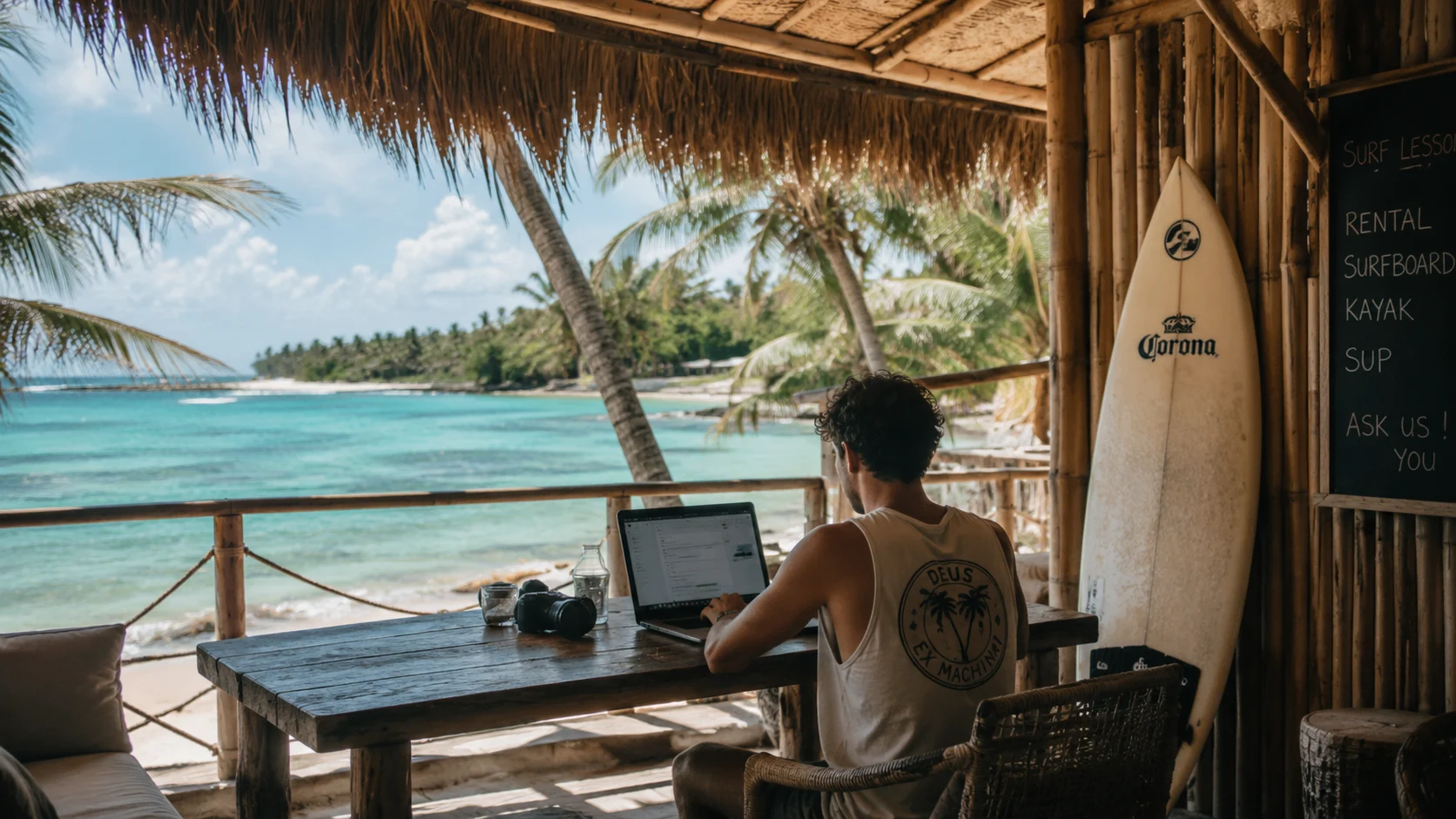
What is the Philippines digital nomad visa?
The Philippines digital nomad visa launched on 24 June 2025 under Executive Order No. 64, signed by President Ferdinand Marcos Jr. It is administered by the Bureau of Immigration (BI) and the Department of Foreign Affairs (DFA), with applications accepted at Philippine embassies and consulates abroad and at BI offices inside the Philippines. The visa lets non-Filipino citizens live in the Philippines for one year, renewable for a second year, while working remotely for a foreign employer or for foreign clients as a self-employed person.
If you are a Filipino national thinking about onshore tax or moving home from overseas, see the Philippines nationality hub for Filipino-passport-specific guidance. The nomad visa is for non-Filipinos only, and reciprocity applies: the visa is open to nationals of countries that offer a similar visa category to Filipino citizens (the DFA publishes the official list, and it includes most major Western and Asian economies as of early 2026).
The Philippines is an archipelago of 7,641 islands with a population of roughly 117 million, making it the second-largest English-speaking country in Asia after India. English and Filipino are both official languages, with English the working language of business, government, and higher education. Currency is the Philippine peso (PHP) at roughly 56 PHP per USD in 2026. Internet speeds in major cities have improved significantly since 2020, reaching 70 to 250 Mbps fiber in Manila, Cebu, and Davao, with Starlink available islands-wide for remote-island stays.
Requirements and income threshold
The Philippines sets the income threshold at EUR 20,000 per year (roughly USD 21,000, or about EUR 1,670 / USD 1,750 per month). That is significantly lower than Indonesia's E33G (USD 60,000/yr) and Bali's second-home visa (USD 130,000 deposit), and undercuts most European nomad visas. Income must come from foreign employment, foreign clients, or a foreign-registered business.
| Requirement | Details |
|---|---|
| Income | EUR 20,000/year minimum (~USD 21,000, ~EUR 1,670/mo). Must come from foreign employer, foreign clients, or foreign business. |
| Savings alternative | Bank statements showing equivalent liquid savings of at least USD 21,000 covering 12 months are typically accepted in lieu of monthly pay slips. |
| Health insurance | Private health insurance covering the Philippines for the full visa duration, minimum USD 35,000 coverage. International policies accepted. |
| Criminal background | Police clearance certificate (NBI equivalent) from country of citizenship, less than 6 months old, apostilled or authenticated. |
| Proof of remote work | Foreign employment contract, foreign client contracts, or foreign business registration documents. Cannot work for Philippine employers or invoice Philippine clients. |
| Other | Passport valid 6+ months beyond visa expiry, biometric photos, reciprocity (your country offers similar visa to Filipinos), application form, fees. |
The reciprocity requirement is the unusual element: the Philippines only issues the nomad visa to nationals of countries whose laws permit a similar long-stay remote-work visa for Filipino citizens. The DFA maintains a published list, and as of early 2026 most major Western economies (US, UK, Canada, Germany, France, Australia, New Zealand) and several Asian economies (Japan, South Korea, Singapore) are included. Check the BI and DFA websites for the current list before applying.
Tax treatment
The Philippines uses a territorial taxation system for non-Filipino tax residents: foreign-source income is generally not taxed in the Philippines for non-residents and for resident aliens engaged exclusively in foreign-source work. Specifically, resident aliens (foreigners living in the Philippines for more than 180 days) are taxed only on Philippine-source income, not worldwide income, which is a major structural advantage versus most European nomad visas. For nomad visa holders working exclusively for foreign employers and foreign clients, this typically means zero Philippine income tax on that foreign-source income.
Philippine-source income (anything earned from a Philippine employer or Philippine client) is taxed at a progressive personal income tax rate from 0 percent (under PHP 250,000/yr) to 35 percent (over PHP 8 million/yr). By the nomad visa's design you cannot earn Philippine-source income on this permit, so this rate is mostly academic. The Philippines has double-tax treaties with 40+ countries including the US, UK, Canada, Germany, France, Australia, Japan, and most of Europe, which provides additional protection where residency rules overlap.
How to apply - step by step
Philippines nomad visa applications can be filed at Philippine embassies or consulates abroad before travelling, or in person at Bureau of Immigration (BI) offices inside the Philippines after entering on a standard tourist visa-free entry (most nationalities get 30 days visa-free, extendable up to 36 months in increments). Processing typically takes 30 to 60 days.
- Confirm eligibility: non-Filipino passport from a reciprocity-list country, foreign income source, annual income at or above EUR 20,000 (~USD 21,000).
- Gather documents: passport, employment or client contracts, last 6 months pay slips or bank statements proving income, police clearance certificate (apostilled), private health insurance covering the Philippines.
- Secure Philippine accommodation: a 6 to 12 month rental contract, condo purchase deed, or notarised host invitation. Short-term Airbnb is generally not accepted as proof for the visa.
- Either apply at a Philippine embassy or consulate abroad before travelling, OR enter the Philippines visa-free as a tourist (30 days, most nationalities) and apply at the Bureau of Immigration main office in Manila.
- Submit application form, supporting documents, biometric photos, and pay the visa fees (BI fees plus DFA fees plus optional courier).
- Attend biometric capture (fingerprints, photo) at the BI office or consulate.
- Wait 30 to 60 days for the decision. Approved applicants receive a 1-year Digital Nomad Visa sticker in their passport and an ACR I-Card (Alien Certificate of Registration).
- Within 60 days of arrival or visa issuance, complete BI annual reporting at any BI office.
- Apply for renewal 30 to 60 days before expiry for the second year (total 2 years maximum on the nomad visa).
Cost breakdown
| Item | Cost |
|---|---|
| Digital Nomad Visa application fee | USD 200 - USD 400 |
| ACR I-Card (Alien Certificate of Registration) | USD 100 |
| BI annual reporting fee | USD 6 |
| Apostilled criminal background check | USD 30 - USD 150 |
| Health insurance (12 months, international) | USD 600 - USD 1,800 |
| Accommodation deposit (1-2 months rent) | USD 400 - USD 1,500 |
| Optional immigration lawyer | USD 500 - USD 2,500 |
| Total first-year minimum | ~USD 1,500 (DIY) to USD 6,000 (with lawyer) |
Cost of living
| Item | Manila (Makati/BGC) | Cebu |
|---|---|---|
| Rent 1br city centre | USD 700 | USD 450 |
| Food (groceries + eating out) | USD 400 | USD 300 |
| Local transport monthly | USD 80 | USD 50 |
| Coworking hot desk | USD 150 | USD 100 |
| Utilities + internet | USD 130 | USD 110 |
| Total per month (single) | ~USD 1,460 | ~USD 1,010 |
Manila's Makati and BGC neighbourhoods are the most expensive parts of the country, with modern condos, international restaurants, and full Western amenities. Cebu is 30 to 40 percent cheaper for a comparable lifestyle. Siargao, Bohol, and Dumaguete are even more affordable: a full nomad lifestyle can run USD 800 to USD 1,200 per month, including beachfront accommodation, eating out daily, and coworking. Domestic flights between major cities run USD 30 to USD 80 one-way on Cebu Pacific or Philippine Airlines.
Family and dependents
The Philippines nomad visa allows family reunification for spouses, registered partners, and dependent children under 18 (and unmarried dependent children up to 21 in full-time education). Each dependent applies for a derivative residence permit valid for the same period as the main applicant, with a separate application fee. The main applicant's income threshold typically rises by 25 to 50 percent for a spouse and 15 to 25 percent per dependent child, so a couple with one child should budget for income around USD 30,000 per year.
Dependents cannot work in the Philippines on the dependent permit but children can attend Philippine schools. Manila and Cebu have excellent international schools including International School Manila (American), British School Manila, Brent International, and Cebu International School, charging USD 8,000 to USD 25,000 per year. Public schools are free but generally Tagalog-language outside the international curriculum tracks. Private family health insurance through Maxicare, Medicard, or international providers runs roughly USD 80 to USD 250 per month.
Path to residency
The Philippines nomad visa itself is capped at 1 year plus 1 renewal (total 2 years) and does not directly lead to permanent residency. After 2 years on the nomad visa, holders who wish to remain longer must convert to a different visa category. Common pivots include the SRRV (Special Resident Retiree's Visa, available from age 35 with a USD 10,000 to USD 50,000 deposit) which grants indefinite residency, a 13(a) marriage visa if married to a Filipino citizen, or a 9(g) work visa with a Philippine employer.
Philippine citizenship by naturalisation generally requires 10 years of continuous legal residence (reduced to 5 years for certain categories), proof of integration, basic Filipino or English language proficiency, and renunciation of prior citizenship in most cases. The Philippines has relatively friendly long-term residency through SRRV and Quota Visas for those who want to stay indefinitely without pursuing citizenship. Compare to Thailand's LTR for the regional benchmark on long-term Asia residence.
Best cities for digital nomads
Manila (specifically Makati and Bonifacio Global City, or BGC) is the country's commercial capital and the most plugged-in nomad base. BGC is purpose-built modern, with 5G everywhere, glass-tower condos, and coworking spaces including Acceler8, Clock In, and KMC Solutions. The Makati CBD is older but more central. Cebu City is the country's second hub, much more relaxed, with a fast-growing IT Park neighbourhood, easy beach access to Mactan and nearby islands, and coworking including iiOffice and Cebu Coworking Space.
Siargao is the surf and nomad mecca, with a growing community in General Luna around the Cloud 9 surf break. Internet is reasonable in town (40 to 80 Mbps fiber) and Starlink fills any gaps. Dumaguete is a university town in the Visayas, very affordable (USD 700 per month comfortable), with a thriving expat community and easy ferry access to Apo Island and Siquijor. Palawan's El Nido and Coron offer extraordinary scenery and slower internet, suited for shorter stints rather than primary base. Davao on Mindanao is large, well-connected, and significantly cheaper than Manila, with a serious tech and BPO sector.
Pros and cons
- ✅ English is an official language - massive advantage over Thailand, Indonesia, Vietnam
- ✅ Income threshold EUR 20,000/yr is less than half of Bali's equivalent
- ✅ Territorial taxation - foreign-source income generally not taxed for nomad visa holders
- ✅ 7,641 islands - surfing, diving, beaches at world-class level
- ✅ Low cost of living (USD 800-1,500 comfortable outside Manila)
- ✅ Excellent international schools and healthcare in Manila and Cebu
- ✅ Strong fibre internet in major cities (70-250 Mbps); Starlink for remote islands
- ❌ Maximum 2 years on the nomad visa - then must pivot to SRRV or 9(g)
- ❌ Reciprocity requirement excludes some nationalities (check DFA list)
- ❌ Manila traffic is notoriously bad (1-2 hour cross-town journeys)
- ❌ Typhoon season June to November can disrupt travel and power
- ❌ Internet quality varies sharply between cities and remote islands
- ❌ Bureaucracy at BI offices can be slow and queue-heavy
الأسئلة الشائعة
When did the Philippines launch its digital nomad visa?
24 June 2025, under Executive Order No. 64 signed by President Ferdinand Marcos Jr. Applications are accepted at Philippine embassies and consulates abroad and at Bureau of Immigration (BI) offices inside the Philippines, with first issuances starting later in 2025.
What is the minimum income for the Philippines nomad visa?
EUR 20,000 per year, roughly USD 21,000 or EUR 1,670 per month. That is significantly cheaper than Indonesia's E33G (USD 60,000/yr) or Bali's second-home visa (USD 130,000 deposit) and a fraction of Thailand's LTR thresholds. Income must come from foreign employment, clients, or business.
Do I pay Philippine tax on the nomad visa?
Generally no for foreign-source income. The Philippines uses territorial taxation for non-Filipino resident aliens: only Philippine-source income is taxed. The nomad visa by design forbids Philippine-source work, so foreign salary and freelance income typically falls outside Philippine income tax for nomad visa holders.
Is the Philippines nomad visa renewable?
Yes, the 1-year visa can be renewed once for a second year, for a total of 2 years on the nomad visa specifically. After that, you must convert to another visa category such as the SRRV retiree visa (from age 35), a 9(g) work visa, or a 13(a) marriage visa if married to a Filipino citizen.
Which nationalities can apply for the Philippines nomad visa?
Only nationals of countries that offer a similar long-stay remote-work visa to Filipino citizens (reciprocity requirement). The DFA publishes the official list. As of early 2026 it includes most major Western economies (US, UK, Canada, Germany, France, Australia, New Zealand) and key Asian economies (Japan, South Korea, Singapore).
Is the internet fast enough for remote work?
Yes in major cities. Manila and Cebu fibre connections reach 70 to 250 Mbps reliably from PLDT, Globe, and Converge. Siargao and Dumaguete reach 40 to 80 Mbps. Remote islands rely on slower DSL or 4G; Starlink is now available nationwide and is the standard fix for serious remote workers in Palawan, Batanes, and outer islands.
Can I bring my family to the Philippines on the nomad visa?
Yes. Spouses, registered partners, and dependent children under 18 (or up to 21 in full-time education) can join under derivative residence permits valid for the same period as the main applicant. Income threshold rises 25-50% for a spouse and 15-25% per child. Dependents cannot work but children can attend Philippine schools.
How does the Philippines compare to Thailand and Indonesia?
The Philippines is the cheapest of the three on threshold (EUR 20K/yr vs Indonesia USD 60K and Thailand DTV THB 500K savings) and the only one where English is an official language. Thailand has better infrastructure and food scene; Indonesia (Bali specifically) has the largest nomad community. The Philippines wins on language and price.
مقالات ذات صلة
استخدم أدواتنا المجانية
حاسبات مجانية لكندا CRS وأستراليا والمملكة المتحدة وألمانيا وحدود رواتب 34 دولة.
جميع الأدوات