
What is the Sri Lanka digital nomad visa?
Sri Lanka first publicly announced a dedicated digital nomad visa in late 2021 as part of a broader effort to rebuild international tourism and attract foreign remittance flows. The launch was repeatedly delayed by the 2022 economic crisis, the IMF bailout negotiations, and political transitions through 2023 and 2024. As of 2026 the program is rolling out in stages through the Department of Immigration and Emigration, with the first pilot cohorts processed in late 2025 and broader availability through 2026.
The current framework, as of early 2026, is a 1-year residence permit for remote workers earning at least USD 2,000 per month from foreign sources, renewable annually. The first-year fee is approximately USD 500, with reduced fees on renewal. The visa is officially branded under the Department of Immigration and Emigration umbrella, although several details (precise income documentation requirements, family member fees, exact processing times) are still being finalised by ministerial gazette. We have flagged each remaining ambiguity in the relevant section.
Sri Lanka's pitch to nomads is distinct from neighbouring countries. The country offers a rare combination of tropical beaches, ancient hill country tea estates, ultra-low cost of living, and an emerging coworking scene in Colombo, Galle, and the surf towns along the south coast. Compare with our Thailand DTV, our Indonesia KITAS, and our Nepal DN visa guides for the regional picture.
Requirements and income threshold
Sri Lanka's headline income requirement is around USD 2,000 per month, one of the lowest in Asia. The income must come from foreign sources (overseas employment, freelance work for foreign clients, or remote work for a non-Sri Lankan employer). The framework as drafted does not yet specify a minimum savings alternative, so applicants should plan to demonstrate stable monthly income rather than a lump-sum bank balance.
| Requirement | Detail |
|---|---|
| Income | Approximately USD 2,000 per month from foreign sources (final figure subject to ministerial confirmation) |
| Eligibility | Open to most nationalities. Standard background checks apply. |
| Health insurance | Required for the full visa period. International policies covering Sri Lanka are accepted. |
| Criminal background | Clean record certificate from country of residence required |
| Remote work proof | Employment contract, freelance contracts, or business registration showing non-Sri Lankan clients or employer |
| Bank statements | Typically 6 months of statements showing inbound income (specific format pending final guidance) |
| Fee | Approximately USD 500 for first year; lower for renewals (pending confirmation) |
| Other | Valid passport (12+ months remaining), passport photos, application form, proof of accommodation in Sri Lanka |
Because the program is still rolling out, applicants should expect the Department of Immigration to issue updated guidance through 2026. The pilot applications processed in late 2025 appear to have used a relatively flexible documentation standard, accepting Upwork dashboards, employment contracts, and business registration certificates from foreign jurisdictions. Sri Lankan immigration officers have historically been pragmatic, although consular consistency is not yet at the level of Portugal or Thailand.
Tax treatment
Sri Lanka operates a partially territorial tax system. Foreign-source income that is not remitted to Sri Lanka is generally not taxable, even for residents. Foreign-source income that IS remitted to Sri Lanka (transferred into a Sri Lankan bank account or used to fund Sri Lankan living costs from a Sri Lankan account) becomes taxable for residents. For digital nomads who keep their primary banking in their home country and use international cards in Sri Lanka, the practical tax exposure tends to be low.
Tax residency in Sri Lanka is triggered by 183 days of presence in any 12-month period, similar to most jurisdictions. As a tax resident, Sri Lanka taxes residents progressively on Sri Lankan-source income from 6 percent (lowest band) up to 36 percent (above LKR 4 million, approximately USD 13,000). Non-residents are taxed only on Sri Lankan-source income. Because the digital nomad visa is annual and renewable, full-year holders will typically be tax residents but may still owe zero on foreign income that is not remitted.
Sri Lanka has 47 double tax treaties including with the UK, Australia, India, Canada, Germany, Singapore, China, and most major economies. There is no current US-Sri Lanka tax treaty, which means US nomads do not benefit from formal treaty protection but can still use the standard Foreign Earned Income Exclusion. UK citizens generally lose UK residency once they meet the Sri Lankan 183-day test.
How to apply - step by step
Sri Lanka's digital nomad visa is processed by the Department of Immigration and Emigration in Colombo. As of early 2026, applications can be submitted both at Sri Lankan diplomatic missions abroad and directly in Colombo (entering Sri Lanka first on an Electronic Travel Authorization). The Colombo route has historically been the faster and more flexible option.
- Confirm your nationality is eligible. The program is open to most nationalities; only a short list of restricted countries is excluded.
- Gather income documentation showing at least USD 2,000 per month from foreign sources. Acceptable evidence includes employment contracts, freelance client contracts, and 6 months of bank statements showing inbound income.
- Obtain a criminal record certificate from your country of residence (FBI Identity History Summary for US, ACRO for UK, equivalent for other countries).
- Purchase international health insurance covering Sri Lanka for the full 12-month visa period. SafetyWing, IMG Global, Cigna Global, and similar are accepted.
- Book initial accommodation in Sri Lanka (Airbnb, serviced apartment, or hotel booking for at least the first month).
- Enter Sri Lanka on a tourist Electronic Travel Authorization (USD 50 for 30 days) and complete the digital nomad visa application at the Department of Immigration in Colombo. Alternatively, apply at a Sri Lankan diplomatic mission abroad.
- Pay the visa fee (approximately USD 500 for the first year) and submit biometric data.
- Wait for processing (typically 2 to 6 weeks as of early 2026). On approval, the visa is endorsed in your passport. You can travel freely in and out of Sri Lanka during the validity period.
Renewals are processed at the Department of Immigration in Colombo before the current visa expires. The renewal fee is expected to be lower than the first-year fee (final figure pending). Family members apply separately under the dependent category, with documentation cross-referencing the primary holder's approval.
Cost breakdown
Sri Lanka has one of the lowest total setup costs of any digital nomad visa globally. The visa fee is moderate by international standards, and the absence of apostille or sworn translation requirements (English is widely used in Sri Lankan administration) keeps costs down.
| Item | Cost (USD) |
|---|---|
| Digital nomad visa fee (first year) | $500 |
| Electronic Travel Authorization (for initial entry) | $50 |
| Criminal record certificate | $20 - $80 |
| International health insurance (12 months) | $500 - $1,200 |
| Document courier and notarisation | $30 - $100 |
| First month accommodation (Colombo 1br) | $300 - $600 |
| Accommodation deposit (typically 1-2 months) | $300 - $1,200 |
| Flights to Colombo | $600 - $1,400 |
| SIM card and initial top-up | $10 - $25 |
| Total first-year setup | $2,310 - $5,155 |
Ongoing monthly costs in Sri Lanka are among the lowest in Asia. Most full-time DN visa holders report comfortable monthly spending of USD 1,000 to 1,800 in Colombo, USD 800 to 1,400 in Galle or along the south coast, and USD 700 to 1,200 in the hill country (Ella, Nuwara Eliya). The local currency (Sri Lankan rupee) has been more stable since the 2023 IMF program but remains volatile relative to the USD.
Cost of living
Colombo is the most expensive city but still substantially cheaper than Bangkok or Jakarta. The south coast surf towns (Weligama, Unawatuna) and the hill country (Ella) offer exceptional value at the expense of fewer coworking options and slower internet.
| Item | Colombo | Galle / south coast |
|---|---|---|
| Rent (1 bedroom, central) | $300 - $600 | $200 - $450 |
| Groceries and home food | $200 - $300 | $150 - $250 |
| Restaurants and local food | $150 - $300 | $120 - $250 |
| Local transport (tuk-tuk, Uber, train) | $30 - $80 | $20 - $60 |
| Coworking membership | $80 - $150 | $50 - $120 |
| Mobile and home internet | $15 - $30 | $15 - $30 |
| Health insurance (international, monthly) | $50 - $100 | $50 - $100 |
| Total estimated monthly | $825 - $1,560 | $605 - $1,260 |
Sri Lankan food is famously cheap and very high quality (a full rice-and-curry meal for USD 1.50 to 3 is normal at local restaurants). Tropical fruit, fresh seafood, and tea are all exceptional value. Internet is improving across the country: Colombo and Galle have reliable fibre (50 to 200 Mbps), but the hill country and some remote beaches still rely on patchy 4G LTE. The hidden cost is petrol or diesel for inter-city travel; trains are cheap but slow.
Family and dependents
Sri Lanka's digital nomad visa framework allows spouses and dependent children to accompany the primary holder, although the exact fee structure and documentation requirements are still being finalised as of early 2026. Pilot applications processed in late 2025 used a per-person dependent fee in the USD 200 to 350 range, but the final published rate is pending ministerial confirmation.
Each family member application typically requires its own passport, photo, application form, and (for spouses) a criminal record certificate from country of residence. The primary holder's USD 2,000 per month income proof covers the household, with no additional per-dependent income uplift currently signalled. International schools are concentrated in Colombo and to a lesser extent Galle. Costs range from USD 4,000 to 18,000 per year, substantially cheaper than Thailand or Malaysia.
Spouses on the dependent visa can do remote work for foreign clients without restriction. Taking Sri Lankan local employment would require a separate work permit through the Board of Investment. The family-friendly elements work well for nomads with school-age children, but families with infants or toddlers should research healthcare carefully: private hospitals in Colombo (Asiri, Nawaloka) are good and affordable, but rural healthcare quality varies significantly.
Path to residency
Sri Lanka does not currently have a direct path from the digital nomad visa to permanent residency or citizenship. The standard routes to Sri Lankan permanent residency are the Resident Guest Scheme (for retirees and investors, requiring USD 250,000 in approved investments), marriage to a Sri Lankan citizen, or sponsorship by a Sri Lankan employer. Time on the digital nomad visa does not formally count toward these thresholds.
However, the digital nomad visa is renewable annually, and there is no formal cap on the number of renewals (although this could change as the program matures). In practice, you can stay on rolling 1-year permits for as long as you continue to meet the income threshold, giving you a stable base without formal residency. This setup is similar to Georgia's Remotely from Georgia program or Mexico's Temporary Resident visa, with the eventual question of permanent residency left open.
If your long-term goal is Sri Lankan permanent residency or citizenship, the Resident Guest Scheme is the cleanest direct path but requires significant investment. For most nomads, treating Sri Lanka as a multi-year rotation base is the practical approach. Compare with the residency tracks in our Portugal and Spain guides if PR is your priority.
Best cities for digital nomads
Sri Lanka is small enough to live in multiple regions within a single year. Colombo is the urban hub, Galle is the heritage and lifestyle pick, and the south coast surf towns suit longer slow-travel stays.
- Colombo (capital, 750K city/5.6M metro). The country's commercial centre and the obvious base for a stable internet connection, international flights, and the country's small but growing tech scene. Cinnamon Gardens (Colombo 7) and Bambalapitiya are popular nomad neighbourhoods. Coworking: Hatch, Likuid Spaces, Colombo Coworking. Rent USD 300 to 600 for a modern 1br. Internet 100+ Mbps fibre standard. Trade-off: humid tropical climate year-round, traffic congestion.
- Galle (south coast, 95K). UNESCO World Heritage walled town. Strong expat and creative community, beautiful 17th-century Dutch colonial architecture, growing coworking scene. Beach access is excellent. Coworking: Galle Co-Working, Why House. Rent USD 250 to 500 for a 1br. Internet 50 to 100 Mbps. Best for lifestyle nomads who want heritage plus beaches.
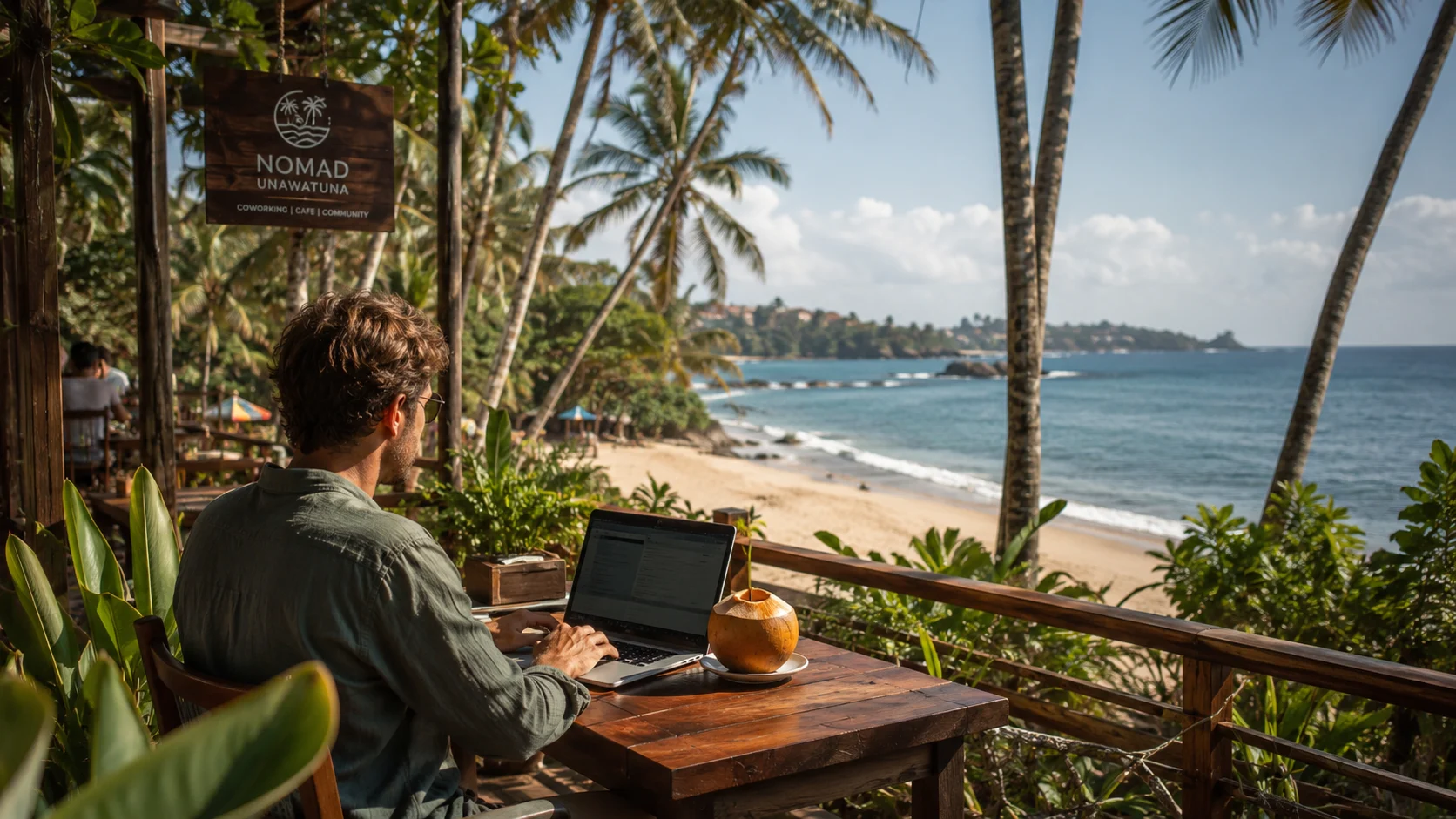
- Unawatuna and Weligama (south coast). Beach and surf focused. Weligama is the main beginner-surfing town, Unawatuna more relaxed swimming. Both have a few cafe-coworking hybrid spaces and reliable 4G or fibre near the main strip. Best as a 2 to 4 month seasonal base rather than year-round. Rent USD 200 to 450 for a 1br near the beach.
- Ella (hill country, 1,400m elevation). Tea plantation country, cooler climate (18 to 25C year-round), backpacker-friendly, growing slow-travel scene. Internet is variable: cafes near the centre have decent fibre, but residential connections can be patchy. Rent USD 200 to 400 for a 1br with mountain views. Best for nomads who can tolerate occasional connectivity hiccups in exchange for spectacular scenery.
Pros and cons
Sri Lanka offers a rare combination of tropical beaches, ancient culture, and very low cost of living, but the program is still maturing and some logistics remain less polished than established destinations.
- Pro: Among the lowest cost of living in Asia
- Pro: Tropical beaches, surf, hill country tea estates, and ancient UNESCO sites within 4 to 6 hours
- Pro: 1-year renewable structure (no 6-month cap)
- Pro: English widely used in administration, tourism, and business
- Pro: Territorial-leaning tax system; foreign income often not remitted, often not taxed
- Pro: Improving infrastructure post-2022 crisis recovery
- Pro: Excellent food culture, very high quality at very low prices
- Con: Program is still rolling out; several details pending ministerial confirmation
- Con: Internet is patchier outside Colombo and Galle (hill country can disappoint)
- Con: No direct path to permanent residency from DN visa
- Con: Currency and tax rules still evolving as part of IMF reform program
- Con: Healthcare quality varies significantly outside major cities
- Con: Smaller established nomad community than Bali, Chiang Mai, or Lisbon
الأسئلة الشائعة
When did Sri Lanka launch its digital nomad visa?
Sri Lanka first announced its digital nomad visa in late 2021, but the launch was delayed by the 2022 economic crisis and IMF program negotiations. The program is rolling out in stages through 2025 and 2026, with the first pilot cohorts processed in late 2025 and broader availability throughout 2026.
What is the income requirement?
Approximately USD 2,000 per month from foreign sources, one of the lowest income bars in Asia. The exact figure and required documentation format are still being finalised by the Department of Immigration and Emigration; check the official website for the most current guidance before applying.
How much does the visa cost?
The first-year fee is approximately USD 500. Renewals are expected to be cheaper, although the exact renewal fee structure is still pending ministerial confirmation as of early 2026. There may also be small additional fees for dependents.
How long is the visa valid?
One year, renewable. There is no formal cap on the number of renewals signalled in the current framework, so in principle you can stay on rolling 1-year permits for as long as you meet the income threshold. This could change as the program matures.
Do I have to pay Sri Lankan tax on my foreign income?
Sri Lanka operates a partially territorial system. Foreign-source income that is not remitted to Sri Lanka is generally not taxable, even for residents. If you become a Sri Lankan tax resident (183+ days in 12 months) and remit foreign income to Sri Lanka, it becomes taxable. Many nomads avoid Sri Lankan tax exposure by keeping foreign banking and using international cards in country.
Can my spouse and children join me?
Yes. Spouses and dependent children can apply as dependents alongside the primary holder. Per-person dependent fees were in the USD 200 to 350 range during the 2025 pilot but the final published rate is pending. The primary holder's USD 2,000 per month income proof covers the household.
What is the internet like?
Improving rapidly. Colombo and Galle have reliable fibre (50 to 200 Mbps). The south coast surf towns near the main strip have decent 4G LTE and selective fibre. The hill country (Ella, Nuwara Eliya) can be patchy in residential accommodation, although cafes and coworking spaces are generally better. Plan to test internet before signing any long-term rental.
How does Sri Lanka compare to Thailand or Bali?
Sri Lanka is cheaper than Thailand and roughly comparable to Bali for cost, but has a smaller established nomad community, patchier internet outside Colombo and Galle, and a less mature visa program. The trade-off is exceptional landscape diversity (beaches, tea country, ancient ruins) and a 1-year renewable structure rather than Thailand's 180-day per-entry cap. Best for nomads who want a quieter, more exploration-focused base.
مقالات ذات صلة
استخدم أدواتنا المجانية
حاسبات مجانية لكندا CRS وأستراليا والمملكة المتحدة وألمانيا وحدود رواتب 34 دولة.
جميع الأدوات