
What is the Ecuador retirement visa?
Ecuador offers two closely related non-immigrant visa categories aimed at retirees and passive-income earners: the Jubilado visa and the Rentista visa. The Jubilado (pensioner) visa is designed for people who receive a verifiable lifetime pension from a government or private pension system, while the Rentista visa targets those who live on investment income, dividends, or rental returns. In practice, most foreign retirees apply for one or the other depending on how their income is structured, and both grant the same rights and follow the same residency ladder. This guide treats them together and refers to both as the Jubilado pathway for simplicity.
Both categories are issued as two-year temporary residency visas under the 2017 Organic Law on Human Mobility (Ley Organica de Movilidad Humana), the statute that replaced Ecuador's earlier immigration framework. During your temporary residency period you may live and travel freely, bring in household goods duty-free, purchase property, open bank accounts, and enroll in the national IESS health insurance scheme. After 21 months of continuous residence you become eligible to apply for permanent residency (Residencia Permanente), and the clock starts from the date your temporary visa is granted. This is the fastest path from arrival to permanent status you will find anywhere in Latin America - and arguably anywhere in the world among comparable retirement programs. See how it stacks up in our retirement visa hub and our dedicated Colombia retirement visa guide for a direct neighbour comparison.
Ecuador is a small, geographically diverse country of about 18 million people straddling the equator on the Pacific coast of South America. It contains the Galapagos Islands, Andean highlands, dense Amazon jungle, and a warm Pacific coastline - all within borders roughly the size of the state of Nevada. That geographic compression means retirees can live in a temperate mountain city like Cuenca and still reach a beach or a cloud-forest cloud lodge within a few hours. The country adopted the US dollar as its official legal tender in January 2000 following a currency crisis, which eliminates exchange-rate risk for American retirees and simplifies budgeting for anyone earning in dollars.
Visa requirements: pension versus certificate of deposit
Ecuador ties its Jubilado and Rentista income thresholds to multiples of the Salario Basico Unificado (SBU), the country's unified minimum wage. As of 2025 and into 2026 the SBU stands at roughly $430 per month, which means the required pension income is set at approximately three times the SBU - currently around $1,290 to $1,325 per month depending on the exact SBU figure in the year you apply. This threshold has increased modestly over the years in line with SBU adjustments, so budget a small buffer above the stated minimum. Each additional dependent (spouse, child under 18, or disabled adult child) added to your visa application requires an additional one times the SBU, roughly $430 per month extra.
| Route | Monthly income required | Evidence needed | Dependents surcharge |
|---|---|---|---|
| Jubilado (pension) | $1,325/mo (approx 3x SBU) | Pension award letter + 3 months bank statements | +$430/mo per dependent |
| Rentista (investment income) | $1,325/mo (approx 3x SBU) | Dividend/rental statements + 3 months bank history | +$430/mo per dependent |
| Certificate of deposit route | $50,000 lump sum | 12-month CD from Ecuadorian bank + proof of funds | No surcharge; deposit covers family |
| Combination route | Partial income + partial CD | Consulate discretion; proportional split | Varies by consulate |
The certificate of deposit (CD) route is the most popular alternative for retirees who do not yet draw a formal pension or whose pension falls short of the threshold. You place a minimum of $50,000 into a fixed-term deposit at a licensed Ecuadorian bank - typically for a one-year term that is renewable - and that deposit serves as proof of your financial capacity in lieu of monthly income. The bank issues a certificate that you submit with your visa application. Interest rates on Ecuadorian CDs have historically ranged from 4% to 8% per year, meaning the $50,000 deposit can itself generate passive income of $2,000 to $4,000 annually, partially or fully satisfying the ongoing income requirement once the account is established. Some applicants use a combination approach: partial pension income supplemented by a proportionally smaller deposit, though this is subject to consulate discretion.
- Valid passport with at least 6 months remaining validity and two blank pages
- Completed visa application form (Form MRE)
- Apostilled criminal background check from your home country issued within 90 days
- Apostilled birth certificate
- Two recent passport-sized photographs (white background)
- Proof of income: pension letter with official English or Spanish translation, or CD certificate from Ecuadorian bank
- Three months of bank statements showing consistent income deposits
- Medical certificate or basic health questionnaire (requirements vary by consulate)
- Proof of address in Ecuador (rental contract or property deed) if applying in-country
- Payment of government visa fee (approximately $450 to $550)
Documents from non-Spanish-speaking countries must be translated into Spanish by a certified translator. Apostilles are required for criminal background checks and birth certificates, meaning documents issued in Hague Convention countries must be stamped by the relevant national authority (in the US, this is typically the Secretary of State for the state that issued the document, or the US State Department for federal documents). Applications can be submitted at an Ecuadorian consulate abroad before you relocate, or inside Ecuador at the Ministry of Foreign Affairs and Human Mobility (Ministerio de Relaciones Exteriores y Movilidad Humana) office if you are already in the country on a tourist visa. Processing times typically run 30 to 90 days at consulates and 15 to 45 days in-country.
Tax treatment for retirees
Ecuador operates a strictly territorial tax system, which means residents are taxed only on income earned from Ecuadorian sources. Foreign-source income - including foreign pensions, US Social Security, dividends paid by overseas companies, rental income from properties abroad, and interest on foreign bank accounts - is completely exempt from Ecuadorian income tax. For retirees whose entire income stream originates outside Ecuador, this effectively means zero local income tax liability. Ecuador does not impose a wealth tax or a tax on foreign asset holdings. Capital gains on the sale of Ecuadorian real estate are subject to a gains tax, but foreign asset sales are not taxed locally.
Ecuador and the United States do not have a bilateral income tax treaty, which means there is no formal mechanism for reducing US taxes on Ecuador-source income or vice versa. However, since most US retirees in Ecuador live primarily on US-source income (Social Security, IRA distributions, pensions), the absence of a tax treaty has little practical impact - their US income is simply not taxed in Ecuador. Ecuadorian tax residents do file an annual tax return (Declaracion del Impuesto a la Renta) if they have local-source income, but most foreign retirees on the Jubilado program have no filing obligation because all their income originates abroad.
Healthcare: IESS public insurance and private options
Ecuador's public healthcare system is administered by the Instituto Ecuatoriano de Seguridad Social (IESS), and foreign residents on legal visas are eligible to enroll as voluntary contributors. The enrollment fee for retirees is calculated as a percentage of the SBU and in 2025 to 2026 runs approximately $85 per month per person for comprehensive coverage that includes doctor visits, specialist consultations, hospitalisation, surgery, laboratory tests, prescribed medications (from a formulary), and maternity care. This flat monthly premium is extraordinarily low by any international standard - a comparable plan in the United States would cost well over $500 per month for a person in their 60s. Spouses can enroll as dependents for an additional fee on the same schedule.
The quality of IESS care varies significantly by city and by facility. In Cuenca and Quito, the main IESS hospitals (Hospital Jose Carrasco Arteaga in Cuenca and Hospital Carlos Andrade Marin in Quito) are modern, well-equipped institutions that handle complex procedures including cardiac surgery, orthopaedics, and oncology. Wait times at IESS facilities can be longer than at private clinics, and not all specialists or medications are available within the public formulary, which is why most expat retirees maintain both IESS coverage for major hospitalisation and a private insurance policy or self-funded private clinic visits for routine and specialist care.
Private healthcare in Ecuador is genuinely affordable by North American and European standards. A private GP consultation in Cuenca typically costs $30 to $60 out of pocket. A private specialist visit runs $40 to $80. A full blood panel at a private laboratory costs $20 to $50. Private hospitals such as Hospital Monte Sinai in Cuenca and Hospital Metropolitano in Quito charge substantially less for procedures than comparable institutions in the United States - a hip replacement, for example, may cost $8,000 to $15,000 all-in at a top Ecuadorian private hospital versus $40,000 or more in the US. Many expats in Cuenca combine IESS as a safety net with a local private insurance policy costing $100 to $200 per month for comprehensive private coverage including dental.
How to apply: step-by-step process
The Ecuador Jubilado visa can be obtained either from an Ecuadorian consulate in your home country before you move, or in-country at the Ministry of Foreign Affairs and Human Mobility if you are already in Ecuador. Most immigration attorneys and expat advisors recommend applying in-country in Cuenca or Quito, where the process is generally faster and you can address any document deficiencies immediately. Ecuador allows tourists to stay for up to 90 days per year without a visa, giving you a comfortable window to gather documents, open a bank account, and submit your application before your tourist period expires.
- Gather all required documents in your home country: apostilled criminal background check, apostilled birth certificate, and your pension award letter or proof of funds for a CD.
- Arrange certified Spanish translations of all documents not already in Spanish. Use a certified translator approved by the Ecuadorian Ministry of Foreign Affairs.
- Travel to Ecuador on a tourist visa (90 days, no visa required for most Western passport holders). Fly into Quito or Cuenca.
- Open a bank account at a licensed Ecuadorian bank (Banco Pichincha and Produbanco are the most expat-friendly). If using the CD route, deposit your $50,000 and obtain the certificate of deposit document.
- Secure a rental contract or property deed to use as proof of address in Ecuador.
- Book an appointment at the Ministry of Foreign Affairs and Human Mobility (Ministerio de Relaciones Exteriores y Movilidad Humana) office in Cuenca (Calle Sucre) or Quito. Online appointments are available at cancilleria.gob.ec.
- Attend your appointment and submit your complete application package along with the government visa fee of approximately $450 to $550. The officer will review documents on the spot and flag any issues.
- Wait for processing. In-country applications typically take 15 to 45 days. You will receive an email notification when your visa is approved.
- Collect your visa sticker and, within 30 days, visit the Civil Registry (Registro Civil) to obtain your cedula (Ecuadorian national ID card). The cedula is required to enroll in IESS, sign lease agreements, and access government services.
- Enroll in IESS online or at a local IESS branch within 30 days of receiving your cedula. Coverage begins 30 days after enrollment.
Most Cuenca-based immigration attorneys charge between $800 and $1,500 for full-service visa assistance including document review, translation coordination, and representing you at the Ministry appointment. While the process is technically doable on a DIY basis for Spanish speakers or those with patience for bureaucracy, attorney assistance substantially reduces the chance of document rejections or delays. Request referrals from local expat Facebook groups such as Cuenca Expats or Cuenca High Life, which have active, well-informed communities.
Cost of living: Cuenca versus Salinas
Ecuador consistently ranks among the five most affordable retirement destinations in the world, and the gap between Ecuador's cost of living and North American or Western European prices is striking even by Latin American standards. A couple can live comfortably in Cuenca on $1,800 to $2,500 per month including rent, food, healthcare, utilities, transportation, and leisure - a budget that would barely cover rent alone in most US cities. The coastal town of Salinas is somewhat cheaper for groceries and accommodation but higher on imported goods, while Quito sits roughly in line with Cuenca. The table below reflects 2026 mid-range estimates for a two-person household.
| Expense | Cuenca (monthly) | Salinas (monthly) | Notes |
|---|---|---|---|
| Rent (2-bed furnished apartment) | $600 to $900 | $450 to $750 | Cuenca colonial center commands a premium |
| Groceries (2 people) | $200 to $300 | $180 to $280 | Local markets far cheaper than supermarkets |
| IESS health insurance (2 people) | $170 | $170 | Flat rate per person ~$85 |
| Private insurance supplement | $150 to $250 | $100 to $200 | Optional but recommended |
| Utilities (electricity, water, internet) | $80 to $120 | $70 to $110 | Internet 50 to 200 Mbps widely available |
| Dining out (2 people, restaurant meals) | $200 to $350 | $180 to $300 | Almuerzo (set lunch) $3 to $5 |
| Transportation (no car) | $30 to $60 | $20 to $50 | Cuenca bus fare ~$0.35 |
| Entertainment and leisure | $150 to $250 | $100 to $200 | Includes travel, activities, subscriptions |
| Total estimate | $1,580 to $2,430 | $1,270 to $2,060 | Mid-range comfortable lifestyle |
Property taxes in Ecuador are exceptionally low - typically 0.25% to 1% of the cadastral (assessed) value annually, and assessed values are set conservatively below market price. A $200,000 home in Cuenca's El Batan neighbourhood might carry an annual property tax bill of only $300 to $600. Utilities are subsidised for residents, and electricity costs are far below US rates. Gasoline is also subsidised, though a car is entirely optional in walkable Cuenca. The combination of low taxes, subsidised utilities, affordable local food, and cheap domestic transport means retirees with incomes above $2,000 per month can live exceptionally well by any measure.
Buying property in Ecuador
Ecuador's constitution explicitly grants foreigners the same property rights as Ecuadorian citizens. There are no restrictions on foreign ownership of residential, commercial, or agricultural property - no requirement to use a local partner, no caps on the number of properties owned, and no minimum investment requirement (unlike some other Latin American countries that tie property ownership rights to visa categories). Foreigners can purchase in their personal name or through a local or foreign corporation. The purchase process uses a standard notarised deed system, and title searches are conducted through the public Property Registry (Registro de la Propiedad).
Closing costs on property purchases in Ecuador are modest compared to most countries. Total transaction costs - including the notary fee, property transfer tax (1% of the declared value), Registry inscription fee, and municipal fees - typically add 2% to 4% of the purchase price. There is no stamp duty and no real estate agent commission is paid by the buyer (agents are typically compensated by the seller at 3% to 5%). Property prices in Cuenca's desirable neighbourhoods such as El Ejido, San Joaquin, and Turi range from $1,200 to $2,500 per square meter for quality construction, meaning a comfortable 100-square-meter apartment might sell for $120,000 to $250,000 - prices that look very attractive to retirees coming from New York, London, or Sydney.
Financing is available from Ecuadorian banks for legal residents, though interest rates on mortgages are higher than in the US or Europe - typically 9% to 12% per year. Most expat retirees who buy property do so with cash or by liquidating assets in their home country, eliminating the need for local financing. Foreigners are also permitted to rent property for long periods under standard lease agreements. Short-term furnished rentals are widely available in expat neighbourhoods, making it practical to rent for six to twelve months before deciding whether and where to buy.
Permanent residency and citizenship timeline
Ecuador's residency pathway for Jubilado visa holders is the fastest among any significant retirement visa program in the world. After holding your two-year temporary residency visa and maintaining 21 months of actual physical presence in Ecuador, you become eligible to apply for Residencia Permanente (permanent residency). The permanent residency application is submitted to the Ministry of Foreign Affairs and Human Mobility and requires evidence of your continued income or CD investment, proof of ongoing residence, your cedula, and a clean criminal record. Once granted, permanent residency has no expiration date and must simply be renewed every five years (a formality involving updated documents rather than a reassessment of financial eligibility).
By comparison, Panama's Pensionado program grants immediate permanent residency upon approval (no temporary stage), but Ecuador's two-year path is faster than Colombia's five-year path, Costa Rica's three-year path, Portugal's five-year path to permanent residency, and Spain's ten-year path to permanent residency. For retirees who prioritise having a permanent, unconditional legal status in their new country of residence, Ecuador is the standout choice in Latin America. Note that permanent residency holders are still required to spend a minimum amount of time in Ecuador each year to maintain their status - the general guidance is at least six months per year, though the law specifies a continuous absence of more than 24 months may trigger a review.
Ecuadorian citizenship is available to permanent residents after three additional years of residence following the granting of permanent residency, meaning the total path from first arrival on a Jubilado visa to a full Ecuadorian passport is approximately five years. Ecuador allows dual citizenship under its constitution, so most retirees from the US, UK, Canada, Australia, and EU countries can naturalise without renouncing their home-country citizenship. An Ecuadorian passport provides visa-free access to over 90 countries and is a valuable travel document in its own right, particularly for access to the Schengen zone, Latin American countries, and Mercosur members.
Best cities for retirement in Ecuador
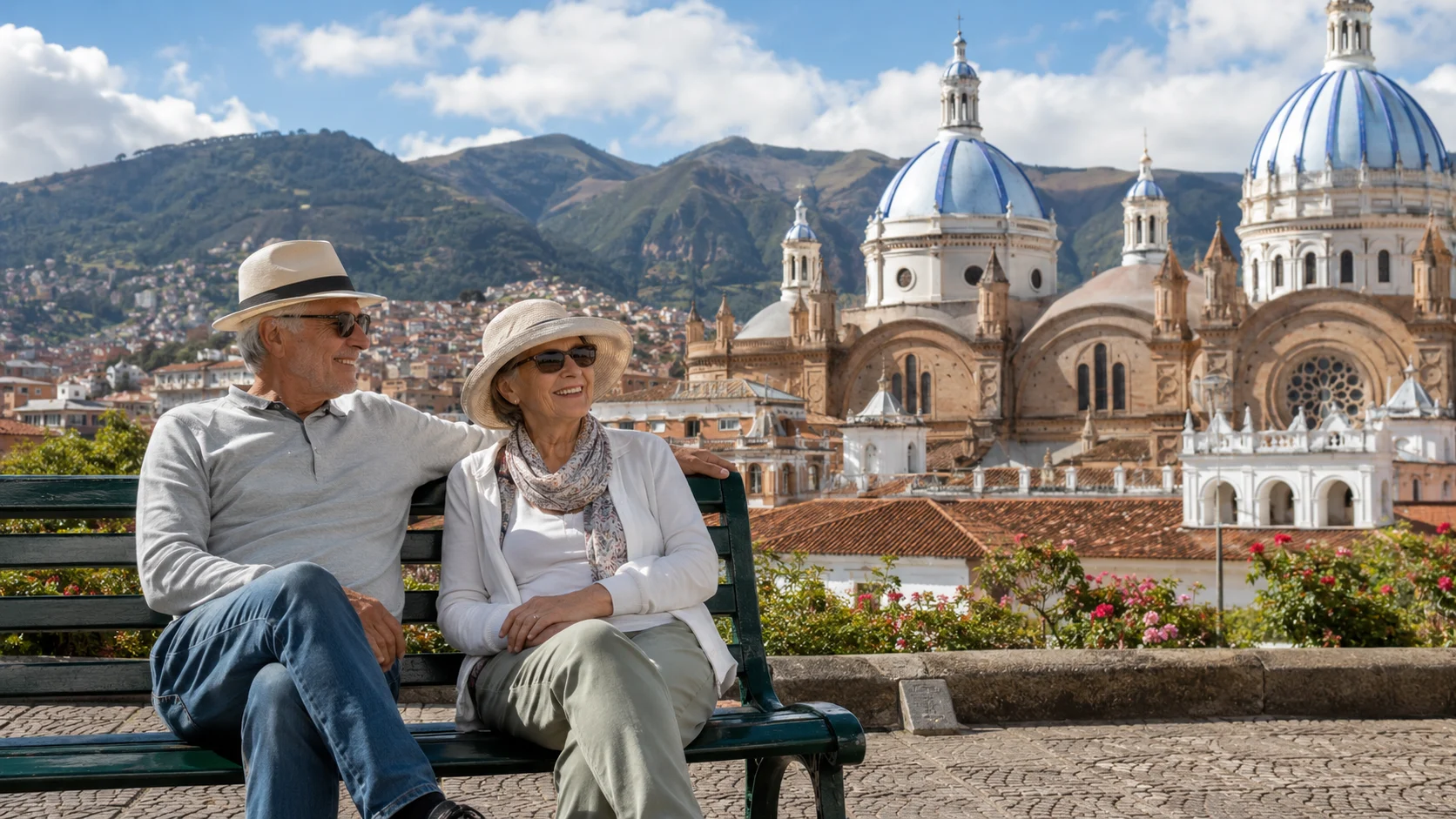
Cuenca is the undisputed flagship of Ecuador's expat retirement scene and has been ranked the number one retirement destination in the world by International Living magazine multiple times over the past decade. The city sits at 2,550 metres (8,370 feet) in the southern Andes, which gives it a perpetual spring climate averaging 65 to 70 degrees Fahrenheit year-round with virtually no humidity. The historic centre (Centro Historico) is a UNESCO World Heritage Site, a living urban museum of colonial Spanish architecture - whitewashed convents, the iconic blue-domed Cathedral Nueva on Parque Calderon, cobblestone streets, and flower-filled plazas - set against a dramatic backdrop of mountain ridges. The city has a thriving arts scene, excellent restaurants across every cuisine and price range, multiple universities, world-class private hospitals, fast-fibre internet, and an international airport with connections to Quito and Guayaquil.
The expat community in Cuenca is estimated at 8,000 to 12,000 people, one of the highest concentrations of foreign retirees per capita in Latin America. English is spoken in most expat-oriented businesses, and the infrastructure for new arrivals - immigration attorneys, bilingual real estate agents, expat-facing banks, foreign-language community events, and active online forums - is well-developed. The Mercado 10 de Agosto and Mercado 27 de Febrero sell fresh local produce, meats, and prepared almuerzo lunches at prices that feel almost unreal to newcomers. Cuenca's flat, walkable grid and its $0.35 city bus system mean a car is a luxury rather than a necessity.
Quito, the capital at 2,850 metres, appeals to retirees who want a full metropolitan city experience with world-class museums, international flights, and a broad cultural calendar. It is larger and more complex than Cuenca, with higher traffic and some neighbourhood-specific security considerations, but its historic centre is also a UNESCO World Heritage Site and the northern suburbs of Cumbaya, Tumbaco, and the Valle de los Chillos offer suburban community living at lower altitudes and comfortable temperatures. Guayaquil, Ecuador's largest city and main port on the Pacific coast, is hot and humid but provides direct international flights and a modern urban lifestyle. For beach retirement, Salinas on the Santa Elena Peninsula is the most developed coastal resort town, with condominiums, promenades, yacht clubs, and a year-round population of Ecuadorian and foreign retirees.
- Cuenca: UNESCO colonial city, spring climate year-round, largest expat community, best healthcare infrastructure outside Quito, top choice for most foreign retirees
- Quito: capital city amenities, international airport hub, UNESCO historic centre, higher altitude (2,850m) suits some less than Cuenca
- Salinas: Pacific coast beach town, warm year-round, good condo market, popular with Ecuadorian and foreign retirees
- Vilcabamba: small mountain village in the Loja province, nicknamed the Valley of Longevity for its reportedly high concentration of centenarians, very low cost of living, strong small expat community
- Cotacachi: artisan leather town in Imbabura province near Otavalo, growing expat population, lake Cuicocha nearby, lower cost than Cuenca
- Manta: coastal city on the Manabi coast, warmer and more humid than Cuenca but with beach access, growing expat infrastructure, direct US flights
Pros and cons of retiring in Ecuador
Ecuador's retirement visa program is genuinely exceptional in several dimensions that matter most to retirees: speed to permanent residency, cost of living, currency stability, healthcare affordability, and the quality of specific cities like Cuenca. But no destination is without drawbacks, and honest assessment of both sides helps set realistic expectations.
- [+] Fastest permanent residency of any major retirement visa program: 2 years to PR with no intermediate steps beyond temporary residency
- [+] US dollar as official currency since 2000 eliminates exchange-rate risk for American retirees and simplifies budgeting for all dollar-based income
- [+] IESS public healthcare enrollment for approximately $85 per month gives access to hospital care, surgery, and specialist services at genuinely affordable cost
- [+] Cuenca is consistently ranked the world's best expat retirement city, combining colonial beauty, temperate climate, large English-speaking expat community, and affordable living
- [+] Territorial tax system means foreign pensions, Social Security, dividends, and overseas rental income are completely exempt from Ecuadorian income tax
- [+] Foreigners buy property with identical rights to citizens, no restrictions, low closing costs, and property taxes well below 1% of assessed value
- [+] Income threshold of ~$1,325 per month is moderate and achievable for most retirees with a US Social Security benefit plus a small pension or investment return
- [+] Ecuadorian citizenship available after 3 years of PR (total ~5 years from arrival), with dual citizenship permitted
- [+] Geographic diversity means beach, mountain, cloud forest, and Amazon all accessible within one country
- [-] Political and economic instability has increased since 2020, with occasional security incidents, protests, and two states of emergency declared in 2024 related to organised crime in certain provinces
- [-] Altitude of Cuenca (2,550m) and Quito (2,850m) causes altitude sickness for some arrivals and is medically inadvisable for people with severe cardiovascular or respiratory conditions
- [-] IESS hospital wait times can be long and specialist availability within the public system is uneven; private supplement is practically necessary for reliable care
- [-] Ecuador is on the US State Department's Level 2 (Exercise Increased Caution) travel advisory list as of 2025 to 2026, reflecting elevated crime in certain coastal and border regions
- [-] No bilateral tax treaty with the United States, meaning US citizens receive no relief from their US worldwide tax obligations when living in Ecuador
- [-] Infrastructure quality is uneven outside major cities, and internet connectivity varies significantly by neighbourhood and region
On balance, Ecuador offers a genuinely competitive package that is hard to match on the specific combination of speed to permanent residency, currency stability, healthcare affordability, and the lifestyle quality of Cuenca. Retirees who are flexible about not being on a beach, who have no serious altitude-related health concerns, and who are comfortable with a developing-country risk profile will find Ecuador delivers outstanding value and quality of life. Those who need guaranteed tropical warmth or prefer the institutional stability of a European destination should weigh Ecuador carefully against neighbours like Colombia and Panama - covered in our Colombia retirement visa guide - or consult the full retirement visa hub for a comprehensive comparison.
احصل على إرشادات تأشيرة شخصية
كل حالة تأشيرة مختلفة. أخبرنا عن حالتك وسيقوم مستشارونا المعتمدون بمراجعة قضيتك خلال 24 ساعة.
الأسئلة الشائعة
How much income do I need for the Ecuador Jubilado visa?
You need approximately $1,325 per month in verifiable pension or passive investment income, which equals about three times Ecuador's unified basic salary (SBU). The exact figure adjusts slightly each year as the SBU increases. Each dependent you add to your visa requires approximately an additional $430 per month. If your income falls short, you can qualify instead by placing a $50,000 certificate of deposit in a licensed Ecuadorian bank.
How long does it take to get permanent residency in Ecuador?
Ecuador is the fastest major retirement destination for permanent residency: you are eligible to apply for Residencia Permanente after just 21 months of holding your two-year temporary residency visa (the visa covers 2 years, but the PR eligibility threshold is 21 months of actual presence). No other widely-known retirement visa program in Latin America or Europe offers permanent residency this quickly. Once granted, permanent residency has no expiration and is renewed every five years as a formality.
Can I use a certificate of deposit instead of a pension?
Yes. If you do not have a qualifying pension or your pension is below the threshold, you can place a minimum of $50,000 in a fixed-term deposit (CD) at a licensed Ecuadorian bank. The bank issues a formal CD certificate that you submit as your proof of financial capacity. Interest earned on Ecuadorian CDs has historically ranged from 4% to 8% annually, so the deposit also generates passive income. Some applicants combine a partial pension with a smaller deposit; consulate discretion applies to combination approaches.
Does Ecuador tax my foreign pension or Social Security?
No. Ecuador uses a territorial tax system, meaning only Ecuadorian-source income is taxed locally. Foreign pensions, US Social Security, overseas rental income, foreign dividends, and interest on overseas bank accounts are entirely exempt from Ecuadorian income tax. Most foreign retirees on the Jubilado program have no Ecuadorian tax filing obligation at all. However, US citizens and Green Card holders must still file and pay US federal taxes on all worldwide income regardless of where they live.
How does IESS healthcare work for foreign retirees?
Legal residents with a valid cedula (Ecuadorian national ID) can enroll in the IESS public health insurance system as voluntary contributors. The monthly premium is approximately $85 per person in 2025 to 2026. Coverage includes doctor visits, specialist consultations, hospitalisation, surgery, laboratory tests, and medications from the IESS formulary. There is a 30-day waiting period after enrollment. Many expats also carry a private insurance supplement or pay out of pocket for private clinic visits where IESS wait times are long or specialists are unavailable in the public system.
Is Cuenca really the best place to retire in Ecuador?
Cuenca is consistently ranked by International Living magazine and other expat publications as one of the top one or two retirement cities in the entire world, not just in Latin America. Its advantages are numerous: a UNESCO World Heritage historic centre, a perpetual spring climate at 2,550 metres (averaging 65 to 70 degrees Fahrenheit), the largest and best-organised expat community in Ecuador (estimated 8,000 to 12,000 people), modern private hospitals, fast internet, an affordable cost of living, and proximity to coastal and Amazon destinations. Its main drawbacks are altitude (which affects some arrivals) and distance from a beach (about 4 hours to Salinas). Quito, Salinas, and Vilcabamba all have their advocates for specific lifestyle priorities.
Can foreigners buy property in Ecuador?
Yes. Ecuador's constitution grants foreigners identical property rights to citizens. There are no restrictions on foreign ownership of residential or commercial property, no requirement to use a local partner, and no minimum investment amount. Foreigners can buy in their own name or through a corporation. Closing costs are low at 2% to 4% of the purchase price, and annual property taxes run well below 1% of assessed value. Most expat buyers pay cash, though Ecuadorian bank mortgages are available for legal residents at interest rates of roughly 9% to 12% per year.
How do I apply for the Ecuador Jubilado visa?
You can apply at an Ecuadorian consulate in your home country or in-country at the Ministry of Foreign Affairs and Human Mobility (Ministerio de Relaciones Exteriores y Movilidad Humana) after entering on a tourist visa. Most immigration advisors recommend applying in-country in Cuenca or Quito for faster processing (15 to 45 days vs 30 to 90 days at consulates). Required documents include apostilled criminal background checks and birth certificates, your pension letter or CD certificate, three months of bank statements, proof of Ecuadorian address, and payment of the government fee of approximately $450 to $550. An immigration attorney ($800 to $1,500) is strongly recommended for a smooth process.
مقالات ذات صلة
استخدم أدواتنا المجانية
حاسبات مجانية لكندا CRS وأستراليا والمملكة المتحدة وألمانيا وحدود رواتب 34 دولة.
جميع الأدوات