
What is the Colombia digital nomad visa?
The Colombia digital nomad visa, formally the V Type Migrant Visa with the Digital Nomad subcategory, was created by Resolution 5477 of 2022 and implemented from October 2023. It is administered by the Ministry of Foreign Affairs (Cancilleria) and grants up to 2 years of legal residence for remote workers and entrepreneurs working for companies based outside Colombia. The visa is part of Colombia's broader strategy to attract foreign talent and capital following the country's reclassification as a high-middle-income economy.
What makes Colombia stand out is the deliberately low income bar. The required monthly income is pegged at three times the Colombian minimum wage, which means it scales with local cost of living rather than tracking dollar benchmarks set in Europe. In 2026 that works out to roughly COP 4.2 million per month, or USD 1,000 to 1,100 depending on the exchange rate. Compared to Portugal's EUR 3,480/month or Spain's EUR 2,646/month, Colombia is an entry-level option. See our digital nomad visa hub for the full global comparison.
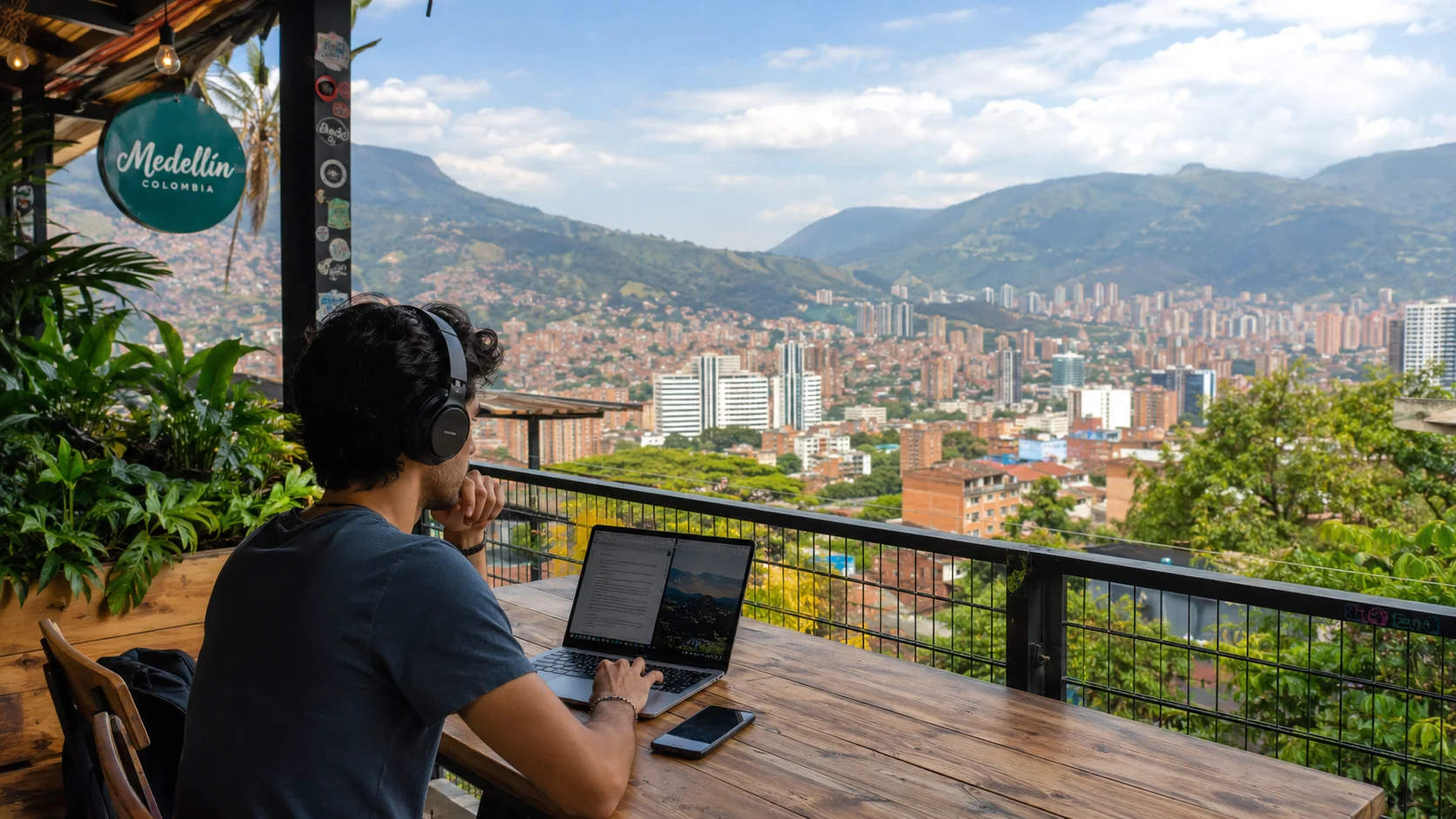
Colombia also benefits from a mature nomad ecosystem long before the formal visa existed. Medellin in particular has been a top-5 global nomad city on Nomad List for years, with the Poblado and Laureles neighborhoods packed with coworking spaces, cafes, and meetups. Bogota, Cartagena, and Cali round out the country's nomad scene. The visa simply legalizes what thousands of nomads were already doing on tourist visas.
Requirements and income threshold
The documentation list is short by Latin American standards and applications can be submitted entirely online through the Cancilleria portal. The most common rejection cause is documents not properly apostilled or translated into Spanish.
| Requirement | Detail |
|---|---|
| Minimum income | 3x Colombian minimum wage (~COP 4.2M / USD 1,000-1,100 per month in 2026) |
| Savings alternative | Not formally accepted; income proof from last 3 months required |
| Health insurance | International health insurance valid in Colombia for full visa period |
| Criminal background | Clean record (no formal certificate; declared on application) |
| Proof of remote work | Employment contract OR business ownership outside Colombia, plus motivation letter |
| Other | Valid passport (6+ months), digital photo, completed online form in Spanish |
All foreign documents (employment contracts, bank statements) must be apostilled in the country of origin and translated into Spanish by a Colombian-certified translator if not originally in Spanish or English. The motivation letter is short (one page) explaining your remote work and why Colombia. It is reviewed but rarely the basis for rejection if other documents are solid.
Tax treatment
Colombia uses a territorial tax system in the first year of residency, which is unusually generous. As a digital nomad on the V visa, you are not considered a Colombian tax resident until you have spent more than 183 days in the country during a 365-day rolling period. Once you cross that threshold, you become tax resident from the following year, and Colombian tax applies on worldwide income from that year onwards. This gives most nomads a clear year-one tax holiday on foreign-source income.
Colombian income tax for residents is progressive, ranging from 0 percent on the first ~COP 53M of annual income (around USD 12,000) up to 39 percent on income above ~COP 1.1 billion (around USD 250,000). Most digital nomads earning USD 30,000 to 80,000 per year would fall in the 19 to 28 percent brackets if they become tax resident. Colombia has double taxation treaties with Spain, Switzerland, Canada, Chile, Mexico, France, the UK (in force from 2025), and several others, but not yet with the US, Germany, or Australia.
How to apply - step by step
Colombia's process is fully online through the Cancilleria visa portal. You do not need to visit a consulate in person and can apply from inside Colombia on a tourist visa.
- Gather documents: passport scan, digital passport photo, last 3 months of bank statements, employment contract or business documents (apostilled and translated), motivation letter in Spanish (1 page), and international health insurance certificate.
- Create an account on the Cancilleria visa portal (visas.cancilleria.gov.co) and select V Visa, then Digital Nomad subcategory.
- Complete the online form. Upload all documents as PDFs. Pay the study fee of USD 54 by credit card.
- Wait 5 to 30 working days for the decision. Most decisions arrive within 2 weeks. You may receive a request for additional documents - respond within 30 days.
- If approved, pay the visa issuance fee of USD 177 (total USD 231 including study fee).
- Receive your e-visa by email. Print it and keep a digital copy. The visa is valid for 2 years from the issue date.
- Within 15 days of either receiving the visa abroad and entering Colombia, OR receiving it inside Colombia, register at a Migracion Colombia office and apply for a Cedula de Extranjeria (foreigner ID card).
- Pick up your Cedula at the Migracion office 4 to 6 weeks later. Use it to open a bank account, sign a lease, and access health and telecom services.
Cost breakdown
The visa itself is extremely cheap. Most of your year-one budget will go to apartment deposits, insurance, and the Cedula. Budget around USD 500 to 800 in pure visa-related fees.
| Item | Cost |
|---|---|
| Application study fee | USD 54 |
| Visa issuance fee | USD 177 |
| Cedula de Extranjeria | USD 60 (COP 240,000) |
| Document apostille (per doc, home country) | USD 20 to 100 |
| Certified Spanish translation (per doc) | USD 30 to 80 |
| International health insurance (annual) | USD 800 to 2,000 |
| Migration registration (within 15 days of entry) | Free |
| Total realistic budget (single, year 1) | USD 1,200 to 2,500 |
Cost of living
Colombia is one of the cheapest serious nomad destinations in the world. Medellin and Bogota are similar in cost, with Cartagena being slightly more expensive due to tourism. Compare to Mexico or Brazil for the other major Latin American nomad markets.
| Item | Bogota | Medellin |
|---|---|---|
| 1 BR apartment (central, furnished) | USD 600 to 1,200/mo | USD 550 to 1,100/mo |
| 1 BR apartment (suburb) | USD 350 to 700/mo | USD 300 to 650/mo |
| Coworking hot desk | USD 90 to 200/mo | USD 80 to 180/mo |
| Meal at mid-range restaurant | USD 8 to 18 | USD 7 to 16 |
| Monthly transport pass | USD 30 (TransMilenio) | USD 25 (Metro) |
| Utilities (1 BR) | USD 60 to 120/mo | USD 50 to 100/mo |
| Gym membership | USD 25 to 80/mo | USD 20 to 70/mo |
| Total realistic monthly budget | USD 1,200 to 2,200 | USD 1,100 to 2,000 |
Family and dependents
The Colombia V visa allows the primary visa holder to bring a spouse (married or civil partner / unmarried permanent partner with 2+ years of cohabitation evidence) and dependent children under 25 if economically dependent or with a disability. Dependents apply for a Beneficiary V Visa using the primary's visa as the basis. Each dependent application costs an additional USD 230 (study + issuance).
There is no formal income uplift for dependents, but the consulate may informally request that you show somewhat higher income (around USD 1,500 to 1,800/month for a couple, USD 2,000+ for a family of 3 to 4) to demonstrate ability to support them. Spouses on the Beneficiary V Visa cannot work in Colombia under a local employment contract, but they can run remote work for a foreign employer without restriction. Children can attend public schools (Spanish-language only) or international schools (USD 4,000 to 18,000 per year in Bogota or Medellin).
Path to residency
Colombia offers a clear path to permanent residency for digital nomads. After holding a V visa continuously for 5 years (across renewals), you can apply for the R Type Resident Visa, which grants permanent residence. The R visa is valid for 5 years and is renewable indefinitely. To maintain the R visa, you must not be absent from Colombia for more than 2 consecutive years.
After 5 years on the R visa (10 years total in Colombia, or 5 if you have Colombian children or are married to a Colombian), you can apply for Colombian citizenship by naturalization. Colombia permits dual citizenship, and a Colombian passport gives visa-free access to most of Latin America and the Schengen Area. This makes Colombia one of the cleanest nomad-to-citizenship pathways in the Americas.
Best cities for digital nomads
Colombia has multiple distinct nomad scenes, each with its own personality. Medellin is the heavyweight, but Bogota offers urban depth, Cartagena offers beach colonial charm, and Cali is the salsa capital for nomads who want a more authentic Colombian immersion.
- Medellin (El Poblado, Laureles, Envigado): consistently ranked top 5 globally on Nomad List. Known as the City of Eternal Spring with year-round 18 to 28°C weather. El Poblado is the upscale expat zone (USD 800 to 1,500 for a 1BR), Laureles is the local-hip mid-range option (USD 500 to 1,000), and Envigado is the family-friendly suburb. Dense coworking scene (Selina, Atom House, Tinkko), nomad meetups every week, and the Medellin metro is the cleanest in Latin America.
- Bogota (Chapinero, Zona Rosa, Usaquen): the capital is at 2,640m altitude, cool (14-19°C year-round), and feels like a serious global city. Chapinero is the bohemian nomad zone, Zona Rosa is upscale, and Usaquen is the foodie north. Higher density of corporate jobs (good for hybrid nomads) and the best museum/theater scene in the country.
- Cartagena (Getsemani, Bocagrande, Manga): beach colonial city on the Caribbean coast. Getsemani is the artsy walled-city extension with the best nomad vibe, Bocagrande is the high-rise beach strip, and Manga is the quieter residential island. Hotter (28-32°C year-round) and more expensive than Medellin due to tourism, but the colonial architecture is among the most beautiful in the Americas.
Pros and cons
- Pro: Lowest income threshold of any DN visa in the world (~USD 1,000/mo).
- Pro: 2-year initial visa with clear path to permanent residency after 5 years and citizenship after 10 years.
- Pro: Territorial tax in year one means foreign income is not taxed before you become tax resident.
- Pro: Medellin is a top-5 global nomad city with world-class climate, coworking, and community.
- Pro: Very low cost of living (USD 1,200 to 2,000 per month for a comfortable lifestyle).
- Pro: Fully online application, no consulate visit needed.
- Con: Limited English outside El Poblado and tourist zones. Practical Spanish becomes important after a few months.
- Con: Safety perception (and reality in some neighborhoods) requires more awareness than in Europe or East Asia. Petty theft is common; stay in nomad-friendly zones.
- Con: Bureaucracy is slow once you become tax resident (year 2+). DIAN tax filings are complex without a local accountant.
- Con: Limited direct flights to Europe and Asia versus Mexico City or Sao Paulo.
अक्सर पूछे जाने वाले प्रश्न
How much do I need to earn to qualify for the Colombia digital nomad visa?
Three times the Colombian minimum monthly wage, which in 2026 is approximately COP 4.2 million or USD 1,000 to 1,100 per month depending on the exchange rate. This is the lowest income threshold of any digital nomad visa in the world.
How long is the Colombia digital nomad visa valid?
The V Type Digital Nomad visa is valid for up to 2 years from the issue date. It can be renewed by submitting a fresh application demonstrating continued income and remote work status.
Do I pay Colombian tax on my foreign income as a digital nomad?
Not in year one. You become a Colombian tax resident only after spending more than 183 days in Colombia within any 365-day period. From the following tax year, you owe Colombian income tax on worldwide income at progressive rates of 0 to 39 percent. US citizens still owe US federal tax regardless due to citizenship-based taxation.
Can the Colombia DN visa lead to permanent residency?
Yes. After holding a V visa continuously for 5 years, you can apply for an R Type Resident Visa for permanent residence. After 5 more years on the R visa (10 years total), you can apply for Colombian citizenship. Dual citizenship is permitted.
Can I work for a Colombian company on this visa?
No. The Digital Nomad visa is strictly for remote work for companies based outside Colombia. If you want to take a Colombian local job, you need to switch to a different V visa subcategory (Worker) sponsored by the Colombian employer.
How long does the Colombia visa application take?
Typically 5 to 30 working days from a complete online application. Most decisions arrive within 2 weeks. Fully online process via the Cancilleria portal with no consulate visit needed.
Can I bring my family on the Colombia digital nomad visa?
Yes. Spouses (including unmarried permanent partners with 2+ years of cohabitation evidence) and dependent children under 25 can apply as beneficiaries. Each dependent application costs USD 230 in fees. The consulate may informally expect higher income (USD 1,500 to 2,000+ per month) to demonstrate ability to support family.
Is Medellin really safe for digital nomads?
El Poblado, Laureles, and Envigado, the three main expat zones, are generally safe with normal big-city precautions (do not flash phones in unfamiliar streets, use Uber or DiDi at night). Medellin has transformed dramatically since the 1990s. The rest of the city varies; stick to nomad-friendly comunas and you will likely have a smooth experience. See our digital nomad visa guide for safety comparisons across destinations.
संबंधित लेख
हमारे मुफ्त टूल्स का उपयोग करें
कनाडा CRS, ऑस्ट्रेलिया पॉइंट्स, यूके Skilled Worker, जर्मनी Opportunity Card और 34 देशों की वेतन सीमा के लिए मुफ्त कैलकुलेटर।
सभी टूल्स देखें