
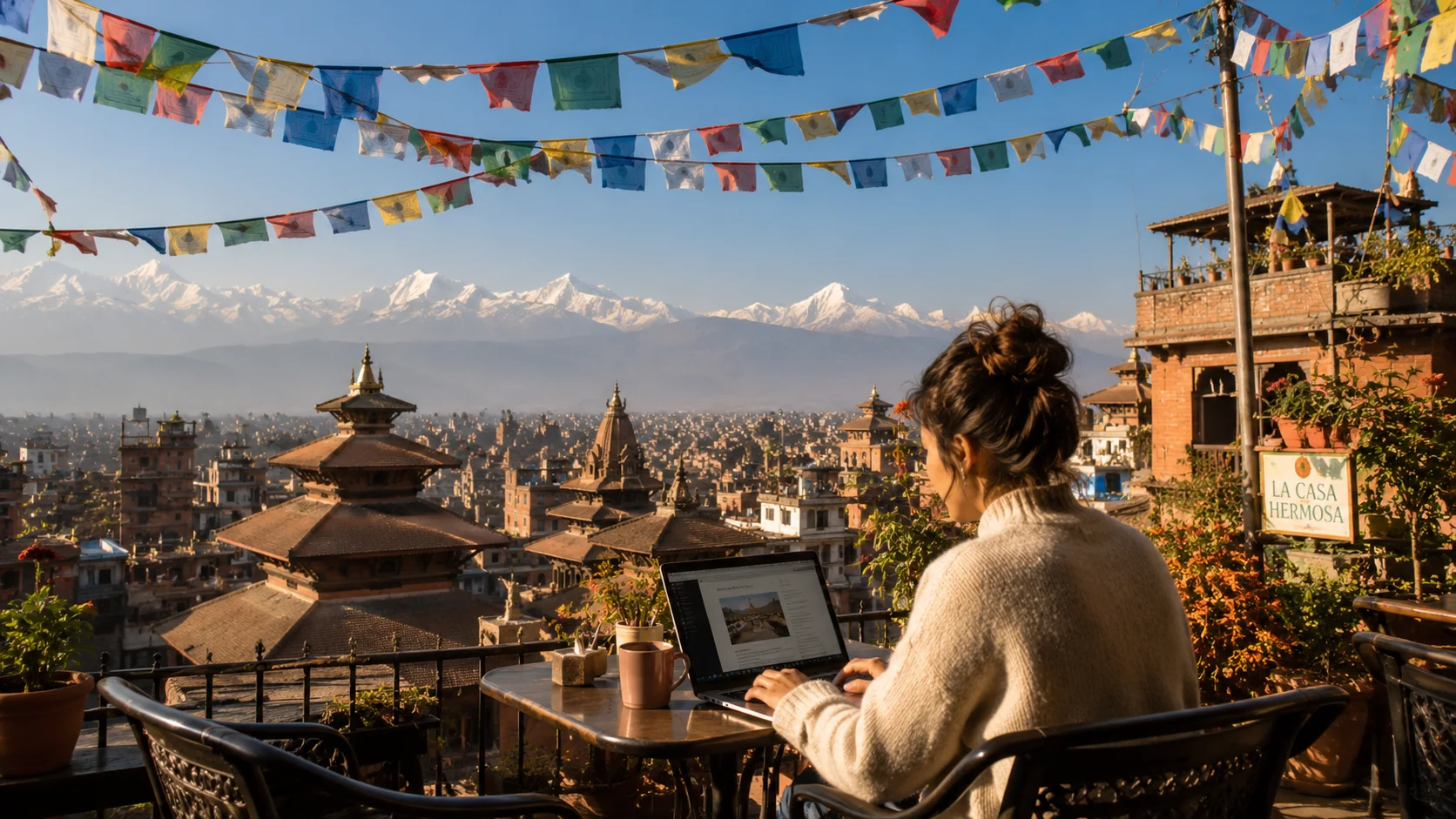
What is the Nepal digital nomad visa?
Nepal's digital nomad visa is a new residence permit category announced by the Department of Immigration and the Ministry of Tourism in late 2025, with the first applications opening in early 2026. It is positioned as a successor to the de facto 'extend-your-tourist-visa-while-trekking' system that thousands of remote workers and trekkers used informally for years, and is part of Nepal's broader push to grow tourism receipts after the pandemic and the 2015 earthquake recovery period. The visa targets non-Nepali remote workers, freelancers, and remote entrepreneurs earning income from outside Nepal.
Nepal sits between India and China, with the world's eight highest peaks including Everest (8,849m), Annapurna, and Kanchenjunga. The population is roughly 30 million, the capital is Kathmandu, and the currency is the Nepali rupee (NPR) at roughly 135 NPR per USD in 2026. English is widely understood in tourist areas and among educated professionals, and the country is one of the few in Asia with no visa requirement for most tourists (visa on arrival for 90 days, extendable to 150). The new nomad visa formalises longer-term stays and adds clearer work-from-here legitimacy.
If you are a Nepali national thinking about onshore options, see the Nepal nationality hub for Nepali-passport-specific guidance. The nomad visa is for non-Nepalis only.
Requirements and income threshold
Nepal's headline financial threshold is USD 1,500 per month in income OR USD 20,000 in liquid savings, making it one of the lowest in the world. By comparison, Thailand's DTV requires THB 500,000 (around USD 15,000) in savings only, Indonesia's E33G remote worker visa requires USD 60,000 per year (~USD 5,000 per month), and Bali's older second-home visa requires USD 130,000 in a frozen deposit. Nepal undercuts all of them by a wide margin.
| Requirement | Details |
|---|---|
| Income | USD 1,500/month minimum from foreign sources (employment, freelance, or remote business). Must be documented via pay slips or bank statements. |
| Savings alternative | USD 20,000 in a bank account in lieu of monthly income documentation. Useful for freelancers without steady pay slips. |
| Health insurance | Private health insurance covering Nepal for the full visa duration. International policies (SafetyWing, Cigna Global, IMG) typically accepted. |
| Criminal background | Police clearance certificate from country of citizenship, less than 6 months old, apostilled or notarised. |
| Proof of remote work | Foreign employment contract OR client contracts OR foreign business registration. No Nepali employer or Nepali client work allowed. |
| Other | Passport valid 12+ months, proof of Nepali accommodation, passport photos, application form, visa fee. |
Final implementing details are still being published as the visa rolls out in early 2026. Expect modest changes to documentation requirements, possible Nepali translations for some documents (typically not required for English-language applications), and refinements to the application channels. Always check the Nepal Department of Immigration website (nepalimmigration.gov.np) for the latest official requirements before applying.
Tax treatment
Nepal taxes residents on worldwide income on a progressive scale from 1 percent to 36 percent, with most middle-income earners falling in the 20 to 30 percent band. However, the implementing details specifically for the digital nomad visa are still being finalised. Early indications from the Department of Immigration suggest that nomad visa holders working exclusively for foreign employers on foreign-sourced income may benefit from a territorial-style exemption, similar to the approach used by Thailand for foreign-source income remitted in a different year.
Tax residency in Nepal follows a 183-day rule. Under 183 days in a fiscal year (mid-July to mid-July) you are a non-resident, and only Nepal-source income is taxable (which by the visa's design is zero). Over 183 days you become a Nepali tax resident with worldwide income taxable in principle, though final treatment under the new nomad visa regulations remains to be confirmed. Nepal has double-tax treaties with roughly 10 countries including India, China, Korea, and Thailand, but notably NOT with the US, UK, Canada, Germany, or France, so plan around that gap and consult a Nepali tax adviser before staying long-term.
How to apply - step by step
Nepal's nomad visa applications are expected to be accepted at the Department of Immigration headquarters in Kathmandu (Kalikasthan), at the Pokhara immigration office, and at Nepali embassies and consulates abroad. An online portal is reportedly being prepared. Initial processing time is expected to be 15 to 30 days.
- Confirm eligibility: non-Nepali passport, foreign income source, USD 1,500/mo income or USD 20,000 savings, no Nepali employer.
- Gather documents: passport, employment or client contracts, last 3 to 6 months pay slips or bank statements, savings balance proof if applicable, police clearance certificate.
- Buy private international health insurance covering Nepal (SafetyWing, Cigna Global, IMG Global) for the visa duration.
- Secure Nepali accommodation: a long-term rental contract in Kathmandu or Pokhara, or a notarised host invitation letter.
- Either apply at a Nepali embassy abroad before travelling, OR enter Nepal on a standard 90-day tourist visa on arrival (USD 50) and apply in person at the Department of Immigration in Kathmandu.
- Submit application, pay the visa fee (expected USD 200 to USD 400 for 12 months based on similar visa categories), submit biometrics.
- Wait 15 to 30 days for the decision. Approved applicants receive a 1-year residence permit sticker in their passport.
- Within 30 days of arrival or visa issuance, register your address at the local ward office in Kathmandu or your city of residence.
- Apply for renewal 30 to 60 days before expiry if continuing into a second year (subject to final renewal rules).
Cost breakdown
| Item | Cost |
|---|---|
| Nomad visa fee (expected, 12 months) | USD 200 - USD 400 |
| Police clearance + apostille | USD 30 - USD 150 |
| Document notarisation | USD 50 - USD 150 |
| Health insurance (12 months, international) | USD 500 - USD 1,500 |
| Accommodation deposit (1-2 months rent) | USD 200 - USD 800 |
| Optional visa agent / fixer | USD 200 - USD 800 |
| Tourist visa on arrival (if applying in Nepal) | USD 50 (90 days) |
| Total first-year minimum | ~USD 1,200 (DIY) to USD 3,500 (with agent) |
Cost of living
| Item | Kathmandu | Pokhara |
|---|---|---|
| Rent 1br city centre | USD 350 | USD 250 |
| Food (groceries + eating out) | USD 250 | USD 200 |
| Local transport monthly | USD 30 | USD 25 |
| Coworking hot desk | USD 80 | USD 60 |
| Utilities + internet | USD 80 | USD 70 |
| Total per month (single) | ~USD 790 | ~USD 605 |
Nepal has among the lowest cost of living in Asia, comparable to rural India or Cambodia but with more international infrastructure. A comfortable lifestyle in central Kathmandu (Thamel, Lazimpat, or Patan) costs roughly USD 800 to USD 1,200 per month including a furnished 1-bedroom, eating out daily at mid-range restaurants, and a coworking membership. Pokhara is 25 percent cheaper and slower-paced. Restaurant mains run USD 3 to USD 8, a strong coffee costs USD 1.50 to USD 3, and a domestic flight Kathmandu to Pokhara is roughly USD 100 (or 6 to 8 hours by bus for USD 10).
Family and dependents
Nepal's nomad visa is expected to allow family reunification for spouses, dependent children under 18, and in some cases dependent parents, though the final implementing rules are still being published. Family members would apply for dependent residence permits valid for the same period as the main applicant, with a modest fee per dependent. The income threshold may rise modestly per dependent (typical structures add 25 to 50 percent for a spouse).
Dependents are generally not permitted to work in Nepal on dependent permits. Children of expat residents can attend Nepali public schools (where instruction is in Nepali) or any of Kathmandu's growing international schools, including Lincoln School (American curriculum, USD 12,000 to USD 25,000 per year), British School Kathmandu, and Ullens School. Private health insurance for a family runs roughly USD 100 to USD 250 per month through international providers, with CIWEC Hospital in Kathmandu the go-to for serious medical issues.
Path to residency
Nepal does not currently offer permanent residency to most foreign nationals, and the new nomad visa is not expected to create a PR pathway. Citizenship by naturalisation is notoriously hard to obtain in Nepal: the legal framework requires 15 years of continuous legal residence, Nepali language proficiency, renunciation of prior citizenship in most cases, and discretionary government approval. Nepal also restricts foreign land ownership in most categories.
For practical purposes, treat Nepal's nomad visa as a 1 to 2 year base for an extended Himalayan chapter, not a long-term immigration plan. If a PR pathway is important to you, consider Portugal, Spain, or other European options that build toward citizenship. For Asian PR options, see Thailand's LTR/DTV combo or Malaysia's MM2H, both of which offer longer-term frameworks.
Best cities for digital nomads
Kathmandu is the practical hub. Thamel is the tourist-friendly heart, packed with cafes, gear shops, and budget hotels but loud and dusty. Lazimpat, Patan (Lalitpur), and Jhamsikhel offer quieter residential life with more reliable power and faster internet. Coworking standouts include Work Around (Pulchowk), Bookmark (Naxal), and Yala Mandala in Patan, with hot desks from USD 60 to USD 100 per month. Average internet speeds in Kathmandu reach 30 to 80 Mbps on fiber from providers like WorldLink and Vianet, with occasional outages during the monsoon (June to September).
Pokhara, 200km west of Kathmandu, is Nepal's lakeside trekking capital and the launchpad for Annapurna treks. The town wraps around Phewa Lake with stunning views of Machapuchare (6,993m), is significantly quieter and cleaner than Kathmandu, and has a small but growing nomad scene around Lakeside. Internet is slightly slower (20 to 60 Mbps typical) and infrastructure is more rural. Bhaktapur, in the Kathmandu valley, is a 30-minute drive from central Kathmandu and offers a UNESCO-listed medieval town centre at a slower pace, popular with longer-stay expats who want history without the chaos.
Pros and cons
- ✅ Just-launched programme - one of the lowest income thresholds globally
- ✅ USD 1,500/mo OR USD 20K savings - far below Thailand, Bali, Spain
- ✅ Ultra-low cost of living (~USD 800-1,200/mo comfortable)
- ✅ Himalayas and 8 of the world's 10 tallest peaks at your doorstep
- ✅ English widely understood in cities and tourist areas
- ✅ Friendly visa-on-arrival 90 days for scoping before applying
- ❌ Internet improving but variable (30-80 Mbps Kathmandu, slower in trekking towns)
- ❌ Power outages and load shedding occasional, especially monsoon season
- ❌ Air pollution in Kathmandu can be severe November to March
- ❌ No path to permanent residency or citizenship
- ❌ Few double-tax treaties (no US, UK, Germany, France treaty)
- ❌ Limited direct international flights - most routes via Delhi, Bangkok, Doha
अक्सर पूछे जाने वाले प्रश्न
When is Nepal's digital nomad visa launching?
Early 2026. The Nepal Department of Immigration and Ministry of Tourism announced the programme in late 2025 with the first applications opening in the first quarter of 2026. Final implementing details continue to roll out, so always check nepalimmigration.gov.np for the latest.
What is the minimum income for the Nepal nomad visa?
USD 1,500 per month from foreign sources, OR USD 20,000 in liquid savings as an alternative. This is one of the lowest thresholds globally, well below Thailand (THB 500,000 savings) and Indonesia (USD 60,000/yr). The threshold is set by the Department of Immigration and may adjust over time.
Will I pay Nepali tax on the nomad visa?
Tax treatment specifically for the nomad visa is still being finalised. Early indications point to a territorial-style approach exempting foreign-source income for the visa category. Under 183 days you are a non-resident and Nepal-source income only is taxed (zero by visa design). Always confirm with a Nepali tax adviser.
How does Nepal compare to Thailand or Bali for nomads?
Nepal undercuts both on cost and threshold by a wide margin: USD 800-1,200/mo comfortable vs USD 1,500-2,500 in Bali or Chiang Mai. Nepal has Himalayan trekking and lower bureaucracy but slower internet, fewer flights, and no PR pathway. Thailand's DTV gives 5-year multi-entry, Bali offers richer expat infrastructure.
Can I apply for the Nepal visa from inside Nepal?
Yes. You can enter on a standard 90-day visa on arrival (USD 50) and apply for the nomad visa in person at the Department of Immigration in Kathmandu. Alternatively, apply at a Nepali embassy or consulate in your country of residence before travelling. An online portal is expected to follow.
What is internet speed like in Nepal?
Surprisingly solid in cities. Kathmandu fiber connections from WorldLink or Vianet reach 30 to 80 Mbps reliably, with 100 Mbps+ plans available. Pokhara is slightly slower (20 to 60 Mbps). Mobile 4G covers most of the country. Trekking towns and remote villages can drop to satellite or sub-10 Mbps speeds.
Can I bring my family to Nepal on the nomad visa?
Yes, family reunification is expected for spouses, dependent children under 18, and in some cases dependent parents under separate dependent residence permits. The income threshold rises modestly per dependent. Final family rules continue to roll out as the programme launches in early 2026.
Does Nepal's nomad visa lead to citizenship?
No. Nepali citizenship by naturalisation requires 15 years of continuous residence, Nepali language fluency, renunciation of prior citizenship in most cases, and discretionary government approval. Nepal also restricts foreign land ownership. Treat the nomad visa as a 1-2 year Himalayan base, not a long-term immigration plan.
संबंधित लेख
हमारे मुफ्त टूल्स का उपयोग करें
कनाडा CRS, ऑस्ट्रेलिया पॉइंट्स, यूके Skilled Worker, जर्मनी Opportunity Card और 34 देशों की वेतन सीमा के लिए मुफ्त कैलकुलेटर।
सभी टूल्स देखें