
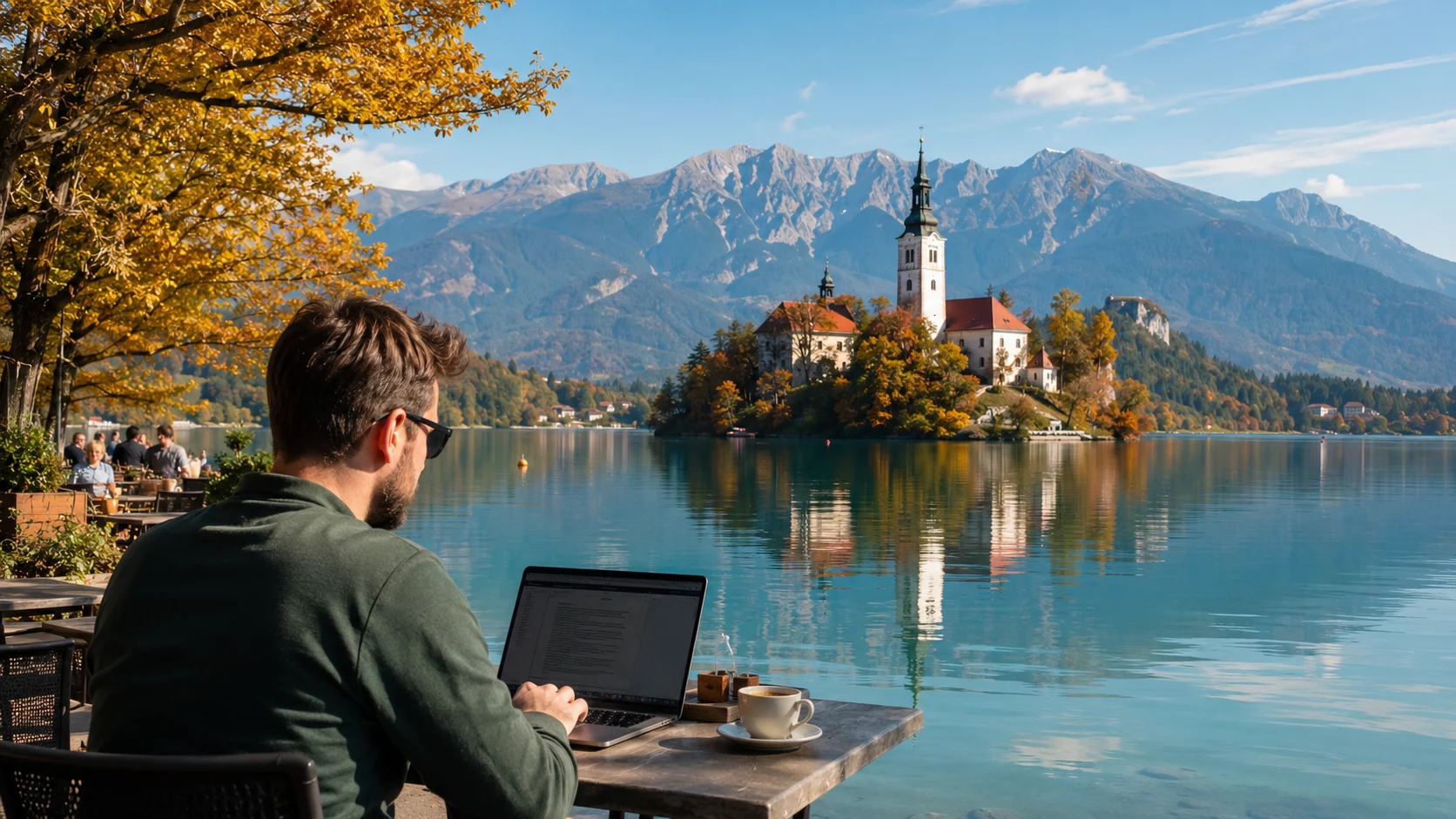
What is the Slovenia digital nomad visa?
The Slovenia digital nomad visa launched on 21 November 2025 under a 2024 amendment to the Foreigners Act (ZTuj-2). It is administered jointly by Slovenia's Ministry of the Interior, local administrative units (upravne enote), and Slovenian consulates abroad. The visa lets non-EU and non-EEA citizens live in Slovenia for up to 12 months while working remotely for a foreign employer or for foreign clients as a self-employed person. Slovenia is the 17th European country with a dedicated nomad route, joining Croatia, Italy, Portugal, Spain, Greece, and others.
The big differentiator versus Slovenia's older work permits is that no Slovenian employer or sponsor is required: you only need to prove income from outside Slovenia. The big catch is that the permit is strictly non-renewable. After your 12 months end, you must spend at least 6 months outside Slovenia (and outside the Schengen area for visa-counting purposes) before you can apply again. That makes Slovenia a great medium-term base for one Alpine year, but not a route to permanent residency or EU citizenship on its own. For PR routes, see the main DN visa guide which compares Portugal, Spain, and other countries that do build toward citizenship.
Slovenia is small (just over 2 million people, roughly the size of New Jersey) but geographically packed: Triglav National Park and the Julian Alps in the north, the 47-kilometre Adriatic coast around Piran in the south-west, the Pannonian plains in the east, and a capital, Ljubljana, that consistently ranks among Europe's most liveable small cities. Average download speeds reach 121 Mbps on fixed connections, ranking in the top 30 globally, and 5G coverage is extensive in Ljubljana, Maribor, and Celje.
Requirements and income threshold
Slovenia's income threshold is pegged to twice the average net monthly Slovenian salary, which works out to approximately EUR 3,200 per month for 2026 (roughly USD 3,450). That is higher than Croatia's EUR 2,540 and Spain's EUR 2,849, broadly in line with Portugal's EUR 3,510, but well below Germany or Estonia. The threshold is recalculated each year based on official statistics published by SURS, the Slovenian statistical office.
| Requirement | Details |
|---|---|
| Income | EUR 3,200/month minimum (2x average Slovenian net salary, ~USD 3,450). Must come from foreign employer or foreign clients. |
| Savings alternative | EUR 38,400 in a bank account covering 12 months of income equivalent (often accepted in lieu of pay slips for freelancers). |
| Health insurance | Private health insurance valid throughout Slovenia and Schengen, minimum EUR 30,000 coverage, valid for the full 12 months. |
| Criminal background | Police clearance certificate from your country of citizenship and any country lived in for the past 5 years, less than 3 months old, apostilled. |
| Proof of remote work | Employment contract with a non-Slovenian employer OR client contracts OR foreign business registration for self-employed applicants. |
| Other | Passport valid 3+ months beyond visa expiry, proof of Slovenian accommodation, biometric photo, completed application form. |
Only non-EU and non-EEA citizens need this visa: EU, EEA, and Swiss nationals can already live and work in Slovenia under freedom of movement. The visa explicitly forbids working for any Slovenian employer or invoicing Slovenian clients. Family reunification is allowed: spouses, registered partners, dependent children, and dependent parents can all be included, though they cannot work in Slovenia on the dependent permit.
Tax treatment
If you stay in Slovenia for more than 183 days in a calendar year, you become a Slovenian tax resident and owe Slovenian personal income tax on worldwide income. Slovenia uses a progressive rate from 16 percent to 50 percent across five brackets, which is on the higher end for Europe. Social security contributions for self-employed residents add roughly 24 percent on top, though digital nomad visa holders working for foreign employers are generally not required to pay Slovenian social contributions if they remain insured at home and document this via an A1 form (for EU/EEA) or a bilateral social security agreement.
If you keep your stay under 183 days in any 12-month period, you are not a Slovenian tax resident and only Slovenian-source income (none, by visa design) is taxed locally. This is the most common strategy: spend 5 to 6 months in Slovenia, the rest elsewhere in Schengen or further afield. Slovenia has double-tax treaties with 60+ countries including the US, UK, Canada, Germany, France, and most of the EU, which prevents double taxation when residency rules overlap. Keep careful records of travel days, as the Slovenian Financial Administration (FURS) can request proof.
How to apply - step by step
Slovenia accepts applications either at a Slovenian consulate abroad, at a Slovenian embassy in your country of residence, or at the local administrative unit (upravna enota) if you are already legally in Slovenia on another permit. Processing currently takes 15 to 60 days depending on the office and the season.
- Confirm eligibility: non-EU/EEA passport, foreign employer or clients, monthly income at or above EUR 3,200, no Slovenian criminal record.
- Gather documents: passport, employment or client contracts, last 3 months of pay slips or bank statements showing income, EUR 38,400 in savings if using the savings alternative, police clearance certificate (apostilled), private health insurance covering Schengen.
- Secure Slovenian accommodation: a 12-month rental contract, property deed, or notarized invitation from a Slovenian resident. Short-term Airbnb is generally not accepted.
- Book an appointment at the Slovenian consulate in your country of residence (Ljubljana operates 50+ consulates worldwide).
- Submit application in person, pay the visa fee of approximately EUR 102, and give biometrics (fingerprints and photo).
- Wait 15 to 60 days for the decision. Approved applicants receive a 12-month residence permit sticker in their passport.
- Enter Slovenia within the validity window. Within 8 days of arrival, register your address at the local administrative unit (upravna enota).
- If you plan to stay more than 90 days in any 6-month period elsewhere in Schengen, track your days carefully under the standard Schengen 90/180 rule, which applies on top of Slovenian residency.
Cost breakdown
| Item | Cost |
|---|---|
| Visa application fee (consulate) | EUR 102 |
| Residence permit card (after arrival) | EUR 50 |
| Apostilled criminal background check | EUR 30 - EUR 150 |
| Certified translations into Slovenian | EUR 200 - EUR 500 |
| Private health insurance (12 months) | EUR 500 - EUR 1,200 |
| Accommodation deposit (2 months rent) | EUR 1,400 - EUR 3,000 |
| Optional immigration lawyer | EUR 1,000 - EUR 3,000 |
| Total first-year minimum | ~EUR 3,500 (DIY) to EUR 8,000 (with lawyer) |
Cost of living
| Item | Ljubljana | Maribor |
|---|---|---|
| Rent 1br city centre | EUR 850 | EUR 500 |
| Food (groceries + eating out) | EUR 450 | EUR 350 |
| Public transport monthly pass | EUR 37 | EUR 25 |
| Coworking hot desk | EUR 150 | EUR 100 |
| Utilities + internet | EUR 200 | EUR 170 |
| Total per month (single) | ~EUR 1,690 | ~EUR 1,145 |
Ljubljana is roughly 35 to 40 percent cheaper than Vienna and 25 percent cheaper than Milan, which is striking given how close all three cities are. Maribor, Slovenia's second city, is another 30 percent cheaper than Ljubljana. Coastal Piran is more expensive in peak summer (June to August) when Italian and Austrian tourists arrive, but very affordable in winter when furnished 1-bedroom apartments rent for EUR 600 to EUR 800.
Family and dependents
Slovenia allows digital nomad visa holders to bring spouses, registered partners, dependent children under 18, dependent children in full-time education up to 26, and dependent parents. Family members apply for dependent residence permits valid for the same 12 months as the main applicant. The income threshold rises by roughly 30 percent for a spouse and 20 percent per child, so a couple with one child must show closer to EUR 4,800 per month.
Dependents cannot work in Slovenia on the dependent permit, but children can attend Slovenian public schools free of charge. Public schools teach primarily in Slovenian, with some bilingual options near the Italian and Hungarian borders. Ljubljana has international schools including QSI International School of Ljubljana and the British International School of Ljubljana, charging EUR 8,000 to EUR 18,000 per year. Private family health insurance with Generali or Triglav runs roughly EUR 80 to EUR 180 per month.
Path to residency
The Slovenia digital nomad visa does NOT lead to permanent residency or citizenship. Time spent on the nomad visa does not count toward Slovenia's 5-year permanent residency rule, and the permit cannot be renewed or converted into another permit category from inside Slovenia. After 12 months you must leave, wait at least 6 months outside Slovenia, and either re-apply for the nomad visa or pivot to a different route such as employment, self-employment with a Slovenian company, study, or family reunification.
If your goal is an EU passport, Slovenia's nomad visa is a poor fit. Consider Portugal's D8 (7-year citizenship route), Spain's DN visa (10-year route), or pursuing ancestry-based citizenship if eligible. Slovenia is best understood as a 12-month Schengen base, not a long-term immigration plan.
Best cities for digital nomads
Ljubljana, the capital, is the primary nomad hub. The car-free Old Town is walkable end to end in 20 minutes, the Ljubljanica river runs through the centre, and Lake Bled (a 50-minute drive) is the most photographed location in Slovenia. Coworking standouts include Poligon Creative Centre, ABC Hub, and HEKOVNIK, with hot desks from EUR 120 per month. Average internet speed in Ljubljana is 200 Mbps on fiber. Public transport (Ljubljanski potniski promet) costs EUR 1.30 per ride.
Maribor, in the wine-growing east, is Slovenia's second city with roughly 95,000 residents. It is significantly cheaper than Ljubljana, has a small but growing tech scene anchored by the University of Maribor, and sits 30 minutes from the Austrian border. Coworking includes Tovarna Podjemov. Celje, the third-largest city, has a small expat community and is well placed for weekend trips to Logarska Dolina valley. For coastal life, Piran (population 4,000) is the postcard town on the Adriatic with Venetian architecture, while nearby Koper has more practical infrastructure for longer stays.
Pros and cons
- ✅ Brand-new programme launched 21 November 2025 - few applicants, low backlog
- ✅ Schengen access from day one (free movement across 29 European countries)
- ✅ Stunning landscape: Alps, Adriatic coast, 12,000 km of marked hiking trails
- ✅ Strong internet (121 Mbps average, 5G in main cities)
- ✅ Central location borders Italy, Austria, Croatia, Hungary
- ✅ English widely spoken in Ljubljana and tourist areas
- ❌ Strictly NOT renewable - hard 12-month cap with 6-month cooldown
- ❌ No path to permanent residency or citizenship
- ❌ Income threshold EUR 3,200/mo higher than Croatia or Czech Republic
- ❌ Slovenian tax (up to 50%) if you exceed 183 days residency
- ❌ Slovenian language barrier outside Ljubljana and the coast
- ❌ Small country (2 million people) - smaller nomad community than Lisbon or Barcelona
अक्सर पूछे जाने वाले प्रश्न
When did the Slovenia digital nomad visa launch?
The visa launched on 21 November 2025, making Slovenia the 17th European country with a dedicated digital nomad route. Applications are processed by Slovenian consulates abroad and local administrative units (upravne enote) inside Slovenia.
Can the Slovenia digital nomad visa be renewed?
No. The permit is strictly non-renewable. After your 12 months end you must leave Slovenia and spend at least 6 months outside the country before you can apply again. This is the single most important restriction to understand before applying.
What is the minimum income for Slovenia's digital nomad visa?
Approximately EUR 3,200 per month (roughly USD 3,450), pegged to twice the average Slovenian net salary. The threshold is recalculated each year based on SURS statistics. Add roughly 30% for a spouse and 20% per dependent child.
Do I pay Slovenian tax on the digital nomad visa?
Only if you stay more than 183 days in a calendar year. Under 183 days you are not a Slovenian tax resident. Over 183 days you owe progressive income tax (16% to 50%) on worldwide income, though double-tax treaties with 60+ countries prevent paying tax twice on the same income.
Can I bring my family to Slovenia on the nomad visa?
Yes. Spouses, registered partners, dependent children under 18 (or up to 26 in full-time education), and dependent parents can all join. Family members get dependent residence permits valid for the same 12 months. They cannot work in Slovenia on the dependent permit but children attend public schools free.
Does the Slovenia nomad visa lead to permanent residency?
No. Time spent on the nomad visa does not count toward Slovenia's 5-year permanent residency rule and the permit cannot be converted to another category from inside Slovenia. For a PR pathway, consider Portugal's D8 (5-year PR, 7-year citizenship) or Spain's DN visa instead.
Can I travel around Schengen on the Slovenia nomad visa?
Yes. The residence permit grants free movement across all 29 Schengen countries for up to 90 days in any 180-day period. You can take long weekend trips to Vienna, Venice, Munich, Zagreb, or Budapest without additional paperwork. Track your days carefully under the Schengen 90/180 rule.
What is the application processing time?
Slovenian consulates and administrative units process digital nomad visa applications in 15 to 60 days, depending on office workload and season. Early 2026 turnaround is on the faster end (under 30 days) as application volumes remain low for the new programme.
संबंधित लेख
हमारे मुफ्त टूल्स का उपयोग करें
कनाडा CRS, ऑस्ट्रेलिया पॉइंट्स, यूके Skilled Worker, जर्मनी Opportunity Card और 34 देशों की वेतन सीमा के लिए मुफ्त कैलकुलेटर।
सभी टूल्स देखें