
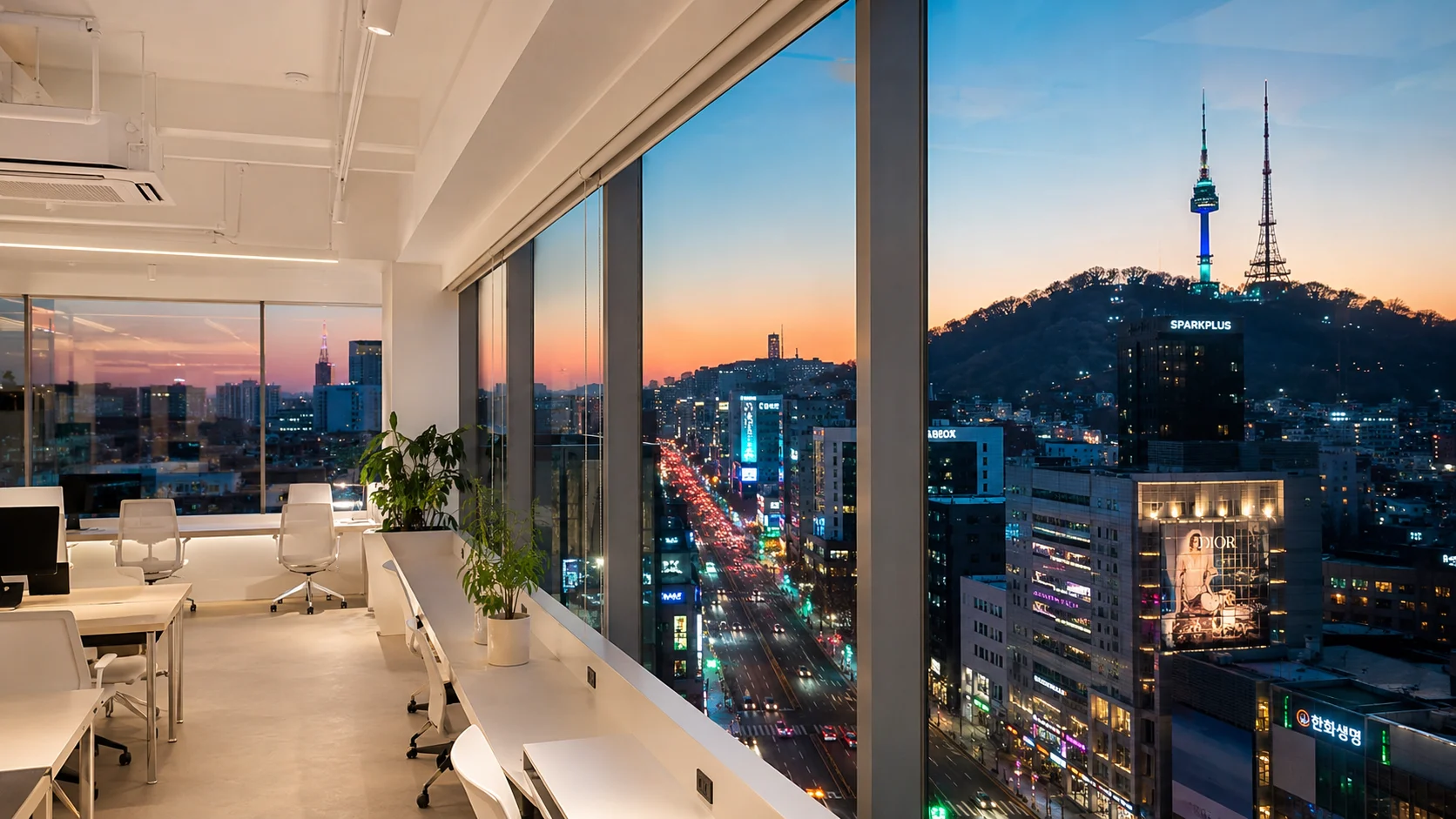
What is the South Korea digital nomad visa?
South Korea introduced the Workation Visa (F-1-D) on 1 January 2024, becoming one of the latest entrants to the global digital nomad visa market. The visa was developed jointly by the Ministry of Justice and the Ministry of Culture, Sports and Tourism, partly in response to the success of Japan's pre-launched nomad visa and rising demand from foreign professionals wanting to experience K-culture firsthand. The F-1-D sits within Korea's broader F-1 (visit) visa class and is specifically subclassed for workation (work + vacation) holders.
The visa is administered by Korean embassies and consulates abroad for initial applications, and by the Korea Immigration Service for renewals. It is issued for one year initially and can be renewed once for another year, giving a maximum stay of 2 years. Unlike Thailand's DTV (5 years) or Indonesia's E33G (5 years), Korea's nomad visa is structurally short-term, reflecting Korea's general caution about extended foreign residence. There is no path from F-1-D to permanent residency or citizenship - the visa is explicitly designed as a temporary cultural and professional experience.
The visa is targeted at higher-income knowledge workers. The income threshold is set at 2x Korea's Gross National Income per capita, which works out to approximately KRW 70.5 million (USD 53,000) per year as of 2026. This makes Korea among the strictest income thresholds globally - significantly higher than Thailand (USD 16,800) or Indonesia (USD 24,000). The trade-off is that successful applicants get to live in one of the most technologically advanced, internet-fast, and culturally vibrant countries in the world.
Requirements and income threshold
The F-1-D has the highest income threshold of any major Asian digital nomad visa. The threshold is pegged at 2x Korea's GNI per capita, currently KRW 70,485,432 (USD 53,000) per year. The Korean government adjusts this annually based on official GNI statistics. Applicants must also demonstrate they have been working remotely for the same employer or in the same self-employed capacity for at least 1 year prior to application.
| Requirement | Detail |
|---|---|
| Income | KRW 70.5 million / USD 53,000 per year minimum (2x Korea GNI per capita) |
| Work history | Minimum 1 year with current foreign employer OR 1 year of self-employed remote work |
| Savings alternative | Not formally accepted as substitute for income |
| Health insurance | Required - minimum KRW 100 million (USD 75,000) coverage for the visa duration |
| Criminal background | Clean police certificate from country of citizenship (apostilled and translated to Korean) |
| Proof of remote work | Employment contract with foreign employer, OR business registration showing self-employed remote work |
| Other | Valid passport (12+ months remaining), application form, biometric photo, KRW 105,000 (USD 80) visa fee, accommodation proof in Korea |
The employer must be incorporated outside Korea. Korean companies and Korean branches of foreign companies do not qualify - the income must genuinely come from foreign business operations. Self-employed applicants typically use a US LLC, UK Ltd, or other foreign business registration as their qualifying entity. Sole proprietors with no formal business registration may struggle to meet the documentation requirements.
Tax treatment
South Korea uses a 183-day tax residency test. If you spend fewer than 183 days in Korea in a calendar year, you are not a Korean tax resident and owe zero Korean tax on your foreign-source income. With a 1-year visa renewable once, most F-1-D holders cross the 183-day threshold and become Korean tax residents during at least one of the two years.
Korean personal income tax is progressive: 6 percent (up to KRW 14 million), 15 percent (up to KRW 50 million), 24 percent (up to KRW 88 million), 35 percent (up to KRW 150 million), 38 percent (up to KRW 300 million), 40 percent (up to KRW 500 million), 42 percent (up to KRW 1 billion), and 45 percent above. For a typical F-1-D holder earning USD 60,000 to 90,000 per year, effective Korean income tax lands around 12 to 20 percent of gross. There is also a 10 percent local resident tax on top of the income tax bill (essentially 10 percent of the tax, not 10 percent of income).
Korea has double tax treaties with over 90 countries including the US, UK, Canada, Australia, all EU states, and most major economies. The treaties prevent double taxation. Foreign-source income is generally taxed only on the portion remitted to Korea for non-resident Korean nationals, but full residents are taxed on worldwide income. The Korean tax authorities are reasonably efficient and most F-1-D holders use a local tax accountant for their first filing year. Note also our Korea EPS work visa guide for an entirely different working visa class.
How to apply - step by step
The F-1-D is applied for at a Korean embassy or consulate outside Korea. Processing typically takes 10 to 30 working days depending on the consulate. Korea's Hi Korea online portal is used for some pre-submission tasks but the final application is in-person at the consulate.
- Confirm income eligibility: at least KRW 70.5 million (USD 53,000) per year of remote work income for at least the past 12 months.
- Gather employment documentation: current contract with foreign employer OR business registration showing self-employed remote operation. Translate to Korean if not in Korean or English.
- Obtain a clean criminal record from your country of citizenship. Apostille and translate to Korean.
- Purchase qualifying health insurance: minimum KRW 100 million (USD 75,000) coverage valid in Korea for the visa duration. Korean insurers (Hanwha, Samsung Fire, Insureon) and international providers (Cigna Global, IMG Global) all sell qualifying policies.
- Secure Korean accommodation: rental contract, hotel booking for first month, or proof of friends/family hosting. At least 30 days proof is typically required.
- Book a Korean embassy or consulate appointment in your country of residence. Some consulates accept walk-ins, others require advance booking (book 2 to 6 weeks ahead).
- Submit application in person. Documents required: passport, biometric photo, application form, income proof (12+ months bank statements + tax returns), employment contract, business registration if self-employed, police certificate, health insurance, accommodation proof. Pay KRW 105,000 (USD 80) visa fee.
- Wait 10 to 30 working days for processing. Decision is communicated by email and visa sticker placed in passport.
- On arrival in Korea, register your address at the local immigration office within 90 days. Receive Alien Registration Card (ARC) which is your Korean ID for the visa duration.
Renewal must be applied for at the Korea Immigration Service inside Korea, at least 30 days before the visa expires. Renewal requires updated income proof, ongoing health insurance, and continued accommodation proof. Maximum one renewal is permitted, after which you must leave Korea (and cannot reapply for F-1-D for at least 6 months).
Cost breakdown
Korea is moderately expensive compared to Southeast Asia but cheaper than Japan for accommodation. The visa fee itself is low but health insurance and Seoul rental deposits add up.
| Item | Cost (USD) |
|---|---|
| F-1-D visa fee (KRW 105,000) | $80 |
| Document translations to Korean | $200 - $500 |
| Apostille fees | $50 - $150 |
| Health insurance (12 months, qualifying) | $1,200 - $2,800 |
| Korean accommodation deposit (key money / wolse) | $1,500 - $5,000 |
| First month rent (Seoul 1br studio) | $700 - $1,400 |
| Alien Registration Card application | $25 |
| Flights to Korea | $700 - $2,500 |
| Total first-year setup | $4,455 - $12,455 |
Korean rental deposits (jeonse or wolse system) are unusual. Some landlords require a deposit of KRW 5 to 20 million (USD 3,800 to 15,000) even for short-term studio rentals - this acts as guarantee, not pre-paid rent. Most F-1-D holders use serviced apartments or sublets to avoid this friction during the visa period. Plan for higher upfront accommodation costs than other Asian destinations.
Cost of living
Seoul is more expensive than Busan or Jeju but offers world-class infrastructure, fastest average internet on Earth, and an unbeatable food and culture scene. Busan is the affordable alternative.
| Item | Seoul | Busan |
|---|---|---|
| Rent (1 bedroom, central) | $700 - $1,400 | $450 - $800 |
| Groceries and home food | $350 - $500 | $300 - $400 |
| Restaurants and street food | $300 - $600 | $200 - $400 |
| Public transport monthly (T-money) | $40 - $60 | $30 - $50 |
| Coworking membership | $200 - $350 | $150 - $250 |
| Mobile and home internet | $50 - $80 | $45 - $70 |
| Health insurance (private) | $100 - $200 | $100 - $200 |
| Total estimated monthly | $1,740 - $3,190 | $1,275 - $2,170 |
Korea has the fastest average internet speeds in the world (200+ Mbps median, with 1 Gbps fibre common). Public transport in Seoul and Busan is exceptional, cheap, and English-friendly. The hidden costs are heating in winter (Korean winters are cold), specialty international groceries (Western products carry import premiums), and bureaucratic translation services (many things still require Korean).
Family and dependents
The F-1-D explicitly supports family members. The primary holder can include their legal spouse and dependent children under 18 with their own F-3 dependent visas. Each family member receives their own residence card and can attend Korean schools or international schools. The income threshold for the primary holder does not increase based on family size, but Korean immigration officers do informally weight income against family size when assessing applications.
Spouses on F-3 dependent visas cannot work for Korean employers without converting to a separate work visa. They can do remote work for foreign clients without restriction. Children attend Korean public schools free of charge (with some local fees), or international schools at USD 15,000 to 50,000 per year (Seoul Foreign School, Yongsan International School, Seoul International School are popular).
Each dependent F-3 visa adds USD 80 in fees plus translation costs. The application is submitted together with the primary holder's F-1-D application or as a separate subsequent family reunification. Korea is generally family-friendly for high-income foreigners but the bureaucratic burden of family applications is higher than in Thailand or Indonesia.
Path to residency
The F-1-D explicitly does NOT provide a direct path to Korean permanent residency or citizenship. Time spent on F-1-D does not accumulate toward Korean residency requirements. The maximum stay is 2 years (1 year initial + 1 year renewal), after which you must leave Korea and cannot reapply for at least 6 months.
If you want a longer-term path in Korea, you would need to switch from F-1-D to a different visa class. Common options include the E-7 (skilled worker, employer-sponsored), F-2 (long-term resident with Korean spouse or significant investment), or F-5 (permanent resident after 5 years of qualifying residence on E or F class visas with KRW 60+ million annual income). Switching requires a sponsoring Korean employer, marriage to a Korean national, or significant investment in Korea.
Korean citizenship is notoriously difficult to obtain. Naturalisation generally requires 5 years of F-5 permanent residency, Korean language proficiency (TOPIK level 3 minimum), passing a Korean culture and history exam, and renunciation of original citizenship. Korea generally does NOT permit dual citizenship for adults (with limited exceptions for those born with dual nationality before age 22). Most F-1-D holders treat Korea as a 1-2 year cultural and professional experience rather than a long-term base.
Best cities for digital nomads
Korea is geographically compact and KTX high-speed trains connect Seoul, Busan, and Daegu in under 3 hours. Most F-1-D holders base in Seoul but explore the country regularly.
- Seoul (capital, 9.5M). The dominant choice. Densest coworking scene (WeWork, Spaces, FastFive, Hive Arena), strongest English-speaking community, world-class internet (avg 250 Mbps), best food culture in Asia. Best neighbourhoods: Gangnam (modern, business), Hongdae (young, creative), Itaewon (international, expat-friendly), Yeonnam (cafe and gallery scene), Seongsu (hip industrial chic).
- Busan (south coast, 3.4M). The relaxed alternative. Korea's second city is a beach and seafood destination with a more laid-back vibe. Coworking: Coworking Busan, BIFC Busan. Significantly cheaper rent than Seoul (40 to 50 percent less). Best for nomads who want Korean infrastructure and culture without Seoul intensity.
- Jeju (island, 700K). Korea's Hawaii. Volcanic island in the south with dramatic landscapes, beach scene, hiking, and a smaller but established digital nomad community. Coworking: Jeju Coworking Centre. Best for nomads who want Korean food and culture in a more rural island setting. Trade-off: less infrastructure than Seoul, smaller English-speaking community.
Pros and cons
Korea is exceptional for infrastructure and cultural experience but has clear limits on duration and the highest income threshold in Asia.
- Pro: World's fastest average internet (200+ Mbps median, 1 Gbps fibre common)
- Pro: Best public transport infrastructure of any major nomad destination
- Pro: Vibrant K-culture immersion (K-pop, K-drama, food, fashion)
- Pro: World-class healthcare with English-speaking international clinics
- Pro: Seoul has the densest cafe and coworking ecosystem in Asia
- Pro: Family inclusion via F-3 dependent visas
- Pro: Korean food culture is arguably best in Asia for diversity and quality
- Con: Income threshold of USD 53,000/yr is the highest in Asia
- Con: Maximum 2 years stay (1+1), no path to PR or citizenship
- Con: Korean language barrier outside Seoul and Busan international neighbourhoods
- Con: Korean rental deposit (key money) requirements can be USD 3,800 to 15,000+
- Con: Cannot work for Korean employers on F-1-D
- Con: Long, cold winters (December to February)
अक्सर पूछे जाने वाले प्रश्न
How much income do I need for the Korea F-1-D?
At least KRW 70.5 million per year (approximately USD 53,000) from remote work for a foreign employer or self-employment. This is 2x Korea's GNI per capita and is adjusted annually. You also need to have been earning this income for at least 12 months prior to application. Korea has the highest income threshold of any major Asian digital nomad visa.
Can I work for a Korean company on the F-1-D?
No. The F-1-D strictly prohibits working for Korean employers or earning Korean-source income. It is only for remote work with foreign clients and employers. To work for a Korean company you need a separate E-series work visa (E-7 for skilled professional, E-1 for professor, etc.) which requires Korean employer sponsorship.
How long can I stay in Korea on the F-1-D?
Maximum 2 years total. The visa is issued for 1 year initially and can be renewed once for another 1 year. After 2 years, you must leave Korea and cannot reapply for F-1-D for at least 6 months. There is no path from F-1-D to a longer-term visa within Korea except by getting Korean employer sponsorship or marrying a Korean national.
Does the F-1-D lead to permanent residency or citizenship?
No. The F-1-D is explicitly a short-term visa and time spent on it does not count toward Korean PR or citizenship requirements. To pursue Korean residency, you would need to switch to a sponsored E-series work visa or F-2 (long-term resident) visa and accumulate years there. Korean citizenship is notoriously difficult and generally requires renunciation of original citizenship.
Do I pay Korean tax on my foreign income?
If you stay more than 183 days in any calendar year, yes. As a Korean tax resident, you owe Korean income tax on worldwide income, with credit available against home-country taxes via double tax treaty. For typical F-1-D holders earning USD 60,000 to 90,000, effective Korean income tax lands around 12 to 20 percent of gross plus a 10 percent local resident surcharge on the tax bill.
Can I bring my spouse and children?
Yes. Family members can apply for F-3 dependent visas alongside or after the primary F-1-D. Spouses can do remote work for foreign clients but cannot take Korean employment. Children attend Korean public schools free of charge or international schools (Seoul Foreign School, Yongsan International School) at USD 15,000 to 50,000 per year. Each dependent visa adds USD 80 in fees.
How does Korea compare to Japan's nomad visa?
Japan and Korea both launched dedicated nomad visas in 2024 with similar high income thresholds (Japan requires JPY 10 million / USD 67,000). Japan's visa is shorter (just 6 months, not renewable). Korea offers 1+1 = 2 years and a slightly lower income bar. Korea has faster internet and denser coworking; Japan has stronger international business community and arguably better English signage. Both target high-income knowledge workers.
What is key money and why does it matter?
Key money (jeonse in Korean) is the Korean rental deposit system where you pay a large refundable deposit instead of monthly rent, or a smaller deposit plus monthly rent (wolse). For 1-year studio rentals in Seoul, deposits typically range KRW 5 to 20 million (USD 3,800 to 15,000) plus USD 500 to 1,000 monthly rent. F-1-D holders often use serviced apartments or short-term sublets to avoid the deposit burden, paying higher monthly rent but skipping the lump-sum deposit.
संबंधित लेख
हमारे मुफ्त टूल्स का उपयोग करें
कनाडा CRS, ऑस्ट्रेलिया पॉइंट्स, यूके Skilled Worker, जर्मनी Opportunity Card और 34 देशों की वेतन सीमा के लिए मुफ्त कैलकुलेटर।
सभी टूल्स देखें