
Work permit + ARC process
Taiwan operates a two-step residence system for foreign teachers. First, your employer obtains a work permit (employment permit) from the Ministry of Labor. This document authorises you to work for that specific employer in Taiwan. Second, after you arrive in Taiwan on the resident visa stamped at your nearest Taiwan representative office, you apply for an Alien Resident Certificate (ARC) at the National Immigration Agency. The ARC is the physical card that proves your legal residence and gives you access to banking, healthcare, mobile phone contracts, and visa-free re-entry to Taiwan.
Work permits are tied to specific employers. If you change jobs you need a new work permit. However, transferring is far easier than in Korea's E-2 system - you can begin a new work permit application before your current one expires and there is no mandatory waiting period or return-home requirement. The work permit is initially valid for 1 to 3 years and renewable. After 5 years of continuous legal residence in Taiwan you can apply for APRC (Alien Permanent Resident Certificate) which decouples you from any single employer and gives indefinite residence.
Taiwan also operates a Gold Card scheme for highly skilled foreign workers in selected fields, which combines work permit, resident visa, and ARC into a single 1-to-3-year document. Foreign teachers with PhDs in education, university teaching experience, or specialised skills (early childhood education, special needs) increasingly qualify under Gold Card. Standard TEFL teachers go through the conventional work permit + ARC route described above.
TFETP - Taiwan Foreign English Teaching Program
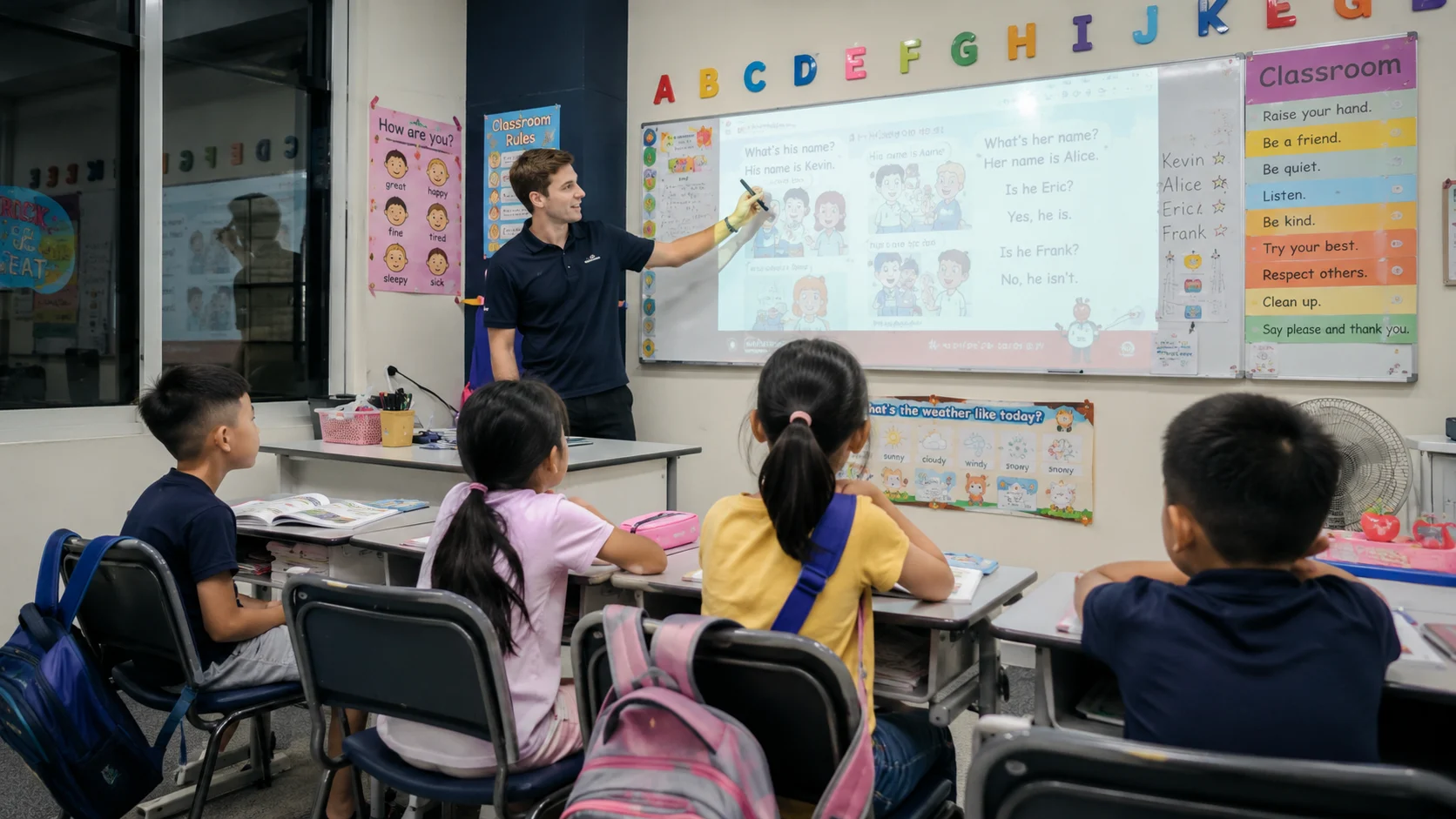
TFETP is Taiwan's government-administered program for placing foreign English teachers in public elementary and high schools across all 22 cities and counties of Taiwan. The program is run by the Foundation for International Cooperation in Higher Education of Taiwan (FICHET) under the Ministry of Education. TFETP is part of Taiwan's 2030 Bilingual Nation Policy, which aims to have Taiwan operating as a bilingual Mandarin-English society by 2030.
TFETP teachers work 22 contact hours per week (plus 8 to 10 hours of planning, meetings, and extracurricular support) in public schools. Salary is NT$62,000 to NT$72,000 per month depending on qualifications and years of teaching experience, plus a housing allowance of NT$8,000 to NT$12,000 per month. National Health Insurance is provided. Annual return flight is included for teachers who complete the full contract. The school year is August through July with normal Taiwanese public school holidays (winter break end-January to mid-February, summer break July to August).
| Qualification level | TFETP monthly salary NT$ | USD equivalent |
|---|---|---|
| Bachelor's + TEFL/CELTA | 62,000-66,000 | 1,940-2,070 |
| Bachelor's in Education or English | 65,000-70,000 | 2,030-2,190 |
| Master's degree + teaching cert | 70,000-72,000 | 2,190-2,250 |
| State teaching licence + 2+ yrs exp | 70,000-75,000 | 2,190-2,350 |
| Plus housing allowance | 8,000-12,000 | 250-375 |
| Plus flight reimbursement annual | 25,000 | 780 |
TFETP is competitive. Applications open in January each year for the August intake; only about 500 teachers are selected from 2,000+ applicants. Priority goes to applicants with state teaching licences, education degrees, or experience teaching young learners (ages 6 to 15). The application process includes an essay, references, a video introduction, and an online interview. Successful applicants are matched to specific schools in May or June and receive their work permit before August arrival.
Cram schools (buxiban) - the bigger market
Cram schools, called buxiban in Mandarin, are the much larger English teaching market in Taiwan. Buxibans are private after-school programs catering to children aged 3 to 18, plus some adult business English programs. There are an estimated 10,000+ buxibans across Taiwan and roughly 5,000 of them employ foreign English teachers. Hiring happens year-round (peak demand August-September and January-February) and the application-to-classroom timeline can be as fast as 4 weeks.
Salary structure differs from TFETP. Buxibans pay hourly: NT$600 to NT$800 per teaching hour for part-time work, or NT$60,000 to NT$75,000 per month for full-time roles (which usually means 25 teaching hours per week plus prep time). The trade-off is hours: buxibans operate after school, so the typical schedule is 2pm or 3pm start through 9pm or 10pm finish, Monday through Friday or Tuesday through Saturday. Most foreign teachers find buxiban hours initially difficult then come to appreciate having mornings free for language study, gym, or freelance work.
| Major buxiban chain | Locations | Salary monthly NT$ | Hours/week |
|---|---|---|---|
| Hess Educational Organization | Nationwide, 200+ branches | 60,000-66,000 | 25-30 |
| Joy English (Kid Castle) | Nationwide, 150+ branches | 58,000-64,000 | 22-28 |
| Kojen English | Taipei and major cities | 62,000-70,000 | 25-30 |
| Shane English School | Taipei, Taichung, Kaohsiung | 60,000-66,000 | 22-28 |
| ELI (English Language Institute) | Taipei, Hsinchu, Taichung | 65,000-75,000 | 25-30 |
| Independent buxibans | Local | NT$600-800/hr | Variable |
Large chains like Hess and Joy are the safest entry point for first-time Taiwan teachers. They handle work permit applications, provide initial training (usually 1 to 2 weeks unpaid orientation), and have HR staff who speak English. Independent buxibans pay more per hour but the legal protection is weaker and some operate in grey-zone work permit arrangements that can leave teachers exposed. Stick with major chains for at least your first contract.
Salary breakdown and savings
Taiwan offers one of the best salary-to-cost-of-living ratios in Asia. Cost of living in Taipei is roughly 40 to 50 percent of Tokyo or Seoul, and Kaohsiung or Tainan are even cheaper. A full-time TFETP or buxiban teacher earning NT$70,000 per month can comfortably save NT$25,000 to NT$35,000 per month after rent, food, transport, healthcare, and entertainment. That is USD 780 to USD 1,090 per month in savings, similar to Korean EPIK savings rates and significantly better than Japan JET program savings.
| Monthly expense | Typical NT$ | USD equivalent |
|---|---|---|
| Gross salary | 70,000 | 2,190 |
| Rent (small Taipei apartment 1-bed) | -15,000 to -22,000 | -470 to -690 |
| Rent (room in shared apt) Taipei | -9,000 to -14,000 | -280 to -440 |
| Food (mix of home cooking + night markets) | -12,000 to -18,000 | -375 to -560 |
| Transport (Taipei MRT + bus + bike) | -1,500 to -2,500 | -47 to -78 |
| National Health Insurance | -1,200 (employer pays employer share) | -37 |
| Mobile + internet | -1,200 | -37 |
| Entertainment + dining out | -5,000 to -10,000 | -155 to -310 |
| Estimated monthly savings | 20,000-35,000 | 625-1,090 |
Taipei rent is the largest single cost. A small 1-bedroom apartment in the city centre runs NT$15,000 to NT$22,000 per month. A room in a shared apartment can be as low as NT$9,000. Living in Kaohsiung, Tainan, Taichung, or smaller cities drops rent by 30 to 50 percent. Many teachers in Tainan, Hualien, or Taitung report saving NT$30,000 to NT$40,000 per month on similar salaries because of the lower rent and lifestyle costs.
Food is famously cheap. Night market dinners cost NT$80 to NT$200 (USD 2.50 to USD 6). A bento box lunch is NT$80. A bubble tea is NT$50. Eating well in Taiwan costs less than eating mediocrely in most Western capitals. Most teachers' food budget actually falls after they discover the local food scene.
Step-by-step visa process
The Taiwan work permit and resident visa process is among the fastest in Asia. From signed contract to ARC card in your hand typically takes 5 to 8 weeks total. Below is the standard sequence assuming you are hired by a Taiwan-licensed employer (buxiban chain, public school via TFETP, or university).
- Secure a job offer and sign the contract. The school typically reviews your degree, TEFL, passport scan, and criminal background check before issuing the offer.
- School submits work permit application to Ministry of Labor with your documents. Processing takes 4 to 6 weeks (TFETP can be faster, independent buxibans sometimes slower).
- Once work permit is approved you receive an electronic copy by email. You take this to the nearest Taipei Economic and Cultural Office (TECO) in your home country to apply for a resident visa.
- TECO issues the resident visa within 2 to 5 working days. Visa fee is around USD 100 to USD 160 depending on jurisdiction.
- Fly to Taiwan on the resident visa. Note: resident visa is valid for 90 days entry but you must enter within 3 months of issue.
- Within 15 days of arrival in Taiwan, apply for ARC at the National Immigration Agency (NIA) office in your city. Bring: passport, resident visa, work permit, employment contract, signed lease or accommodation proof, ARC application fee NT$1,000 per year of validity.
- ARC card issued within 7 working days. NIA will collect biometrics and stamp your passport.
- After 6 months of residence in Taiwan you become eligible for National Health Insurance enrolment (mandatory; premiums NT$1,200 per month for employee share, employer pays NT$3,500 share).
Many teachers underestimate the document preparation step. Your bachelor's degree certificate must be authenticated by the Taipei Economic and Cultural Office (TECO) in your home country before submission. Authentication involves: (1) notarising your degree, (2) certifying the notarisation at your state Secretary of State or federal authentication office, (3) submitting both to TECO for the final Taiwan authentication stamp. Total process takes 3 to 6 weeks. Start early. For visa photo specifications (35x45mm, white background, taken within 6 months) refer to our visa photo requirements guide.
Required documents
Taiwan's work permit requirements are relatively standard but the authentication chain is the part that most catches first-time applicants off guard. Below is the full checklist for the standard teacher work permit (Ministry of Labor Class 1 employment permit).
- Bachelor's degree certificate (any field accepted). Must be authenticated through your local notary public, then state-level Secretary of State or federal authentication office, then the Taipei Economic and Cultural Office (TECO) in your country. Total cost USD 100 to USD 200, time 3 to 6 weeks.
- TEFL/CELTA certificate. Most employers want minimum 120-hour TEFL. TFETP requires CELTA, DELTA, PGCE, or state teaching licence. Standard TEFL certificate does not require TECO authentication for buxiban roles but TFETP requires it.
- Passport with at least 6 months remaining validity at the time of work permit application.
- Criminal background check from your country (FBI for US, DBS for UK, RCMP for Canada, AFP for Australia, NZ Police for New Zealand). Issued within 6 months. Apostille or TECO authentication depending on country.
- Health check at a Taiwan-approved hospital AFTER arrival in Taiwan. Tests include HIV antibody, syphilis screening, hookworm stool test, chest x-ray for TB, plus visual and physical exam. Cost NT$1,500 to NT$3,000. Done within 30 days of arrival.
- Recent passport-sized photos (35x45mm, white background, taken within 6 months) - minimum 4 copies.
- Signed employment contract (English or bilingual).
- For dependents - marriage certificate (authenticated), children's birth certificates (authenticated), all submitted with primary work permit application.
Native speaker rules in Taiwan are explicit. Ministry of Labor regulations limit standard English teaching work permits to citizens of: United States, Canada, United Kingdom, Ireland, Australia, New Zealand, and South Africa. Other nationalities (India, Philippines, Singapore) can teach in Taiwan but only at universities or international schools that hold special category permits, not at standard buxibans. Filipino teachers have become increasingly common in Taiwan over the past 5 years through these special permits.
Why Taiwan instead of Korea
Many teachers considering East Asia weigh Taiwan against South Korea. Both offer similar gross compensation, free or subsidised housing in some cases, and well-developed teaching infrastructure. The differences matter though, and most experienced teachers who have done both have strong preferences. Read our Korea E-2 visa guide for the full Korea picture, but here is the short comparison.
| Factor | Taiwan | South Korea |
|---|---|---|
| Visa processing time | 2-4 weeks fast | 8-12 weeks |
| Salary monthly USD | 1,900-2,500 | 2,000-2,800 |
| Free housing provided | Rare (housing allowance instead) | Standard at EPIK + most hagwons |
| Cost of living | Low | Mid-high |
| Net savings potential | Similar | Similar |
| Cultural openness to foreigners | Very high, friendly | More reserved |
| Eligible nationalities | 7 countries inc South Africa | 7 countries excl South Africa |
| Permanent residence after | 5 years | 5 years (F-2 visa earlier) |
| Mandarin learning value | Excellent base | n/a |
| Working hours typical | 22-30/week | 22-30/week |
Taiwan wins on cultural ease for foreigners. Taiwanese society is famously friendly and curious about foreigners, with very low harassment, high English signage in major cities, and an enormous expat community well-integrated into local life. Korea remains more culturally insular and the workplace culture in hagwons can be high-pressure. Taiwan wins on visa flexibility too: changing employers, renewing ARC, and qualifying for APRC are all materially easier in Taiwan than Korea's E-2 to F-2 to F-5 ladder.
Korea wins on structured programs (EPIK is more organised than TFETP), higher gross salaries at the top end, and the cultural appeal for K-pop and K-drama enthusiasts. Korea also provides housing as standard at most schools, whereas Taiwan teachers usually have to find their own apartment with a housing allowance to offset. If you are deciding between China, Korea, and Taiwan, also see our China teaching visa guide which covers the higher-paying but more bureaucratic Chinese market.
Sık sorulan sorular
How much can I save per month teaching in Taiwan?
Most full-time TFETP or buxiban teachers save NT$20,000 to NT$35,000 per month (USD 625 to USD 1,090). Teachers outside Taipei (Kaohsiung, Tainan, Taichung, Hualien) often save NT$30,000+ because rent is 30 to 50 percent lower. Adding 5 to 10 hours of private tutoring at NT$600 to NT$1,000 per hour can push savings to NT$45,000 (USD 1,400) per month.
How fast is the Taiwan teaching visa process?
Taiwan is the fastest teaching visa in Asia. From signed contract to ARC card in hand typically takes 5 to 8 weeks total. Work permit is 4 to 6 weeks. Resident visa stamping at TECO is 2 to 5 working days. ARC after arrival is 7 working days. Document authentication (degree at TECO before applying) takes 3 to 6 weeks of preparation upfront.
Can I teach in Taiwan without a TEFL certificate?
Some buxibans hire native English speakers with just a Bachelor's degree, but the vast majority of reputable employers (chain buxibans, public schools, universities) require at least a 120-hour TEFL or equivalent. TFETP requires CELTA, DELTA, PGCE, or state teaching licence. Without TEFL you will be limited to lower-tier independent buxibans, which often pay less and offer weaker legal protections.
What are the biggest scams in Taiwan teaching?
Three main scams. First, fake work permits - some independent buxibans hire teachers on tourist visas and claim they will arrange the work permit later (which often never happens). This puts you at risk of deportation. Second, contract bait-and-switch where the offered hours or pay differs from the actual arrangement. Third, fake recruiters charging upfront fees - legitimate Taiwan employers never charge candidates. Stick with major chains for your first contract.
Can I bring my spouse and children on a Taiwan teaching visa?
Yes. Spouses and unmarried children under 20 can join you on dependent ARCs. Your work permit must show monthly salary above a threshold (around NT$48,000) which all full-time teaching roles meet. Spouses can study or work in Taiwan after obtaining their own work permit or open work right. Most international schools offer fee discounts of 30 to 100 percent for teachers' own children.
Do non-native English speakers have any path to teach in Taiwan?
Yes, but limited. Standard buxiban work permits require nationality from one of 7 countries (US, Canada, UK, Ireland, Australia, New Zealand, South Africa). Non-native English speakers from other countries can teach in Taiwan at universities holding special category permits, at international schools (with specialist subject expertise), or in Mandarin-medium schools as subject teachers. Filipino teachers have become increasingly common over the past 5 years through these alternative routes.
What is the cost of living in Taipei vs other Taiwan cities?
Taipei is the most expensive Taiwan city, with 1-bed apartment rents of NT$15,000 to NT$22,000 (USD 470-690). Kaohsiung 1-bed is NT$8,000 to NT$13,000 (USD 250-410). Tainan even cheaper at NT$6,000 to NT$11,000. Food, transport, and entertainment are similar across all Taiwan cities. Living outside Taipei can effectively give you NT$10,000+ per month in additional disposable income on the same salary.
Can I get permanent residence in Taiwan after teaching?
Yes, after 5 consecutive years of legal residence on ARC you can apply for APRC (Alien Permanent Resident Certificate), Taiwan's permanent residency. APRC has no employer restriction, allows freelance and self-employment, and is valid indefinitely (renewable every 10 years). Requirements include continuous residence (no absences over 183 days per year), demonstrated financial means, and no serious criminal record. Many long-term teachers convert to APRC and then to citizenship after 10 years total.
İlgili makaleler
Ücretsiz araçlarımızı kullanın
Kanada CRS, Avustralya puanları, İngiltere skilled worker, Almanya Fırsat Kartı ve 34 ülke maaş eşikleri için ücretsiz hesaplayıcılar.
Tüm araçları gör