
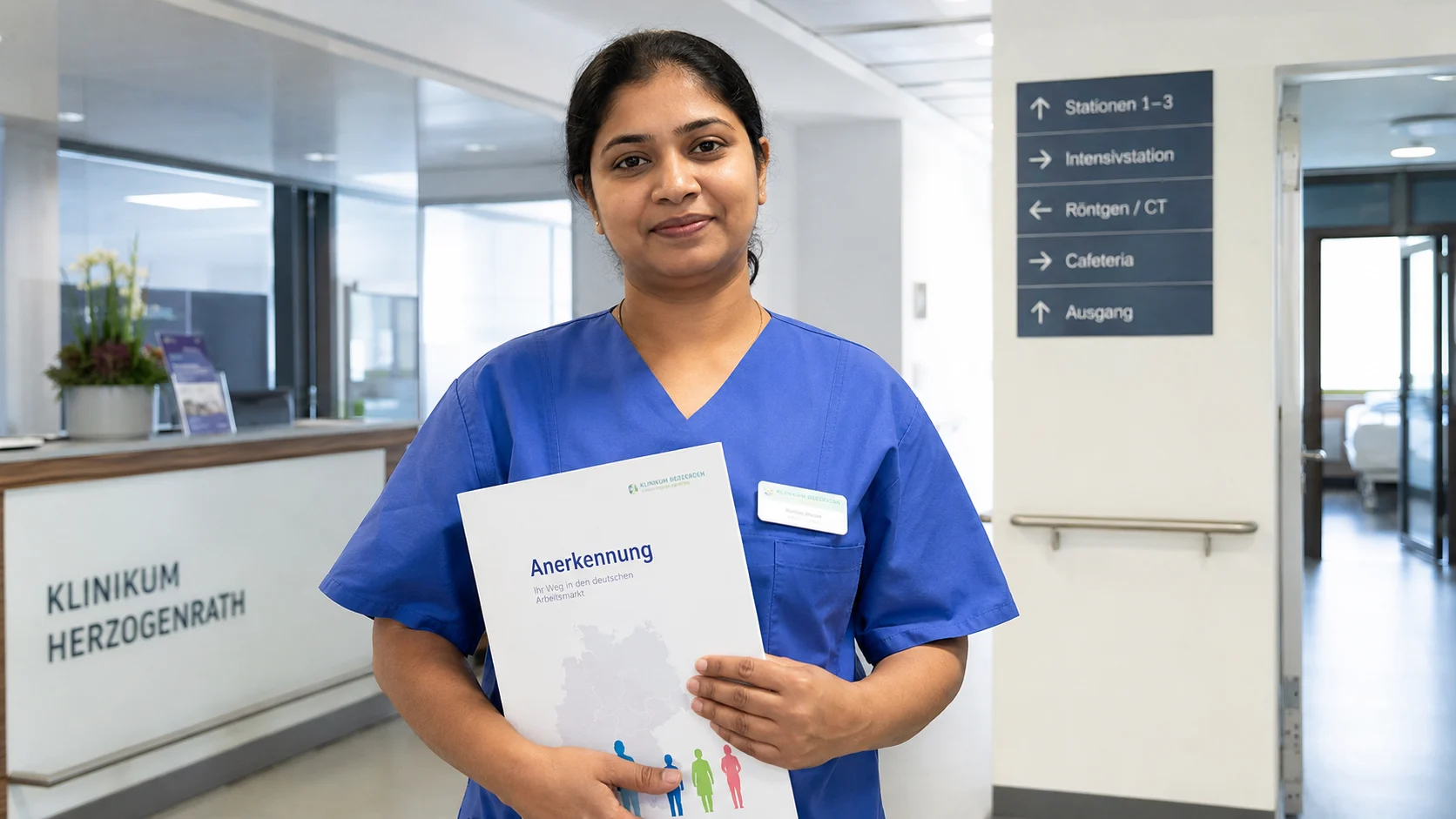
Why Germany is recruiting foreign carers
Germany is ageing fast and its care system is running short of staff. As of 2026, projections point to a care-worker shortage of 350,000 to 500,000 by 2035, one of the largest gaps in Europe. This is not a temporary blip tied to a single year of demand; it is a structural shortfall driven by a large retiring generation and a shrinking domestic workforce entering nursing and elder care.
That pressure has turned Germany into one of the most active recruiters of foreign nurses and caregivers on the planet. Federal and state authorities, hospital groups, nursing-home operators, and care providers run dedicated recruitment programmes, and the legal framework has been reshaped to let qualified care professionals move, work, and settle. For a skilled nurse who is willing to learn German and complete recognition, Germany is one of the strongest long-term destinations available, with a clear pathway to permanent residency.
It helps to be precise about the difference between roles. In German, a fully recognised, three-year-trained nurse is a Pflegefachfrau or Pflegefachmann (the gender-neutral and updated qualification standard). Below that sit care assistants and nursing aides with shorter training. The highest pay, the cleanest visa routes, and the fastest settlement all flow to people who can have their qualification recognised against the Pflegefachfrau/-mann standard, so that is what most of this guide focuses on. For a wider view of how Germany compares with Italy, Japan, Korea, and Canada, see our caregiver visa worldwide guide and the cluster hub on countries facing worker shortages.
Recognition of your qualification (Anerkennung)
Recognition, in German Anerkennung, is the single most important step and the one most applicants underestimate. Germany does not automatically accept a foreign nursing diploma. Your qualification has to be formally compared against the German Pflegefachfrau/-mann standard, and you can only work as a fully qualified nurse once that comparison results in recognition. Without it, you are limited to assistant-level roles at assistant-level pay.
Two bodies matter here. The ZAB (Zentralstelle fuer auslaendisches Bildungswesen, the Central Office for Foreign Education) is the central national authority that evaluates foreign qualifications and issues assessments. Alongside it, the actual decision on a regulated profession like nursing is made by the state recognition authority (the competent body in the German Bundesland where you intend to work), because nursing recognition is administered at state level. In practice you typically apply to the recognition authority of the state where your future employer is located.
The assessment compares your training and experience to the German standard and produces one of three outcomes. If it matches, you get full recognition. If there are significant gaps, you receive a partial or deferred decision and must close those gaps through either an adaptation course (Anpassungslehrgang, supervised practical training at a German facility) or a knowledge test (Kenntnispruefung, an examination of theory and practice). Most internationally trained nurses go through one of these two routes before reaching full recognition, so plan for it from the start rather than treating it as an afterthought.
You do not always have to finish recognition before you arrive. Germany deliberately created routes that let you enter while recognition is still in progress, including the recognition partnership and the visa for the purpose of recognition under Section 16d (covered below). That said, completing as much as possible from home, including a German-language CV, certified translations, and your application to the state authority, makes everything faster once you land.
Visa routes for nurses and caregivers
There is no single "care worker visa" in Germany. Instead, several routes lead to care work, and the right one depends on whether your qualification is already recognised, whether you have a job offer, and your salary level. The table below maps the main options as of 2026.
| Route | Best for | Key requirement | Notes |
|---|---|---|---|
| Skilled Worker Visa | Nurses with full recognition + job offer | Recognised qualification, employment contract | Standard route for qualified Pflegefachkraefte |
| EU Blue Card | Higher-paid recognised nurses | Recognised degree + salary above the Blue Card threshold | Faster settlement; see the EU Blue Card guide |
| Recognition partnership / Section 16d | Nurses still completing recognition | Recognition started + employer/training agreement | Enter Germany while finishing Anerkennung |
| Opportunity Card (Chancenkarte) | Job-seekers without an offer yet | Points-based: qualification, German, experience, age | Look for work on the ground; use the calculator |
The skilled worker visa is the main route for recognised professionals. Once your nursing qualification is recognised and you have a German employment contract, this is the standard path into the country and into a Pflegefachfrau/-mann role at full pay.
The EU Blue Card is available to qualifying nurses whose recognised qualification and salary meet the Blue Card thresholds. It is worth chasing where you qualify, because it offers the fastest route to a settlement permit and the most generous rules on family and mobility within the EU. Not every care role pays enough to clear the Blue Card salary bar, so check the current threshold before assuming you are eligible.
The recognition partnership and the visa for the purpose of recognition (Section 16d) exist specifically for people who are still completing Anerkennung. Under a recognition partnership you can come to Germany with an employer who commits to supporting you while you finish the recognition steps (adaptation course or knowledge test) alongside working. Section 16d more broadly allows entry for the purpose of having your qualification recognised. These routes are how many nurses actually get in: they start the process from home, then complete it in Germany with a guaranteed employer behind them.
Finally, the Opportunity Card (Chancenkarte) is a points-based job-seeker route. It does not require a job offer up front; instead you score points for your qualification, German level, work experience, age, and ties to Germany, and if you reach the threshold you can come to look for work on the ground. It suits carers who are confident they can secure an offer once they are in the country. Estimate your points first with our Opportunity Card calculator.
The German language requirement
Be honest with yourself about this: German is the main barrier, not the visa paperwork. Care work means communicating with vulnerable patients, families, doctors, and colleagues, so language ability is treated as a patient-safety issue, not a nice-to-have. As of 2026, care roles generally require B1 to B2 German on the Common European Framework, with B2 increasingly expected for fully qualified nursing positions and B1 often accepted to start a recognition partnership.
The two main testing and teaching pathways are the Goethe-Institut and telc (including telc Deutsch Pflege, a German exam tailored to nursing vocabulary). Both are widely recognised by employers and recognition authorities. Reaching B2 from scratch typically takes many months of serious study, and this is where most timelines slip. The applicants who succeed treat German as the first investment they make, often beginning in their home country well before they apply for anything.
There is a silver lining: language is the gate, but it is also the lever. Reaching B1 and then B2 not only unlocks the visa and recognition, it also speeds up your route to permanent residency, because settlement rules reward stronger German. In other words, the effort you put into German pays off twice.
What care workers earn in Germany
Pay is where Germany stands out. As of 2026 data, care workers can earn up to around EUR 1,705 per month net, which is the highest net caregiver pay among the major destination countries we compare. That figure is a net (take-home) amount after German taxes and social contributions, which is why it is so useful for comparison: many countries quote gross salaries that look larger but shrink sharply after deductions.
It is important to understand gross versus net. German payslips deduct income tax plus contributions for health insurance, pension, unemployment, and long-term care insurance, so your gross salary is meaningfully higher than what lands in your account. The flip side is that those deductions buy you genuine health coverage and pension rights from day one. Pay also varies by region (employers in higher-cost western and southern states often pay more than in the east), by employer type (hospital, nursing home, or home care), by your recognition status, and by collective wage agreements (Tarifvertrag), which lift pay where they apply.
| Item | Detail (as of 2026) | Note |
|---|---|---|
| Top net pay | Up to ~EUR 1,705/mo net | Highest among major caregiver destinations |
| Gross vs net | Gross is higher; deductions fund health, pension, care | Net is the realistic take-home figure |
| Regional variation | West/south often higher than east | Tarifvertrag agreements raise pay where in force |
| Recognition impact | Full Pflegefachkraft pays more than assistant roles | Another reason to complete Anerkennung |
For comparison with lower-paid but quota-driven routes, see our guides on the Italy caregiver visa and the South Korea worker visa. Germany usually wins on net pay and on the strength of its long-term settlement pathway, while trading off a tougher language and recognition barrier up front.
Step-by-step: from qualification to settlement
The order of steps matters, because some can run in parallel and the language work should start first. Here is the sequence most successful applicants follow.
- Get your nursing qualification recognised (Anerkennung) through the state recognition authority and ZAB, or formally start a recognition partnership if you will finish in Germany.
- Reach the required German level (B1 to start, B2 for full nursing roles) via Goethe-Institut or telc, ideally beginning in your home country.
- Secure an employer or job offer (a hospital, nursing home, or care provider), or qualify for the Opportunity Card to job-seek on the ground.
- Apply for the right visa (skilled worker, EU Blue Card, Section 16d / recognition partnership, or Opportunity Card) at your German mission.
- Work in Germany, completing any adaptation course or knowledge test needed to reach full recognition if you arrived part-way through.
- Apply for a settlement permit (permanent residency) once you meet the time, language, and contribution conditions.
The timeline below shows how those steps stack up and where the route to permanent residency sits. Treat the durations as planning estimates as of 2026, not guarantees, because processing times vary by state, by mission, and by individual case.
| Stage | Typical duration (2026 estimate) | What moves it faster |
|---|---|---|
| German B1-B2 | 6-18 months of study | Starting early, intensive courses, telc Pflege |
| Recognition (Anerkennung) | 3-12 months (longer with adaptation/test) | Pre-submitting documents, partial start abroad |
| Job offer + visa | 2-6 months | Employer-led recruitment programmes |
| To settlement permit | 21-33 months total | B1/B2 German shortens the qualifying period |
Permanent residency in 21-33 months
One of Germany's biggest selling points for carers is how quickly settlement can come. As of 2026, recognised skilled workers and EU Blue Card holders can reach a settlement permit (permanent residency) in roughly 21 to 33 months, and the exact point depends heavily on your German level. Stronger German (B1 and especially B2) shortens the qualifying period, which is yet another reason language is worth front-loading.
The mechanism runs through the skilled-worker and Blue Card settlement rules. In broad terms, you need a qualifying period of employment, the relevant German language level, sufficient pension contributions over that period, secure income, and adequate accommodation. The Blue Card generally offers the shortest path to settlement when you meet its salary and language conditions, while the standard skilled-worker route takes a little longer. Permanent residency then removes the renewal cycle and, in time, opens the door to naturalisation.
For a country-level overview of living and working in Germany, see our Germany country guide. And before you submit anything, read our guide to common visa rejection reasons, because incomplete recognition paperwork and weak proof of German are two of the most frequent and avoidable reasons care-worker applications stall.
Routes by nationality and next steps
The exact documents, mission, and processing times depend on where you apply from. We maintain nationality-specific guides that walk through the Germany route from particular countries, including two of the larger source nations for care recruitment.
- Morocco to Germany visa guide - documents, mission, and timeline from Morocco.
- Egypt to Germany visa guide - documents, mission, and timeline from Egypt.
- Opportunity Card calculator - estimate your Chancenkarte points before applying.
- EU Blue Card guide - check whether your salary and qualification clear the threshold.
Whatever your nationality, the winning formula is the same: start German early, get recognition moving (or join a recognition partnership), then line up an employer. For the full cross-country picture, return to the caregiver visa worldwide hub and the worker-shortage hub.
احصل على إرشادات تأشيرة شخصية
كل حالة تأشيرة مختلفة. أخبرنا عن حالتك وسيقوم مستشارونا المعتمدون بمراجعة قضيتك خلال 24 ساعة.
الأسئلة الشائعة
How do I get my nursing qualification recognised in Germany?
Through the process called Anerkennung. Your foreign nursing qualification is formally compared against the German Pflegefachfrau/-mann standard. The ZAB (Central Office for Foreign Education) evaluates foreign qualifications nationally, while the actual recognition decision for nursing is made by the recognition authority of the German state where you will work. If there are gaps, you complete an adaptation course (Anpassungslehrgang) or a knowledge test (Kenntnispruefung) to reach full recognition. As of 2026, always confirm the exact procedure with the relevant state authority.
Do I need to speak German to be a carer in Germany?
Yes. Care roles generally require B1 to B2 German as of 2026, with B2 increasingly expected for fully qualified nursing positions and B1 often enough to start a recognition partnership. German is treated as a patient-safety requirement. The main pathways are the Goethe-Institut and telc (including telc Deutsch Pflege for nursing). German is the biggest barrier on this route, so start studying early.
How much do care workers earn in Germany?
As of 2026 data, care workers can earn up to around EUR 1,705 per month net, the highest net caregiver pay among the major destination countries. That is take-home pay after German taxes and social contributions. Gross salary is higher but is reduced by income tax and contributions to health, pension, unemployment, and long-term care insurance. Pay varies by region, employer type, your recognition status, and any applicable collective wage agreement (Tarifvertrag).
How fast can I get permanent residency?
As of 2026, recognised skilled workers and EU Blue Card holders can reach a settlement permit (permanent residency) in roughly 21 to 33 months. The exact timing depends on your German level: B1 and especially B2 shorten the qualifying period. You also need sufficient pension contributions, secure income, and adequate housing. The EU Blue Card generally offers the fastest path to settlement when you meet its salary and language conditions.
What is the recognition partnership visa?
It is a route that lets you enter Germany while you are still completing recognition of your qualification, rather than finishing everything from home first. Under a recognition partnership, an employer commits to supporting you while you complete the remaining recognition steps (an adaptation course or knowledge test) alongside working. It is closely related to the visa for the purpose of recognition under Section 16d. These routes are how many nurses actually get in: they start Anerkennung abroad and finish it in Germany with a guaranteed employer.
Can I come to Germany to look for a care job without an offer?
Yes, through the Opportunity Card (Chancenkarte), a points-based job-seeker route that does not require a job offer up front. You score points for your qualification, German level, work experience, age, and ties to Germany, and if you reach the threshold you can come to look for work on the ground. It suits carers confident they can secure an offer once in the country. Estimate your points with the Opportunity Card calculator before applying.
Which visa route is best for a qualified nurse?
If your nursing qualification is fully recognised and you have a job offer, the skilled worker visa is the standard route, and the EU Blue Card is worth chasing if your salary clears its threshold because it settles fastest. If you are still completing recognition, a recognition partnership or Section 16d route lets you enter and finish in Germany. If you have no offer yet, the Opportunity Card lets you job-seek on the ground. The right choice depends on recognition status, salary, and whether you already have an employer.
How large is Germany's care-worker shortage?
As of 2026, projections point to a care-worker shortage of 350,000 to 500,000 by 2035, one of the largest in Europe. It is a structural gap driven by an ageing population and a shrinking domestic care workforce, not a one-off shortfall. That is why federal and state authorities, hospitals, and care providers actively recruit foreign nurses and caregivers, and why the legal framework supports recognition, entry, and settlement for qualified care professionals.
مقالات ذات صلة
استخدم أدواتنا المجانية
حاسبات مجانية لكندا CRS وأستراليا والمملكة المتحدة وألمانيا وحدود رواتب 34 دولة.
جميع الأدوات