
Why Korea is opening its doors now
To understand Korea's work visas in 2026 you have to start with the demographics, because they are the engine driving every policy change. South Korea has become a super-aged society, meaning more than one in five people, 21.2% of the population, is now over 65. That milestone arrived faster in Korea than in almost any other developed country, and it sits alongside one of the lowest birth rates in the world. The result is a workforce that is shrinking from the bottom while the number of older people who need care grows from the top.
Nowhere is the pressure sharper than in elder care. Korea's own projections point to an elder-care workforce shortfall of roughly 116,000 workers by 2028, and that gap cannot be closed by domestic recruitment alone because there simply are not enough working-age Koreans entering the sector. This is the structural reason behind the recent expansion of foreign worker channels into care, and it is why a country that historically guarded its labour market tightly is now actively designing routes for foreigners to fill these roles.
Manufacturing, agriculture, fishing and construction face their own versions of the same problem. Small and mid-sized factories in particular struggle to recruit locally for production-line work, and rural farming and coastal fishing communities are ageing even faster than the cities. Korea's answer has been to expand the headline foreign-worker quota year after year, while keeping the system firmly employer-led and quota-controlled. If you are reading this as a prospective applicant, the demographic crisis is the wind at your back, but the system you must navigate is still rules-heavy and selective.
Korea is far from the only country reacting to an ageing population. For the wider picture of which nations are short of workers and what they are doing about it, see our hub on countries facing worker shortages, and for the care sector specifically our guide to the caregiver visa worldwide. Korea's care opening sits inside a global competition for the same workers that also includes Japan, Germany and Italy.
The two doors: E-9 versus E-7 at a glance
Korea's work visas split into two fundamentally different categories, and the single most common mistake applicants make is blurring them together. The E-9 visa is for non-professional employment and is administered through the Employment Permit System, almost always written as EPS. The E-7 visas are for skilled and professional work, and within E-7 the two that matter most to people coming up through the labour market are E-7-2 and E-7-4. They differ in who can apply, how long you can stay, how much you can move between jobs, and whether they lead anywhere.
| Feature | E-9 (EPS) | E-7-2 | E-7-4 |
|---|---|---|---|
| Type | Non-professional employment | Designated skilled occupation | Skilled worker (points-based) |
| Who it is for | Manual workers in shortage sectors | Workers in specified skilled roles | Experienced workers transitioning up, often ex-E-9 |
| Selection | EPS-TOPIK test + skills + roster | Employer + occupation criteria | Points: experience, income, Korean ability |
| Job mobility | Limited, employer-assigned | Tied to designated employer/role | More flexibility once granted |
| Term | Fixed-term (renewable within limits) | Renewable | Longer-term, renewable |
| Path to longer residency | Indirect (via E-7-4) | Possible | Yes, the main upgrade route |
| Korean level | EPS-TOPIK (basic) | Higher TOPIK typically | Higher TOPIK typically |
Read that table as a journey, not just a list. Most foreign workers in the labour market enter Korea on the E-9 (EPS) visa, spend several years building experience and Korean-language ability, and then aim to convert to E-7-4 through its points system. The E-9 is the entry door; the E-7-4 is the upgrade door; and the E-7-2 is a parallel skilled track for designated occupations. The sections below take each in turn, honestly, including the real limitations of the E-9 that recruiters often gloss over.
The E-9 (EPS) visa explained
The E-9 visa is the workhorse of Korea's foreign-labour system, and it operates entirely through the Employment Permit System, the EPS. The EPS is a government-to-government scheme: Korea signs a memorandum of understanding (MOU) with each partner country, and recruitment runs through those official channels rather than through private brokers. As of 2026 there are around 16 source countries with active EPS MOUs, spread across South and Southeast Asia and beyond, and the list is reviewed periodically by HRD Korea, the body that administers the system. Always check the current participating-country list before assuming you are eligible.
The E-9 covers a defined set of shortage sectors rather than the whole economy. As of 2026 these centre on manufacturing, agriculture and livestock, fishing, construction, and a growing band of permitted services. The annual number of E-9 workers admitted is capped by a quota set each year by the Korean government, and that quota is split across the sectors. The table below shows the broad sector structure as of 2026; treat the specific allocation as indicative, because the government revises both the overall ceiling and the per-sector split annually.
| Sector | Typical E-9 work | Notes (as of 2026) |
|---|---|---|
| Manufacturing | Production line, factory operations | Largest single share of the quota |
| Agriculture & livestock | Farm, greenhouse, livestock work | Acute rural shortages |
| Fishing | Coastal and offshore fishing crews | Physically demanding, ageing workforce |
| Construction | Site labour | Quota-limited |
| Services | Selected permitted service roles | Gradually expanding scope |
Selection for the E-9 is not first-come-first-served. The core gate is the EPS-TOPIK, a Korean-language and basic-aptitude test built specifically for the EPS (it is distinct from the academic TOPIK most students sit). You take the EPS-TOPIK in your home country, and your score, together with skills assessments and other criteria, determines whether you enter the pool of approved candidates. From that pool, Korean employers select workers, and a job offer is matched to you. You do not choose your employer freely; you are assigned, which is one of the defining features, and limitations, of the E-9.
Be clear-eyed about what the E-9 is and is not. It is a genuine, legal, well-trodden route into Korea for manual workers, and it pays at Korean wage levels, which are far above what most source countries offer for similar work. But it is fixed-term, it ties you closely to an assigned employer, and your ability to change jobs is restricted to specific permitted circumstances rather than being a free choice. It does not, by itself, lead to permanent residency. Anyone selling the E-9 as a simple ticket to settling permanently in Korea is misleading you; the settlement story runs through E-7-4, which we cover below. For deeper, step-by-step detail on the EPS mechanics, see our dedicated Korea EPS work visa guide.
How the EPS application works, step by step
The EPS process is sequential and government-controlled at almost every stage. Skipping a step or trying to route around the official system through a private agent is the fastest way to lose eligibility, and in some cases to be barred. The ordered list below sets out the realistic path as of 2026. Confirm the current procedure and deadlines on the official EPS system and with the EPS office in your own country before you begin.
- Confirm your country has an active EPS MOU with Korea and that recruitment in your sector is open for the year.
- Register and sit the EPS-TOPIK Korean-language and aptitude test in your home country, run under the national EPS authority.
- Pass any required skills test or competency assessment for your chosen sector.
- Enter the approved jobseeker roster with your test results and personal profile submitted to the EPS system.
- Wait to be selected by a Korean employer, who chooses workers from the roster (you are matched, not free to pick).
- Receive the standard labour contract and the employer's employment permit confirmation.
- Apply for the E-9 visa with the issued Certificate of Confirmation of Visa Issuance, then complete medical and entry requirements.
- Arrive in Korea, attend mandatory EPS orientation/training, and begin work with your assigned employer.
Two things in that sequence catch people out. First, the EPS-TOPIK is a real hurdle: it is basic Korean, but it is still a language test, and passing it is non-negotiable. Second, being on the roster does not guarantee selection; you can pass every test and still wait to be matched with an employer, because demand is capped by the annual quota. Patience and a realistic timeline are part of the process.
The skilled routes: E-7-2 and E-7-4
The E-7 family is Korea's route for skilled and professional foreign workers, and within it the E-7-2 and E-7-4 categories are the ones most relevant to people in the labour market rather than to executives or specialists arriving from abroad. The E-7-2 covers designated skilled occupations: specific job titles that the government has identified as needing foreign skilled labour, each with its own qualifying criteria. If your occupation appears on the designated list and you meet the requirements, the E-7-2 lets you work in that role at a clearly skilled level, with renewability and a more stable footing than the E-9.
The E-7-4 is the more important category for anyone thinking about the long term, because it is the skilled-worker route built as a points-based transition. It is explicitly designed so that experienced workers, including long-term E-9 holders, can move up from non-professional status into a skilled category. Rather than requiring a university degree, the E-7-4 scores you on a combination of factors. As of 2026 the points framework weighs your accumulated work experience in Korea, your income level, and your Korean-language ability, among other criteria, and sets a threshold you must clear. Reach the threshold and you can convert, opening the door to longer-term residency that the E-9 alone does not provide.
This is the realistic settlement story for most foreign manual workers in Korea, and it is worth stating plainly. You enter on the E-9, you work for several years, you raise your Korean to a higher TOPIK level than the EPS-TOPIK required, you build verifiable income and experience, and then you apply to convert to E-7-4 through the points system. It is not automatic and the threshold is real, but it is a designed, documented pathway rather than a loophole. The E-7-2 sits alongside this as the route for those who already qualify for a designated skilled occupation. Note that E-7-4 conversion numbers are themselves managed by annual quotas, so confirm the current allocation and points threshold with the authorities.
If your application is refused at any stage, whether for the E-9 visa itself or for an E-7 conversion, the reasons usually trace back to documentation, eligibility gaps, or language shortfalls rather than anything mysterious. Our guide to the most common visa rejection reasons walks through how to avoid the errors that sink otherwise-qualified applicants, and most of them apply directly to the Korean system.
Elder care: the fast-growing opening
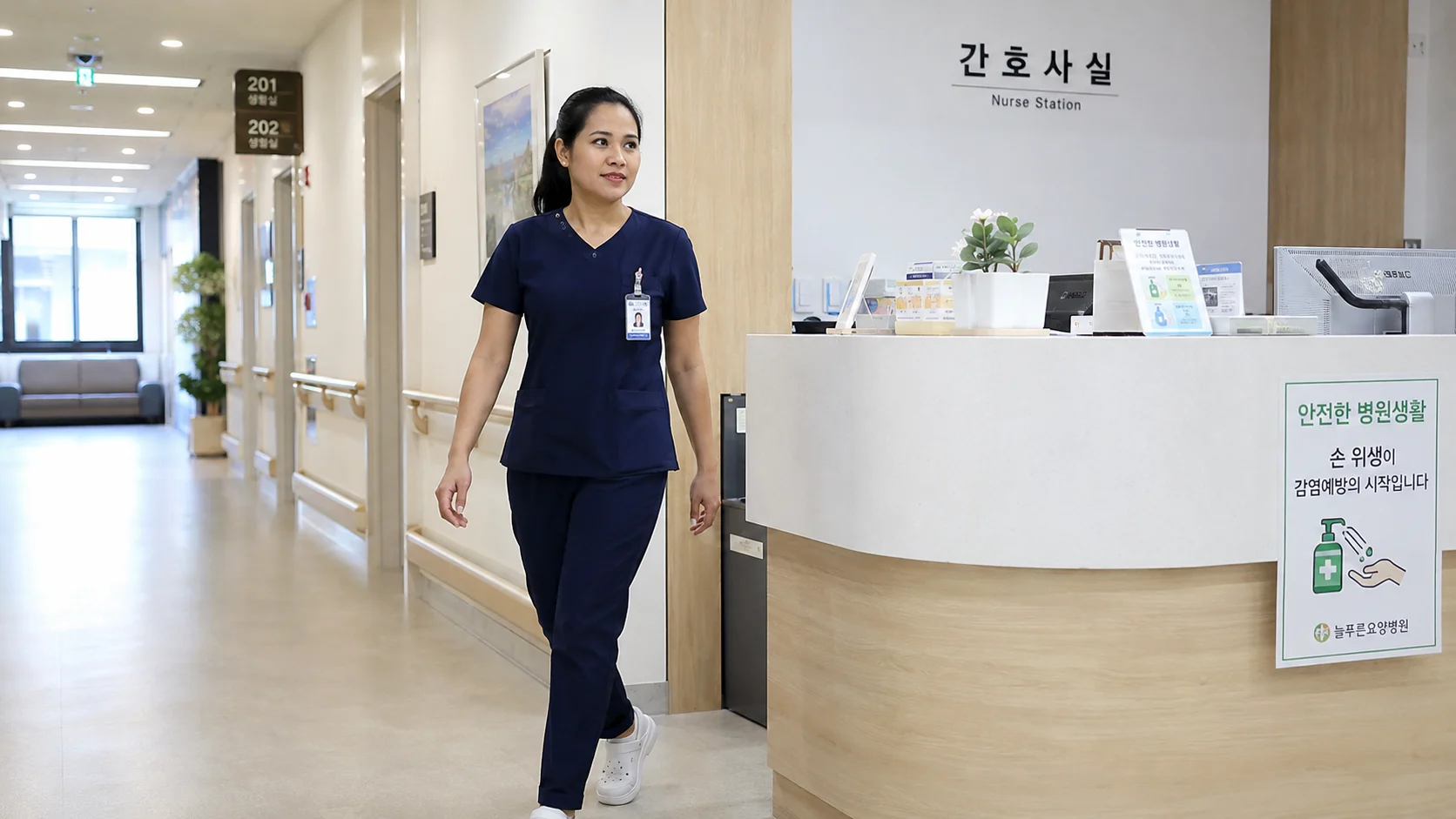
Elder care is where Korea's demographic crisis and its visa policy meet most directly. With the over-65 share at 21.2% and an elder-care workforce shortfall projected at around 116,000 by 2028, the government has moved to formalise and expand foreign participation in care work. Across 2024 and 2025, care roles were brought more explicitly into the skilled-visa framework, with wage protections attached so that foreign care workers are not undercut below domestic standards. This formalisation matters because care had previously sat in a grey zone; making it an explicit, protected channel signals that Korea intends foreign caregivers to be a permanent part of its system, not a temporary patch.
For 2026, Korea has launched a notable pilot aimed at building a formal, qualified care workforce from the ground up: dedicated caregiver degree tracks at 24 universities. Rather than relying solely on importing already-trained workers, this approach trains care professionals through the higher-education system, which over time should create a recognised, credentialled pool of caregivers including foreign students who study these tracks. It is an early-stage pilot, so the details of how graduates transition into work visas will evolve, but the direction of travel is unmistakable: Korea is institutionalising care work as a skilled profession.
Be honest with yourself about the language bar in care. Manual sectors on the E-9 require only the basic EPS-TOPIK, but care work involves communicating with vulnerable older people, their families, and medical staff, so the practical and formal Korean requirements are higher, generally a higher TOPIK level than the entry E-9 standard. If elder care is your target, invest early and seriously in Korean. Korea's care opening is genuine, but it rewards language ability more than almost any other sector.
Korea is competing for the same caregivers as several other ageing economies, and it helps to see the alternatives. Compare its approach with Japan's care and Specified Skilled Worker systems in our Japan SSW visa guide, and with Germany's care-worker route in our Germany care worker visa guide. For the global overview of where caregivers are wanted and on what terms, the caregiver visa worldwide guide pulls it all together.
Language honestly: EPS-TOPIK versus higher TOPIK
Korean language is the single requirement that determines which doors are open to you, so it deserves a clear-eyed section of its own. There are effectively two language tiers in this system. The first is the EPS-TOPIK, the purpose-built test that gates the E-9 visa. It assesses basic, work-relevant Korean and aptitude, and it is pitched at a level that a committed beginner can reach with several months of focused study. It is the minimum entry standard for non-professional work, and it is non-negotiable for the E-9.
The second tier is the standard academic TOPIK, scored across levels, which becomes relevant for skilled and care routes. To strengthen an E-7-4 points application, and to qualify for and succeed in care work, you typically need a higher TOPIK level than the basic EPS-TOPIK demands. Korean ability is also one of the scored factors in the E-7-4 points system, so improving your TOPIK does double duty: it makes you eligible for better roles and it directly adds to your conversion score. In practical terms, the foreign worker who treats Korean as a long-term investment from day one is the worker who ends up converting to E-7-4 and staying; the one who learns only enough to pass the EPS-TOPIK and then stops tends to remain locked in the fixed-term E-9 cycle.
There is no shortcut around this. Korea's whole skilled-migration logic rewards language, and the gap between the EPS-TOPIK entry bar and the higher TOPIK needed for skilled and care work is exactly the gap that separates a temporary job from a longer-term life in the country. Plan your study accordingly, and do not let recruiters tell you that Korean is optional, because for any route beyond the basic E-9 it is not.
The bottom line for 2026
South Korea in 2026 is a genuinely opening labour market, pushed open by a demographic reality it cannot reverse: a super-aged population with 21.2% over 65 and an elder-care shortfall of roughly 116,000 workers by 2028. For foreign workers, that creates real opportunity, but only for those who understand the structure. The E-9 (EPS) is your entry door if you are coming in for manual work in manufacturing, agriculture, fishing, construction or permitted services, and it runs through official government-to-government channels, the EPS-TOPIK test, and an annual quota.
The skilled E-7-2 and E-7-4 visas are where the longer-term future lies. The E-7-4 in particular is the designed bridge from temporary E-9 status to longer-term residency, scoring you on experience, income and Korean ability. Elder care is the fastest-growing opening, now formalised with wage protections and supported by a 2026 pilot training caregivers at 24 universities. Across all of it, language is the decisive variable: the EPS-TOPIK gets you in, but a higher TOPIK is what lets you move up and stay.
Treat every figure here as a 2026 snapshot and verify before you act. Quotas, the 16-country EPS MOU list, sector allocations, and E-7-4 points thresholds all change annually. The authoritative sources are HRD Korea and the official EPS system; check them first, then build your plan around the honest realities of selection, fixed terms, and language rather than around recruiter promises.
احصل على إرشادات تأشيرة شخصية
كل حالة تأشيرة مختلفة. أخبرنا عن حالتك وسيقوم مستشارونا المعتمدون بمراجعة قضيتك خلال 24 ساعة.
الأسئلة الشائعة
What is the E-9 (EPS) visa?
The E-9 is South Korea's non-professional employment visa, administered through the Employment Permit System (EPS). It lets foreign workers take manual jobs in shortage sectors such as manufacturing, agriculture and livestock, fishing, construction and selected services. Recruitment runs government-to-government through MOUs with around 16 source countries (as of 2026), selection is gated by the EPS-TOPIK test, and the annual number admitted is capped by a quota. It is employer-assigned and fixed-term. Verify the current rules with HRD Korea and the official EPS system.
What is the difference between E-9 and E-7?
The E-9 is for non-professional (manual) employment under the EPS, with basic Korean (EPS-TOPIK), employer assignment, fixed terms and limited job mobility. The E-7 visas are for skilled and professional work: E-7-2 covers designated skilled occupations, and E-7-4 is the points-based skilled-worker route. E-7 categories generally require a higher TOPIK level, offer more stability, and unlike the E-9 can lead toward longer-term residency. In short, E-9 is the entry door and E-7 is the skilled door.
Can I move from E-9 to a skilled visa?
Yes, and this is the realistic path to longer-term status. The E-7-4 skilled-worker visa is a points-based transition designed so that long-term E-9 workers can move up. As of 2026 the points consider your accumulated work experience in Korea, your income level and your Korean-language ability, against a threshold you must clear. It is not automatic and the threshold and conversion quotas are real, but it is a documented pathway from temporary E-9 status toward longer-term residency. Confirm the current points framework with the authorities.
Does Korea need caregivers?
Yes, urgently. Korea is a super-aged society with 21.2% of its population over 65, and it projects an elder-care workforce shortfall of about 116,000 by 2028. In response it formalised and expanded foreign care work in 2024-25 with wage protections, and for 2026 it launched a pilot offering dedicated caregiver degree tracks at 24 universities to build a formal care workforce. Care work, however, demands a higher Korean level than basic manual jobs, so language is the main barrier to entry.
What is the EPS-TOPIK test?
The EPS-TOPIK is the Korean-language and aptitude test built specifically for the Employment Permit System, and it is the main selection gate for the E-9 visa. It is taken in your home country and is distinct from the standard academic TOPIK that students sit. It assesses basic, work-relevant Korean at a level a committed beginner can reach with several months of focused study, but it is a genuine hurdle and passing it is non-negotiable for the E-9. Higher (academic) TOPIK levels become relevant for skilled and care routes.
Which countries can apply for the E-9 (EPS)?
Only nationals of countries that have signed an active EPS memorandum of understanding (MOU) with Korea can apply, and as of 2026 there are around 16 such source countries, concentrated in South and Southeast Asia and beyond. The list is reviewed periodically by HRD Korea, so it can change. If your country is not an EPS partner, you are not eligible for the E-9 and would need to look at the skilled E-7 routes or other categories. Always check the current participating-country list before starting.
Does the E-9 visa lead to permanent residency?
Not by itself. The E-9 is a fixed-term, non-professional visa with limited job mobility, and on its own it does not lead to permanent residency. The realistic settlement route is to convert from E-9 to the E-7-4 skilled-worker visa through its points system, by building experience, income and Korean ability over time. Anyone presenting the E-9 as a direct ticket to settling permanently in Korea is misleading you; the longer-term path runs through E-7-4.
How long can I stay on the E-9 visa?
The E-9 is a fixed-term visa that is renewable within set limits rather than open-ended, and you are tied closely to an assigned employer for the duration. Changing jobs is restricted to specific permitted circumstances rather than being a free choice. Workers who want to stay longer typically aim to convert to the skilled E-7-4 category before their E-9 entitlement runs out. Because the specific term lengths and renewal rules are revised periodically, confirm the current limits with HRD Korea and the official EPS system before relying on any figure.
مقالات ذات صلة
استخدم أدواتنا المجانية
حاسبات مجانية لكندا CRS وأستراليا والمملكة المتحدة وألمانيا وحدود رواتب 34 دولة.
جميع الأدوات