
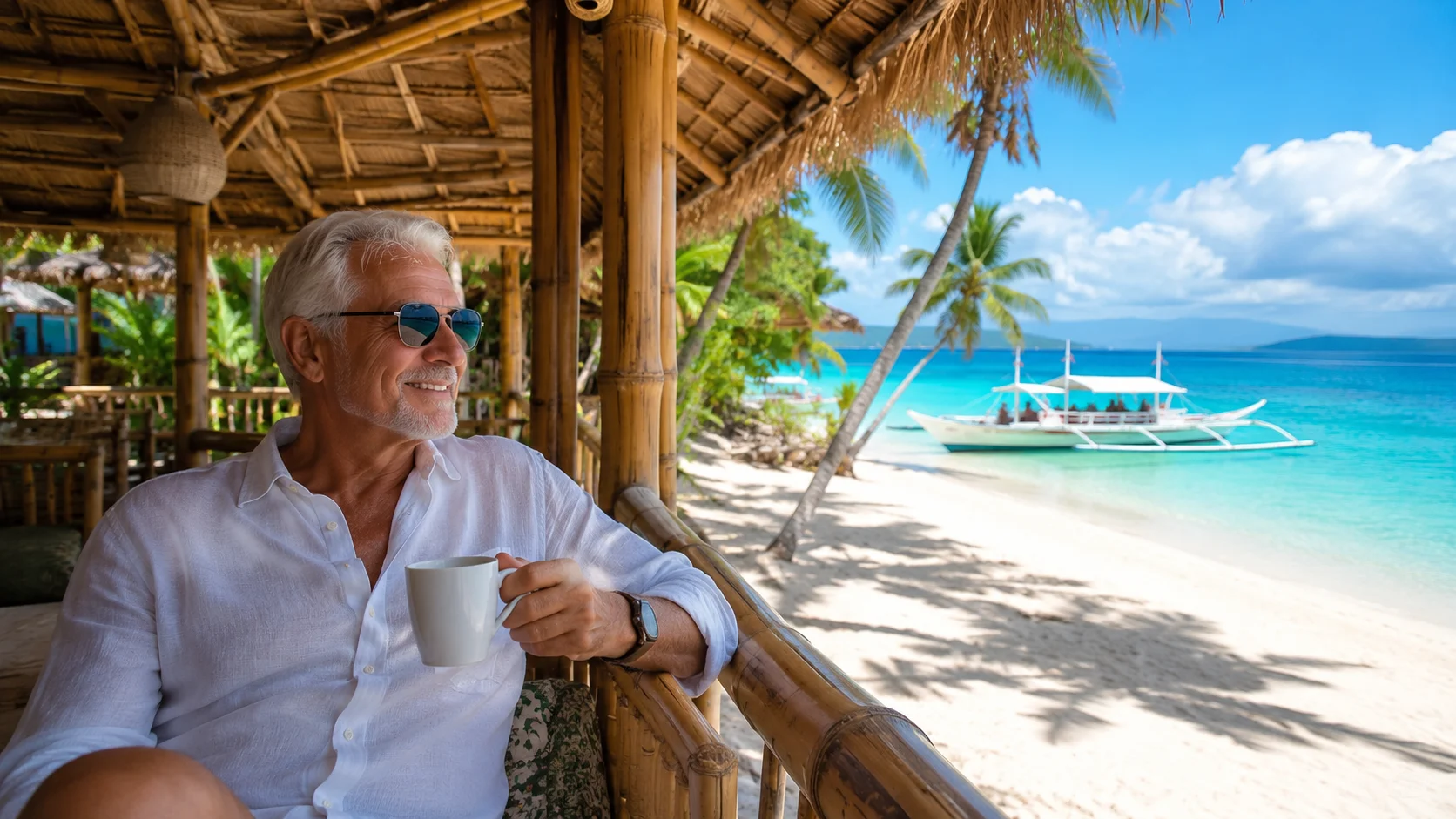
What is the Philippines retirement visa?
The Special Resident Retiree's Visa (SRRV) is a long-stay immigration program administered by the Philippine Retirement Authority (PRA), a government agency under the Department of Tourism. Unlike pension-income programs such as Thailand's retirement visa or Malaysia's MM2H, the SRRV is deposit-based: you place a defined amount of foreign currency into a PRA-accredited bank in the Philippines, and that deposit serves as your qualification rather than a monthly income stream. Once your application is approved, you receive a permanent, multiple-entry residency stamp with no annual renewal requirement.
The SRRV was created to attract foreign retirees and stimulate local economies through sustained consumer spending and real-estate investment. The program has operated since the 1980s and has issued visas to tens of thousands of retirees from the United States, Canada, Japan, South Korea, Australia, and Europe. Unlike many other Southeast Asian retirement schemes that operate in legal gray zones or require annual renewals, the SRRV is backed by Republic Act 7919 and related executive orders, giving it a firm statutory basis.
There are several SRRV sub-categories, but the two most commonly used by foreign retirees are the SRRV Smile and the SRRV Classic. The Smile variant, introduced as a simplified track, requires a $20,000 deposit for applicants aged 35 and above. The Classic variant has a tiered deposit that depends on age and whether the applicant can demonstrate receipt of a pension or Social Security payment from overseas. The deposit is not a fee - it is your money, held in a time-deposit account that earns interest in Philippine peso. Most retirees consider it a forced savings vehicle rather than an expense. For the full picture of global options, see our retirement visa hub.
One feature that sets the SRRV apart from every other retirement visa in Asia is the language advantage. Filipino and English are the two official languages of the Philippines. Signs, menus, hospital documents, lease contracts, and government forms are routinely available in English. Most educated Filipinos are conversational or fluent in English, which removes the linguistic friction that many Western retirees encounter in Thailand, Vietnam, or Japan. For retirees who want full immersion without a language barrier, the Philippines is hard to beat.
SRRV requirements and deposit tiers
The Philippines offers multiple SRRV sub-categories, but most applicants fall into Smile or Classic. The key variables are age at application and whether you receive a pension from abroad. The table below summarises the two main tracks and their deposit requirements.
| SRRV Type | Age | Pension Required? | Required Deposit |
|---|---|---|---|
| SRRV Smile | 35+ | No | $20,000 |
| SRRV Classic (with pension) | 50+ | Yes - min $800/month individual | $10,000 |
| SRRV Classic (with pension) | 50+ couple | Yes - min $1,000/month couple | $10,000 |
| SRRV Classic (no pension) | 50+ | No | $20,000 |
| SRRV Classic (no pension) | 35 to 49 | No | $50,000 |
Note that the SRRV Classic with pension has the lowest deposit threshold at $10,000, making it the cheapest entry point if you already receive a qualifying overseas pension of at least $800 per month as an individual or $1,000 per month as a couple. US Social Security, UK State Pension, Canadian CPP/OAS, and Australian Age Pension all qualify as acceptable pension income, provided you can supply official documentation. The pension deposit track is only available from age 50 onward.
In addition to the deposit, all applicants must pay a one-time PRA membership fee (currently $1,400 for the principal applicant) and provide a clean police clearance certificate from your home country and any country where you have lived for the past 12 months, a medical certificate signed by a licensed physician, proof of health insurance valid in the Philippines, and a valid passport with at least 18 months of remaining validity. Dependants such as a spouse and unmarried children under 21 can be added to the visa for additional fees. The deposit earns peso-denominated interest while held, and the principal is fully repatriated if you decide to leave the Philippines and surrender your SRRV.
Tax treatment for SRRV holders
The Philippines operates a territorial tax system for foreign retirees holding the SRRV. This means that income sourced from outside the Philippines, such as foreign pensions, Social Security payments, overseas dividends, rental income from foreign property, and foreign bank interest, is not subject to Philippine income tax. The Bureau of Internal Revenue (BIR) only taxes income earned within Philippine territory. For most retirees who live on overseas savings or pension income, the effective Philippine tax rate on that income is zero.
If you generate income inside the Philippines, for example by renting out a condo you own, providing consulting services to local clients, or investing in Philippine stocks or businesses, that income is taxable at Philippine rates. The personal income tax schedule runs from 15 percent to 35 percent for residents, though the effective rate for most moderate-income retirees falls in the 15 to 20 percent range. VAT at 12 percent applies to most goods and services you purchase locally, but this is already embedded in prices and requires no filing on your part.
Estate and gift tax considerations are worth reviewing for retirees who own Philippine assets. The Philippines charges estate tax at a flat 6 percent on the net estate, and gift tax at 6 percent on donations above an annual threshold. Proper estate planning with a Philippine attorney is advisable if you acquire property or maintain significant bank balances in-country.
Healthcare for retirees in the Philippines
The Philippines has a two-tier healthcare system. PhilHealth, the national public insurance scheme, covers Filipino citizens and formal employees, but it does not offer comprehensive coverage for foreign retirees. SRRV holders are required to hold private health insurance valid in the Philippines, and in practice most long-term expat retirees rely entirely on private hospitals and private insurance.
Private hospital care in the Philippines is significantly cheaper than in Western countries and is also more affordable than comparable facilities in Singapore or Thailand. A routine GP consultation at a private clinic in Cebu or Manila typically costs between $15 and $35. A full day of hospital admission including basic room and board runs $80 to $200 at a mid-range private hospital. Major surgery is a fraction of US costs, and many hospitals in Cebu and Metro Manila cater specifically to medical tourists and expat retirees with English-speaking staff and international-standard facilities.
Recommended hospital networks for retirees include Chong Hua Hospital and Cebu Doctors' University Hospital in Cebu, St. Luke's Medical Center and Makati Medical Center in Metro Manila, and Davao Doctors Hospital in Mindanao. All of these facilities have JCI accreditation or equivalent, English-language billing, and telemedicine services. Dental care is an outstanding value - complex procedures like implants and crowns cost 70 to 80 percent less than in the United States, and Cebu in particular has a thriving dental tourism industry.
For international health insurance, reputable providers with strong Philippines networks include Cigna Global, Allianz Care, AXA Philippines, and Pacific Cross. Annual premiums for a healthy 60-year-old with a comprehensive plan and a $5,000 deductible typically run between $2,500 and $4,000 per year. Retirees with pre-existing conditions should shop carefully and compare lifetime limits and exclusions. Purchasing a plan before you reach age 65 is strongly advisable, as premiums increase sharply and some providers cap enrollment at 65.
How to apply for the SRRV
The SRRV application is submitted to the Philippine Retirement Authority (PRA), which has its principal office in Pasay City, Metro Manila, with satellite offices in Cebu and Davao. The process can be completed in person in the Philippines or started remotely through a PRA-accredited facilitator. The typical timeline from first contact to visa issuance is four to eight weeks, assuming documents are complete.
- Gather required documents: valid passport (18+ months remaining), National Bureau of Investigation (NBI) clearance or home-country police clearance with apostille, medical certificate from a licensed physician, proof of health insurance valid in the Philippines, and recent bank statements showing sufficient funds.
- Open a time-deposit account at a PRA-accredited bank such as BDO Unibank, Metrobank, Land Bank, Development Bank of the Philippines, or Chinabank. Wire your deposit ($10,000, $20,000, or $50,000 depending on your track) into that account.
- Obtain a bank certificate confirming the time deposit, issued on the bank's letterhead and addressed to the Philippine Retirement Authority.
- Submit your complete application package to the PRA office in person or through an accredited representative. Pay the one-time PRA membership fee (currently $1,400 for the principal applicant, with additional fees for dependants).
- Attend a PRA interview if scheduled. In most cases the application is assessed on documentation alone without a formal interview.
- Receive your SRRV multiple-entry visa stamp from the Bureau of Immigration, which the PRA coordinates on your behalf. You may be asked to appear at a BI office in person to be photographed and fingerprinted.
- Register with your local government unit (LGU) barangay and obtain a Certificate of Residency once you have established a fixed address, which is useful for opening additional bank accounts and obtaining a Tax Identification Number (TIN).
The PRA strongly recommends engaging an accredited facilitator or attorney if you are applying from abroad, as document authentication requirements (apostilles, notarisation standards) vary by country and errors can cause significant delays. Several law firms in Cebu, Manila, and Davao specialise exclusively in SRRV applications and charge $500 to $1,500 for full-service facilitation.
Cost of living as a retiree in the Philippines
The Philippines consistently ranks among the three cheapest countries in Asia for Western retirees, alongside Vietnam and Cambodia. The combination of a low peso exchange rate, cheap local food, affordable rent outside Metro Manila, and very low utility costs means a comfortable retirement lifestyle is achievable on $1,500 to $2,500 per month in most provincial cities. The table below compares typical monthly costs in Dumaguete and Cebu City, two of the most popular expat retirement hubs.
| Expense Category | Dumaguete (monthly) | Cebu City (monthly) |
|---|---|---|
| 1-bed furnished condo (expat area) | $350 to $500 | $500 to $900 |
| 2-bed furnished condo (expat area) | $550 to $750 | $800 to $1,400 |
| Groceries (Western-style diet) | $250 to $350 | $300 to $400 |
| Local restaurant meal (per person) | $3 to $6 | $4 to $8 |
| Western restaurant meal (per person) | $10 to $18 | $12 to $25 |
| Utilities (electricity, water, internet) | $100 to $180 | $120 to $200 |
| Private health insurance (age 60) | $200 to $350 | $200 to $350 |
| Housekeeper / cleaner (full-time) | $150 to $250 | $200 to $300 |
| Total comfortable monthly budget | $1,500 to $2,200 | $2,000 to $3,000 |
Electricity deserves a special note: the Philippines has among the highest electricity rates in Southeast Asia due to its reliance on imported fossil fuels for island-by-island power generation. Air conditioning is a major cost driver. Retirees who invest in ceiling fans, efficient inverter air-con units, and sensible scheduling of appliance use typically keep electricity bills at the lower end of the range. Fibre internet is widely available in Cebu and Dumaguete at speeds of 100 Mbps to 1 Gbps for $25 to $50 per month, which is an exceptional value compared to the global average.
Domestic helpers and household staff deserve mention because they represent a lifestyle feature almost unavailable at comparable price points anywhere else. A full-time live-in housekeeper who cooks, cleans, and runs errands earns roughly $150 to $250 per month in Dumaguete or around $200 to $300 in Cebu, inclusive of their room and board allowance. Many retirees who would never consider household help in their home country find it transforms their quality of life and local economic participation in the Philippines.
Buying and renting property as a foreign retiree
Foreign nationals, including SRRV holders, cannot own land in the Philippines. The 1987 Philippine Constitution reserves land ownership for Filipino citizens and corporations with at least 60 percent Filipino equity. This is a firm restriction and cannot be circumvented through nominee arrangements or land lease structures without legal risk. However, the prohibition on land ownership does not extend to condominium units. Under the Condominium Act (Republic Act 4726), foreigners may own condominium units in a building as long as total foreign ownership in that building does not exceed 40 percent of total floor area.
Condominium prices vary enormously by location. In Mactan Island (Cebu), a furnished one-bedroom condo in a reputable development runs $80,000 to $180,000. Metro Manila's Bonifacio Global City (BGC) and Makati commands $150,000 to $400,000 for similar units. In Dumaguete, studio and one-bedroom condos are available in the $50,000 to $120,000 range, often with sea views and resort-style amenities. Upfront transaction costs, including documentary stamp tax, transfer tax, and registration fees, add roughly 4 to 7 percent to the purchase price.
For SRRV holders, the PRA has a specific conversion feature: if you acquire an eligible condominium or a long-term lease, your bank deposit can be applied toward the purchase or lease payment, subject to PRA approval and a formal conversion request. This makes the deposit feel less like a parking obligation and more like an advance on a real-estate investment. SRRV holders can also enter into long-term leases on land (up to 50 years, renewable for another 25 years) under the Investors Lease Act (Republic Act 7652), which provides a mechanism to effectively use and enjoy land without technically owning it.
Path to permanent residency and citizenship
The SRRV is itself a form of indefinite permanent residency. Unlike Malaysia's MM2H or Thailand's LTR visa, which are renewable long-stay permits, the SRRV gives you immediate, permanent, multiple-entry status with no annual renewal required. There is no probationary period, no points test, and no naturalisation clock that starts ticking. From day one of SRRV issuance, you hold a status that is functionally equivalent to permanent residency for immigration purposes.
Philippine citizenship is an entirely different matter and one where the Philippines is notably restrictive by Asian standards. Naturalisation under the Revised Naturalization Law (Commonwealth Act 473) requires at least ten years of continuous legal residence in the Philippines, with the residency period reduced to five years in certain circumstances (such as having a Filipino spouse or having been born in the Philippines). During the residency period you must demonstrate substantial compliance with Philippine laws and customs, ownership or lease of residential property, knowledge of Filipino history and the constitution, and an ability to speak Filipino or English fluently. The application is a judicial process, not an administrative one, and requires filing a petition in a Regional Trial Court. Approval timelines are measured in years, not months.
In practice, very few foreign SRRV holders pursue naturalisation. Most long-term retirees are content with the indefinite residency that the SRRV provides and have no reason to relinquish their home-country passport. The Philippines also does not permit dual citizenship for naturalised citizens under normal circumstances (though a separate law allows former Filipino citizens who naturalised abroad to reacquire Philippine citizenship). For retirees prioritising a straightforward path to a second passport, countries like Portugal, Malta, or Panama are better choices. However, if your priority is indefinite residency with low cost of living and no bureaucratic renewal burden, the SRRV is exceptional. See the full Philippines visa overview for details on other immigration routes.
Best cities for retirees in the Philippines
The Philippines offers an extraordinary variety of retirement environments across its major island groups. Choosing where to settle depends on your priorities: urban amenities vs. small-town calm, beach lifestyle vs. mountain cool, proximity to international airports vs. lower cost of living. Below are the five cities most frequently chosen by foreign SRRV holders.
- Cebu City and Mactan Island - The second city of the Philippines and the retirement hub of the Visayas. Mactan Island, connected to Cebu City by two bridges, hosts most expat retirees and has a strong infrastructure of international-standard hospitals, Western supermarkets, golf courses, and beach resorts. Mactan Cebu International Airport has direct flights to Hong Kong, Singapore, Tokyo, and Seoul. Monthly costs are moderate by expat standards. The city itself has world-class malls and dining but heavy traffic in peak hours.
- Dumaguete - Known as the City of Gentle People, this compact university city on Negros Oriental island is the most talked-about small-city retirement destination in the Philippines. Its population of around 140,000 keeps costs low and traffic minimal while its large university student population creates a lively cafe and arts culture. Expat associations are active, English is nearly universal, and the waterfront boulevard is a genuine social hub. Dumaguete is accessible via direct flights from Manila or Cebu, and fast-craft boats connect to Cebu in about three hours.
- Subic Bay Freeport Zone - The former US Navy base turned special economic zone offers Western-standard infrastructure, very low crime, a large English-speaking expat community, and excellent roads. Many American retirees with a military background feel instantly at home. The Zone has its own immigration facilities, a yacht club, marinas, golf courses, and a stable electricity grid independent of the national system. It is about two hours from Manila by car.
- Baguio City - For retirees who find tropical heat exhausting, Baguio at 1,500 meters elevation in the Cordillera mountains offers a refreshing climate of 16 to 25 degrees Celsius year-round. The city is a major educational and arts centre with a well-developed infrastructure. Retirees who enjoy hiking, cool evenings, and a mountain-town atmosphere consistently rate Baguio among the Philippines' most liveable cities. It is about five hours north of Manila by car or a short flight.
- Davao City - The largest city in Mindanao and one of the safest and most organised cities in the Philippines, Davao has a reputation for exceptional cleanliness, strong law enforcement, and an accessible outdoors scene including access to Mount Apo, the country's highest peak. Davao International Airport has improving international connections and a direct low-cost carrier route to Singapore. Cost of living is slightly lower than Cebu, and healthcare infrastructure has improved markedly in the past decade.
Pros and cons of the Philippines SRRV
The SRRV is one of the most straightforward retirement visa programs in Asia, but it is not without trade-offs. The following list covers the points most commonly raised by SRRV holders after settling in.
- [+] Deposit-based: no monthly income test to satisfy or document year after year.
- [+] Immediate indefinite residency with no annual renewal and no continuous-residency requirement to maintain the visa.
- [+] English is an official language, eliminating the language barrier that complicates daily life in most of Asia.
- [+] Territorial tax system means foreign pension, Social Security, and investment income is not taxed in the Philippines.
- [+] Lowest cost of living in Asia for a comparable quality of life, with world-class private healthcare at a fraction of Western prices.
- [+] Deposit can be converted into a condominium purchase or long-term lease, so the capital is not permanently locked up.
- [+] Warm, welcoming culture with a long history of hosting foreign retirees and a large English-speaking support ecosystem.
- [+] Multiple island environments to choose from, including beach, mountain, city, and small-town settings.
- [-] Foreigners cannot own land, limiting property investment options compared to Malaysia or Portugal.
- [-] Citizenship is complex, lengthy, and rarely granted, so the Philippines is not suitable for retirees who want a second passport on any predictable timeline.
- [-] US citizens face US worldwide tax obligations regardless of where they live - the Philippines' territorial system does not help.
- [-] Electricity costs are the highest in Southeast Asia, and power outages (brownouts) still occur in some provincial areas.
- [-] Typhoon season from June through November affects Luzon and the Visayas. Flooding and property damage are real risks in low-lying coastal areas.
- [-] Strong bureaucratic processes at the PRA mean the application takes four to eight weeks and documentation requirements are exacting.
- [-] Political and regulatory risk: the SRRV terms have changed modestly several times over the decades, and deposit amounts could in principle be revised by future administrations.
احصل على إرشادات تأشيرة شخصية
كل حالة تأشيرة مختلفة. أخبرنا عن حالتك وسيقوم مستشارونا المعتمدون بمراجعة قضيتك خلال 24 ساعة.
الأسئلة الشائعة
How much do I need to deposit for the Philippines SRRV?
The deposit depends on your age and whether you receive an overseas pension. Applicants aged 50 and over who can show a qualifying pension of at least $800 per month need only deposit $10,000. Without a pension, the deposit is $20,000 for those aged 50 and over, and $50,000 for those aged 35 to 49. The SRRV Smile track also requires $20,000 and is open from age 35 with no pension requirement. The deposit is fully returnable if you later surrender the visa.
Is the SRRV deposit refundable when I leave?
Yes. If you decide to leave the Philippines permanently and formally surrender your SRRV to the PRA, your time deposit plus accrued interest is fully repatriated to you. The process involves notifying the PRA, surrendering your SRRV ID and visa documents, and the bank then releasing the funds. Allow two to four weeks for the repatriation process after all paperwork is cleared.
Do I pay tax on my pension or foreign income in the Philippines?
No. The Philippines uses a territorial tax system, which means income sourced outside the Philippines, including foreign pensions, Social Security, overseas dividends, and foreign rental income, is not subject to Philippine income tax. You only pay Philippine tax on income earned within the country. US citizens are an important exception: the United States taxes its citizens on worldwide income regardless of residence country, so US retirees must still file US federal returns and may owe US tax on pension distributions.
Can foreigners buy property in the Philippines?
Foreigners cannot own land in the Philippines, but they can own condominium units under the Condominium Act, as long as total foreign ownership in the building does not exceed 40 percent of floor area. SRRV holders can also enter into long-term land leases of up to 50 years (renewable for 25 more years) under the Investors Lease Act. Many retirees find condo ownership combined with a long-term lease arrangement gives them all the practical control they need without technically owning land.
What is the best city in the Philippines for foreign retirees?
Dumaguete is consistently voted the top small-city retirement destination for its low cost of living, safe environment, active expat community, and lively university town atmosphere. For those who want urban conveniences and strong healthcare infrastructure, Cebu (especially Mactan Island) is the top choice. Subic Bay appeals to American retirees, particularly those with a military background, because of its Western-standard infrastructure and low crime rate. Baguio suits retirees who prefer a cool mountain climate.
How long does it take to get the SRRV approved?
The typical timeline is four to eight weeks from submission of a complete application to visa issuance, assuming all documents are in order. The most common delays are incomplete apostille certification on police clearances or medical certificates, discrepancies in bank documentation, or high PRA workload during peak periods. Using a PRA-accredited facilitator in the Philippines significantly reduces the risk of documentation errors and can shorten the process.
Does the SRRV give permanent residency?
Yes, the SRRV grants immediate indefinite multiple-entry residency. It does not expire and does not require annual renewal. This is different from programs such as Thailand's OA retirement visa (which must be renewed annually) or Malaysia's MM2H (which has a fixed validity period). SRRV holders can come and go from the Philippines without affecting their status, as long as they do not formally surrender the visa.
Can I get Philippine citizenship through the SRRV?
Not automatically. Philippine naturalisation requires at least ten years of continuous legal residence (reduced to five years in special circumstances such as having a Filipino spouse), a judicial petition before a Regional Trial Court, demonstrated knowledge of Philippine history and law, and substantial compliance with local laws and customs. Very few foreign retirees pursue this route. For retirees whose primary goal is indefinite residency rather than a second passport, the SRRV provides everything they need without requiring citizenship.
مقالات ذات صلة
استخدم أدواتنا المجانية
حاسبات مجانية لكندا CRS وأستراليا والمملكة المتحدة وألمانيا وحدود رواتب 34 دولة.
جميع الأدوات