What is the Colombia retirement visa?
Colombia's retirement visa sits within the country's Migrant (M) visa category, formally called the Visa M - Pensionado. It was overhauled by Resolution 5477 of 2022, which reorganized all Colombian visa types into two broad tiers: the V (Visitor) visa for short stays and the M (Migrant) visa for longer-term residents who intend to live in Colombia but do not yet qualify for permanent residency. The pensionado subcategory within M is one of the most straightforward routes: you demonstrate a lifetime pension or retirement annuity that equals or exceeds three times the Colombian monthly minimum wage, and the government grants you a three-year multiple-entry visa to live anywhere in the country.
The visa is squarely aimed at foreign retirees receiving Social Security, state pension, private annuity, or any other guaranteed lifetime income stream. It is not designed for people living on savings withdrawals, investment dividends, or rental income alone - those sources generally do not count as a qualifying pension under the resolution. The income must be recurring, guaranteed, and of a pension or retirement nature. A letter from the Social Security Administration, your national pension agency, or an insurance company administering a lifetime annuity will satisfy the requirement. See the retirement visa hub for a global comparison of competing programs.
Colombia's appeal goes far beyond paperwork. The country has transformed dramatically over the past two decades, and cities like Medellin, Bogota, Cartagena, and Santa Marta now attract tens of thousands of foreign retirees and remote workers every year. Medellin in particular has earned a global reputation as one of the best cities in the world to grow old in: its permanent spring-like climate (temperatures hover between 17C and 26C year-round), modern metro and cable-car infrastructure, world-class hospitals, and a large English-speaking expat community make it easy to settle in without speaking a word of Spanish, though learning the language will enrich your life enormously. If the pensionado visa does not fit your situation, also consider the Colombia digital nomad visa as an alternative entry point.
Eligibility requirements
The requirements for the M pensionado visa are deliberately lean. Colombia's immigration authority, the Cancilleria (Ministry of Foreign Affairs), wants to attract foreign retirees who will spend money locally and not compete in the job market. The core requirement is income - specifically, a lifetime guaranteed pension equal to at least three times the current Colombian monthly minimum wage (salario minimo mensual legal vigente, or SMMLV). For 2025, the SMMLV is approximately COP 1,423,500 per month, making the threshold roughly COP 4,270,500 per month, which at current exchange rates translates to approximately $1,050 to $1,100 per month. In prior years when the peso was weaker, that figure fell as low as $750. The number shifts with both Colombian minimum wage increases (which happen every January) and the USD-COP exchange rate.
| Requirement | Detail | Acceptable Evidence |
|---|---|---|
| Age | No minimum age | Passport (must be valid 6+ months beyond intended stay) |
| Pension income | 3x Colombian monthly minimum wage (~$750 to $1,100/mo) | Official pension letter, SSA benefit verification, annuity contract |
| Clean criminal record | No serious criminal convictions | National police clearance from home country (apostilled) |
| Health insurance | Valid in Colombia for the full visa period | Policy document naming Colombia as covered territory |
| Passport validity | 6 months beyond intended stay | Passport bio page |
| Application photos | 2 recent passport-size photos, white background | Physical or digital as instructed by Cancilleria |
| Visa fee | Approximately $52 USD (paid online) | Payment receipt from Cancilleria portal |
All foreign documents must be apostilled (if your country is a Hague Convention signatory) or legalized through the Colombian consulate in your country. Pension letters from the US Social Security Administration, UK Department for Work and Pensions, or similar agencies are well recognized by the Cancilleria and rarely cause problems. The letter must be recent - issued within the last 90 days is the safest approach - and must state the monthly benefit amount in clear terms. If your pension is in a currency other than USD or COP, include a simple currency conversion note referencing the Banco de la Republica exchange rate on the date of application.
Tax treatment for retirees in Colombia
Colombia operates on a territorial tax system for new arrivals, which means that during your first year of residence, foreign-source income - including your pension, Social Security benefits, dividends earned abroad, and rental income from overseas properties - is generally not subject to Colombian income tax. This is one of the most frequently cited financial advantages of retiring to Colombia rather than staying in a high-tax home country. The territorial tax benefit applies broadly in that first period, making Colombia genuinely attractive from a tax planning perspective for retirees whose income is entirely foreign-source.
After you have spent 183 days or more in Colombia within a 365-day calendar year, you cross the threshold for Colombian tax residency. At that point, Colombia's tax authority (DIAN) may consider your worldwide income taxable in Colombia, not just your Colombian-source income. However, Colombian tax law does include favorable treatment for pensions in certain categories. Foreign pensions derived from labor performed outside Colombia may retain exemptions or reduced rates under domestic provisions. The interaction between Colombian tax residency rules, pension exemptions, and applicable tax treaties is genuinely complex, and you should engage a Colombian tax advisor (contador publico with international tax experience) before crossing the 183-day mark in your first year.
Colombia has signed double taxation agreements with a growing number of countries, including Spain, Chile, Canada, Mexico, the Czech Republic, India, South Korea, and Switzerland, among others. If your home country has a treaty with Colombia, the treaty may limit Colombia's right to tax your pension or provide a credit for taxes paid to Colombia against your home-country liability. For retirees from countries without a treaty (including the United States as of 2026), the analysis relies purely on domestic Colombian law and any unilateral relief provisions.
Healthcare for foreign retirees
Colombia has one of the most developed healthcare systems in Latin America, divided into a public contributory regime (EPS, or Entidad Promotora de Salud) and a private sector with hospitals and clinics that rival anything in North America or Europe at a fraction of the price. Once you obtain your M pensionado visa and register as a resident (cedula de extranjeria), you are eligible to enroll in the EPS contributory system by paying a monthly premium based on your income - typically around 12.5% of your declared monthly income. For a retiree declaring $1,000 per month, that works out to roughly $125 per month for comprehensive public health coverage.
Many expat retirees in Colombia opt to use both systems in parallel: they maintain private international health insurance (required for the visa application) and also enroll in EPS for routine care and prescriptions. Medellin in particular is home to several internationally accredited hospitals, including Hospital Pablo Tobon Uribe and Clinica Las Americas, which are on par with major US academic medical centers for complex procedures. Medical tourism has become a significant industry in Medellin, drawing patients from across the Americas for dental work, orthopedic surgery, cardiac care, and plastic surgery at prices 50% to 80% lower than equivalent US costs.
For the visa application itself, you need private health insurance valid in Colombia for the full duration of your requested visa. International policies from providers like Cigna Global, Allianz Care, or Aetna International are accepted. Budget travelers sometimes use local Colombian private insurers, which are significantly cheaper but may have network limitations. Once you are a full resident enrolled in EPS, you can reduce or cancel your international policy if you prefer, but many retirees keep a lighter international policy for coverage when traveling outside Colombia.
How to apply for the Colombia M pensionado visa
The entire Colombian visa application process was moved online in 2022 under the new resolution, and is now handled through the Cancilleria's digital platform at cancilleria.gov.co. There is no requirement to visit a consulate in person - you submit everything digitally from wherever you are in the world. Processing times have ranged from 3 to 30 business days in practice, with most straightforward applications resolving in 5 to 10 business days. The steps below follow the process as of early 2026.
- Gather all supporting documents: passport (valid 6+ months), pension verification letter (issued within 90 days, apostilled), criminal background check from your home country (apostilled), health insurance policy, and two passport photos.
- Translate any non-Spanish and non-English documents. The Cancilleria accepts documents in Spanish or English; other languages require a certified translation by a registered Colombian translator.
- Create an account at the Cancilleria visa portal (cancilleria.gov.co/tramites-servicios/visas) and select 'Visa M - Pensionado' from the dropdown.
- Fill in the online application form completely. Every field is required; incomplete submissions are rejected without refund.
- Upload all documents in the required format (PDF for most, JPEG for photos). File size limits apply; compress large PDFs as needed.
- Pay the application fee online via credit or debit card. The fee is approximately $52 USD equivalent and is non-refundable.
- Monitor your registered email address for correspondence from the Cancilleria. They may request additional documents (a 'requerimiento') before issuing a decision.
- Upon approval, you receive a digital visa sticker emailed in PDF. Print this and carry it with your passport. You do not receive a physical sticker by mail.
- After entering Colombia on your new visa, register with Migración Colombia within 15 days of arrival at a regional office to obtain your cedula de extranjeria (foreigner ID card). This ID enables you to open bank accounts, sign leases, and enroll in EPS.
Many retirees use a licensed Colombian immigration attorney or visa agency for the application, particularly when their pension documents are complex or their home country's apostille process is slow. Attorney fees for a pensionado application typically run $300 to $600 USD, which is modest insurance against a rejection that requires waiting another 30 days before reapplying. That said, straightforward applications from US, UK, EU, Canadian, and Australian retirees with clean records and clear SSA or government pension letters are routinely self-filed without issue.
Cost of living comparison: Medellin vs Cartagena
Colombia remains one of the most affordable retirement destinations in the Americas, particularly compared to Panama, Costa Rica, or Mexico's Pacific coast. The cost of living varies significantly between cities, and even within neighborhoods of the same city. The two most popular retirement bases for foreigners - Medellin and Cartagena - offer very different lifestyle and cost profiles. Medellin appeals to those who want a walkable urban lifestyle with cool evenings and strong infrastructure; Cartagena appeals to those who want tropical beaches, colonial architecture, and Caribbean energy.
| Expense category | Medellin (El Poblado) | Cartagena (Bocagrande/Getsemani) |
|---|---|---|
| 1-bed apartment (long-term lease) | $500 to $900/mo | $600 to $1,100/mo |
| 2-bed apartment (long-term lease) | $700 to $1,400/mo | $800 to $1,600/mo |
| Utilities (electricity, water, internet) | $80 to $150/mo | $100 to $180/mo |
| Groceries (local market focus) | $150 to $250/mo | $170 to $280/mo |
| Local restaurant meal | $3 to $8 | $4 to $10 |
| Good restaurant meal for two | $25 to $60 | $35 to $80 |
| Private health insurance (expat plan) | $100 to $250/mo | $100 to $250/mo |
| EPS public health enrollment (~12.5% of income) | $100 to $140/mo | $100 to $140/mo |
| Full monthly budget (comfortable lifestyle) | $1,500 to $2,500/mo | $1,700 to $2,800/mo |
Cartagena's coastal position, UNESCO World Heritage status, and year-round tourist traffic push real estate and restaurant prices higher than Medellin, particularly in the historic walled city (Centro) and the beachfront Bocagrande neighborhood. However, areas like Getsemani and Manga offer more local pricing just minutes from the tourist zones. In Medellin, El Poblado is the most expat-dense and most expensive neighborhood; Laureles and Envigado (a separate municipality that effectively merges with Medellin) offer similar quality of life at 20% to 30% lower rent. The key takeaway is that a retiree with $1,500 per month net income can live very comfortably in Medellin on a local lifestyle, whereas $2,000 to $2,500 per month enables a truly comfortable existence including occasional restaurants, travel within Colombia, and private healthcare.
Buying property in Colombia as a foreigner
Colombia has some of the most foreigner-friendly property ownership laws in Latin America. Foreign nationals can purchase real estate in Colombia on the same terms as Colombian citizens - there are no restrictions on foreigners buying apartments, houses, commercial properties, or land. You do not need to be a permanent resident or citizen to own property. A tourist, visa holder, or even someone with no Colombian immigration status can legally buy real estate, although in practice you will want a cedula de extranjeria or at least a Colombian tax identification number (NIT or cedula de extranjeria number) to complete the transaction and register the purchase with the Oficina de Registro de Instrumentos Publicos.
The purchase process involves a preliminary sales agreement (promesa de compraventa), a due diligence period to verify the property's title history (estudio de titulos) is clear, payment in full or via mortgage, and a formal notarial deed (escritura publica) signed before a Colombian notary. Foreigners cannot currently access Colombian bank mortgages in most cases, so the majority of expat buyers purchase with cash or seller financing. Notary fees, transfer taxes, and registration fees add roughly 2% to 3% to the purchase price. You should engage both a property attorney and a reputable real estate agent who works regularly with foreign buyers.
Property prices in Medellin's El Poblado have increased significantly over the past decade due to foreign demand, but still compare favorably to North American or European urban markets. A well-appointed two-bedroom apartment in El Poblado typically sells for $120,000 to $280,000 USD. In Cartagena's Bocagrande, comparable apartments run $100,000 to $250,000, while the historic Centro can command premiums for renovated colonial homes. Laureles and Envigado in greater Medellin offer solid construction and high quality of life at 20% to 30% below El Poblado prices. Importantly, purchasing property in Colombia does not itself grant you any immigration status - the path to residency runs through the M visa and accumulated time, not property investment.
Residency and citizenship pathway
The M pensionado visa is valid for three years from the date of issue and allows unlimited entries and exits from Colombia. You are not required to spend any minimum number of days in Colombia each year to maintain the visa - Colombia does not have a presence requirement for M visa holders. This makes it particularly attractive for retirees who want to spend part of the year in Colombia and part elsewhere (for example, near family in North America or Europe) without jeopardizing their status.
After accumulating five years of continuous residence in Colombia on M visas, you become eligible to apply for the R (Resident) visa, which is Colombia's permanent residency. The five years does not need to be on a single visa - two M visa periods (the first three years, then a renewal for another two or more) count cumulatively. Continuous residence is interpreted as not having been absent from Colombia for more than 180 consecutive days at any point, though in practice the Cancilleria reviews cumulative time. Once you hold the R visa, you have indefinite permission to live and work in Colombia without further renewals.
Colombian citizenship by naturalization is available after five years of residence, meaning that in practice a pensionado who begins at year zero could apply for citizenship around year five or six (five years of M visa residence plus the application processing period). Colombia allows dual citizenship, so you do not need to renounce your existing nationality. The naturalization process requires a Spanish language test and a basic knowledge of Colombian history and civics, so retirees who intend to pursue citizenship should start studying the language early. Colombian citizenship grants you a powerful passport with visa-free access to Schengen countries, the UK, and much of Latin America.
| Stage | Visa type | Duration | Key condition |
|---|---|---|---|
| Year 0 to 3 | M - Pensionado | 3 years | 3x minimum wage pension income maintained |
| Year 3 to 5 | M - Pensionado (renewal) | 2 years (to reach 5yr total) | Continue demonstrating qualifying pension income |
| Year 5+ | R - Resident visa | Indefinite | 5 years continuous M visa residence |
| Year 5 to 6 | Nationality application | 6 to 12 months processing | 5 years residence + Spanish + civics test |
Best cities for retirees in Colombia
Medellin is the undisputed top pick for most foreign retirees and consistently ranks in global best-places-to-retire lists. Situated in the Andes at roughly 1,500 meters above sea level, it enjoys what locals call eternal spring: daytime temperatures of 22C to 26C year-round, cool evenings, low humidity, and no extreme seasons. The metro and cable-car network make it easy to get around without a car. El Poblado, the neighborhood of choice for most expats, has dozens of English-friendly cafes, international restaurants, language schools, gyms, and medical clinics catering specifically to foreigners. Laureles and Envigado offer a more authentic Colombian neighborhood feel with strong infrastructure at lower rents. Medellin also hosts one of Colombia's best private hospital systems.
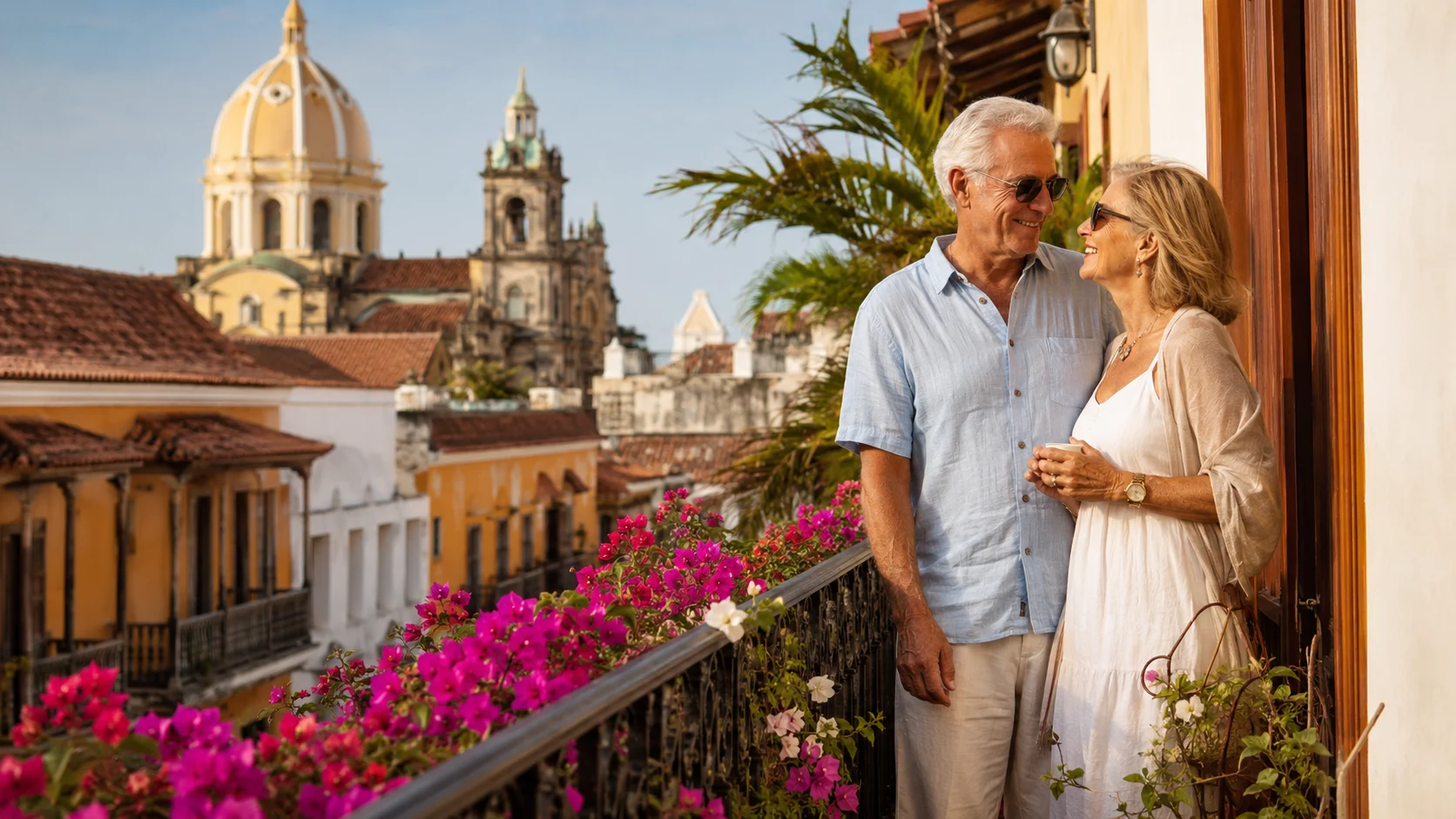
Cartagena on the Caribbean coast is the choice for retirees who want warm water and colonial-era architecture rather than mountain air. The UNESCO-listed walled city is one of the most beautiful in the Americas, with cobblestone streets, bougainvillea-draped balconies, and a vibrant nightlife and restaurant scene. The downside is heat and humidity: Cartagena's average temperature is around 30C year-round with high humidity, which some retirees find oppressive. Bocagrande is the modern beachfront district preferred by many foreigners for its apartment towers and proximity to the beach, while Getsemani (now gentrifying rapidly) offers more affordable rents and authentic local culture.
Bogota, Colombia's capital at 2,600 meters, is the most cosmopolitan option with the best international airport connections, finest dining and arts scene, and every international brand and service imaginable. However, it is colder (average 14C), can feel grey and overcast, and has higher traffic congestion. It suits retirees who prioritize urban sophistication and connectivity over warmth. Santa Marta on the northern coast is smaller and quieter than Cartagena with a more relaxed backpacker-meets-expat vibe and proximity to the Tayrona National Park, one of Colombia's natural gems. Bucaramanga in the northeastern Andes offers an excellent climate similar to Medellin, lower costs, less tourist infrastructure, and a strong local middle-class culture - it is becoming increasingly popular with retirees who want Medellin's climate without Medellin's prices.
Pros and cons of retiring in Colombia
Colombia offers an extraordinary combination of low income threshold, excellent climate choices, strong healthcare, genuine residency and citizenship pathways, and one of the most affordable costs of living in the Americas. Like any destination, it comes with genuine challenges that retirees should evaluate honestly before committing.
- [+] Lowest pension income threshold in the world: roughly $750 to $1,100 per month qualifies you for a three-year residence visa.
- [+] Medellin's eternal spring climate is among the most comfortable in the world for year-round outdoor living without air conditioning.
- [+] No minimum stay requirement on the M visa - retire here part-time and travel freely.
- [+] Territorial tax system in your first year means your foreign pension is not taxed locally initially.
- [+] World-class private hospitals in Medellin and Bogota at 50% to 80% lower cost than the US or UK.
- [+] Dual citizenship allowed - no need to give up your existing passport.
- [+] Foreigners can buy property with the same rights as Colombian nationals.
- [+] Five-year pathway to permanent residency (R visa) and then citizenship.
- [+] Strong, growing expat community with well-established English-language support infrastructure.
- [+] Stunning geographic diversity: Andes mountains, Caribbean coast, Amazon, coffee region - all within a few hours.
- [-] Security concerns vary significantly by neighborhood and city; some areas require caution, especially for new arrivals unfamiliar with local dynamics.
- [-] The income threshold is denominated in Colombian pesos, so the dollar equivalent can change significantly with exchange rate shifts.
- [-] After 183 days you become a Colombian tax resident, potentially triggering worldwide income tax exposure - requires professional tax advice.
- [-] US citizens continue to owe IRS taxes on worldwide income and face complex dual-filing obligations.
- [-] Language barrier is real: outside El Poblado and major tourist areas, English is uncommon and Spanish is essential for daily life.
- [-] Bureaucratic processes (cedula de extranjeria, EPS enrollment, bank account opening) can be slow and require patience.
- [-] Some retirees find the high-altitude cities (Bogota, Medellin) require an acclimatization period, especially with pre-existing cardiovascular or respiratory conditions.
Overall, Colombia offers a compelling retirement proposition that is hard to match globally at its price point. The M pensionado visa's low income threshold opens the door to retirees who might be priced out of Panama's $1,000 minimum or Portugal's higher requirements. For those who take the time to learn basic Spanish, engage a good local attorney for the visa and property process, and choose their city and neighborhood carefully, Colombia rewards the effort with an exceptional quality of life and a genuine long-term legal pathway.
Obtenga asesoramiento personalizado de visa
Cada situación de visa es diferente. Cuéntenos sobre la suya y nuestros consultores acreditados revisarán su caso en 24 horas.
Preguntas frecuentes
What is the minimum income required for the Colombia retirement visa?
You need a guaranteed pension income equal to at least three times Colombia's monthly minimum wage (SMMLV). For 2025, that works out to approximately $1,050 to $1,100 per month, though in earlier years when the peso was weaker the dollar equivalent was closer to $750. The threshold is reset every January when Colombia announces its new minimum wage, so always verify the current figure before applying.
Does the Colombian retirement visa require me to live in Colombia full time?
No. The M pensionado visa does not impose a minimum presence requirement. You can enter and exit Colombia freely during the three-year visa period. However, if you want to eventually qualify for the R (Resident) visa after five years, you must not have been absent for more than 180 consecutive days at any single stretch, so very extended absences could interrupt your residency clock.
Can I include my spouse or dependents on my Colombia retirement visa?
Spouses and dependent children can apply for their own M visa as companions of the primary pensionado visa holder. The companion must demonstrate the relationship (marriage certificate or birth certificate, apostilled) and the primary applicant's visa approval is typically required first. Each companion applicant pays the visa application fee separately. Children under 18 are generally covered; adult children with disabilities may also qualify as dependents.
Does Social Security count as qualifying pension income for the Colombia visa?
Yes. US Social Security retirement benefits are among the most straightforward sources accepted by the Cancilleria. You will need an official benefit verification letter from the Social Security Administration showing your monthly benefit amount. This letter must be recent (issued within the past 90 days) and should be apostilled or otherwise authenticated for Colombian official use.
Will Colombia tax my foreign pension?
In your first year of residence, Colombia's territorial tax system generally means foreign-source income like your pension is not taxed locally. Once you have spent 183 days or more in Colombia within a 365-day period, you become a Colombian tax resident and worldwide income may become taxable. However, Colombian law provides favorable treatment for certain pension categories, and a Colombian tax advisor should assess your specific situation before you cross the 183-day threshold.
How long does it take to process the Colombia retirement visa application?
The Cancilleria's official target is 30 business days, but in practice most straightforward applications are resolved in 5 to 15 business days. Complex cases, requests for additional documentation (requerimientos), or high application volumes during peak periods can extend processing. Applying well before your intended arrival date is advisable. The application is submitted entirely online and you receive the visa by email as a PDF.
Can I work in Colombia on the M pensionado visa?
No. The M pensionado visa does not authorize employment in Colombia. It is for retirees who are supported by foreign pension income and not looking to work in the Colombian labor market. If you wish to work or earn income from Colombian sources, you would need a different visa category. You may, however, continue receiving your foreign pension and investment income without restriction.
How does the Colombia retirement visa compare to Ecuador and Panama?
Colombia's income threshold (roughly $750 to $1,100 per month) is the lowest of the three. Ecuador's Pensionado visa requires approximately $800 per month but has been subject to policy changes. Panama's Pensionado program is one of the most established in the world with a $1,000 per month threshold and exceptional lifetime discounts on services, but Panama's cost of living is higher than Colombia's. Colombia adds the bonus of a more diverse geography, lower costs, and a five-year citizenship pathway. See our comparison in the retirement visa hub for full details.
Artículos relacionados
Use nuestras herramientas gratuitas
Calculadoras gratuitas para CRS Canadá, puntos Australia, Skilled Worker UK, Tarjeta de Oportunidad Alemania y umbrales salariales de 34 países.
Ver todas las herramientas