
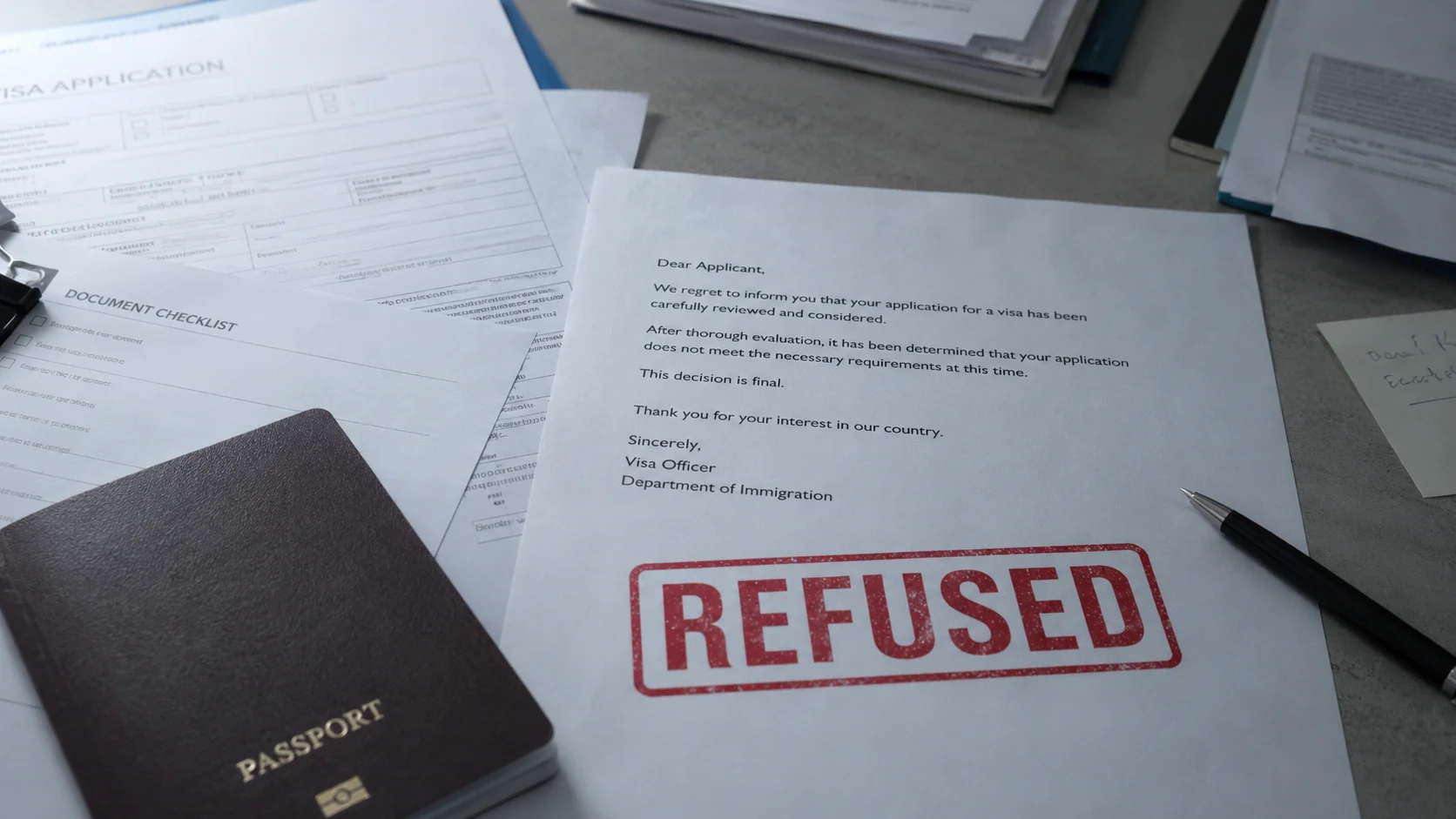
10 most common UK visa refusal reasons in 2026
UK Visas and Immigration (UKVI) entry clearance officers refuse visitor, work, student, and family applications for a fairly predictable set of reasons. Reading any refusal letter carefully shows the officer is almost always quoting from one of ten recurring categories. Knowing which one applies to you decides whether you fix and reapply in two weeks, or whether you face a much longer recovery journey. The list below covers the top ten causes, in roughly the order they appear in the refusal letters our readers send us.
1) Financial inconsistency. This is the single biggest visitor visa refusal reason in 2026. Officers cross-check your bank statements against your declared salary, employment letter, and tax filings. Sudden large deposits in the last 30-60 days before you applied raise an immediate red flag. So do salary credits that do not match payslips. A balance that drops to zero halfway through the statement period suggests the funds are not genuinely yours. The fix is boring but effective: six months of clean statements, salary credits that match payslips, tax filings that match income, and no last-minute deposits from third parties.
2) Weak ties to the home country. UKVI assesses whether you have a real reason to return. Officers look for employment letters with leave dates, property documents, business registration, family obligations such as dependent children or elderly parents, and ongoing financial commitments such as loans or school fees in your home country. If your application looks like someone with nothing to come back to, you will be refused. A clear cover letter guide that frames each tie in plain language helps the officer connect the documents.
3) Incomplete or non-compliant documents. Missing pages from bank statements, untranslated documents, statements older than 31 days at the date of decision, photos that do not meet the UK biometric specification, and missing payslips are all common. Officers are not allowed to chase you for missing documents in the visitor route; they refuse. Review our UK biometric photo requirements before you upload anything to TLS or VFS Global.
4) Wrong visa category. Applying as a Standard Visitor when your real purpose is to start a job, do a paid internship, or live with a partner long-term is a refusal almost every time. Officers are trained to spot the gap between your stated purpose and your true intent. Switching from visitor to work or family inside the UK is heavily restricted, so picking the right category upfront matters more than people realise.
5) Previous overstay or immigration violation. Any prior overstay in the UK, or in many Commonwealth and Schengen countries, surfaces in UKVI's databases. Even a one-day overstay from a decade ago can be the reason your visitor application is refused today. Disclosing the overstay yourself and providing evidence of voluntary departure is always better than letting the officer find it.
6) Undisclosed criminal record. UK applications ask about convictions, cautions, and pending charges in any country, no matter how minor. Failing to disclose a 15-year-old drink-driving caution can lead to a refusal under suitability grounds and, in the worst case, a deception finding. Always disclose, then explain in your cover letter.
7) Genuine relationship not proven for spouse and partner visas. Family route refusals usually hinge on whether the couple is in a genuine and subsisting relationship. Officers want chronological evidence: WhatsApp and call logs across years, photos in multiple settings with timestamps, joint financial commitments, joint tenancy or property, and statements from family on both sides. A relationship that exists only on paper, or only on Instagram, will fail.
8) English language requirement not met. Skilled Worker, Student, and partner route applications require an approved Secure English Language Test (SELT) from a designated provider such as IELTS for UKVI, Pearson, Trinity, or LanguageCert. Test reports from non-approved providers, expired test results (older than two years), and tests not held in person at an approved centre are routinely refused.
9) Maintenance requirement not met. Student and Skilled Worker visas require specific funds to be held in your account for 28 consecutive days, with no dip below the threshold on any day. The exact amount varies by route, dependants, and whether you are inside London. Officers calculate the lowest closing balance during the period and refuse if it falls even one pound short. The 28-day rule is unforgiving.
10) Deception or misrepresentation. This is the worst category by far. Submitting a forged bank statement, fake employment letter, sham marriage evidence, or simply ticking 'No' to a previous refusal you actually had triggers a refusal under paragraph 9.8 of the Immigration Rules. The consequence is a mandatory ten-year ban on most UK visa categories. There is no fee waiver and no appeal that meaningfully reverses it. The next section covers this in detail.
Administrative Review vs Appeal - which applies?
One of the biggest misunderstandings about UK refusals is the right to appeal. For most categories, there is no full appeal. Your only legal recourse is an Administrative Review (AR), which is a paper review by a different UKVI caseworker, or a fresh application. The table below summarises which route applies to each visa category in 2026.
| Visa type | Right to appeal | Right to AR | Fee | Deadline |
|---|---|---|---|---|
| Standard Visitor | No | No (refused outside UK) | n/a | Reapply only |
| Skilled Worker | No | Yes | £80 | 28 days |
| Student | No | Yes | £80 | 28 days |
| Family / Spouse (refused outside UK) | Yes (FTT IAC) | No | £140 oral / £80 paper | 28 days |
| Family / Spouse (refused inside UK) | Yes (FTT IAC) | No | £140 oral / £80 paper | 14 days |
| Human Rights / Asylum | Yes (FTT IAC) | No | £140 oral / £80 paper | 14 days |
| EU Settlement Scheme | Yes (FTT IAC) | Yes | £140 oral / £80 paper | 14-28 days |
Administrative Review is narrow. The reviewing caseworker can only look for casework errors, not re-weigh the evidence. If the original officer missed a document or applied the wrong financial threshold, AR can fix it. If the officer correctly read your documents and simply was not convinced you would return home, AR will not save you. Success rates for AR sit around 12-18% depending on the category. The full appeal route, where it exists, is heard by an independent immigration judge at the First-tier Tribunal Immigration and Asylum Chamber (FTT IAC) and success rates are higher, around 35-45%, but the process takes 9-15 months and almost always benefits from legal representation. Our full visa appeal guide walks through both routes in detail.
The 10-year deception ban explained
The UK's 10-year deception ban is the single most underrated risk in any UK application. It is mandatory, automatic, and triggered by a list of behaviours that look smaller than they are. The ban is codified in paragraphs 9.8.1 to 9.8.7 of the Immigration Rules (Part 9: Grounds for Refusal). Once a UKVI decision-maker concludes that deception was used, the ten-year clock starts from the date of the refusal letter, not from when you applied.
Behaviours that trigger the ban include: submitting a forged or altered document, declaring income or employment you do not have, hiding a previous UK or foreign visa refusal, hiding a criminal conviction or caution, working in the UK on a visitor visa, entering into a sham marriage, and using a false identity. Importantly, the ban applies even if your deception was discovered in a later application. If you lied on a visitor application in 2024 and the deception only surfaces when you apply for a Skilled Worker visa in 2026, the ten-year clock still runs from the original deception finding.
Recovery from a deception ban is brutal. The only routes back are: (a) waiting for the full ten years to pass before reapplying in any category that the ban touches, or (b) making an extraordinary human rights or family life claim under Article 8 of the European Convention on Human Rights. Article 8 cases succeed only where there is a British citizen partner or child whose family life would be ruptured by exclusion, and even then, the success rate is low. There is no quicker way back, no fee-paid waiver, and no humanitarian work-around for ordinary cases. The lesson is simple: if you have a previous refusal anywhere in the world, declare it. If you have a 12-year-old caution, declare it. If your last UK application had a typo about your job title, fix it openly in this one. Every honest declaration is safer than every clever omission.
Refusal patterns by UK visa type
Different UK visa routes fail for different reasons. Knowing the dominant failure mode for your category lets you target your evidence rather than scattering documents. Below are the most common reasons by category, drawn from UKVI's published transparency data and from refusal letters our readers share each month.
Standard Visitor. The big three are financial inconsistency, weak ties to the home country, and clarity of purpose. Officers want to see a salary that matches your bank balance, a clear leave letter, a documented reason to return, and a specific itinerary. Vague applications such as 'visit family for a holiday' with no dates and no return ticket fail far more often than applications with a precise day-by-day plan.
Skilled Worker. Refusals here cluster around three areas. First, the maintenance funds requirement (currently around £1,270 held for 28 days unless the sponsor certifies maintenance). Second, sponsor credibility: officers check the sponsor's licence rating, Compliance Officer history, and whether the Certificate of Sponsorship (CoS) salary matches the going rate for the SOC code. Third, English language at CEFR B1 with an approved SELT. A surprising number of Skilled Worker refusals are also driven by criminal record disclosures the applicant left out.
Student. The Genuine Student test is the most common refusal ground. Officers ask whether the chosen course makes sense given your academic background, why you picked the UK over your home country or other options, and whether your post-study plans are credible. A computer science graduate suddenly applying for a one-year hospitality diploma will struggle unless the cover letter explains the pivot convincingly. Maintenance funds (£1,334 per month in London, £1,023 outside, held for 28 days) and English at the right level round out the top three.
Spouse and Partner. The refusal pattern is dominated by genuine relationship doubts, the £29,000 minimum income requirement (rising in stages), and English at A1 for the initial application. Photo evidence from one trip, sparse messaging history, and no shared finances will fail even an obviously real relationship. Bring chronological proof: timeline of how you met, multi-year communication logs, joint financial commitments, and family witness statements on both sides.
Reapplying after a UK refusal - what to fix
The UK does not impose a formal cooling-off period for most refused applicants. You can reapply the next day if you want. But reapplying without addressing the refusal reasons is the single most common mistake we see, and it usually leads to a second refusal that quotes the same paragraphs as the first. Follow this sequence instead.
- Read the refusal letter twice. Identify every paragraph reference and Immigration Rules citation. Each one points to a specific failure that you must address.
- For each refusal reason, gather NEW evidence. Do not resubmit the same bank statements. Fresh statements covering a new 6-month period, new employer letters, additional ties documents, new financial guarantor letters.
- Write a cover letter that responds to each refusal ground in order. Quote the paragraph the officer used, then explain the new evidence that addresses it. Brevity beats waffling.
- For visitor visas, wait 3-6 months. Officers expect 'material changes in circumstances' between applications. A one-week gap with the same documents will be rejected on sight.
- Disclose the previous refusal in your new application. UKVI's databases will find it anyway, and not disclosing it triggers the deception ban.
- Pay the new fee and biometric enrolment. There is no fee waiver for reapplications.
Use our cover letter template as a starting point. The structure (purpose, ties, finances, response to previous refusal) maps directly onto how officers review your file. The single biggest improvement most reapplications make is converting a 50-document data dump into a 12-page cover letter that walks the officer through exactly what each document proves.
How to verify your UK refusal letter
UK refusal letters arrive by email through your TLScontact or VFS Global account, with the physical passport returned separately. The letter is two to four pages and follows a standard template. It opens with your details, then lists each refusal reason as a paragraph quoting from the Immigration Rules (for example 'Appendix V: Visitor, paragraph V 4.2 (a)'), then closes with the right of appeal or AR information and the decision-maker's name.
Decoding each paragraph reference is essential because the rule citation tells you exactly which evidence the officer found insufficient. Our decode your UK refusal letter guide maps every paragraph to a plain-English explanation. Cross-reference it with our VFS application status tool to confirm your application is closed in the system before you reapply. Submitting a new application while the old one is still 'in process' creates an automatic system flag that adds weeks of admin delay.
Finally, check your nationality-specific patterns. Refusal rates and dominant refusal grounds vary widely by country. If you are applying from Nigeria, Pakistan, Bangladesh, India, Ghana, or Kenya, our nationality hubs at /nationality/nigeria, /nationality/pakistan, /nationality/bangladesh, /nationality/india, /nationality/ghana, and /nationality/kenya include UK-specific refusal data and the evidence patterns most likely to work for applicants from your country.
lead.rejectionHeading
lead.rejectionDesc
Sık sorulan sorular
Can I appeal a UK visitor visa refusal?
No. Standard Visitor visa refusals carry no right of appeal and no Administrative Review when refused from outside the UK. Your only options are to reapply with a stronger file, or in rare cases, to challenge the decision by judicial review at the High Court if you can show the officer acted irrationally or unlawfully. For 99% of refused visitors, reapplying with new evidence and a clear cover letter is the right path.
How long does the 10-year UK deception ban last?
Exactly ten years from the date of the refusal letter that found deception. It applies to most chargeable visa routes including visitor, work, student, and family categories. The only realistic routes back during the ban are extraordinary Article 8 human rights claims (typically requiring a British partner or child) or simply waiting out the full ten years and reapplying with full disclosure.
Is there a cooling-off period before I can reapply for a UK visa?
No formal cooling-off period exists for most categories. You can technically reapply the next day. In practice, for visitor visas, UKVI looks for 'material change in circumstances' between applications, so a gap of three to six months with new financial evidence, a new job, or new ties documentation usually works better than an immediate reapply with the same file.
If my Skilled Worker visa is refused, is my sponsor in trouble?
Not directly from your individual refusal. However, if UKVI finds that the Certificate of Sponsorship (CoS) salary or SOC code was wrong, or that the sponsor's compliance records are weak, your refusal can trigger a wider sponsor audit. A pattern of refusals across multiple sponsored workers can downgrade the sponsor's licence from A-rated to B-rated, or in serious cases, lead to revocation.
What English level do I need for a UK visa?
It depends on the route. Skilled Worker requires CEFR B1 in all four skills. Student visa for degree-level study requires B2; below degree-level requires B1. Spouse and partner initial entry requires A1, rising to A2 at extension and B1 at settlement. Tests must be from an approved Secure English Language Test (SELT) provider such as IELTS for UKVI, Pearson PTE Academic UKVI, Trinity ISE, or LanguageCert, taken in person at an approved centre.
My spouse visa was refused for not proving a genuine relationship. What evidence helps?
Chronological evidence wins. Build a timeline of how you met, multi-year WhatsApp and call logs (exported with timestamps), photos in multiple settings and dates, joint financial commitments (joint bank account, joint tenancy, joint utility bills, joint life insurance), travel together with boarding passes, and witness letters from family and friends on both sides. A single trip's photos and a sparse messaging history rarely succeed.
How much money should I show for a UK visitor visa?
There is no fixed minimum, but officers want to see that you can comfortably cover your trip without working. A rough benchmark is around £100-150 per day of stay, plus your return flight, plus accommodation if not pre-paid. More importantly, the funds must be genuinely yours, held for at least three to six months, and consistent with your declared income. A sudden large deposit shortly before applying is a bigger problem than a low balance.
Is hiring a UK immigration lawyer worth the cost?
For straightforward visitor reapplications, usually no. For Skilled Worker, Student, or family route refusals where you have a right of appeal at the FTT IAC, a regulated OISC Level 3 adviser or solicitor is usually worth £1,500-4,000 of fees because appeal success rates rise sharply with proper representation. For deception findings, refusals on suitability grounds, or any case involving prior immigration history, get legal advice before you reapply.
İlgili makaleler
Ücretsiz araçlarımızı kullanın
Kanada CRS, Avustralya puanları, İngiltere skilled worker, Almanya Fırsat Kartı ve 34 ülke maaş eşikleri için ücretsiz hesaplayıcılar.
Tüm araçları gör