
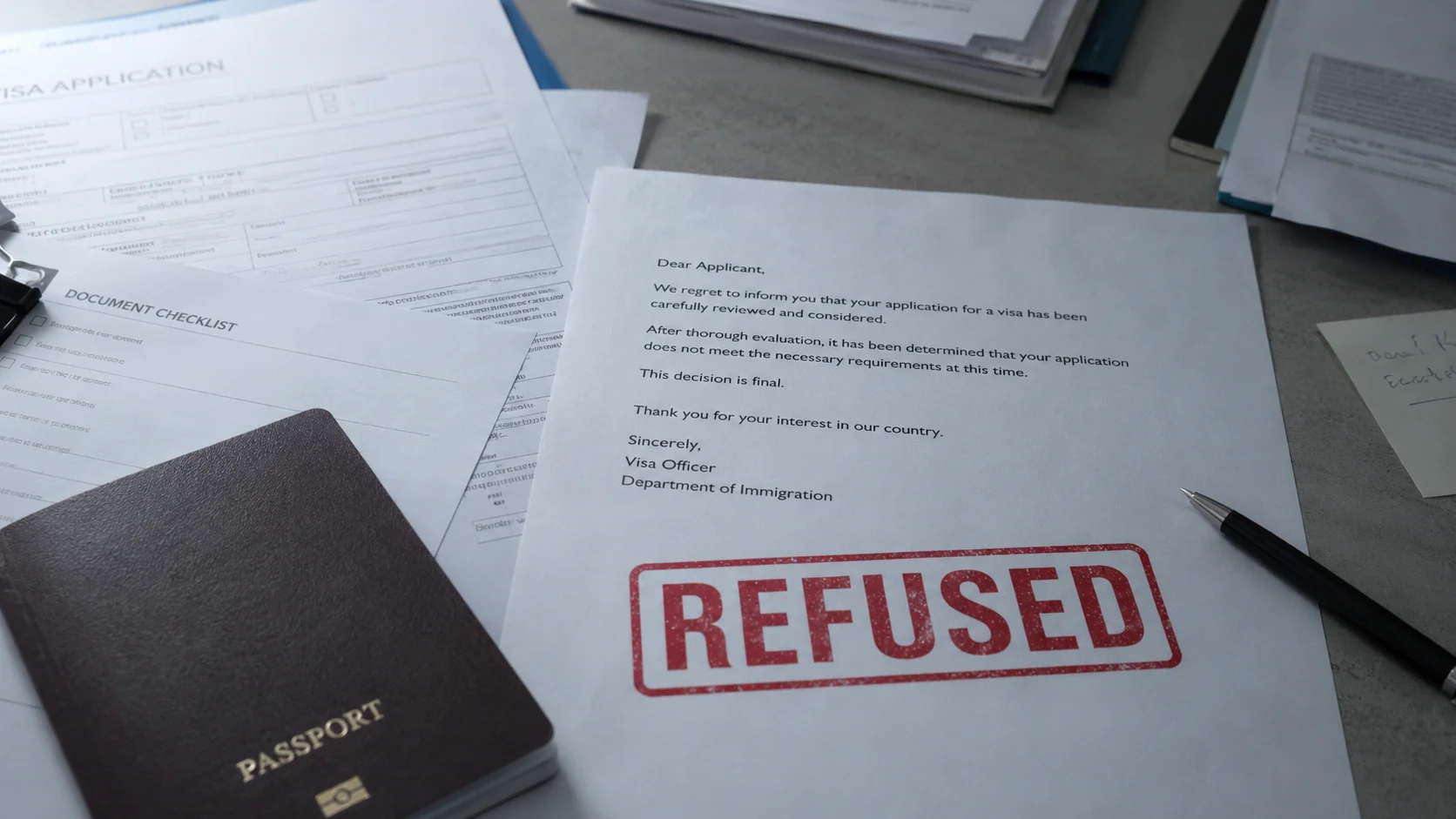
Schengen rejection rates by nationality (2024)
The European Commission publishes annual Schengen short-stay visa statistics broken down by applicant nationality and processing consulate. The 2024 data set, released in early 2025, covers more than 11.7 million applications processed across roughly 2,000 consulates in 27 Schengen states. The headline number is a 16.4 percent overall rejection rate, the highest since pre-pandemic 2014. But the average hides enormous nationality-level variance. Six countries have rejection rates above 35 percent. Eight countries have rates below 5 percent. The table below covers the major source countries.
| Nationality | Schengen Rate 2024 | Volume | YoY Trend |
|---|---|---|---|
| Bangladesh | 62.4% | ~110,000 apps | Up |
| Pakistan | 62.1% | ~150,000 apps | Up |
| Ethiopia | 41.2% | ~25,000 apps | Up |
| Senegal | 38.7% | ~80,000 apps | Up |
| Ghana | 35.2% | ~50,000 apps | Stable |
| Algeria | 35.0% | ~520,000 apps | Down slightly |
| Cameroon | 33.5% | ~30,000 apps | Up |
| Egypt | 30.5% | ~280,000 apps | Up |
| Nigeria | 30.3% | ~120,000 apps | Stable |
| Morocco | 25.4% | ~700,000 apps | Stable |
| Iran | 24.6% | ~250,000 apps | Stable |
| Sri Lanka | 24.5% | ~50,000 apps | Stable |
| Kenya | 22.0% | ~30,000 apps | Stable |
| Vietnam | 19.0% | ~150,000 apps | Stable |
| India | 15.0% | ~1,200,000 apps | Stable |
| Philippines | 14.8% | ~280,000 apps | Stable |
| Turkey | 12.5% | ~1,000,000 apps | Stable |
| Indonesia | 8.2% | ~150,000 apps | Stable |
| China | 4.6% | ~1,500,000 apps | Down |
| Saudi Arabia | 1.9% | ~280,000 apps | Down |
| Russia | 1.8% | ~440,000 apps | Down |
| UAE | 1.1% | ~150,000 apps | Down |
The GCC anomaly deserves its own paragraph. Saudi Arabia, the UAE, Qatar, Kuwait, Bahrain, and Oman all post Schengen rejection rates under 2 percent. Their immediate neighbours, including Iran, Iraq, Egypt, and Yemen, post rates between 25 and 60 percent. The difference is not religion, language, or geography. It is the combination of high GDP per capita, low irregular-migration risk to Europe, and a strong bilateral relationship. Russia at 1.8 percent is an even stranger outlier given the geopolitical context, but most Russian Schengen applications are filed in Moscow or St Petersburg by frequent travellers with extensive prior visa history, which heavily skews the approval rate. The Indian rate of 15 percent is the global benchmark for a high-volume, middle-income country, and it has stayed within two points of that level for a decade.
Why African applicants are rejected twice as often
Henley and Partners published a widely cited 2024 analysis showing African applicants face an average Schengen rejection rate of 45 percent while Asian applicants face 22 percent. That is a 23-point gap. Filtering for income-comparable countries does not close it. Filtering for prior visa history does not close it. The gap has been stable since at least 2018 and shows up in UK, US, and Canadian data sets as well. Despite submitting half as many applications per capita as Asian travellers, African applicants are twice as likely to be rejected on a per-application basis.
Three structural causes explain most of the gap. First, documentary requirements designed for European-style bureaucracies are harder to meet in countries with large informal economies. Formal employment contracts, registered property titles, and audited tax returns are the bread and butter of a strong visa application. In Nigeria, Ghana, and Kenya, fewer than 20 percent of working-age adults hold formal-sector jobs. Property is widely owned but rarely registered with deeds an officer would recognise. The same applicant who is solidly middle class and demonstrably rooted in their community may look paper-thin to an officer who has never visited the country. See our Nigeria nationality guide, Ghana guide, and Kenya guide for documentation strategies that work despite these structural gaps.
Second, multiple academic studies have documented consular-officer bias as a measurable factor. A 2023 study by the LSE Africa Centre found that identical applications submitted under different nationalities by mystery shoppers received different decisions. The bias is not necessarily conscious. It reflects officer caseload patterns, training defaults, and the way overstay statistics are presented in officer dashboards. The third factor is statistical artefact. Algeria alone files roughly 520,000 Schengen applications per year, almost all to French consulates, with a 35 percent rejection rate. That single corridor pulls the continental African average up by several points. Stripping Algeria out reduces the gap meaningfully but does not eliminate it.
Knowing the gap exists is not a reason to give up. It is a reason to over-document. Applicants from high-rejection nationalities who match the application quality of low-rejection nationality applicants close most of the gap. The remaining gap is structural and unavoidable, but it shrinks from 23 points to perhaps 5 to 8 points when documentation is excellent and travel history is established.
US rejection rates by nationality
US visa data is published annually by the State Department in the Report of the Visa Office. The two most-watched figures are the B1/B2 visitor visa refusal rate and the F-1 student visa refusal rate, both under INA section 214(b). FY2024 saw the highest F-1 refusal rate ever recorded for India at 41 percent, up from 36 percent the year before. The rejection rates below are full-year FY2024 figures, with key behavioural patterns called out by nationality.
| Nationality | B1/B2 Refusal Rate | F-1 Refusal Rate | Key Pattern |
|---|---|---|---|
| India | 27-30% | 41% (FY2024 record) | Strong scrutiny on immigrant intent |
| Pakistan | 35%+ | 50%+ | Security checks common |
| Bangladesh | 35%+ | 40%+ | Financial scrutiny intense |
| Nigeria | 30%+ | 35%+ | 214(b) presumption strict |
| Ghana | 25%+ | 30%+ | Stable, improving slowly |
| Egypt | 25%+ | 30%+ | Tightening since 2023 |
| Iran | 35%+ | 45%+ | Heavy security check |
| Morocco | 20% | 22% | Stable |
| Mexico | 25%+ | N/A | Border-state variation |
| Vietnam | 20%+ | 25%+ | Improving |
| Philippines | 20% | 18% | Strong K-1 visa flow |
| China | 15% | 8% | Lower than expected |
| Brazil | 12% | 10% | Lower than peers |
| Colombia | 18% | 15% | Stable |
| South Korea | 5% | 4% | Visa Waiver eligible |
Consulate variation inside a single country is often as large as country-to-country variation. Indian applicants at the Mumbai consulate posted a 22 percent B1/B2 refusal rate in FY2024 while applicants at Hyderabad posted 38 percent, and the gap is not explained by applicant quality alone. Hyderabad processes more first-time student visa applicants, who carry higher refusal rates by definition, but officer culture and interview length differ measurably. Nigerian applicants face similar variation between Lagos and Abuja, with Abuja generally posting lower refusal rates because the applicant pool skews towards diplomatic, business, and established travellers. If you have a choice of consulate, the data matters.
UK rejection rates by nationality (visitor)
UK Home Office quarterly transparency data publishes visitor visa refusal rates by nationality. The 2024 calendar year figures show the same broad pattern as Schengen but with slightly higher refusal rates for South Asian applicants and slightly lower rates for some African nationalities. The UK uses a single-page refusal letter with paragraph references to V3 of Appendix V, the visitor rules, which makes the decoding process more transparent than the Schengen standard letter.
| Nationality | UK Visitor Rate | Key Drivers |
|---|---|---|
| India | 9% | Largest single source country |
| Bangladesh | 40%+ | Family ties and travel history |
| Ghana | 40%+ | Financial and ties to home |
| Pakistan | 35%+ | Financial and family ties |
| Nigeria | 35%+ | Financial and purpose |
| Iran | 30%+ | Security and ties |
| Algeria | 30%+ | Stable |
| Sri Lanka | 25%+ | Stable |
| Egypt | 25%+ | Stable |
| Kenya | 20% | Improving |
| Vietnam | 18% | Improving |
| Philippines | 15% | Family visa heavy |
| Indonesia | 12% | Stable |
| China | 5% | Lowest large source |
| South Africa | 8% | Visa-free for most |
The UK has not published a consulate-by-consulate breakdown since 2019 because almost all visitor visa decisions are now made at centralised decision-making centres in Sheffield, Croydon, and overseas hubs, not at the application centre where biometrics are submitted. That means the consulate you visit no longer affects your decision in the same way it does for Schengen or US applications. The decision-maker has only your paper file. Read our UK refusal reasons deep dive for paragraph-by-paragraph guidance on the most common V3 grounds.
Canada rejection rates by nationality (study + visitor)
Canada's IRCC publishes monthly approval data through ATIP requests rather than regular open-data releases, which makes the picture lumpy. The 2025 figures below reflect the post-SDS environment, after Canada terminated the Student Direct Stream in November 2024 and doubled the proof-of-funds requirement to CAD 20,635. Indian study permit refusals rose from 32 percent in early 2024 to 74 percent in early 2025, the largest year-on-year shift any major country has recorded for any visa stream. Bangladesh and Pakistan now face national-level study permit caps in addition to per-applicant scrutiny.
| Nationality | Visitor TRV | Study Permit | Key 2025 Change |
|---|---|---|---|
| India | 45% | 74% | SDS ended, doubled funds requirement |
| Bangladesh | 50%+ | 65%+ | National caps applied |
| Pakistan | 50%+ | 60%+ | National caps applied |
| Nigeria | 40% | 50% | Stable |
| Ghana | 35% | 40% | Stable |
| Sri Lanka | 30% | 35% | Stable |
| Iran | 30% | 35% | Security and funds |
| Vietnam | 25% | 30% | Stable |
| Kenya | 25% | 30% | Stable |
| China | 18% | 25% | Stable |
| Philippines | 18% | 22% | Stable |
The Indian collapse from 32 to 74 percent study permit refusal in twelve months is the headline story of Canadian immigration in 2025. The combination of SDS termination, doubled funds, provincial allocation caps, and a deliberate policy shift to reduce overall student volumes from India by 35 percent has produced a refusal regime that even strong applicants struggle to clear. The lesson for every nationality is that program-level policy changes can move refusal rates by 40 points overnight, so checking the most recent data before applying is essential. See our Canada refusal deep dive for the latest IRCC reasoning patterns.
How to beat the odds if you're from a high-rejection country
The structural disadvantage is real, but it is not destiny. Applicants from high-rejection nationalities who present excellent documentation routinely get approved at rates close to the global average. The playbook below distils what works.
- Six or more months of consistent bank statements. Officers look for steady balances, not sudden lump-sum deposits that look like loaned funds. A 12-month statement showing a stable balance is worth more than a 1-month statement showing a high balance.
- Employer letter on company letterhead, signed by HR or your direct manager, with the company stamp. The letter must state your role, salary, length of service, approved leave dates, and explicit obligation to return to work after travel.
- Property ownership documentation if applicable. Title deeds, mortgage statements, or land registry extracts. Even renting on a long-term lease (12+ months) registered with a local authority counts as a return tie.
- Family obligations documented with birth certificates and school records. Officers weigh dependent parents, school-age children, and spouses staying behind heavily as return-intent evidence.
- Travel history ladder. Apply for Schengen first, then UK, then US, then Canada. Each successful trip strengthens the next application by an order of magnitude. Schengen multi-entry visas are easier to obtain after one short successful trip.
- Cover letter explaining purpose and return reasons specifically. A generic itinerary is not enough. State why you are going, who you will meet, what you will do daily, and exactly why you will return on the stated date.
- Apostille or legalise all official documents. A Hague Apostille on your birth certificate, marriage certificate, and educational qualifications costs little and signals professionalism. Officers process apostilled documents faster.
- Professional translation of non-English documents by a certified translator. Self-translation or relying on the consulate to interpret is a refusal risk.
Nigerian applicants face particular scrutiny on financial documents because of the prevalence of round-trip bank statement schemes. Counter this with statements showing salary credits matching your employer letter exactly, plus a tax clearance certificate from FIRS. See the Nigeria nationality guide for the full playbook.
Pakistani applicants should lead with prior travel history wherever possible. Even a single Turkey trip with stamps in the passport changes the conversation. Combine with a strong employer letter and a notarised affidavit of return obligation if travelling for business. The Pakistan nationality guide covers the appeal templates that work best at Pakistani consulates.
Bangladeshi applicants face the steepest climb of any major nationality. Bank statements alone are rarely enough. Combine with property documents, a notarised affidavit of return from a guarantor with property, and family ties documentation. The Bangladesh nationality guide covers the recently updated documentation patterns following the 2024 rate spike.
Indian applicants benefit most from the ladder approach. The 15 percent Schengen rate is achievable for almost any white-collar applicant with three months of payslips and a confirmed itinerary. See the India nationality guide for the visa-by-visa breakdown.
Egyptian applicants are dealing with a rising rejection trend, partly driven by EU migration politics. Counter with proof of established business or employment, multiple recent travel stamps to easier destinations like Turkey or the UAE, and a clear professional purpose for travel.
Ghanaian applicants benefit from booking biometric appointments at the larger Accra centre rather than smaller centres, because Accra applicants generally cluster towards better documentation and the officer caseload is more familiar with Ghanaian financial documents. See the Ghana nationality guide for visa-specific guidance.
Lower-risk alternatives for high-rejection nationalities
If you have been refused two or three times by Schengen, the UK, or the US, the rational move is often to redirect rather than reapply. Several countries actively welcome applicants from Bangladesh, Pakistan, Nigeria, and similar high-rejection nationalities, either through visa-free or visa-on-arrival policies or through digital-nomad and remote-work visas with no nationality restrictions.
- Georgia gives Bangladeshis, Pakistanis, and Nigerians 1 year of visa-free stay. No application required, no rejection possible. Strong WiFi, low cost of living, and a path to residency through company incorporation.
- Thailand DTV (Destination Thailand Visa) is open to all nationalities with a remote work contract or freelance income above 500,000 THB savings. 5-year multi-entry, 180 days per entry. Rejection rate close to zero.
- UAE virtual working programme accepts all nationalities with 5,000 USD per month income. Renewable annually, family included.
- Indonesia E33G (digital nomad) gives 1 year for remote workers with USD 60,000 in annual income. Bali base, very high approval rate.
- Mauritius Premium Visa is open to all nationalities for 1 year. USD 1,500 monthly income required.
See our easiest work visas 2026 guide for the full list of nationality-friendly programmes. Building a six-month residency history in Georgia or Thailand changes the calculus of a subsequent Schengen or UK application because you are now applying from a stable third-country base, not from your nationality of origin.
lead.rejectionHeading
lead.rejectionDesc
Sık sorulan sorular
Which country has the highest visa rejection rate?
For Schengen visas in 2024, Bangladesh tops the list at 62.4 percent, narrowly ahead of Pakistan at 62.1 percent. Among countries with at least 20,000 annual applications, Ethiopia (41.2 percent) and Senegal (38.7 percent) round out the top four. Lower-volume countries can have higher rates but are not statistically comparable. For US visas, Pakistan and Iran consistently post the highest refusal rates at 35 to 50 percent depending on visa class.
Why are Bangladeshi applicants rejected so often?
Three structural reasons. First, Bangladesh has a high irregular migration profile, particularly to Italy, which makes consular officers extra cautious. Second, the formal economy is small, so documenting steady employment, registered property, and audited finances is harder than in comparable Asian economies. Third, prior visa history is sparse because Bangladeshis are not in any major visa-free travel corridor, so applicants struggle to show the cumulative travel record that lowers risk perception. The 62 percent rate is beatable, but requires excellent documentation.
Does the consulate I apply at affect my chances?
For Schengen yes, dramatically. The German consulate in Mumbai approves at different rates than the French consulate in Mumbai for identical applicant profiles. Choose the Schengen consulate of the country you genuinely plan to spend the most time in, then within that country choose the consulate covering your residential area. For US visas, applicants in major metro consulates (Mumbai, Lagos, Manila) generally face higher caseloads and shorter interviews than smaller consulates, and outcomes vary measurably. For UK and Canada, central decision-making has reduced consulate variation to near zero.
Are African applicants really rejected twice as much?
Yes. The 2024 Henley analysis found African applicants face a 45 percent average Schengen rejection rate vs 22 percent for Asian applicants. The gap is real and persistent. Some of it is explained by documentation patterns and Algeria volume distortion, but a measurable structural component remains. Excellent documentation closes most of the gap, leaving a 5 to 8 point residual that is unavoidable for first-time applicants.
Can I improve my chances by applying as a tourist first?
Yes, and this is the single most effective long-term strategy. A successful short tourist trip to Schengen unlocks multi-entry visas on subsequent applications and dramatically improves UK and US application odds. The recommended ladder is Schengen first (often easiest for a short trip with hotel bookings), then UK, then US. Each successful stamp on the passport reduces the perceived risk of the next application.
Do GCC nationals really get approved at 99%+?
Approximately yes. Saudi Arabia, the UAE, Qatar, Kuwait, Bahrain, and Oman all post Schengen rejection rates between 1.1 and 2.0 percent. The combination of high income, low irregular-migration risk, and strong bilateral relationships produces near-automatic approval for routine applications. Refusals when they occur are almost always for incomplete documentation rather than risk concerns.
Why did Indian Canadian study permits jump from 32% to 74% refusal?
Canada terminated the Student Direct Stream (SDS) in November 2024, doubled the proof-of-funds requirement to CAD 20,635, applied provincial allocation caps that disproportionately reduced Indian volumes, and shifted policy explicitly to reduce study permit inflow from India by 35 percent. The combined effect was the largest year-on-year refusal rate move ever recorded for any major country on any visa stream.
Should I move to a country with a better passport before applying?
If you have the time horizon (3 to 5 years), yes, this is a legitimate strategy. Building residency in Georgia, the UAE, Singapore, or Portugal and then naturalising changes your visa application risk profile permanently. Even short-term, holding a 1-year Georgian residence permit improves Schengen approval odds for Bangladeshis or Pakistanis substantially because you now have a third-country base demonstrating ties beyond your nationality of origin.
İlgili makaleler
Ücretsiz araçlarımızı kullanın
Kanada CRS, Avustralya puanları, İngiltere skilled worker, Almanya Fırsat Kartı ve 34 ülke maaş eşikleri için ücretsiz hesaplayıcılar.
Tüm araçları gör