What is Section 214(b)?
Section 214(b) of the Immigration and Nationality Act (INA) is the legal hammer behind most US non-immigrant visa denials. The statutory text says, in essence, that every person applying for a non-immigrant visa is presumed to be an intending immigrant unless the applicant establishes to the satisfaction of the consular officer that they are entitled to a non-immigrant status. In plain English: the law assumes you want to stay in the United States permanently, and it is your job to convince the officer otherwise.
This presumption flips the burden of proof. In most areas of US law, the government must prove something against you. Under 214(b), the consular officer does not have to prove that you will overstay or work illegally. They only have to remain unconvinced that you will leave at the end of your authorised stay. Silence, weak evidence, vague answers, and missing documents all count against you because they do not move the presumption.
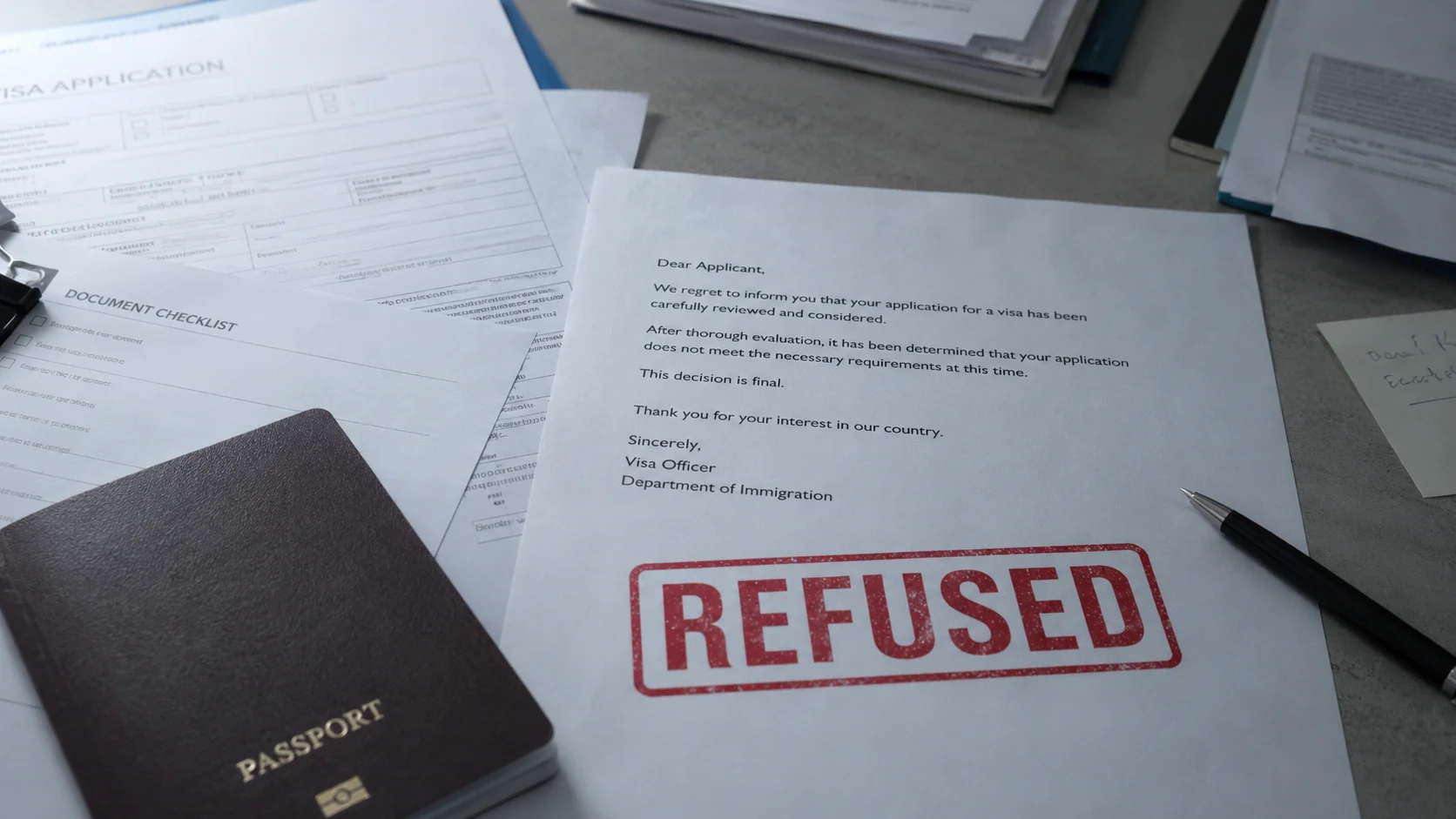
Two practical consequences flow from this. First, consular officers do not need to write detailed reasons for a 214(b) denial. The standard refusal letter is a one-page template that simply says 'You have not established eligibility for the visa category you applied for' and refers to section 214(b). Second, the interview is short for a reason. Most officers reach a 214(b) decision within 60-120 seconds based on a handful of questions designed to test ties, purpose, and consistency. The application form (DS-160) and supporting documents matter, but the interview is where the presumption is moved.
Why there is NO appeal under 214(b)
Unlike UK and Canadian visa systems, the US offers no appeal mechanism for a 214(b) refusal. This is not an administrative gap; it is a deliberate feature of US law. INA Section 104 vests visa adjudication authority in consular officers and explicitly excludes their decisions from review by the Department of State or US courts. The legal doctrine that protects this is called consular nonreviewability, sometimes shortened to consular absolutism, and it has been upheld by the US Supreme Court on multiple occasions including in Kleindienst v. Mandel (1972) and Trump v. Hawaii (2018).
Mandamus actions, where a court orders a government official to perform a duty, occasionally work for delays in administrative processing (221(g) cases) but almost never for 214(b) discretion. The reason is that a 214(b) refusal is not a delay; it is a fully-made decision, and courts treat the discretionary judgement of a consular officer as outside their jurisdiction. A handful of constitutional and statutory carve-outs exist (for example where a US citizen spouse's fundamental rights are at stake), but they apply to immigrant visa categories, not B1/B2, F-1, or J-1 denials.
The practical takeaway is simple. Your only remedy after a 214(b) denial is to reapply, with stronger evidence, at a future interview. Lawyers cannot file appeals. Members of Congress can sometimes ask the consulate for a courtesy review, but in our experience this almost never reverses a 214(b) decision. Your time and money are better spent strengthening the next application than chasing a remedy that does not exist.
What the officer is actually looking for
Consular officers receive specialised training on the 214(b) presumption and the indicators that move it. Across thousands of refusal letters our readers share, four evidence categories come up again and again. Building each one before your interview is the most reliable path to an approval.
Strong ties to your home country. This is the single biggest category. Officers want concrete reasons you will return: a permanent job (employment letter with leave dates and salary), property ownership (title deed or rental agreement in your name), close family that depends on you (dependants, elderly parents), a business you run, school enrolment for your children. Single applicants in their twenties without property, dependants, or established careers face the steepest 214(b) presumption. They can still get approved, but they need stronger purpose and travel history to compensate.
Clear purpose of travel. A specific itinerary helps far more than 'visiting friends'. Officers respond well to dated invitation letters from US contacts, conference or training registrations, hotel reservations, return flights booked (not necessarily paid), and a written day-by-day trip plan. Tourism visa applicants who can name the cities and dates they will visit do measurably better than those who answer 'whichever places are nice'.
Financial capacity. Officers want to see six or more months of consistent bank statements with a salary credit that matches your employment letter, and tax returns or W-2 equivalents that match your income. A sudden deposit shortly before the interview is a red flag, not a positive signal. The funds must be plausibly yours, not borrowed for the visa interview.
Travel history. Each prior compliant visa is evidence that you respect immigration rules. A Schengen visa used and returned, a UK visit completed on time, a Canadian visa with stamps showing entry and exit, prior US trips with no overstay record - all of these move the presumption in your favour. The DS-160 has space to list previous travel; use it fully and bring your old passports to the interview.
214(b) for different visa types
214(b) applies across the non-immigrant visa spectrum, but the dominant failure pattern looks different for each category. Knowing the specific risk profile for your visa type lets you target your evidence rather than scattering documents.
B1/B2 (tourist and business visitor). This is the most common 214(b) category. The interview is short, the questions revolve around purpose, ties, and finances, and the officer is testing whether your story holds together. Single applicants from high-refusal posts get refused more often than couples or families with US-based relatives, but every applicant can succeed with the right evidence package. Specific dates, clear purpose, and documented ties are the three pillars.
F-1 (student). F-1 has its own version of the 214(b) test focused on whether you intend to return after completing your studies. Officers ask why you chose this US university over similar options in your home country or elsewhere, what you plan to do after graduation, and how the degree fits your career path. They also probe finances heavily because F-1 applicants must show full first-year tuition and living costs, with credible sources of funds for subsequent years. A clear academic plan, a credible post-study return plan, and documented finances are the F-1 trifecta.
J-1 (exchange visitor). Similar 214(b) principles apply, with the added expectation that you will genuinely participate in the exchange programme and return home to share what you learned. J-1 also carries a separate two-year home residency requirement for some programmes, which is a different issue from 214(b) but often comes up in the same interview.
H-1B (specialty worker). Dual intent is statutorily permitted for H-1B, which means the consular officer cannot refuse you under 214(b) simply because you might eventually file for a green card. H-1B refusals usually occur under 221(g) for missing documents or 212(a) for inadmissibility, not under 214(b). If you receive a 214(b) refusal on H-1B, something has gone unusually wrong; review the specific reasons and get legal advice.
L-1 (intra-company transferee). Like H-1B, L-1 permits dual intent. 214(b) refusals on L-1 are rare. When they happen, the issue is usually that the consular officer is not convinced of the qualifying employment relationship or the specialised knowledge claim, which is technically a category eligibility issue rather than pure non-immigrant intent.
How to reapply after a 214(b) denial
There is no mandatory waiting period after a 214(b) denial. You can technically reapply the next day. In practice, the right gap depends on what new evidence you have.
- If your circumstances have not changed (same job, same finances, no new travel), wait 6-12 months. Reapplying immediately with the same evidence almost always produces the same outcome, and a quick second refusal can hurt your file.
- If you have STRONG new evidence (new better-paying job, new property, completed Schengen or UK trip, completed family ties such as marriage or new dependant), reapply in 0-3 months. New material evidence is the entire point of a reapplication.
- Pay the full MRV fee again (currently $185 for B1/B2 and most non-petition NIVs). The fee is non-refundable and does not carry over from your previous application.
- Schedule a new interview slot through the US Travel Docs portal in your country. Wait times vary widely; check the State Department published wait times before booking.
- Update your DS-160 to reflect any new circumstances. Be consistent with your previous DS-160 on facts that have not changed (address, employer history, family). Inconsistencies are flagged.
- Bring NEW evidence to the interview. Do not show up with the same folder. The officer will see your previous refusal in their system and will be looking for what has changed.
Be honest about the previous refusal. The DS-160 asks whether you have been refused a US visa before, and the officer can see your full history on screen. Trying to hide a previous 214(b) does not hide it; it adds a deception concern on top of the original ties question. Disclose, then explain what is different now.
221(g) vs 214(b) - which one did you get?
One of the most confusing things about US visa refusals is the difference between 221(g) and 214(b). Both arrive as a paper slip handed to you at the end of your interview, often in the same coloured envelope, but they mean very different things.
221(g) means 'administrative processing'. Your application is on hold, not refused outright. The consulate is requesting additional documents (commonly a letter from your employer, more financial evidence, transcripts, or a CV), or your case has been sent for a security advisory opinion or other clearance. 221(g) cases typically resolve within 60 days but can take 4-6 months for security checks. Once you submit the requested documents or the clearance comes back, the consulate usually issues the visa without a second interview.
214(b) means the consular officer made a final decision: refused, presumption of immigrant intent not overcome. Your only path forward is to reapply with new evidence at a future interview. There is no document you can submit to flip the decision.
Read the slip carefully. The section quoted (either 214(b) or 221(g)) tells you exactly which path you are on. Our decode your US refusal letter guide covers every code that appears on US refusal slips, including the less common 212(a) inadmissibility codes covered in the next section.
212(a) inadmissibility vs 214(b) - the big difference
Both 214(b) and 212(a) result in a visa denial, but the seriousness gap between them is enormous. Understanding which one you received decides whether you reapply in three months or whether you need an immigration lawyer immediately.
INA 212(a) is the inadmissibility section of US immigration law. It lists the categories of people who are not eligible for any visa, regardless of category. The most common 212(a) grounds are: health (specific communicable diseases, lack of required vaccinations), criminal (crimes of moral turpitude, drug offences, prostitution, multiple convictions), security (espionage, terrorism), public charge (likely to depend on government benefits), labour certification issues, illegal entrants and prior immigration violators (3-year, 10-year, or permanent bars), and fraud or misrepresentation. Some 212(a) bars are permanent unless waived; others have a defined duration. Several require a formal I-601 or I-601A waiver granted by USCIS before a visa can be issued, even after the underlying issue is otherwise resolved.
214(b) by contrast is purely about non-immigrant intent on the day of the interview. It is not a finding of misconduct, fraud, or ineligibility. You remain admissible to the United States in theory; the consular officer simply was not convinced that this specific application met the non-immigrant standard. Recovery is straightforward: build the evidence, reapply, succeed.
Recovery from 212(a) is almost always slower and almost always requires legal help. Waivers can take 12-24 months to adjudicate. Some 212(a) grounds (such as a lifetime ban for fraud combined with an aggravated felony conviction) have very limited or no waiver path. If your refusal slip cites 212(a), do not reapply without speaking to an experienced US immigration attorney. The difference between handling it well and badly is years of your life.
lead.rejectionHeading
lead.rejectionDesc
Sık sorulan sorular
How soon can I reapply after a 214(b) refusal?
There is no mandatory waiting period. You can reapply the next day. But you should only reapply when you have new evidence that addresses the officer's concerns. Same application, same documents, same answers will produce the same result. Most successful reapplications happen 3-12 months after the first refusal, after material changes such as a new job, new property, completed international travel, or a new family situation.
What evidence works best for proving non-immigrant intent?
The four pillars: strong ties to home country (job, property, dependants, business), clear purpose with specific dates and itinerary, six or more months of consistent finances, and prior compliant international travel history. Use all four together. Single pieces of evidence rarely move the 214(b) presumption on their own; the combination tells a coherent story that you are returning home.
Why was I refused after only two questions in the interview?
Consular officers make 214(b) decisions quickly because the presumption is set in law before you walk up. Most decisions are reached within 60-120 seconds based on the application file plus a handful of clarifying questions. If the officer felt your file did not overcome the presumption, additional questions would not help. The short interview is a signal, not the cause; the decision was driven by the strength or weakness of your evidence package.
Will hiring an attorney help with a 214(b) refusal?
For pure 214(b) on B1/B2 visitor visas, usually no. Attorneys cannot appeal 214(b) decisions and cannot accompany you to the interview window. They can help you prepare a stronger evidence package and DS-160 for a reapplication. For F-1 and J-1 student or exchange refusals, a specialist consultant who understands the genuine student test can be useful. For H-1B and L-1 refusals (which are usually 221(g) or 212(a) rather than pure 214(b)), an immigration attorney is essential.
Does a US 214(b) denial hurt my chances at a UK or Canadian visa?
Indirectly. Other countries do not automatically reject you because the US refused you, but they will see the refusal on your record and may apply extra scrutiny. The UK and Canada both ask about previous visa refusals in any country on their application forms. Disclose the US 214(b) honestly, explain that the basis was non-immigrant intent (not fraud or inadmissibility), and provide the same strong ties evidence to the new country.
Will the 214(b) refusal affect my next US interview years from now?
The officer can see your full visa history including all previous refusals. A single old 214(b) does not doom future applications, but a pattern of repeated refusals signals weak ties or inconsistencies. When you reapply, expect the officer to ask 'what is different now since your previous refusal?'. Have a clear, specific answer based on documented changes in your circumstances.
Can a mandamus lawsuit force the consulate to issue my visa after 214(b)?
Almost never. Mandamus actions occasionally succeed for delays in administrative processing (221(g) cases stuck for many months), but courts respect the doctrine of consular nonreviewability for substantive visa decisions including 214(b). The discretionary judgement of the consular officer on non-immigrant intent is treated as outside judicial review. Money spent on a mandamus for 214(b) is almost always wasted; it is better invested in strengthening your reapplication.
Do waivers exist for 214(b) refusals?
No. Waivers (I-601, I-601A) exist for specific 212(a) inadmissibility grounds such as fraud or certain criminal convictions. 214(b) is a non-immigrant intent finding, not an inadmissibility ground, and there is no waiver process for it. The only remedy is to reapply with new evidence. If someone offers to file a '214(b) waiver' on your behalf, they are misrepresenting US immigration law.
İlgili makaleler
Ücretsiz araçlarımızı kullanın
Kanada CRS, Avustralya puanları, İngiltere skilled worker, Almanya Fırsat Kartı ve 34 ülke maaş eşikleri için ücretsiz hesaplayıcılar.
Tüm araçları gör