
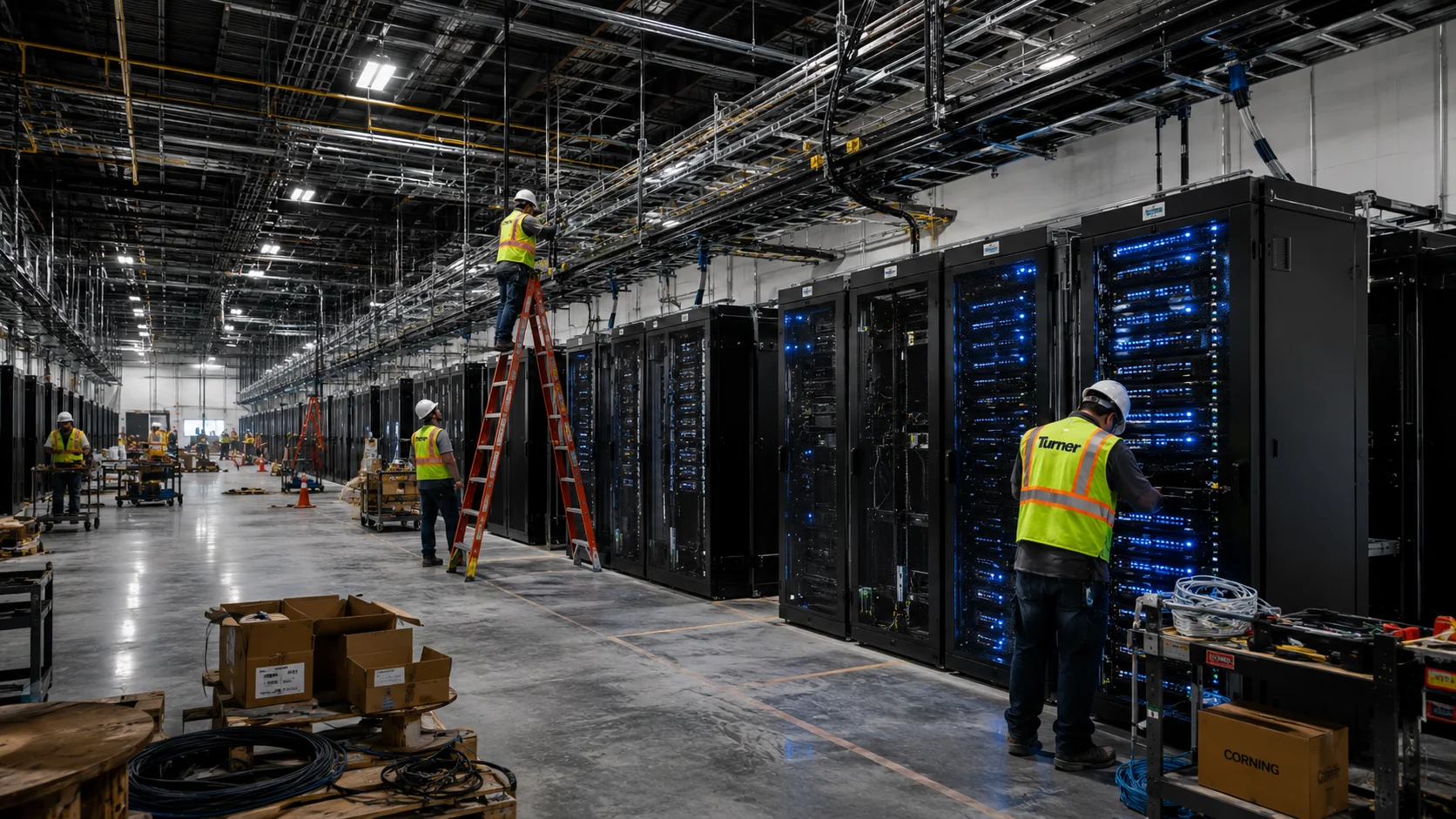
The AI infrastructure labor crisis explained
In 2026, the five biggest technology companies - Meta, Microsoft, Amazon, Google, and Oracle - collectively committed more than $700 billion in capital expenditure, a significant share of which is flowing directly into data centers and semiconductor fabrication facilities across the United States. Microsoft alone has pledged $80 billion for fiscal year 2026. Amazon has announced over $100 billion in planned infrastructure investment. Google has committed $75 billion. Meta is spending at a rate that dwarfs its own previous records. Oracle is building out what it calls the largest AI data center campus on the planet in Abilene, Texas, as part of the Stargate initiative alongside OpenAI. Every dollar of this investment depends on one thing: workers who can actually build the facilities.
The math is staggering. Industry analysts consistently estimate that every $1 billion of large-scale construction spend creates roughly 3,450 direct and indirect jobs. Apply that multiplier to $700 billion in AI-driven capex and you arrive at a figure that exceeds 2.4 million job-years of construction labor. Even accounting for multi-year project timelines, the immediate demand is enormous - and the domestic supply is not there. The data center construction industry is currently short 499,000 workers compared to projected demand, according to research from the Data Center and AI Infrastructure Coalition. On the operational side, there are approximately 340,000 unfilled data center roles in the United States right now, covering everything from electrical maintenance technicians to critical facilities managers.
Semiconductor fabrication adds a separate and equally severe crunch. The CHIPS and Science Act is funding a domestic chip manufacturing renaissance led by TSMC in Phoenix, Arizona; Intel in Columbus, Ohio; and Samsung and Micron across other US sites. The Semiconductor Industry Association projects more than 45,000 unfilled chip fab positions by 2030 in roles ranging from process technicians and cleanroom operators to mechanical and electrical construction trades supporting facility buildout. These are not entry-level roles that can be filled overnight - they require specific training, certifications, and in many cases years of hands-on experience.
The immigration environment has made the shortage sharper, not softer. Stricter enforcement since 2025 has disrupted the traditional construction labor ecosystem that relied on a mix of documented and undocumented workers, particularly in the Sun Belt states where most of the new AI infrastructure is being built. Texas, Arizona, Georgia, and Virginia are all experiencing acute shortages of licensed electricians, HVAC specialists, and pipefitters precisely when demand from AI projects is spiking. The result is a rare window: the United States needs skilled foreign workers badly enough that both employers and the immigration system are adapting to accommodate them. Understanding which visa pathway fits your trade and your qualifications is the critical first step.
The Stargate project in Abilene, Texas alone represents a $500 billion ten-year commitment from OpenAI, SoftBank, and Oracle. TSMC Arizona is scaling to five fabs by the end of the decade. Intel Ohio (New Albany) is projected to become the largest semiconductor manufacturing site in the world. The geographic concentration of these projects matters for visa strategy - data center and fab hotspots qualify as genuine shortage regions, which directly affects how quickly PERM labor certifications are approved for skilled trades workers seeking green cards.
Two tiers of AI infrastructure jobs
AI infrastructure jobs split into two broad tiers with very different visa pathways. Engineers, architects, and specialists at the top tier typically hold degrees and qualify for H-1B or O-1A status. Skilled trades workers - the electricians, HVAC technicians, pipefitters, and welders who physically build and maintain the facilities - do not need a degree, but they need demonstrated experience and the right employer willing to sponsor an EB-3 or H-2B petition. Understanding which tier you belong to is the first step to choosing the right strategy.
| Tier | Roles | Visa Pathways | Degree? | Salary |
|---|---|---|---|---|
| Engineers / Specialists | DC engineers, network, power electronics, AI/ML | H-1B, O-1A, EB-1, EB-2 NIW | Yes | $84K to $250K |
| Skilled Trades | Electricians, HVAC, pipefitters, welders | EB-3 Skilled, H-2B | No (experience) | $45K to $120K+ |
| Technicians | Fab techs, DC operations, commissioning | EB-3, H-1B if degree | Varies | $60K to $150K |
The distinction between tiers matters enormously because the visa pathways diverge completely. An electrical engineer with a bachelor's degree and a job offer from a hyperscale data center operator enters the H-1B lottery in March and may have status by October. A licensed electrician with ten years of experience building data centers has no path through H-1B at all - that program requires a degree in a specialty occupation. The electrician's route runs through EB-3 Skilled Worker (a permanent green card) or H-2B (a temporary seasonal worker visa). Both are legitimate, both lead to real employment, but they work on completely different timelines and requirements.
Technicians occupy a middle ground. A semiconductor process technician with an associate degree and two years of fab experience may qualify for EB-3 or, if the role is sufficiently specialized and wages are high enough, for H-1B. Commissioning specialists with cleanroom certifications are increasingly being treated as specialty workers by immigration attorneys, and some have succeeded with H-1B petitions where the job description emphasizes technical complexity and industry-specific knowledge rather than general electrical work. That said, the dominant pathway for most technicians without a four-year degree remains EB-3.
The master visa comparison
Before diving into each pathway in detail, this comparison table gives you a side-by-side view of every major visa option relevant to AI infrastructure work. The most important columns are the degree requirement, the job-offer requirement, and whether the visa leads to a green card. Workers often make costly mistakes by targeting the wrong visa category - understanding the full landscape saves time and legal fees.
| Visa | For | Degree? | Job Offer? | Duration | Green Card? | Processing |
|---|---|---|---|---|---|---|
| H-1B | Engineers, AI specialists | Bachelor's | Yes | 3+3yr | Via employer | Lottery (Mar) |
| O-1A | Top AI researchers | No (extraordinary ability) | Yes | 3yr renewable | Via EB-1 | 2 to 3 months |
| EB-2 NIW | AI experts (self-petition) | Advanced | No | Green card | Yes, direct | 1 to 3yr |
| EB-3 Skilled | Electricians, HVAC, welders (2yr exp) | No | Yes | Green card | Yes, direct | 2 to 4yr |
| H-2B | Temporary trades | No | Yes | Under 1yr (seasonal) | No | 3 to 4 months |
A few patterns stand out in this table. First, the only pathways that lead directly to a green card without going through a separate immigrant petition are EB-2 NIW, EB-3, and (for the most accomplished researchers) O-1A converting to EB-1. H-2B explicitly does not lead to a green card - it is a nonimmigrant temporary worker visa, and dual intent is not clearly permitted, though many H-2B workers do subsequently find EB-3 sponsors and adjust status. Second, processing times vary wildly: H-1B is bound to the fiscal year lottery cycle while O-1A can be filed any time and approved in two to three months with premium processing.
For most skilled trades workers reading this guide, the practical choice is between EB-3 Skilled Worker and H-2B. The difference is permanence versus speed. H-2B gets you to the US faster (three to four months versus two to four years for EB-3) but the status expires and renewal is not guaranteed. EB-3 takes longer but ends in a green card and full permanent residency. Many workers use H-2B as a bridge - they come on a temporary basis, demonstrate their skills to a US employer, and then ask that employer to sponsor an EB-3 petition for permanent residence.
For skilled trades - the EB-3 green card path
The EB-3 Skilled Worker category is the most important visa pathway for the millions of electricians, HVAC technicians, pipefitters, and welders who power the AI infrastructure boom. To qualify, you need at least two years of job training or experience in your trade, a permanent full-time job offer from a US employer, and a prevailing wage offer that meets the Department of Labor standard for your occupation in the specific geographic area. No college degree is required. What matters is documented, verifiable experience - and in trades, that documentation is usually your apprenticeship records, union books, or employer letters.
The employer must first file a PERM labor certification application with the Department of Labor before the immigrant petition can proceed. PERM requires the employer to conduct a supervised labor market test demonstrating that no qualified US worker is available for the position at the offered wage. This typically involves placing job ads, reviewing applications, and documenting why any US applicants were not selected. The process takes eight to fourteen months in standard processing, though premium processing is not available for PERM. Here is where AI infrastructure workers have a meaningful structural advantage: data center hotspots like Northern Virginia, Phoenix, and the areas surrounding Stargate in Abilene are all certified shortage regions for relevant trades. When USCIS and the DOL can see that electricians in that ZIP code are genuinely unavailable at any wage, the labor market test becomes easier to pass and PERM audits are less likely.
Once PERM is approved, the employer files Form I-140 (the immigrant petition) with USCIS. For EB-3 Skilled Worker, the annual worldwide cap allocates roughly 40,000 green cards per year across all three EB-3 subcategories (skilled, professional, and unskilled). The practical wait time depends on your country of birth, not your current citizenship. Workers born in high-demand countries like India and China face backlogs measured in years - sometimes decades for India. Workers born in most other countries, including the Philippines, Nigeria, Egypt, Mexico, and European nations, typically see current priority dates or backlogs of three to five years. The Visa Bulletin published monthly by the State Department tells you where your country stands in the queue.
Strengthening your EB-3 petition matters. The National Center for Construction Education and Research (NCCER) offers a tiered credentialing system from Level 1 (core safety and hand tools) through Level 4 (advanced craft skills and supervision). Holding NCCER credentials, particularly at Levels 3 and 4, signals to immigration attorneys, sponsoring employers, and USCIS adjudicators that your experience is documented, standardized, and genuinely at the journeyman level. EPA 608 certification for HVAC technicians serves the same signaling function. Union membership with documented apprenticeship hours is also compelling evidence. The stronger your paper trail, the more cleanly your petition clears the experience requirement.
Salary compliance is non-negotiable. Your employer must offer at least the prevailing wage for your occupation and location as determined by the Department of Labor's Foreign Labor Certification Data Center. In the Northern Virginia data center market, prevailing wages for journeyman electricians are already running above the $120,000 annual threshold. This is good news - it means that employers genuinely offering market wages will satisfy DOL requirements without heroics, and it eliminates a common reason for PERM denial. Before accepting any job offer tied to an EB-3 sponsorship promise, verify that the offered wage meets prevailing wage for your role and location. An immigration attorney can pull the DOL wage tables in minutes.
For a complete walkthrough of the EB-3 process including PERM timelines, employer responsibilities, and country-specific backlogs, read the full EB-3 skilled trades guide. For electricians specifically working in or targeting data centers, the data center electrician visa guide covers the specific job titles, prevailing wages, and employer types most likely to sponsor your petition.
For engineers - H-1B and the FY2027 changes
Engineers, power systems specialists, network architects, and AI/ML practitioners targeting AI infrastructure roles should anchor their strategy around the H-1B visa hub and the significant changes taking effect for the FY2027 cap season. Beginning in late February 2026, USCIS shifted from a pure random lottery to a wage-weighted selection system for H-1B cap registrations. Under this model, petitions offering higher wages relative to the Department of Labor wage level for the occupation receive priority in the selection pool. Data center engineers, power electronics specialists, cybersecurity architects, and AI researchers - all of whom command salaries well above the Level 1 prevailing wage - are structurally favored under this system.
The practical implication is that if you are an engineer with a strong offer from a data center operator or hyperscaler at $150,000 or more, your odds of H-1B selection are materially better than they were under the old lottery. Conversely, if your offer is at or near the Level 1 wage floor for your occupation, your chances drop. Immigration attorneys are increasingly advising employers to offer Level 3 or Level 4 wages specifically to improve selection odds, which aligns well with the genuine market rates being paid for AI infrastructure roles. The registration window is typically mid-March and results come in early April for an October 1 start date.
For the most senior engineers and researchers - those with patents, peer-reviewed publications, industry awards, or a track record of directing major projects - the O-1A extraordinary ability visa is a faster and more reliable path than H-1B. O-1A has no annual cap, no lottery, and can be filed year-round with a typical adjudication time of two to three months under premium processing. The standard of proof is high (you must demonstrate you are in the top tier of your field) but for AI infrastructure veterans with notable accomplishments, it is very achievable. O-1A holders can later transition to EB-1A (extraordinary ability) or EB-1B (outstanding researcher) for a green card without going through a lottery.
Engineers who want a green card without waiting for an employer to file on their behalf should evaluate EB-2 National Interest Waiver (NIW). This self-petition category allows applicants with an advanced degree or exceptional ability to bypass the PERM labor certification process entirely, arguing that their work is in the national interest of the United States. Given the explicit federal policy commitment to domestic AI infrastructure through the CHIPS Act and executive orders supporting data center buildout, building the legal argument that skilled AI infrastructure engineers serve national interest has become considerably stronger than it was three years ago. Processing times range from one to three years depending on country of birth and USCIS workload. See the data center engineer visa guide for a detailed breakdown of how engineers in this specific field structure their EB-2 NIW petitions.
Where the jobs are - US hotspots
AI infrastructure investment is not evenly distributed across the United States. It clusters in regions with the right combination of cheap land, reliable power, fiber connectivity, tax incentives, and (increasingly) access to water for cooling. Understanding the hotspot map is important for visa strategy because shortage-region designation affects PERM approval speed and because salary premiums vary significantly by geography. Northern Virginia pays dramatically more than rural South Carolina for the same electrician role, and that wage difference matters both for your income and for your H-1B wage-level selection odds.
| Region | Projects | Top Roles | Salary Premium |
|---|---|---|---|
| Northern Virginia | Data Center Alley (largest globally) | Electricians, DC techs | $120K+ electricians |
| Texas (Abilene) | Stargate (OpenAI / Oracle) | Construction trades, electricians | High |
| Arizona (Phoenix) | TSMC fabs | Fab techs, cleanroom, construction | High |
| Ohio (Columbus) | Intel fabs | Fab techs, construction | High |
| Georgia (Atlanta) | Hyperscale DCs | HVAC, electricians | High |
Northern Virginia's Loudoun County is the single most concentrated data center market on the planet, hosting hyperscale campuses from AWS, Microsoft Azure, Google Cloud, and dozens of colocation operators. The density of demand means electricians and critical facilities technicians there face effectively zero unemployment - licensed journeyman electricians routinely earn $55 to $65 per hour (over $120,000 annually at full-time hours) plus overtime and prevailing wage differentials on government-adjacent projects. The density also makes PERM labor certifications easier to pass because DOL's own data confirms the shortage.
The Stargate project in Abilene, Texas represents the most dramatic single concentration of AI infrastructure investment in history. The first phase calls for ten data center buildings totaling roughly 500 megawatts of capacity. At full build-out, the campus may reach 5 gigawatts - more than many small nations consume. Oracle is the construction and operations anchor. OpenAI is the primary tenant. SoftBank is the primary funder. The construction workforce demand for Abilene alone is measured in thousands of electricians, HVAC technicians, plumbers, ironworkers, and general construction laborers. Texas has a favorable prevailing wage environment and the state has aggressively courted foreign-born skilled tradespeople through workforce development partnerships.
In Arizona, TSMC's multi-fab campus in north Phoenix is the defining project. The first fab (N4 process node) began limited production in late 2024. Fab 2 (N3) and Fab 3 (N2 and 2nm-class) are under construction. Each fab requires hundreds of cleanroom technicians, process engineers, facilities electricians, HVAC specialists, and ultra-pure water systems technicians. TSMC has invested heavily in partnerships with Maricopa Community Colleges and Arizona State University to train domestic workers, but demand still substantially exceeds local supply. Intel's New Albany, Ohio campus is similarly scaling - it is projected to become the largest semiconductor manufacturing site in the Western Hemisphere, with multiple fab buildings under construction simultaneously.
Beyond the US - global AI infrastructure jobs
The AI infrastructure labor shortage is not exclusive to the United States. Countries across the Gulf, Europe, and Southeast Asia are pouring investment into data centers and facing the same deficit of skilled workers. For workers who face multi-year backlogs in the US immigration queue (particularly those born in India or China), or for workers who simply want to move faster, these international pathways deserve serious attention. The UAE AI Specialist Visa is one of the most significant new programs globally.
The United Arab Emirates launched its AI Specialist Visa in December 2025 as part of a broader initiative to position the UAE as a global hub for artificial intelligence development and deployment. The visa covers AI researchers, data center engineers, and technology specialists, with a five-year residency and a path to long-term residency for top performers. The UAE is simultaneously building out massive data center capacity - Abu Dhabi's G42 and Microsoft's joint venture alone represents billions in investment. Dubai's planned AI District is attracting hyperscale operators from around the world. For engineers and senior technicians, the combination of tax-free salaries, fast processing, and genuine demand makes this worth exploring in parallel with US applications. See all options at the UAE work visas page.
Saudi Arabia's NEOM project and associated data center buildout represent another major opportunity, particularly for workers from neighboring countries. Saudi Arabia has historically sourced construction and infrastructure labor from South Asia and the Philippines through bilateral labor agreements. Data center construction specifically is drawing Egyptian, Pakistani, and Filipino workers in large numbers - Egypt's proximity and established labor corridors to the Gulf make it a primary source. The Egyptian workers in the Gulf page covers the specific pathways and labor protections available.
Germany and the broader European Union represent a third destination worth considering. Germany's skilled immigration reform in 2024 created new pathways for non-EU tradespeople with recognized qualifications, and the country's data center industry is expanding rapidly in Frankfurt, Munich, and Berlin. Germany faces a structural shortage of electricians and building services technicians that is, if anything, more acute than the US shortage on a per-capita basis. The EU Blue Card has been reformed to be more accessible for highly skilled workers, and Germany's Chancenkarte (opportunity card) system allows workers to enter for job-seeking without a pre-arranged offer.
Malaysia and Singapore together form the dominant Southeast Asia data center hub, with over $30 billion in announced investment from hyperscalers including AWS, Microsoft, Google, and Meta over the 2024 to 2028 period. Malaysia's Johor state has attracted particular attention given its proximity to Singapore and lower land and power costs. Both countries have active foreign skilled worker programs and are actively recruiting data center technicians, electrical engineers, and HVAC specialists from the Philippines, India, and Bangladesh. The relatively short processing times (typically two to four months) and proximity to home countries make this an attractive option for workers who want to build international experience before targeting the US or Europe.
How to position yourself
Knowing that the shortage exists is not enough. Employers receive hundreds of applications from workers abroad and their immigration attorneys must believe the petition has a high probability of approval. The following strategies materially increase your chances of finding an EB-3 sponsor, clearing a PERM audit, or winning an H-1B selection.
- For skilled trades workers: earn your NCCER certification at the highest level your experience supports. Level 3 and Level 4 credentials are respected by US employers and serve as documentary proof of journeyman-level competency for PERM filings.
- For HVAC technicians: obtain EPA 608 certification before applying. It is a federal requirement for handling refrigerants in the US and its absence is an immediate disqualifier.
- For electricians: document every year of experience with dated employer letters, pay stubs, or union records. The PERM labor certification requires proof of the two-year minimum, and gaps in documentation get petitions denied.
- For all trades: target shortage regions deliberately. Applying for roles in Northern Virginia, Phoenix, Abilene, or Columbus dramatically increases your sponsor's ability to clear the PERM labor market test.
- For engineers targeting H-1B: ensure your job offer is at Level 3 or Level 4 DOL wage for your occupation and location. Under the FY2027 wage-weighted selection system, this directly improves your lottery odds.
- For senior engineers and researchers: catalog your publications, patents, awards, speaking invitations, and media citations before consulting an attorney. This is the raw material for O-1A and EB-1 petitions, which bypass the lottery entirely.
- For technicians: pursue cleanroom certifications, OSHA 10 or 30 cards, and any commissioning credentials your industry association offers. Fabrication technicians with documented cleanroom experience are in particular demand for TSMC and Intel fab buildouts.
- For workers born in India and China: seriously evaluate non-US destinations in parallel. The EB-3 backlog for Indian nationals can exceed ten years in the worst cases. The UAE AI Specialist Visa, Malaysian Employment Pass, or German skilled immigration pathways may offer a faster route to high-paying AI infrastructure work.
Nationality matters for both strategy and timeline. Indian skilled workers face the longest US green card queues due to per-country limits and should plan accordingly, considering O-1A and EB-1 as alternatives that use a separate (and far shorter) queue. Filipino tradespeople are in high demand across multiple destination countries - the US, Saudi Arabia, Malaysia, and Singapore all have active labor agreements or established hiring corridors with the Philippines, and Filipino electricians and HVAC technicians command strong wage premiums in all of them.
Working with a licensed US immigration attorney (rather than an unlicensed consultant or recruiter) is not optional - it is foundational. PERM is a complex DOL process with strict procedural rules; a single misfiled ad or improperly documented rejection of a US applicant can invalidate months of work and trigger a multi-year audit. Good attorneys cost money but they save far more in avoided mistakes, and under the EB-3 framework the employer almost always bears the legal fees.
Scam warning
The AI infrastructure visa space has attracted a significant number of fraudulent operators who exploit workers' unfamiliarity with US immigration law and their desperate desire to access high-paying American jobs. The most common scam follows a predictable pattern: a recruiter advertises a data center electrician or HVAC technician role in the United States, promises H-1B sponsorship, and charges anywhere from $2,000 to $15,000 in upfront fees for visa filing services, training preparation, or documentation. In reality, no legitimate H-1B petition for an electrician can succeed because electricians do not work in a specialty occupation requiring a bachelor's degree - the fundamental legal requirement for H-1B.
A second and increasingly common scam targets workers who know about EB-3 and are actively looking for sponsoring employers. Fraudulent operators create fake job postings for data center roles in Northern Virginia, Texas, or Arizona, conduct what appear to be genuine interviews, and then offer employment contracts contingent on the worker paying upfront fees for PERM filing, attorney costs, or credential evaluation. Legitimate EB-3 sponsors do not charge workers for visa costs. Under US law (8 USC 1182(a)(6)(C)), charging workers for immigration fees in connection with an employment-based petition can be grounds for both criminal prosecution of the employer and potential bars on the worker's future immigration filings.
Protecting yourself requires a few non-negotiable practices. Verify any US company through the Secretary of State business registry for its state of incorporation. Check that the immigration attorney on a petition is licensed to practice law and a member of the American Immigration Lawyers Association (AILA). Never pay any fee described as a visa fee, PERM fee, or filing fee directly to a recruiter or employer - legitimate employers pay these costs through licensed attorneys. For a broader overview of scam patterns in the visa process, read common visa scams and rejection reasons.
Explore all 8 guides
This hub article gives you the full strategic framework. Each guide below goes deep on a specific role type, visa category, or destination - with exact employer names, specific DOL wage data, NCCER requirements for that trade, and real petition timelines. If you know your trade or target role, start with the specific guide and return to this hub for the comparative context.
- Data center electrician visa - complete guide to EB-3 and H-2B for licensed electricians
- Data center HVAC technician visa - EPA 608, EB-3 pathways, and salary data for critical cooling roles
- Data center engineer visa - H-1B, O-1A, and EB-2 NIW for power and network engineers
- Semiconductor fab worker visa - CHIPS Act roles, TSMC and Intel hiring, and EB-3 for fab technicians
- EB-3 skilled trades visa - full PERM to green card walkthrough for workers without a degree
- H-2B visa for skilled trades - temporary work in AI infrastructure construction with faster entry
- UAE AI Specialist Visa 2025 - five-year residency for AI and data center professionals
- AI engineer global talent visa - UK, Australia, Canada, and Germany pathways for tech professionals
Obtenga asesoramiento personalizado de visa
Cada situación de visa es diferente. Cuéntenos sobre la suya y nuestros consultores acreditados revisarán su caso en 24 horas.
Preguntas frecuentes
Do you need a degree for AI data center jobs?
No, not for the majority of roles. The most acute shortage in the AI infrastructure buildout is in skilled trades - electricians, HVAC technicians, pipefitters, and welders - where a college degree is irrelevant and hands-on experience is everything. What you need is documented experience (typically two or more years for EB-3 sponsorship), trade certifications like NCCER or EPA 608, and a clean employment history. Engineers and architects working on data center design do require degrees, but they represent a minority of the total workforce needed. Commissioning technicians and operations specialists occupy a middle ground, where an associate degree or technical diploma helps but is not always required.
Can an electrician get a US work visa?
Yes, and demand for electricians in the US is higher right now than at almost any point in recent history. The correct pathways are EB-3 Skilled Worker for a permanent green card or H-2B for a temporary work period. EB-3 requires at least two years of documented experience, a US employer willing to file a PERM labor certification, and an offer of at least the prevailing wage for your location. H-2B is faster (three to four months processing) but the status is temporary and non-renewable indefinitely. Many electricians use H-2B to get their foot in the door with a US employer and then transition to EB-3 sponsorship once the employer sees their skills firsthand.
Is H-1B available for trade workers like electricians and HVAC technicians?
No, and this is one of the most important things to understand before you start your visa journey. H-1B is a nonimmigrant visa for specialty occupations, defined in US immigration law as roles that require at minimum a bachelor's degree in a specific field directly related to the job. Electricians, HVAC technicians, welders, and pipefitters do not qualify because these trades do not have a degree requirement in the US. Any agent or recruiter who tells you they can secure H-1B sponsorship for a trade role is either mistaken or running a scam. Do not pay upfront fees to anyone making this promise. The legitimate visa pathways for skilled trades workers are EB-3 and H-2B.
What is the EB-3 Skilled Worker visa?
EB-3 Skilled Worker is an employment-based immigrant visa category (the third preference, or EB-3) specifically designed for workers in skilled occupations requiring at least two years of training or experience. It is a direct path to a US green card - permanent residency - rather than a temporary work status. The process requires your US employer to first obtain a PERM labor certification from the Department of Labor (proving no qualified US worker is available for the role), then file an I-140 immigrant petition with USCIS, and finally for you to go through consular processing or adjustment of status. The total timeline from start to green card ranges from two to five or more years depending on your country of birth.
How long is the EB-3 wait time?
It depends almost entirely on your country of birth. Workers born in most countries - including the Philippines, Nigeria, Egypt, Mexico, Brazil, and all European nations - currently see EB-3 Skilled Worker priority dates that are current or very close to current, meaning the wait after I-140 approval can be as short as several months. Workers born in India face severe backlogs due to high demand and per-country annual limits - current estimates put the EB-3 backlog for Indian nationals at anywhere from eight to twenty or more years in the worst cases. Workers born in China face a similar but somewhat shorter backlog. The monthly Visa Bulletin published by the US State Department is the authoritative source for current priority dates.
Which US regions have the most AI infrastructure jobs?
Northern Virginia, particularly Loudoun County, is the single largest data center market in the world and has the deepest and most persistent shortage of licensed electricians and critical facilities technicians. The Stargate campus in Abilene, Texas is generating enormous demand for construction trades. Phoenix, Arizona hosts TSMC's multi-fab semiconductor campus and multiple hyperscale data centers. Columbus, Ohio is anchored by Intel's New Albany semiconductor complex. Atlanta, Georgia has a growing hyperscale data center cluster drawing HVAC technicians and electricians. All of these regions have been designated as shortage areas for skilled trades by relevant labor authorities, which improves the speed and success rate of PERM labor certifications for EB-3 petitions.
What salary can a data center electrician earn in the US?
In Northern Virginia, the benchmark market for data center electricians, journeyman electricians working on data center construction and commissioning routinely earn $55 to $65 per hour, which translates to $114,000 to $135,000 per year at 40 hours per week before overtime. Overtime is common on fast-track projects, pushing total compensation above $150,000 in some cases. In Texas and Arizona, wages are somewhat lower but still well above the national median for electricians. The Department of Labor prevailing wage for data center electricians in Northern Virginia is currently above $120,000 annually, which means any EB-3 sponsoring employer in that region must offer at least that salary, providing a built-in wage floor. These figures represent a generational opportunity for skilled electricians from countries where equivalent wages are a fraction of that level.
What changed with H-1B for FY2027?
Beginning with the FY2027 cap season (registration in March 2026), USCIS implemented a wage-weighted selection system replacing the previous pure random lottery. Under this change, H-1B cap registrations are ranked and selected based on the offered wage relative to the Department of Labor prevailing wage for the occupation in the offered location. Registrations offering Level 3 or Level 4 wages (the 67th and above percentile for the occupation) receive priority over Level 1 and Level 2 registrations. This change directly benefits engineers and AI specialists targeting high-paying AI infrastructure roles, as their offers are more likely to be at Level 3 or Level 4 wage tiers. It also means that employers who previously suppressed wages to save on labor costs now face a structural disadvantage in winning H-1B selection for those workers.
Are there AI infrastructure jobs outside the US?
Yes, and in several cases non-US destinations offer faster access to well-paying roles. The UAE launched its AI Specialist Visa in December 2025 and is building out massive data center capacity with salaries that are tax-free. Saudi Arabia is drawing construction and data center labor from Egypt, the Philippines, and South Asia through established Gulf labor corridors. Germany faces a structural electrician and building services technician shortage and has reformed its skilled immigration rules to make it easier for non-EU workers to qualify. Malaysia and Singapore are the Southeast Asia hub for hyperscale data centers, with over $30 billion in committed investment, and both have active foreign worker programs with two to four month processing times.
How do I avoid visa scams targeting AI infrastructure workers?
The two most common scams are (1) fake H-1B offers for trade roles (H-1B is not legally available to electricians or HVAC technicians, so any offer is fraudulent) and (2) fake EB-3 job offers demanding upfront fees from the worker. Legitimate US employers pay all visa and legal costs through their own licensed immigration attorneys - workers never pay filing fees. Always verify the employer exists through the relevant state's Secretary of State business registry before submitting documents. Confirm that the attorney handling your case is a licensed member of the American Immigration Lawyers Association (AILA). Never wire money or share passport details based solely on an online job posting or WhatsApp message. If something feels rushed or the fees are being described as refundable after arrival, it is a scam.
Artículos relacionados
Use nuestras herramientas gratuitas
Calculadoras gratuitas para CRS Canadá, puntos Australia, Skilled Worker UK, Tarjeta de Oportunidad Alemania y umbrales salariales de 34 países.
Ver todas las herramientas