
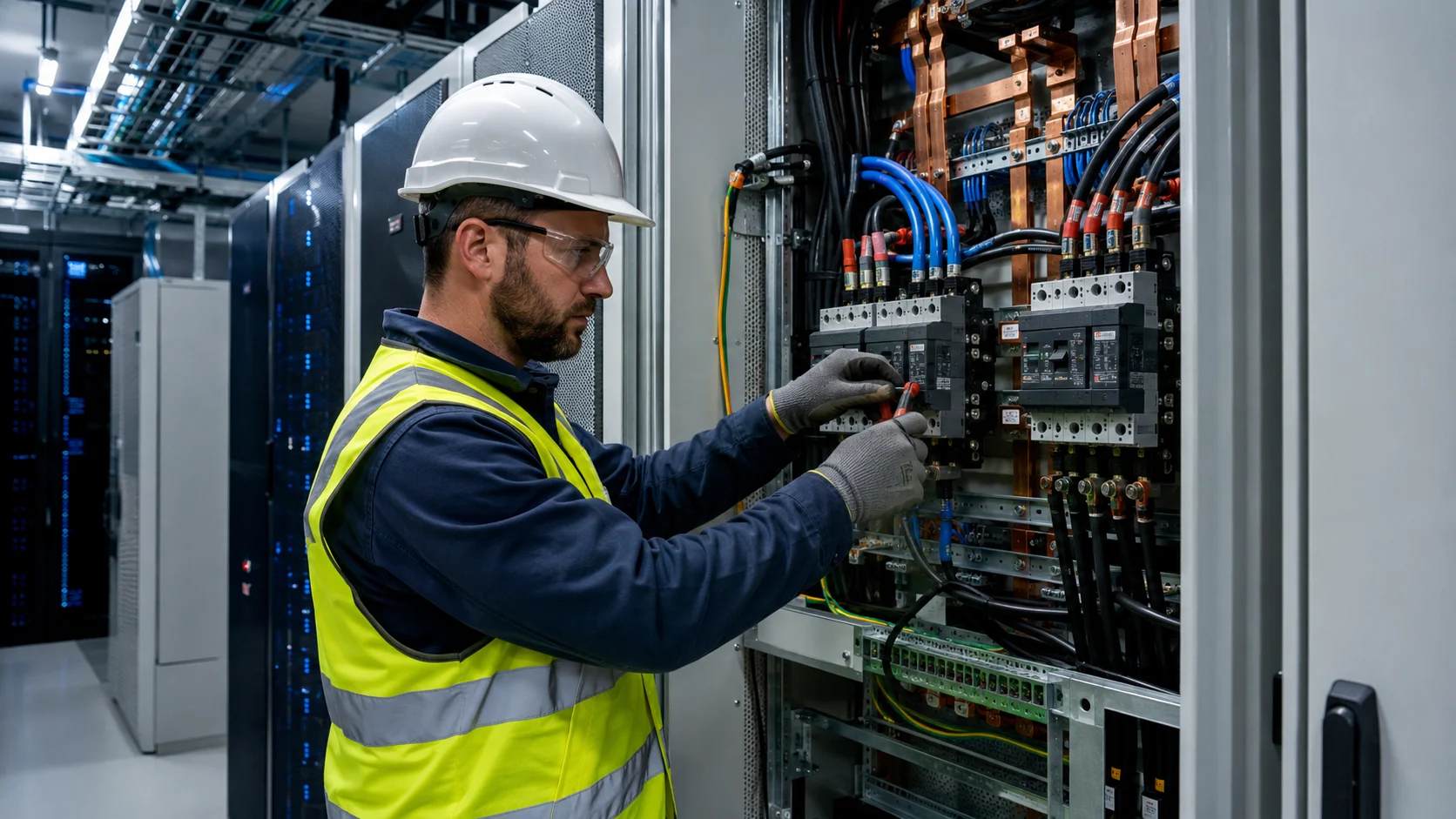
Why data centers need electricians
The United States is in the middle of the largest data center construction boom in history. Hyperscalers like Microsoft, Amazon, Google, Meta, and Oracle have committed hundreds of billions of dollars to building and expanding facilities through 2030. Each of those campuses requires licensed electricians for every phase of work: installing medium-voltage switchgear and unit substations, pulling and terminating high-ampacity feeders, commissioning critical UPS systems, wiring precision power distribution units, and maintaining the busway systems that feed tens of thousands of servers.
The shift to AI workloads has changed the electrical density picture dramatically. A conventional enterprise server rack draws roughly 5 to 10 kilowatts. A modern GPU cluster rack for AI training can demand 60 to 100 kilowatts or more, and next-generation liquid-cooled AI racks are being designed for 120 to 200 kilowatts. That means the electrical infrastructure per square foot of a modern AI data center is many times greater than older facilities, requiring far more electricians per megawatt of deployed capacity. Every new campus needs N+1 or 2N redundancy designed into the distribution system, which doubles or triples the amount of switchgear, transfer switches, and cabling work compared to a non-critical commercial building.
Northern Virginia, known in the industry as Data Center Alley, is the world's single largest concentration of data center space. The counties of Loudoun, Prince William, and Fairfax contain over 35 percent of all US hyperscale capacity. Communities like Ashburn, Sterling, and Manassas are adding millions of square feet annually. The demand for qualified electricians there has outpaced the local workforce for years, which is exactly why general contractors and electrical subcontractors have turned to international recruitment. Texas (Abilene, San Antonio, Dallas), Arizona (Phoenix, Mesa), Ohio (Columbus, New Albany), and Georgia (Atlanta metro) are the other major build-out zones, and all of them are short on licensed data center electricians.
- Medium-voltage switchgear installation and startup
- Unit substation and transformer wiring
- UPS system commissioning and tie-in
- Busway and cable tray installation
- Generator paralleling and automatic transfer switch wiring
- PDU installation and low-voltage branch circuit work
- Critical environment commissioning (Cx) and integrated system testing
Commissioning work is a particular growth area. Every major data center now goes through a rigorous integrated system test before going live, and that process requires electricians who can read single-line diagrams, operate test equipment, and document results to ASHRAE, BICSI, or owner-specific standards. Electricians with commissioning experience routinely earn $10,000 to $20,000 more per year than those doing straight installation work, and those roles are explicitly on the radar of immigration attorneys who help employers build PERM cases.
Visa pathways for electricians
There are two realistic US visa pathways for foreign electricians targeting data center work: the EB-3 Skilled Worker green card and the H-2B temporary nonimmigrant work visa. A third category, the H-1B, is frequently misrepresented by fraudulent recruiters as available to electricians, but it is not. Understanding the difference is the first thing you must get right before spending time or money on any application process.
The EB-3 Skilled Worker category is the primary path for most internationally-recruited electricians. It results in lawful permanent residence (a green card), meaning you can live and work in the United States permanently, bring your immediate family, and eventually apply for citizenship. It requires an employer to go through a government-supervised recruitment process called PERM, which takes time, but it is permanent, stable, and gives you full labor mobility once your card is approved. The EB-3 skilled trades guide covers the category in full detail.
The H-2B visa is a temporary worker category used for peak-load and seasonal labor shortages. It is valid for up to one year, extendable to three years total. It is a real, legal option but it ties your status to a specific employer, is subject to an annual 66,000-person cap that often fills within days of opening, and does not automatically lead to a green card. However, some employers use H-2B as a bridge while simultaneously building an EB-3 case for the same worker, which can work well for candidates from countries without long green card backlogs.
| Factor | EB-3 Skilled Worker | H-2B Temporary |
|---|---|---|
| Result | Permanent green card | Temporary work authorization (up to 3 years) |
| Degree required? | No | No |
| Experience required | 2 years minimum | Varies by employer |
| Who files? | Employer (PERM + I-140) | Employer (temporary labor cert) |
| Processing time | 12 to 30+ months | 3 to 6 months |
| Annual cap? | No hard cap (subject to visa bulletin backlogs) | 66,000 per fiscal year |
| Family included? | Yes (spouse + children get green cards) | Dependents can get H-4 status but cannot work |
| Path to citizenship? | Yes (after 5 years as LPR) | No direct path |
| Job mobility after approval? | Full (after green card) | Employer-specific |
For most internationally-recruited electricians with 2 or more years of documented trade experience, EB-3 is the better long-term option. H-2B makes sense if you want to get into the US quickly while an EB-3 case is being built, or if your employer only has temporary project work available. Read the full comparison in the AI infrastructure jobs hub to see how electricians fit into the broader skilled trades recruitment picture.
The EB-3 green card path step by step
The EB-3 Skilled Worker category is designed for jobs that require at least two years of training or experience but do not require a four-year university degree. Electrician roles fit squarely in this definition. The Department of Labor's Standard Occupational Classification for electricians explicitly recognizes apprenticeship completion or equivalent experience as the qualifying standard, which is what the PERM process references when the employer documents the minimum requirements for the position.
- Document your experience. Gather reference letters from every employer, pay stubs, trade licenses or registration certificates, apprenticeship completion records, and union cards if applicable. The PERM process requires the employer to prove you meet the minimum qualifications, and you will need contemporaneous evidence, not just a letter written today about work done five years ago.
- Secure a full-time permanent job offer. The employer must offer a genuine permanent full-time position with a defined wage. Staffing agency placements usually do not qualify because the employer of record relationship is ambiguous. You need a direct-hire offer from an electrical contractor or an owner-operator of a data center facility.
- PERM labor certification. Your sponsoring employer files an Application for Permanent Employment Certification (ETA Form 9089) with the Department of Labor. The employer must first conduct a supervised recruitment campaign to prove no qualified US worker is available for the role at the offered wage. This process takes 8 to 14 months on average, and the employer bears all costs (you cannot legally be charged for PERM).
- Prevailing wage determination. Before filing PERM, the employer requests a prevailing wage determination from DOL. This sets the minimum salary the employer must pay. For journeyman electricians in data center markets the prevailing wage is typically $38 to $52 per hour, well below what most data center contractors actually pay.
- I-140 immigrant petition. Once PERM is approved, the employer files Form I-140 (Immigrant Petition for Alien Workers) with USCIS. This petition establishes your eligibility and locks in your priority date. Premium processing (currently $2,805) cuts the adjudication time to 15 business days. Your priority date is the date DOL received the PERM application.
- Wait for a visa number. Check the State Department Visa Bulletin monthly. Workers born in most countries (UK, Nigeria, Kenya, the Philippines, South Africa, most of Europe and Latin America) have current or near-current priority dates in EB-3 Skilled Worker. Workers born in India or China face multi-year backlogs. If your priority date is current, you can proceed to the final step immediately.
- Consular processing or adjustment of status. If you are outside the US, you attend an immigrant visa interview at a US embassy or consulate (DS-260 package). If you are already in the US in valid status, your attorney files Form I-485 to adjust status. Either way, your spouse and unmarried children under 21 are included as derivative beneficiaries and receive green cards simultaneously.
The total timeline from job offer to green card in hand is typically 18 to 36 months for workers from countries without backlogs. Indian and Chinese nationals should plan for significantly longer waits due to per-country visa limits, and should consult an attorney about whether H-2B bridging or Canadian temporary residence might be useful while waiting. The employer bears the legal and filing fees for PERM and I-140; if a recruiter demands you pay those fees, that is a red flag. You may, and should, hire your own immigration attorney to review the process independently.
One important nuance is the job description scope. Attorneys who specialize in data center trades often write PERM job descriptions at the journeyman electrician level rather than the more specialized data center commissioning electrician level, because the broader description gives more flexibility in the recruitment campaign and is less likely to draw a technical audit from DOL. This means your actual work on site may involve far more specialized skills than the petition language suggests, which is normal and legal as long as the minimum requirements are genuinely satisfied by your background.
The H-2B temporary option
The H-2B visa allows US employers to bring foreign workers for temporary or seasonal non-agricultural work when they can demonstrate a temporary labor need. For data center electrical work, an employer might use H-2B to staff a large construction project with a defined end date, to cover a commissioning push during a peak hiring period, or to bring experienced foreign workers while simultaneously building a longer-term EB-3 pipeline. See the full H-2B trades guide for complete application details and cap strategies.
The 66,000 annual cap is the biggest practical constraint. Congress has authorized supplemental H-2B numbers in recent years (adding 64,716 extra visas in FY2024 alone) but this is not guaranteed each year. Petitions for the first half of the fiscal year (October start dates) are typically oversubscribed within days of the filing window opening in April. Petitions for the second half of the year (April start dates) face a second lottery. Timing your application correctly is critical, and most employers work with specialized H-2B attorneys who track the cap filing windows closely.
To get H-2B status, your employer must first apply to the Department of Labor for a temporary labor certification, demonstrating the temporary nature of the need and conducting a limited job posting. Once DOL certifies the need, the employer files Form I-129 with USCIS. If approved, you obtain an H-2B visa stamp at a US consulate. The entire government processing chain typically takes 3 to 6 months from start to visa-in-hand, which means employers planning a large data center commissioning project must start recruiting internationally 6 to 9 months in advance.
- H-2B is valid for the period of need, up to 1 year, extendable to a maximum of 3 consecutive years.
- After 3 years on H-2B, you must leave the US for at least 3 months before getting a new H-2B.
- H-2B workers are tied to the petitioning employer; switching jobs requires a new petition.
- Dependents (spouse and children) can accompany you on H-4 status but cannot work legally.
- H-2B can be used as a bridge while an EB-3 I-140 is pending, if the employer is willing to file both concurrently.
Some mid-sized electrical contractors who work on data center projects use H-2B to evaluate foreign workers before committing to the longer EB-3 sponsorship process. If you perform well on an H-2B contract, your employer may be willing to invest in the PERM filing for a permanent position. This is not guaranteed, so you should have an explicit conversation about the employer's intentions before accepting an H-2B offer if your goal is permanent residency.
Certification and US licensing
The United States does not have a single federal electrician license. Licensing is done at the state level, and in many states at the county or city level. This is one of the most confusing aspects of the US trades system for internationally-trained electricians. The good news is that US employers who sponsor foreign workers understand this system and will typically help you navigate the licensing requirements in the specific state where you will work.
The National Center for Construction Education and Research (NCCER) is the most widely recognized credentialing body for construction trades in the US. NCCER offers a four-level electrician curriculum aligned with the National Electrical Code (NEC). Level 1 and 2 cover residential and commercial fundamentals; Level 3 and 4 cover industrial and advanced commercial applications including motor controls, programmable logic controllers, and medium-voltage systems. Data center employers and their contractors look specifically for candidates with Level 3 or 4 credentials, or equivalent documented experience. If you have completed a recognized apprenticeship in your home country, an NCCER assessor can often map your experience to an equivalent NCCER level through a portfolio evaluation.
Most states require either a journeyman electrician license or a master electrician license to do independent electrical work. A journeyman license typically requires completion of a 4-year or 5-year apprenticeship (roughly 8,000 hours of on-the-job training plus classroom hours) and passing a state exam based on the NEC. A master electrician license requires additional experience and a more advanced exam, and is needed to pull permits and supervise journeymen. For immigration purposes, the PERM job description typically requires journeyman-level experience and may note that a state license is required or preferred. Employers will generally allow a reasonable period after arrival for you to obtain the local license, particularly if you hold an equivalent qualification from your home country.
- NCCER Electrician Level 1 to 4 - the primary credential recognized by US data center contractors
- Journeyman Electrician License - state-specific, exam based on the NEC, typically required to work independently
- Master Electrician License - needed to pull permits and run an electrical contracting business
- OSHA 30-Hour Construction - required by most large general contractors on data center job sites
- NFPA 70E Arc Flash Safety - required for work on energized equipment, standard on all live data center work
- Low-Voltage Certification - some states require separate licensing for voice/data/video (VDV) and fiber work
OSHA 30-hour Construction certification is not a license but it is a near-universal site requirement on major data center projects. You can complete the OSHA 30 course online from outside the US and arrive with your card already in hand. NFPA 70E training covers the electrical safety requirements for work on or near exposed energized conductors, which is directly relevant to UPS maintenance and switchgear work in live data centers. These two credentials, combined with your NCCER documentation and any NEC knowledge you have built up studying for the journeyman exam, will make you a very competitive candidate in the US data center labor market.
Salary and best regions
Data center electrician salaries in the US have risen sharply over the past three years as construction demand outpaced workforce supply. In the hottest markets, experienced journeyman electricians earn $55 to $70 per hour in base wages, with overtime and shift differentials pushing all-in annual compensation well above $120,000. The prevailing wage set by DOL for EB-3 PERM cases in these markets is typically lower than the actual market rate, which means the employer must pay at least the prevailing wage but is competing with other employers who offer significantly more. Workers with commissioning experience, BMS controls knowledge, or medium-voltage certification command the highest rates.
| Region | Metro Area Examples | Typical Annual Salary | Key Employers |
|---|---|---|---|
| Northern Virginia | Ashburn, Sterling, Manassas | $110,000 to $140,000+ | Rosendin, Holder, DPR, Turner |
| Texas | Abilene, San Antonio, Dallas | $85,000 to $110,000 | Rosendin, Faith Technologies, ACCO Brands |
| Arizona | Phoenix, Mesa, Goodyear | $90,000 to $115,000 | Sturgeon Electric, IEC contractors |
| Ohio | Columbus, New Albany | $80,000 to $100,000 | Messer, Turner, local union hall signatory contractors |
| Georgia | Atlanta metro, Douglasville | $85,000 to $108,000 | DPR, Holder, Brasfield and Gorrie |
| Pacific Northwest | Quincy WA, Hillsboro OR | $95,000 to $120,000 | Rosendin, Bergelectric |
Northern Virginia remains the highest-paying market largely because of the extreme density of hyperscale campuses and the resulting bidding war for qualified labor. Loudoun County alone has added tens of millions of square feet of data center space in recent years, and local electrician pipelines from trade schools and union halls have not kept pace. Employers in this market routinely offer sign-on bonuses of $5,000 to $15,000 for experienced candidates willing to relocate, which can offset some of the higher cost of living in the DC metro area. The outer suburbs of Prince William and Fauquier counties offer more affordable housing while still being within commuting distance of Ashburn-area campuses.
Texas is attractive from a visa sponsorship standpoint because several major projects in Abilene and San Antonio are greenfield builds where the entire workforce is being assembled from scratch, giving international hires a real shot at getting on project rosters early. Phoenix has grown dramatically since the CHIPS Act started bringing semiconductor fab construction alongside data center work; electricians there can take on both data center and fab project work, which broadens employment options. Columbus, Ohio benefits from Amazon's heavy investment in the New Albany area, with multiple large campus expansions underway through 2028. The lower cost of living in Ohio makes the somewhat lower salaries go further in real terms.
Who sponsors - top employers
Data centers are built by general contractors (GCs) who hire electrical subcontractors for the MEP (mechanical, electrical, plumbing) scope of work. Both GCs and electrical subs can serve as EB-3 sponsors, but in practice it is most often the electrical subcontractor that employs the journeyman electricians and therefore files the PERM petition. Understanding the contractor hierarchy in data center construction helps you target your job search correctly.
Among the electrical subcontractors most active in data center work, Rosendin Electric stands out as one of the largest and most internationally experienced. They have sponsored H-2B and EB-3 workers for data center projects in Northern Virginia, Texas, and the Pacific Northwest and have an internal international recruitment function. Faith Technologies and its subsidiary Faith Technologies Unlimited are similarly active in hyperscale data center electrical work. Bergelectric, Mass Electric (a Quanta Services subsidiary), and IEC (Integrated Electrical Services) subsidiaries appear on major hyperscale project lists repeatedly. For union work, IBEW Local 26 (Northern Virginia) and Local 3 (New York area) have experience with international journeyman placements through reciprocity arrangements.
On the GC side, DPR Construction, Holder Construction, Turner Construction, and Brasfield and Gorrie are among the most active builders of hyperscale data centers in the US. These GCs typically do not directly employ journeyman electricians but they do influence which electrical subs get awarded contracts, and some have their own workforce development programs. If you have a relationship with a GC through prior project work, they can sometimes make introductions to their preferred electrical subs in new markets.
Some hyperscalers, particularly Amazon Web Services, Meta, and Google, use Engineering, Procurement, and Construction (EPC) firms for their largest campuses. These EPCs, which include companies like AECOM, Jacobs, and specialized data center EPCs, employ both engineers and craft trades directly on some contracts. Microsoft and Oracle have also been known to work with international specialty contractors on European and US projects. Direct hyperscaler employment for electricians is rare but not impossible, particularly for commissioning roles where the owner maintains its own commissioning team.
- Search PERM disclosure data on the DOL FLAG system to find employers who have sponsored electricians in specific states - this is public information and updated quarterly.
- LinkedIn searches for 'data center electrician PERM sponsor' or 'journeyman electrician visa sponsorship' in target metro areas turn up active postings.
- IBEW union halls in high-growth markets (Local 26 in NoVA, Local 520 in Austin, Local 640 in Phoenix) sometimes have information on contractors open to international members.
- International recruitment agencies that specialize in US construction trades include ATC Global and several Philippines-based agencies licensed by POEA for US placements.
- NCCER-affiliated training centers sometimes maintain employer partnership networks that connect foreign-trained electricians with sponsoring contractors.
One practical tip: avoid paying upfront fees to recruiters. Under US law and standard industry practice, the employer (not the worker) pays for PERM filing and I-140 attorney fees. Legitimate recruiters who place workers with sponsoring employers are paid by the employer, not by you. If a recruiter asks you to pay $3,000 to $10,000 upfront for visa processing, PERM filing, or placement, that is a fraud pattern. Report such actors to the US Embassy in your country and to the American Immigration Lawyers Association (AILA).
How to apply - step by step
The application process for an electrician seeking a US data center job with visa sponsorship has several distinct phases. The hardest part is not the paperwork - it is finding a sponsoring employer who is actively recruiting internationally. Once you have that employer, the immigration process is well-defined. Here is the full sequence from start to landing.
- Build your credential package. Gather trade certificates, apprenticeship completion records, reference letters from supervisors (on company letterhead, signed and dated), pay stubs or employment contracts for each role, photos or project records of specialized data center work (switchgear, UPS, busway), and your journeyman or master license if you hold one. Translate all documents into English with a certified translator.
- Obtain or document NCCER equivalency. If you do not have an NCCER credential, contact an NCCER accredited assessment center to do a portfolio-based evaluation of your existing experience. This can map your foreign apprenticeship or trade certificate to an NCCER level, which is valuable for US employer recognition.
- Complete OSHA 30 Construction online. This takes approximately 10 hours of coursework spread over multiple sessions and costs $150 to $200 from authorized providers. Having this card in hand before you apply makes you more competitive and removes one employer administrative step.
- Research active sponsoring employers. Use DOL PERM disclosure data, LinkedIn, IBEW local hall contacts, and trade publications like Data Center Frontier and DCF to identify electrical contractors working on large data center projects. Target companies with documented prior PERM sponsorship history in your target state.
- Apply directly and transparently. In your cover letter or email, state explicitly that you are seeking EB-3 sponsorship, your years of experience, your NCCER level or equivalent, and your OSHA 30 status. Employers who sponsor internationally expect this framing; burying the sponsorship question until later wastes everyone's time.
- Clear the prevailing wage check. When an employer expresses interest, their immigration attorney will request a prevailing wage determination from DOL. Confirm with the employer that the offered salary meets or exceeds the prevailing wage for the relevant occupation and location. For journeyman electricians in data center markets this should not be an obstacle.
- Support the PERM process. Your employer's attorney will need your full employment history, education records, and documentation of your qualifications. Respond to requests promptly and accurately. The PERM application must accurately describe your qualifying experience, so provide complete and honest documentation.
- Prepare for the consular interview. Once your priority date becomes current and the National Visa Center processes your immigrant visa package, you will be scheduled for a DS-260 interview at your nearest US embassy. Bring all original documents, medical exam results (Form I-693 equivalent for abroad), and police clearance certificates. Standard DS-260 processing at high-volume consulates in Manila, Lagos, or Nairobi currently runs 3 to 8 months from NVC to interview.
- Arrive and obtain state licensing. After entering the US on your immigrant visa, you have a short window to get your Social Security number and then begin the process of obtaining a state journeyman electrician license. Most states require passing the NEC-based exam; study materials and practice tests are widely available. Your employer should support this process as their site access requirements depend on your being properly licensed.
The entire process from first application to green card in hand typically takes 18 to 30 months for workers from non-backlogged countries. During that time, staying organized, responsive, and honest with your sponsoring employer is the most important thing you can do. Immigration attorneys handling PERM cases sometimes encounter applicants who exaggerated experience or provided inconsistent dates across different documents; this can cause a PERM denial and delay the whole process by a year or more. The investment in getting it right from the start pays off significantly.
For further context on how this process compares to other AI infrastructure trade roles, the AI infrastructure jobs hub and the dedicated EB-3 skilled trades guide are the best next reads. They cover how electricians fit alongside HVAC technicians, pipefitters, and control systems technicians in the same construction ecosystem, and what employers are doing to streamline multi-trade international recruitment programs.
Obtenga asesoramiento personalizado de visa
Cada situación de visa es diferente. Cuéntenos sobre la suya y nuestros consultores acreditados revisarán su caso en 24 horas.
Preguntas frecuentes
Can an electrician get an H-1B visa to work at a US data center?
No. The H-1B visa requires the position to be a specialty occupation normally requiring a bachelor's degree in a specific field. Electrician roles are classified as skilled trades that require an apprenticeship or equivalent experience, not a degree. They do not qualify for H-1B. The correct pathways are EB-3 Skilled Worker (permanent green card) and H-2B (temporary nonimmigrant). Anyone claiming otherwise is misinformed or running a scam.
How much experience do I need to qualify for EB-3 as an electrician?
The EB-3 Skilled Worker category requires at least two years of training or experience in the occupation. For electricians, this typically means two or more years of documented on-the-job trade work, which can include apprenticeship hours. The employer sets the minimum requirements in the PERM filing; most data center electrical roles require 3 to 5 years of journey-level experience in practice, even if the legal minimum is two years.
Do I need a US electrician license before I can be sponsored?
No, you do not need a US license before the sponsorship process begins. However, once you arrive in the US, you will typically need to obtain a journeyman electrician license in the state where you work, which involves passing a state exam based on the National Electrical Code. Your sponsoring employer should give you time and support to complete this process after you arrive. NCCER credentials and foreign trade certificates can help document your qualifications during the visa process itself.
What is PERM and why does it take so long?
PERM is the Program Electronic Review Management system, the Department of Labor process employers must complete before sponsoring a foreign worker for an EB-3 green card. The employer must conduct a supervised domestic recruitment campaign, advertise the job, document that no qualified US worker accepted the offer, and then submit the application. DOL currently processes most PERM applications within 8 to 14 months, though audited cases can take 18 months or longer. The delay is a DOL staffing and workload issue, not something the employer or attorney can speed up in most cases.
What salary can I expect as a sponsored data center electrician?
Salaries vary by region but are consistently high relative to other US construction trades. Northern Virginia (the largest market) pays journeyman data center electricians $110,000 to $140,000 or more per year including overtime, with the base hourly rate typically $55 to $70. Texas and Arizona range from $85,000 to $115,000. The Department of Labor prevailing wage for EB-3 purposes is set below market rate in most of these markets, so the employer is legally required to pay at least the prevailing wage but the competitive market rate is considerably higher.
Can my family come with me on an EB-3 green card?
Yes. Your spouse and unmarried children under 21 are included as derivative beneficiaries of your EB-3 petition. They receive green cards at the same time as you (or shortly after), can work legally in the US from the moment their green cards are issued, and are on the same path to US citizenship as you. This is one of the major advantages of EB-3 over temporary work visas like H-2B, where dependents receive H-4 status and cannot legally work.
What is NCCER and do I need it before applying?
NCCER is the National Center for Construction Education and Research, the primary credentials body for construction trades in the US. NCCER electrician credentials range from Level 1 (basic) through Level 4 (advanced industrial and commercial). Most data center contractors prefer NCCER Level 3 or 4, or equivalent documented experience. You do not need NCCER before applying, but having it or getting an NCCER equivalency evaluation of your foreign credentials makes you significantly more competitive. NCCER assessors can evaluate portfolio evidence from internationally-trained electricians.
Is the H-2B cap a serious obstacle for electricians?
It can be. The H-2B program has a statutory cap of 66,000 visas per fiscal year, split between the first and second halves of the year. This cap fills very quickly, often within days of the filing window opening. Congress has authorized supplemental H-2B numbers in recent years but this is not guaranteed annually. Employers who want to bring electricians on H-2B must plan their projects and staffing needs at least 6 to 9 months in advance to meet the filing windows. For electricians with long-term US residency goals, EB-3 avoids this cap entirely.
Artículos relacionados
Use nuestras herramientas gratuitas
Calculadoras gratuitas para CRS Canadá, puntos Australia, Skilled Worker UK, Tarjeta de Oportunidad Alemania y umbrales salariales de 34 países.
Ver todas las herramientas