
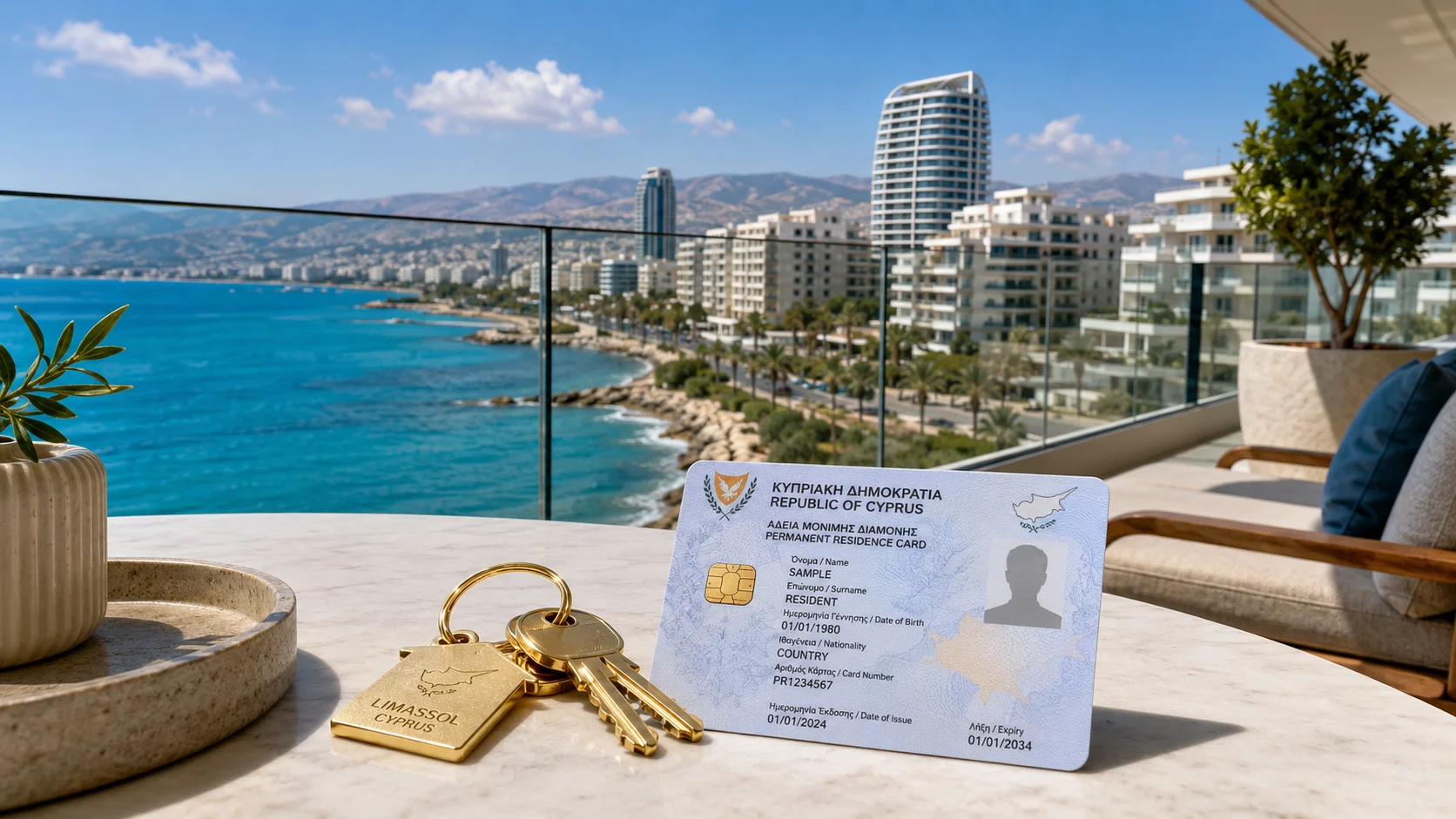
Two EU residency programs, two very different routes
As of 2026, Cyprus and Bulgaria both offer permanent residency by investment to non-EU nationals, but they reach the same destination by opposite roads. Cyprus is built around real estate: invest EUR 300,000 plus VAT in qualifying property (or in company shares or a Cyprus investment fund) and you receive lifetime permanent residency within roughly two to three months. Bulgaria is built around financial instruments: place EUR 512,000 (1,000,000 BGN) into government bonds or a qualifying portfolio and you receive immediate permanent residency, one of the only programs in the world that skips the temporary-residency stage altogether. Both sit inside the European Union, but they differ on Schengen membership, tax, and stay requirements in ways that matter a great deal.
Neither program sells citizenship. This is the single most important point to understand before reading any older marketing material. Cyprus terminated its citizenship-by-investment scheme - the so-called golden passport - in 2020 after abuse scandals, and Bulgaria abolished the citizenship element of its program in 2022. What remains in both cases is residency: the right to live in the country indefinitely, with citizenship available only through the standard naturalisation route after years of genuine residence. This places both firmly in the residency-by-investment (golden visa) category rather than citizenship-by-investment (CBI). You can see how they compare to the rest of the field on the golden visa hub.
The choice between them usually comes down to three questions: do you want to physically use the residency (Bulgaria has no stay requirement and is now in Schengen, Cyprus requires a visit every two years but is outside Schengen), do you want to become a tax resident (Bulgaria's flat 10% income tax is the EU's lowest, Cyprus offers a generous non-dom regime), and how much capital you want tied up (Cyprus from EUR 300,000, Bulgaria from EUR 512,000). The sections below cover each country in detail before a direct side-by-side comparison.
Cyprus permanent residency by investment
The Cyprus permanent residency program grants non-EU nationals lifetime permanent residency in exchange for a qualifying investment of at least EUR 300,000 (plus VAT where applicable). The defining feature is speed and permanence: processing typically takes only two to three months, and the resulting status does not expire. Unlike most golden visas that issue renewable temporary cards, Cyprus issues a permanent residence permit that you hold for life, provided you meet a light maintenance condition - you must visit Cyprus at least once every two years. Miss that window and the permit can be revoked, but there is no requirement to actually live in Cyprus.
There are four qualifying investment routes, all at the EUR 300,000 threshold. The most popular by far is buying a brand-new residential property directly from a developer. Alternatively you can invest in commercial real estate, in the share capital of a Cyprus company that physically operates on the island and employs at least five local people, or in units of a licensed Cyprus investment fund. Whichever route you choose, you must also demonstrate a secured annual income arising from abroad - around EUR 50,000 per year for the main applicant, with prescribed increases for a spouse and each dependent child. This income test ensures applicants can support themselves without working locally.
| Cyprus PR route | Minimum amount | Notes |
|---|---|---|
| New residential property | EUR 300K + VAT | From a developer; most common route |
| Commercial real estate | EUR 300K + VAT | Offices, shops, hotels (can be resale) |
| Cyprus company shares | EUR 300K | Company must employ 5+ locals |
| Cyprus investment fund (AIF) | EUR 300K | Units in a licensed Cyprus fund |
| Secured annual foreign income | ~EUR 50K | Main applicant; rises for dependents |
A critical detail for 2026 planning: Cyprus is in the European Union but is NOT in the Schengen Area. It remains a Schengen candidate and is expected to join in the coming years, but as of 2026 a Cyprus residence permit does not by itself give you visa-free Schengen travel the way a Greek or Maltese permit does. If frictionless Schengen movement is your priority today, this is a meaningful limitation and is the single biggest reason some investors choose Bulgaria - now a full Schengen member - or a mainland program like Greece's golden visa instead.
On tax, Cyprus is highly attractive but only if you actually become tax resident there (by spending 183 days a year on the island, or 60 days under the alternative test if you meet additional conditions). New tax residents who were not domiciled in Cyprus can claim non-domicile status for up to 17 years, during which dividends and interest are exempt from the Special Defence Contribution - meaning effectively zero tax on most investment income. Combined with no inheritance tax and a 12.5% corporate rate, the Cyprus non-dom regime is one of the most generous in Europe. If you simply hold the PR card without becoming tax resident, none of this applies - you remain taxed wherever you are resident.
What happened to the Cyprus golden passport
For about a decade Cyprus ran a famous citizenship-by-investment program, often called the golden passport, which sold full EU citizenship in exchange for an investment of around EUR 2 million. It was lucrative for the state but became controversial, and in 2020 an undercover investigation exposed officials apparently willing to help applicants with criminal backgrounds. The fallout was immediate: Cyprus terminated the citizenship-by-investment scheme in November 2020. Since then, no amount of money buys a Cyprus passport directly.
What this means in practice is that the permanent residency program described above is now the only investment route into Cyprus. PR does not convert automatically into citizenship. To naturalise as a Cypriot citizen you must follow the standard rules - generally around seven years of legal residence with substantial physical presence, plus Greek-language and integration requirements - the same as any other long-term migrant. Anyone promising you a fast Cyprus passport through investment in 2026 is describing a program that no longer exists, which is exactly the kind of red flag covered in our guide to visa rejection reasons and due diligence.
Bulgaria permanent residency by investment
Bulgaria's investor program is unusual and, for some applicants, uniquely valuable: it grants immediate permanent residency. Most golden visas issue a temporary permit first and only allow permanent residency after five years of holding and renewing it. Bulgaria skips that entirely. Invest EUR 512,000 (1,000,000 BGN) into Bulgarian government bonds or another qualifying portfolio of financial instruments, and you receive permanent residency from the outset. The capital is typically held for five years, after which the bonds mature and can be returned, while the residency remains.
Just as important, Bulgaria imposes no stay requirement. You are not obliged to spend any minimum number of days in the country to keep your permanent residency, which makes it well suited to investors who want an EU foothold and Schengen access without relocating. This is a sharper version of the flexibility Cyprus offers - Cyprus asks for a visit every two years, Bulgaria asks for nothing. For mobile entrepreneurs and families with bases elsewhere, that zero-presence rule is a major draw.
| Bulgaria PR route | Minimum amount | Notes |
|---|---|---|
| Government bonds | EUR 512K (1M BGN) | Held ~5 years, then returned |
| Qualifying investment portfolio | EUR 512K (1M BGN) | Approved financial instruments |
| Stay requirement | None | No minimum days to keep PR |
| Personal income tax | 10% flat | EU's lowest, if tax resident |
| Corporate tax | 10% flat | Among the lowest in the EU |
Bulgaria's tax regime is the headline financial attraction. The country levies a flat 10% personal income tax - the lowest in the entire European Union - and a flat 10% corporate tax. There are no progressive bands; a high earner and a modest earner pay the same 10% rate on income. As with Cyprus, this only benefits you if you become a Bulgarian tax resident, generally by spending more than 183 days a year in the country or having your centre of vital interests there. An investor who keeps the PR card but remains tax resident elsewhere does not get the 10% rate on their worldwide income.
The 2026 geography is the other big change in Bulgaria's favour. Bulgaria has joined the Schengen Area as a full member, including its land borders, and is in the process of adopting the euro. This transformed the value of Bulgarian residency: a Bulgarian PR card now carries the same Schengen free-movement benefits as residency in long-established members, letting you travel across the zone without internal border checks. Combined with no stay requirement and the flat tax, this makes Bulgaria a compelling pure-mobility play. Processing the application typically takes a few months, in the range of two to four months.
Bulgaria citizenship: the fast track is gone
Bulgaria historically paired its residency program with a fast-track citizenship route: investors who doubled their investment could naturalise in a fraction of the normal time, effectively buying an EU passport. Under pressure from the European Commission, which has campaigned hard against citizenship-by-investment across the bloc, Bulgaria abolished the citizenship-by-investment element of the program in 2022. The accelerated, investment-linked path to a Bulgarian passport no longer exists.
Today Bulgaria should be treated as a permanent-residency program only. Citizenship is still possible, but through the ordinary naturalisation route: roughly five years of permanent residence, plus Bulgarian-language proficiency and the standard integration and good-character conditions. Permanent residency from day one is genuinely useful for starting that clock, but no one can sell you a Bulgarian passport directly in 2026. This pattern - countries closing the citizenship door while keeping residency open - is exactly what we track in our overview of the golden visa landscape.
Cyprus vs Bulgaria: side-by-side comparison
Both programs deliver EU permanent residency by investment, and neither delivers citizenship. The differences are in cost, mobility, tax, and presence requirements. The table below puts the two head to head on the factors that most often decide which one an applicant chooses. As always, treat these as the headline numbers and verify the current detail with a licensed advisor before committing.
| Factor | Cyprus | Bulgaria |
|---|---|---|
| Status granted | Lifetime PR | Immediate PR |
| Minimum investment | EUR 300K + VAT | EUR 512K |
| Main investment type | Property / fund / shares | Govt bonds / portfolio |
| Processing time | 2-3 months | 2-4 months |
| In Schengen? | No (EU, candidate) | Yes (full member) |
| Eurozone? | Yes (long-standing) | Adopting the euro |
| Stay requirement | Visit every 2 years | None |
| Personal income tax | Non-dom: 0% on div/interest | 10% flat |
| Citizenship by investment | Abolished 2020 | Abolished 2022 |
| Route to citizenship | Naturalisation ~7 yrs | Naturalisation ~5 yrs |
In plain terms: choose Cyprus if you want the lowest entry cost, a property asset you can use or rent, lifetime permanence, and a generous non-dom tax regime, and you can live with being outside Schengen for now. Choose Bulgaria if Schengen free movement and zero stay obligations matter most, you value immediate permanent status, and the flat 10% tax appeals - accepting a higher capital outlay that is largely returned when the bonds mature. Investors comparing these two often also look at Malta's residency-by-investment program and Latvia's golden visa, which sit at different points on the same cost-versus-mobility spectrum.
How to apply: step by step
The two programs share a broadly similar shape - choose a route, make the qualifying investment through a regulated channel, file with the relevant authority, and collect your residence permit - but the documents and order of steps differ. The numbered process below describes the common path; a licensed local lawyer or registered agent in each country handles the filing in practice.
- Choose your country and route. Decide between Cyprus (property, fund, or shares from EUR 300,000) and Bulgaria (bonds or portfolio from EUR 512,000) based on Schengen needs, tax goals, stay tolerance, and budget.
- Engage a licensed local advisor. Both programs require filings by regulated agents or lawyers. Run independent due diligence on any developer, fund, or brokerage before transferring money - the most common losses come from bad counterparties, not bad programs.
- Prepare documentation. Gather a valid passport, clean criminal-record certificate from your home country (apostilled and translated), proof of the source of funds, and - for Cyprus - evidence of your secured annual foreign income of around EUR 50,000.
- Open the necessary accounts. For Cyprus you will typically open a local bank account and deposit the secured income evidence; for Bulgaria you open the account through which the EUR 512,000 bond or portfolio investment is made.
- Make the qualifying investment. In Cyprus, complete the property purchase, fund subscription, or share acquisition. In Bulgaria, subscribe to the qualifying government bonds or approved portfolio totalling EUR 512,000.
- File the residency application. Cyprus applications go to the Civil Registry and Migration Department; Bulgaria applications go through the migration authorities. Biometrics and supporting evidence are submitted at this stage.
- Await approval and collect your permit. Cyprus typically issues lifetime PR in two to three months; Bulgaria issues immediate permanent residency in roughly two to four months. Include dependents in the same application where eligible.
- Maintain your status. For Cyprus, visit the island at least once every two years. For Bulgaria, there is no stay requirement, but keep your investment in place for the required holding period and your documents current.
Costs, fees and tax in detail
The headline investment figure is never the full cost. Both programs add government fees, professional fees, and - for Cyprus property - VAT and transfer-related charges. The table below gives indicative all-in ranges as of 2026; exact amounts depend on family size, property value, and the agent you use. Treat these as planning figures rather than quotes.
| Item | Cyprus | Bulgaria |
|---|---|---|
| Core investment | EUR 300K + VAT | EUR 512K (largely returned) |
| VAT on new property | Up to 19% (reduced rate may apply) | n/a |
| Government / application fees | EUR 500 to 1,000 per person | EUR 1,000+ range |
| Legal / agent fees | EUR 5K to 10K | EUR 10K to 20K |
| Secured income proof | ~EUR 50K/yr | Not required |
| Personal income tax | Non-dom: 0% on div/interest | 10% flat |
| Corporate tax | 12.5% | 10% |
On the Cyprus side, VAT is the cost line most applicants underestimate. New residential property carries VAT of up to 19%, although a reduced rate can apply to a primary residence within certain size and value limits. Budget for it from the start, because the EUR 300,000 threshold is measured before VAT. Bulgaria has no property VAT in the program because the investment is in financial instruments, and the bulk of the EUR 512,000 is returned when the bonds mature, so the true economic cost is the opportunity cost of the capital plus fees rather than the headline number.
For non-US investors the picture is friendlier, but tax benefits in both countries depend entirely on becoming tax resident there. Holding a Cyprus or Bulgaria PR card while remaining tax resident in a high-tax home country gives you mobility and security, not a tax cut. If reducing your tax bill is a primary goal, you need to plan an actual relocation - days of presence, centre of vital interests, and the unwinding of your old tax residency - with professional advice, not just the residence permit.
Pros and cons of each program
No single program is best for everyone. The right choice depends on whether you weight cost, mobility, tax, or flexibility most heavily. The summary below lays out the strengths and weaknesses of each as they stand in 2026.
- [+] Cyprus: lowest entry cost at EUR 300,000, with a tangible property asset
- [+] Cyprus: lifetime permanent residency that does not expire
- [+] Cyprus: fast processing, around two to three months
- [+] Cyprus: generous 17-year non-dom regime - 0% on dividends and interest if tax resident
- [+] Bulgaria: immediate permanent residency from day one, skipping temporary status
- [+] Bulgaria: now a full Schengen member with free movement across the zone
- [+] Bulgaria: flat 10% income tax, the lowest in the EU, plus 10% corporate tax
- [+] Bulgaria: no stay requirement at all and capital largely returned at maturity
- [-] Cyprus: NOT in Schengen as of 2026 - no automatic free movement yet
- [-] Cyprus: must visit at least once every two years or risk revocation
- [-] Cyprus: VAT of up to 19% on new property adds substantially to the real cost
- [-] Bulgaria: higher capital outlay at EUR 512,000 tied up for around five years
- [-] Bulgaria: citizenship-by-investment fast track abolished in 2022 - standard naturalisation only
- [-] Both: neither sells citizenship; a passport requires years of genuine naturalisation
- [-] Both: tax advantages apply only if you actually become tax resident in the country
What changed in 2024 to 2026
The defining trend across EU investment migration in recent years has been the closing of citizenship-for-cash routes while residency programs survive in restructured form. Cyprus set the tone by scrapping its golden passport in 2020, and Bulgaria followed by abolishing its citizenship-by-investment element in 2022. The European Commission has continued to press member states on this, and a 2025 EU Court of Justice ruling against another member state's citizenship-by-investment scheme reinforced the direction of travel. The clear message for 2026: invest for residency, not for a passport.
The biggest positive change has been Bulgaria's accession to the Schengen Area, including land borders, together with its move toward adopting the euro. This dramatically upgraded the practical value of Bulgarian residency, which previously lacked Schengen free movement. Cyprus, by contrast, remains a Schengen candidate as of 2026 - widely expected to join, but not yet a member - so the mobility gap between the two has, for now, actually widened in Bulgaria's favour even though Cyprus is the cheaper entry point.
For prospective applicants, the takeaway is to plan around the rules and geography that exist today. Verify the current Cyprus investment thresholds, the secured-income figure, and the exact Bulgarian bond requirement directly with a licensed advisor before transferring funds, and compare both against the wider field on our golden visa hub before deciding. Programs that look similar on a brochure can differ enormously once Schengen status, stay rules, and tax residency are factored in.
Obtenga asesoramiento personalizado de visa
Cada situación de visa es diferente. Cuéntenos sobre la suya y nuestros consultores acreditados revisarán su caso en 24 horas.
Preguntas frecuentes
Does Cyprus give citizenship by investment in 2026?
No. Cyprus does not offer citizenship by investment in 2026. The Cyprus golden passport scheme, which sold EU citizenship for an investment of around EUR 2 million, was scrapped in 2020 after an undercover investigation exposed abuse. Since then the only investment route into Cyprus is permanent residency from EUR 300,000, and that PR does not convert automatically into a passport. To become a Cypriot citizen you must naturalise through the standard process, generally around seven years of legal residence with Greek-language and integration requirements. Anyone promising a fast Cyprus passport by investment is describing a program that no longer exists.
Is Bulgaria in Schengen?
Yes. As of 2026 Bulgaria is a full member of the Schengen Area, including its land borders, having completed accession in recent years. This means a Bulgarian permanent residence permit carries the same Schengen free-movement benefits as residency in long-established member states, letting you travel across the zone without internal border checks. Bulgaria is also in the process of adopting the euro. This is a major reason investors who prioritise free movement choose Bulgaria over Cyprus, which remains outside Schengen for now. Always confirm the latest status before relying on it for travel planning.
Is Cyprus in the Schengen Area?
No, not as of 2026. Cyprus is a member of the European Union but it is not yet part of the Schengen Area. It is a Schengen candidate and is widely expected to join in the coming years, but at present a Cyprus residence permit does not by itself grant automatic visa-free movement across Schengen the way Bulgarian, Greek, or Maltese residency does. If frictionless Schengen travel is essential to you today, this is an important limitation to weigh. Plan around the rules that exist now rather than the ones that may apply after a future accession.
How long does Cyprus permanent residency take and does it expire?
Cyprus permanent residency is one of the faster programs available, typically processed in around two to three months from a complete application. The status granted is lifetime permanent residency, meaning it does not have an expiry date in the way most renewable residence cards do. There is one maintenance condition: you must visit Cyprus at least once every two years, otherwise the permit can be revoked. There is no requirement to actually live in Cyprus or to spend a minimum number of days there beyond that periodic visit. This combination of speed and permanence is one of the program's main attractions.
Why does Bulgaria's program grant immediate permanent residency?
Bulgaria is one of very few countries that grants immediate permanent residency to qualifying investors, skipping the temporary-residency stage that almost every other golden visa requires. By investing EUR 512,000 (1,000,000 BGN) in Bulgarian government bonds or an approved portfolio, you receive permanent status from the outset rather than after five years of holding a temporary card. The capital is typically held for around five years, after which the bonds mature and the funds can be returned while the residency remains. There is also no stay requirement, so you are not obliged to spend any minimum time in Bulgaria to keep the status. This makes it well suited to mobile investors who want an EU and Schengen foothold without relocating.
How much tax will I pay in Cyprus or Bulgaria?
Both countries offer attractive tax regimes, but only if you actually become tax resident there. Bulgaria levies a flat 10% personal income tax, the lowest in the European Union, plus a flat 10% corporate tax. Cyprus offers a non-domicile regime lasting up to 17 years, under which dividends and interest are effectively exempt, alongside a 12.5% corporate rate and no inheritance tax. Tax residency generally requires spending more than 183 days a year in the country (Cyprus has an alternative 60-day test under certain conditions). If you keep the PR card but remain tax resident in your home country, neither regime reduces your tax bill - you would need to plan a genuine relocation with professional advice.
Can I get an EU passport through either program?
Not directly, and not quickly. Neither Cyprus nor Bulgaria sells citizenship anymore: Cyprus ended its citizenship-by-investment scheme in 2020 and Bulgaria abolished its fast-track citizenship element in 2022. Both now offer permanent residency only. You can still become a citizen of either country, but through ordinary naturalisation - roughly seven years of residence for Cyprus and around five years for Bulgaria - with language proficiency and integration requirements. Permanent residency from these programs is genuinely useful for starting that residence clock, but no investment buys an EU passport outright in 2026. Be sceptical of any promoter claiming otherwise.
Should I choose Cyprus or Bulgaria for residency by investment?
It depends on your priorities. Choose Cyprus if you want the lowest entry cost (from EUR 300,000), a tangible property asset, lifetime permanent residency, fast processing, and a generous non-dom tax regime, and you can accept being outside Schengen for now. Choose Bulgaria if Schengen free movement and a zero stay requirement matter most, you value immediate permanent status, and the flat 10% income tax appeals, accepting the higher EUR 512,000 outlay that is largely returned at bond maturity. Many investors compare both against Malta, Greece, and Latvia before deciding. Speak to a licensed advisor and run due diligence on any counterparty before committing funds.
Artículos relacionados
Use nuestras herramientas gratuitas
Calculadoras gratuitas para CRS Canadá, puntos Australia, Skilled Worker UK, Tarjeta de Oportunidad Alemania y umbrales salariales de 34 países.
Ver todas las herramientas