
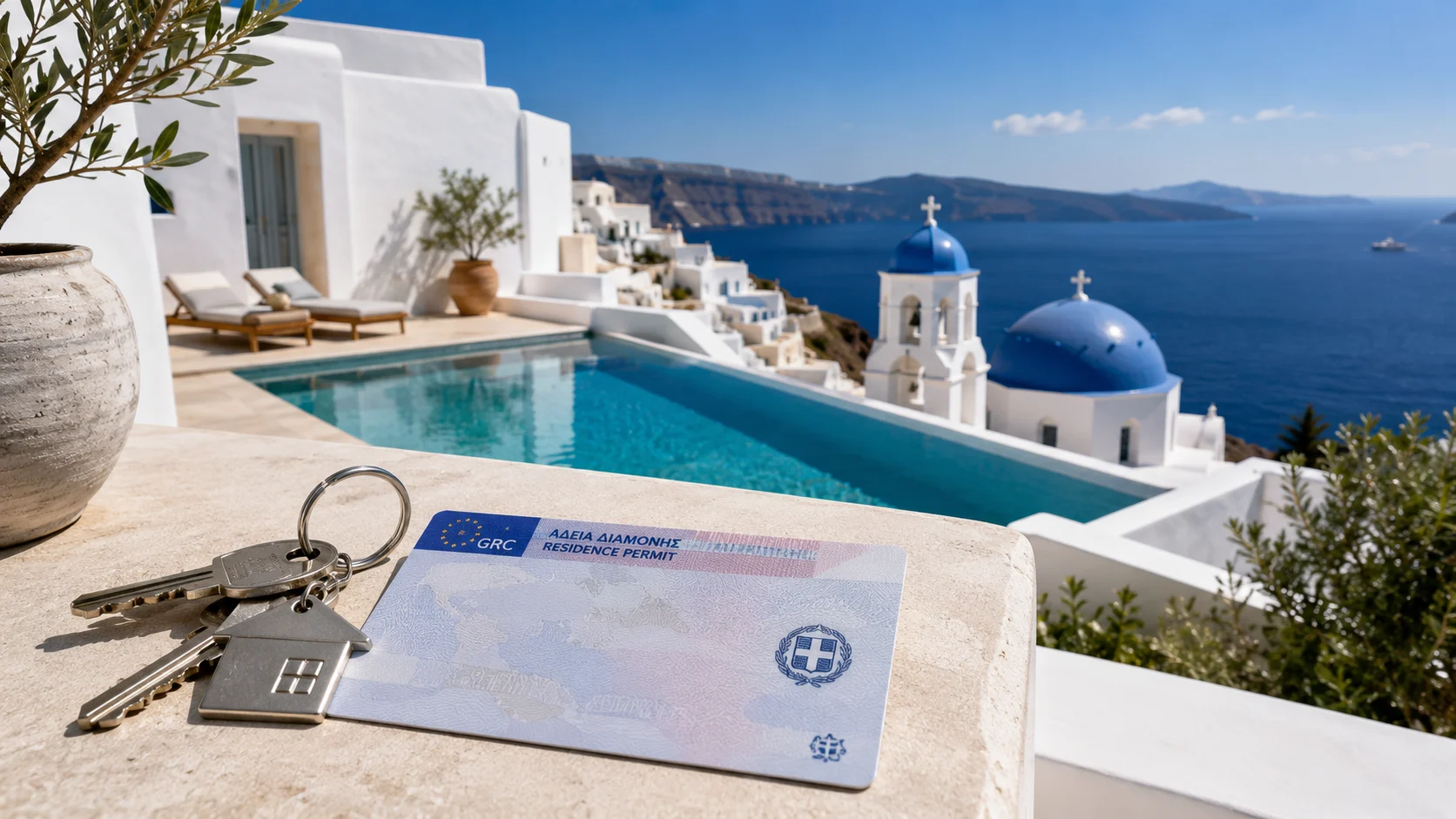
What is the Greece golden visa?
As of 2026, the Greece golden visa is the leading real estate residency-by-investment program in the European Union. It grants non-EU nationals a renewable five-year residence permit in exchange for a qualifying property investment, with thresholds that vary by location. The program was launched in 2013 and has become the most popular route of its kind in Europe, in large part because the two former heavyweights - Portugal and Spain - have both shut their property options. You can see how Greece stacks up against the remaining open programs in the golden visa hub.
A golden visa is not the same thing as citizenship by investment (CBI). A golden visa gives you residency - the right to live in the country and travel freely inside the Schengen Area - but it does not hand you a passport. Citizenship, if you want it, comes later and only after you satisfy the standard naturalisation requirements (in Greece, seven years of residence plus language and integration tests). Programs like those in some Caribbean states sell passports directly; Greece does not. This distinction matters because most Greece golden visa investors never intend to naturalise at all. They want the residency, the Schengen access, and a tangible asset in a recovering Mediterranean property market, and they treat citizenship as an optional bonus rather than the goal.
The headline appeal of Greece in 2026 is that it kept what its rivals abandoned. Portugal removed residential real estate from its golden visa in 2023, pushing investors toward funds and other vehicles - a shift covered in our Portugal golden visa guide. Spain ended its golden visa entirely in 2025. That leaves Greece, alongside Italy and a handful of smaller programs, as one of the few EU routes where buying property still buys you residency. The trade-off is that Greece raised its prices in response to demand, which is why the entry point is now tiered rather than a flat EUR 250,000 everywhere.
Property tiers and exact thresholds
The defining feature of the 2026 program is its three-tier pricing, introduced by the threshold reform that took effect in September 2024. Instead of a single nationwide figure, the minimum investment now depends on where the property sits and, in the lowest tier, on what kind of property it is. The three headline numbers are EUR 250,000, EUR 400,000, and EUR 800,000.
| Tier | Minimum | Where / what it applies to |
|---|---|---|
| High-demand zones | EUR 800K | Attica (greater Athens), Thessaloniki, Mykonos, Santorini, and islands with population over 3,100 |
| Rest of Greece | EUR 400K | All other regions and mainland areas outside the high-demand zones |
| Special cases | EUR 250K | Converting a commercial property to residential, or restoring a listed / heritage building |
For the EUR 400,000 and EUR 800,000 tiers, the rules require a single property of at least 120 square metres. You cannot stitch the threshold together from several small apartments in these tiers - it must be one qualifying asset meeting the size floor. This was a deliberate change designed to steer investment toward larger, genuine residences rather than fragmented buy-to-let micro-units.
The EUR 250,000 entry point still exists, but it is now a special-case route rather than the default. It applies in two situations: where you buy a commercial property and convert it to residential use, or where you invest in restoring a listed building or one with heritage protection. These projects carry more complexity and renovation risk, so the lower headline price reflects real work, not a discount. If you want the cheapest clean entry into the program, the realistic figure for most buyers is EUR 400,000 in the standard tier or EUR 800,000 if you have your heart set on central Athens, Thessaloniki, or the marquee islands.
Eligibility and requirements
Eligibility for the Greece golden visa is straightforward compared with active-business or employment routes. You must be a non-EU/EEA national, over 18, with a clean criminal record, and you must make the qualifying property investment in your own name (or through a wholly owned company in certain structures). The funds must come from outside Greece and be transferred through the Greek banking system so that the source and the inbound transfer are documented. There is no language test, no interview on the merits, and crucially no minimum stay - the program is deliberately passive.
The investment must be maintained for the life of the permit. If you sell the qualifying property, the residence permit tied to it lapses, although you can sell to another non-EU buyer who may then apply on the same asset. You also need valid private health insurance covering you and any dependents in Greece, since golden visa holders are not automatically enrolled in the public health system unless they become tax resident and contribute.
| Requirement | Detail |
|---|---|
| Nationality | Non-EU / non-EEA national, aged 18 or over |
| Investment | Single qualifying property at the tier threshold (120 sq m min for 400K/800K) |
| Source of funds | Transferred from abroad via the Greek banking system, documented |
| Criminal record | Clean certificate from home country and any country of residence |
| Health insurance | Private cover for applicant and all included family members |
| Greek tax number (AFM) | Required before purchase and for the application |
| Stay requirement | None - zero days per year to keep the permit |
| Family | Spouse, children up to 21, and parents of both spouses included |
Family inclusion is generous. A single application covers the main investor, their spouse or registered partner, their unmarried children up to the age of 21 (extendable to 24 in some dependent-student situations under separate rules), and the parents of both the investor and the spouse. That means one EUR 400,000 purchase can deliver residence permits and Schengen access to a three-generation family, which is a large part of why Greece is so popular with applicants from outside Europe.
How to apply - step by step
The process is handled largely by your lawyer and can be completed without you spending months in Greece. Biometrics require an in-person visit, but the property selection and most paperwork can be managed remotely under a power of attorney. From signed purchase to permit in hand, expect roughly four months, which is fast by European standards.
- Engage a licensed Greek immigration lawyer and obtain a Greek tax number (AFM) and a Greek bank account. The AFM is required to transact property and to file the application, and the bank account is needed to route the investment funds through the Greek banking system.
- Select and perform due diligence on a qualifying property. Confirm the zone classification (which tier applies), the size meets the 120 sq m floor where relevant, the title is clean, and there are no planning or heritage encumbrances. This is where a careful lawyer earns their fee.
- Transfer the investment funds from abroad into Greece through the banking system so the inbound transfer and source of funds are fully documented. Mixing in untraceable cash is a common cause of refusal.
- Sign the purchase deed before a Greek notary and register the property. The notary verifies the transaction and the deed is recorded at the local land registry or cadastre.
- Submit the golden visa application to the Greek authorities with the deed, proof of the qualifying investment, passports, criminal record certificates, health insurance, and the AFM, for yourself and every included family member.
- Provide biometrics (fingerprints and photo) at an in-person appointment in Greece. This is generally the one step that requires physical presence, and family members give their biometrics too.
- Receive a confirmation receipt (the 'blue receipt') which itself acts as proof of legal status and lets you travel while the card is produced. The physical residence permit cards typically follow within the roughly four-month overall window.
- Renew every five years. As long as you still own the qualifying property and keep your health insurance, renewal is essentially a formality with no stay requirement to satisfy.
Before you choose a property purely on price, it is worth understanding why golden visa and residency applications get refused, because most rejections come down to documentation rather than the investment itself. Our guide to common visa rejection reasons walks through the source-of-funds and due diligence pitfalls that trip up otherwise qualified investors.
Costs and fees beyond the purchase price
The headline tier figure is the property price, but it is not the total cost. Greece levies transfer tax and a stack of professional and government fees on top. As a rough rule, budget an additional 8% to 12% of the purchase price for the full transaction, more if you are taking the EUR 250,000 renovation route where construction costs and VAT come into play.
| Cost item | Typical amount |
|---|---|
| Property transfer tax | 3.09% of property value (most resale properties) |
| Notary fees | ~0.8% to 1.5% of value |
| Land registry / cadastre | ~0.5% of value |
| Legal fees | ~1% to 2% of value (plus VAT) |
| Government application fee | EUR 2,000 per main applicant |
| Family member fee | ~EUR 150 per dependent permit |
| Biometrics / card issuance | ~EUR 16 to EUR 30 per person |
| Health insurance | From a few hundred EUR per year per person |
The EUR 2,000 government fee applies to the main applicant; dependents are charged a much smaller per-permit fee. Property transfer tax in Greece is currently around 3.09% for most resale properties, which is low compared with many European markets - though newly built properties sold by a developer registered for VAT can attract VAT instead, and the treatment depends on the building permit date, so check the specific property. Annual ongoing costs include the recurring property tax (ENFIA), property management or maintenance, and the renewal of health insurance, all of which are modest relative to the investment size.
For the EUR 250,000 special-case route, the lower entry price is offset by renovation outlay and the risk and timeline of converting or restoring a building. Heritage restorations in particular can face strict rules on materials and methods, and timelines slip. Many advisors steer first-time investors toward a clean EUR 400,000 standard-tier purchase rather than the cheaper but more demanding special-case projects.
Tax treatment
A critical point first: holding the Greece golden visa does not, by itself, make you a Greek tax resident. Because there is no stay requirement, many investors keep the permit while remaining tax resident elsewhere, and they are taxed in Greece only on Greek-source income such as rent from the property. You only fall into Greece's worldwide tax net if you actually become tax resident, generally by spending more than 183 days a year in the country or by establishing your main centre of vital interests there. Most golden visa holders never cross that line.
For those who do choose to become Greek tax resident, Greece offers two attractive optional regimes. Foreign pensioners who relocate and become tax resident can elect a flat 7% tax on their foreign-source income (including pensions) for up to 15 years, which overlaps with the appeal of the Greece retirement route for those who want to actually live there. Separately, high-net-worth individuals can opt into a non-dom regime that caps tax on all foreign-source income at a lump sum of EUR 100,000 per year (plus EUR 20,000 per family member), regardless of how large that foreign income is. Both regimes are elective and only relevant if you become tax resident.
For non-US investors, the typical position is simpler: if you do not become Greek tax resident, your home-country tax situation is largely unchanged and Greece taxes only the rental income (if any) generated by the property. If you do plan to relocate and live in Greece, model the 7% pension regime or the EUR 100,000 non-dom cap carefully against your home rates, because the right election can be very favourable. As always, get a tailored assessment before you move money.
Residency to citizenship timeline
The Greece golden visa is, first and foremost, a residency product. The permit is issued for five years and renewed every five years indefinitely for as long as you keep the qualifying property and your insurance. There is no upgrade to permanent residency required to maintain it - the renewable five-year cycle is itself effectively permanent in practice, provided you hold the asset.
Citizenship is a separate and much longer road. Naturalisation in Greece generally requires seven years of legal residence, and here the absence of a stay requirement cuts both ways. Because the golden visa imposes no physical presence, time spent abroad does not build toward the genuine-residence threshold that naturalisation demands. To pursue Greek citizenship you would in practice need to actually live in Greece for the qualifying period, demonstrate Greek language proficiency, and pass an integration and civics examination. This is why the overwhelming majority of golden visa investors use the program for residency and Schengen access only and never apply for the passport.
If an EU passport is genuinely your end goal, the golden visa is a slow vehicle for it, and you should weigh routes that combine investment with a real relocation. But if what you want is a secure, low-maintenance EU residency, a hard asset in a recovering market, and the ability to come and go across Schengen, the seven-year citizenship horizon is largely beside the point. Greece sits alongside Italy's investor visa and a handful of smaller schemes such as those in Cyprus and Bulgaria as the main remaining EU residency-by-investment options in 2026.
Pros and cons
Greece earns its top ranking on the investment-migration indices for concrete reasons, but the 2024 price increases and the citizenship realities mean it is not the right fit for everyone. The summary below covers the main considerations.
- [+] Strongest real estate golden visa left in Europe after Portugal and Spain closed their property routes
- [+] No stay requirement at all - you never have to live in Greece to keep the permit
- [+] Fast processing, roughly four months from purchase to permit
- [+] Whole-family coverage: spouse, children up to 21, and parents of both spouses on one application
- [+] Schengen travel access across the area without separate visas
- [+] Tangible hard asset in a recovering Mediterranean market, rather than a sunk fee
- [+] Optional 7% flat tax on foreign pensions and a EUR 100,000 non-dom cap if you do relocate and become tax resident
- [+] Five-year permit renewed indefinitely while you hold the property
- [-] Thresholds rose sharply in September 2024 - EUR 800K in Attica, Thessaloniki, and the top islands
- [-] The EUR 250K headline is now a special-case renovation route, not the default, and carries construction risk
- [-] No path to citizenship without actually living in Greece for seven years - the passive permit does not count toward naturalisation residence
- [-] Total transaction costs add roughly 8% to 12% on top of the purchase price
- [-] Selling the qualifying property ends the permit tied to it
- [-] US citizens keep full US worldwide tax and reporting obligations regardless
What changed in 2024 to 2026
The competitive landscape for European golden visas was reshaped in just a few years, and Greece is the main beneficiary. As of 2026, three shifts define where things stand.
First, the rivals left the field. Portugal removed residential real estate from its golden visa in 2023, redirecting investors to funds and other qualifying vehicles. Spain went further and terminated its golden visa program entirely in 2025. With the two largest property-based programs gone, demand concentrated on Greece, which is why Greece now tops the global investment-migration rankings for real estate routes.
Second, Greece responded to that demand by raising prices. The September 2024 reform replaced the old flat EUR 250,000 nationwide threshold with the current three-tier structure: EUR 800,000 in high-demand zones (Attica, Thessaloniki, Mykonos, Santorini, and islands above 3,100 population), EUR 400,000 across the rest of the country, and EUR 250,000 retained only for commercial-to-residential conversions and listed-building restorations. The reform also introduced the 120 square metre minimum and the single-property rule for the higher tiers, closing the door on fragmented micro-unit strategies.
Third, the surrounding regimes stayed attractive for those who relocate. The optional 7% flat tax for foreign pensioners and the EUR 100,000 non-dom lump sum remain in place, keeping Greece appealing not just as a passive residency play but as a genuine relocation destination - an overlap with both the Greece retirement visa and, for remote workers, the Greece digital nomad visa. The net effect of these three changes is a program that is more expensive than it was in 2023 but more dominant, because almost everyone else has left or scaled back. For a side-by-side of what remains open, see the golden visa hub.
Obtenga asesoramiento personalizado de visa
Cada situación de visa es diferente. Cuéntenos sobre la suya y nuestros consultores acreditados revisarán su caso en 24 horas.
Preguntas frecuentes
How much do I need to invest for the Greece golden visa?
As of 2026 the minimum depends on location. You need EUR 800,000 for property in high-demand zones such as Attica (greater Athens), Thessaloniki, Mykonos, Santorini, and islands with a population over 3,100. In the rest of Greece the threshold is EUR 400,000. A reduced EUR 250,000 entry point survives only for special cases - converting a commercial property to residential use, or restoring a listed or heritage building. For the EUR 400,000 and EUR 800,000 tiers the investment must be a single property of at least 120 square metres. On top of the purchase price, budget roughly 8% to 12% for transfer tax, notary, registry, legal fees, and the EUR 2,000 government fee.
Do I have to live in Greece to keep the golden visa?
No. The Greece golden visa has no minimum stay requirement at all - this is one of its biggest selling points. You can hold and renew the permit indefinitely without ever spending a single day in Greece, provided you keep owning the qualifying property and maintain valid health insurance. The permit is renewed every five years and remains valid as long as the investment is in place. The trade-off is that because the time does not count as genuine residence, the absence of any stay requirement means the golden visa on its own does not move you toward Greek citizenship.
Why is Greece considered the best real estate golden visa in 2026?
Because its main competitors closed their property routes. Portugal removed residential real estate from its golden visa in 2023 and Spain terminated its program entirely in 2025. That left Greece as the strongest property-based residency-by-investment program in the European Union, and it is regularly ranked at or near the top of the global investment-migration indices. Greece combines a tangible real estate asset, no stay requirement, fast roughly four-month processing, broad family inclusion, and Schengen access. The 2024 price increases made it more expensive, but it remains the leading open option for investors who specifically want to buy property to obtain EU residency.
Can my family be included in one application?
Yes, and the family rules are generous. A single qualifying investment covers the main applicant, their spouse or registered partner, their unmarried children up to the age of 21, and the parents of both the investor and the spouse. That allows a three-generation family to obtain residence permits and Schengen travel rights from one property purchase. Each dependent is charged a small per-permit fee rather than the full EUR 2,000 main-applicant government fee, and every included family member provides biometrics. This whole-family coverage is a major reason the program is so popular with applicants from outside Europe.
Does the Greece golden visa lead to citizenship?
It can, but slowly and only if you actually relocate. Greek naturalisation generally requires seven years of legal residence, plus Greek language proficiency and an integration and civics examination. Because the golden visa has no stay requirement, time spent abroad does not build toward the genuine-residence threshold that naturalisation demands - so to pursue citizenship you would in practice need to live in Greece for the qualifying period. For this reason the large majority of golden visa investors use the program purely for residency and Schengen access and never apply for the passport. If an EU passport is your primary goal, the golden visa is a slow vehicle for it.
How long does processing take?
Roughly four months from completing the property purchase to holding the residence permit, which is fast by European standards. The timeline includes obtaining a Greek tax number and bank account, transferring funds, signing the notarial deed, submitting the application, and giving biometrics in person. Once you submit and provide biometrics you receive a confirmation receipt (the 'blue receipt') that acts as proof of legal status and allows travel while the physical card is produced. Most steps can be handled remotely by your lawyer under a power of attorney, with the biometrics appointment being the main step that requires physical presence in Greece.
Will I pay tax in Greece if I get the golden visa?
Not automatically. Holding the golden visa does not make you a Greek tax resident, so by default you are taxed in Greece only on Greek-source income such as rent from the property. You become liable for worldwide tax in Greece only if you actually become tax resident, generally by spending more than 183 days a year there. If you do relocate and become tax resident, Greece offers attractive optional regimes: a flat 7% tax on foreign-source income (including pensions) for foreign pensioners for up to 15 years, and a non-dom regime capping tax on all foreign income at a EUR 100,000 annual lump sum. US citizens, however, remain liable for US worldwide tax and FBAR/FATCA reporting regardless of where they live.
What happens to my permit if I sell the property?
The residence permit is tied to the qualifying investment, so if you sell the property the permit linked to it lapses. You cannot keep the residency while cashing out the asset. However, you can sell the qualifying property to another non-EU buyer, who may then apply for their own golden visa on the same asset, which keeps the property liquid within the program. If you want to retain residency yourself, you would need to maintain a qualifying investment at the current threshold. This is why the investment is described as needing to be maintained for the life of the permit, and why exit planning should be discussed with your lawyer before you buy.
Artículos relacionados
Use nuestras herramientas gratuitas
Calculadoras gratuitas para CRS Canadá, puntos Australia, Skilled Worker UK, Tarjeta de Oportunidad Alemania y umbrales salariales de 34 países.
Ver todas las herramientas