
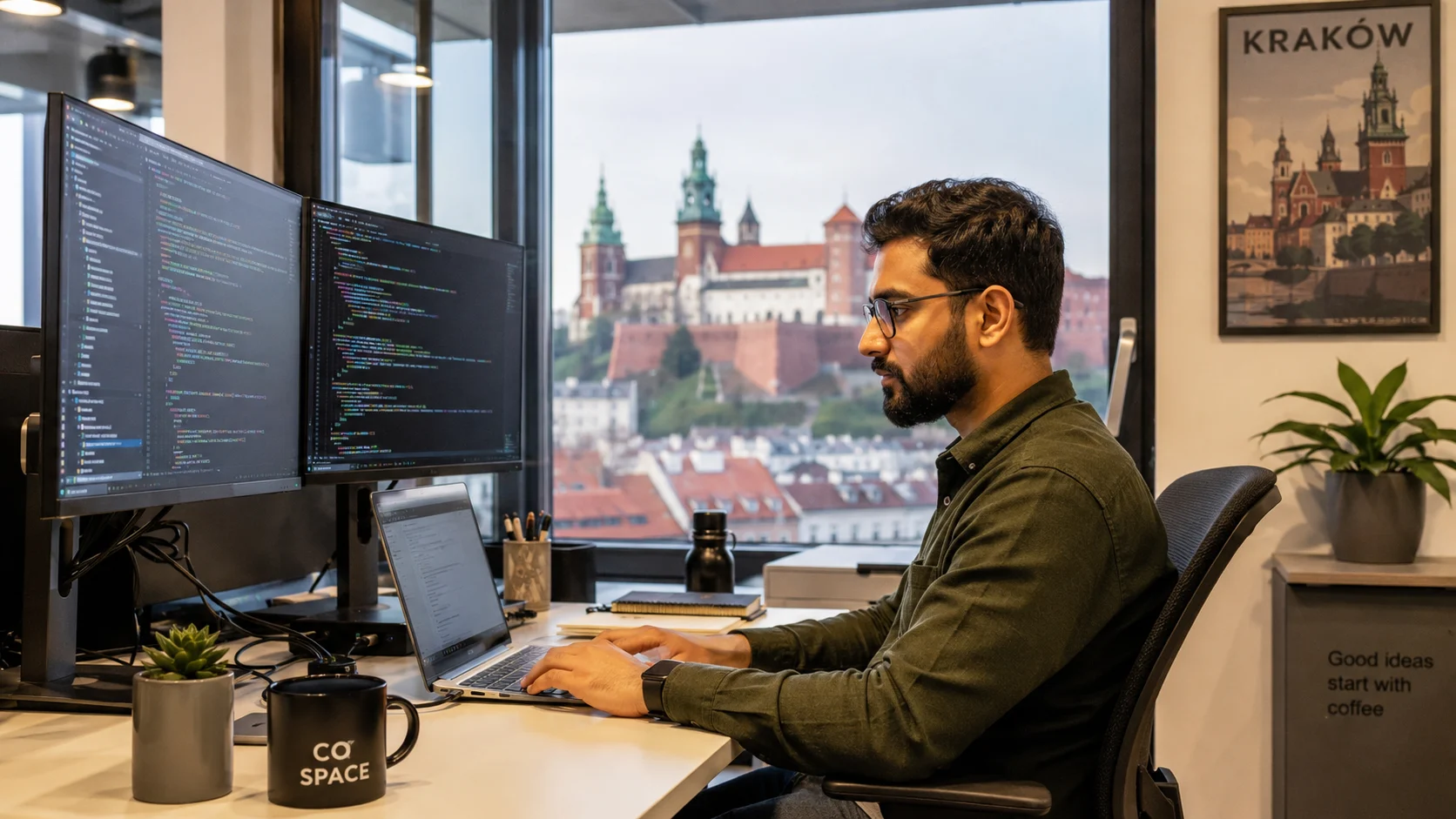
Why Indian IT professionals are choosing Poland
Poland has quietly become one of Europe's biggest IT hubs. Kraków alone hosts the Polish R&D centres of Google, Cisco, ABB, HSBC, JP Morgan, IBM, and Motorola. Warsaw is the headquarters for Microsoft Central and Eastern Europe, Samsung Poland, Citi, and BNP Paribas tech. Wrocław hosts Capgemini, Nokia, Volvo IT, and BNY Mellon. Gdańsk has Intel, Amazon Web Services, and Schibsted. Combined, these multinationals employ approximately 100,000-150,000 IT engineers across Poland - and the headcount is growing 8-12% annually.
For Indian IT professionals specifically, Poland offers three strategic advantages over the typical Germany or Netherlands path. First, the EU Blue Card salary threshold in Poland is PLN 10,800/month gross (~₹2.6 lakh/month) - the lowest in the entire EU. Germany's threshold for shortage occupations is €45,300/year (~PLN 19,000/month). Netherlands requires roughly €5,331/month. Spain €33,000/year. Poland is genuinely the cheapest Blue Card entry point in the EU. Second, the cost of living in Poland is dramatically lower than Western Europe - a Warsaw IT salary stretches roughly 40-60% further than the equivalent Berlin or Amsterdam salary. Third, after 18 months on a Polish Blue Card, you can transfer to any other EU member state's Blue Card without restarting the immigration clock. The smart strategy: get the Blue Card in Poland for the easy salary threshold, work 2 years, then transfer to Germany or Netherlands for higher pay.
The March 2026 reform eliminates the labour market test, accelerating processing from 3 months to 4-8 weeks. For Indian applicants accustomed to long Germany Blue Card waits (currently 4-8 months), Poland's speed is decisive. See our Poland vs Germany comparison for the full strategic analysis.
Salary comparison - India vs Poland (IT, in ₹)
| Role | India (₹/mo) | Poland (₹/mo) | Multiple |
|---|---|---|---|
| Software engineer (junior, 0-2 yrs) | ₹40,000-80,000 | ₹2,70,000-4,00,000 | 5-7× |
| Software engineer (mid, 3-5 yrs) | ₹80,000-1,50,000 | ₹2,70,000-4,00,000 | 2.5-3.5× |
| Senior software engineer (5-8 yrs) | ₹1,50,000-3,00,000 | ₹4,00,000-5,80,000 | 2-3× |
| Tech lead / architect | ₹2,50,000-5,00,000 | ₹5,80,000-8,90,000 | 2-3.5× |
| Data scientist (mid) | ₹1,00,000-2,00,000 | ₹3,60,000-5,80,000 | 3-4× |
| DevOps / SRE | ₹1,20,000-2,50,000 | ₹3,60,000-6,70,000 | 2.5-5× |
| Engineering manager | ₹3,00,000-6,00,000 | ₹6,70,000-10,00,000 | 1.5-3× |
| IT Blue Card (degree + experience) | Variable | ₹2,60,000+ required | Threshold |
The salary multiple is most attractive for junior and mid-level engineers (5-7× and 2.5-3.5×). For senior architects and engineering managers already earning ₹3-6 lakh/month in Bangalore or Hyderabad, the absolute Poland uplift is smaller (1.5-2×) but the lifestyle, EU residency, and onward-Europe optionality often justify the move. Crucially, Polish income tax for IT salaries lands around 12-32% depending on bracket, vs India's effective tax + surcharge of ~30% for ₹15 lakh+ earners - net take-home in Poland is competitive after factoring living costs.
How to apply from India
- Secure a Polish job offer from a Polish-registered company (Google Kraków, Microsoft Warsaw, Capgemini, etc.). Use LinkedIn (best), Pracuj.pl, NoFluffJobs.com (IT-specific), and JustJoin.it for Polish IT roles.
- For EU Blue Card: confirm salary is PLN 10,800+/mo and you have a recognised degree (or 5 years equivalent IT experience). For Type A: any Polish-minimum-wage salary qualifies.
- Polish employer applies for your work permit at the Voivodeship Office. Processing 4-8 weeks (post-March 2026).
- Apply for Type D National Visa OR EU Blue Card visa at the Polish Embassy in New Delhi (Shantipath, Chanakyapuri) OR the consulate in Mumbai (TVS Building, Worli). VFS Global handles biometrics at multiple Indian cities.
- Submit through VFS Global Poland portal. Cities with VFS Poland centres: New Delhi, Mumbai, Bengaluru, Chennai, Kolkata, Hyderabad. This means you don't necessarily need to fly to Delhi/Mumbai for biometrics - submit at your local VFS centre.
- Visa approved (2-4 weeks for Type D, can take longer for Blue Card if degree assessment needed).
- Travel to Poland. Common routes: Delhi (DEL) → Frankfurt (FRA) → Warsaw (WAW) via Lufthansa, OR Mumbai/Bengaluru → Doha/Dubai → Warsaw via Qatar Airways or Emirates.
- Register address + apply for PESEL within 3 days of arrival.
- Apply for Karta Pobytu within 3 months. For EU Blue Card, this is the "Blue Card residence permit" - same process at Voivodeship Office.
EU Blue Card - the Indian IT fast track
The EU Blue Card is the premium pathway for Indian IT professionals to Poland. It's strictly better than the Type A work permit for anyone who qualifies:
- Salary threshold: PLN 10,800-11,700/month gross (~₹2.6-2.8 lakh/month) - lowest in EU
- Degree required: Yes (or 5+ years of equivalent IT experience, with employer attestation)
- Validity: Up to 3 years initial, renewable
- Permanent residence: After 33 months (or 21 months with Polish/EU language B1)
- EU mobility: After 18 months in Poland, transfer to any other EU member state's Blue Card without restarting clock
- Family: Immediate spouse + minor children eligible for dependant Blue Card; spouse has full work rights
- Tax advantage: standard Polish income tax (12% to PLN 120,000/yr, 32% above) - competitive with most EU
Read the full EU Blue Card overview for cross-EU comparison. The 5-year IT experience exemption (Article 5(7) of the EU Blue Card Directive) is particularly important for Indian developers without a 4-year bachelor's degree - Polish authorities accept 3-year BTech and 5+ years of relevant IT employment as equivalent. This exemption does NOT exist in the same form in every EU country.
Poland vs Germany for Indian IT
| Factor | 🇵🇱 Poland | 🇩🇪 Germany |
|---|---|---|
| EU Blue Card salary threshold | PLN 10,800/mo (~₹2.6L) | €45,300/yr (~₹4.4L/mo) |
| IT experience exemption | Yes (5+ years) | Yes (5+ years, 'IT specialist') |
| Processing time (post-2026) | 4-8 weeks | 6-12 weeks (variable) |
| Total worker cost | $157 | ~$300 |
| Average IT salary (mid-level) | PLN 12,000-18,000/mo | €4,500-6,500/mo (PLN 19K-28K) |
| Cost of living index (Warsaw vs Berlin) | 100 (baseline) | 145 |
| English-language work | Yes (Google, MS, etc.) | Yes (Berlin, Munich) |
| Indian diaspora | ~25,000 | ~250,000 |
| PR timeline (Blue Card) | 33 months (21 w/ B1) | 21 months (15 w/ B1) |
| Path to EU citizenship | 8 years total | 5-8 years |
Read the full Poland vs Germany work visa comparison - the article covers when each country wins for which profile.
March 2026 reform - what changed for Indian applicants
Before March 23, 2026, Indian applicants for Polish work permits typically faced 12-16 weeks of total processing because Polish employers had to complete the labour market test (4-6 weeks of advertising and labour office certification) before applying for the work permit itself (another 6-10 weeks). The reform eliminated the labour market test entirely.
For Indian IT professionals specifically, the practical impact is significant. Previously, an Indian engineer with an offer from Google Kraków might wait 4 months between contract signing and Polish work permit issuance - during which time the engineer often had to remain in their current Indian job, putting both careers on hold. The Polish employer also bore real risk that the candidate would take another offer during the wait. Post-reform, total work permit processing has fallen to 4-8 weeks, plus 2-4 weeks for the Type D visa stamp at the Polish Embassy New Delhi or VFS biometrics elsewhere. Total: 6-12 weeks from contract signing to Warsaw arrival, vs the prior 16-20 weeks.
This makes Poland competitive with Germany on speed for the first time. Germany's Blue Card processing currently runs 6-12 weeks itself (with variation by federal state). Poland's reformed processing is now roughly equal. Combined with Poland's lower salary threshold, lower cost of living, and lower visa cost, the 2026 reform tilts the math toward Poland for many Indian IT applicants who would previously have defaulted to Germany.
The Indian community in Poland
Approximately 25,000 Indians live in Poland as of 2025-26, with the community growing 15-20% annually since the post-COVID IT hiring surge. The largest concentrations: Kraków (8,000-10,000, primarily IT engineers at Google, Cisco, IBM), Warsaw (6,000-8,000 across IT, finance SSCs, and corporate roles), Wrocław (3,000-4,000 at Capgemini, Volvo IT, Nokia), and Gdańsk (2,000-3,000 at Intel and AWS).
Indian food in Poland is widely available in major cities. Warsaw has 30+ Indian restaurants (Namaste India, Bombay Music, India House, Curry Garden). Kraków has 20+ (Indian Tandoor, Curry Bowl, India Gate). Indian grocery stores: Warsaw's Praga and Wola districts, Kraków's Kazimierz district. Hindu temples and Sikh gurdwaras: Hindu Mandir Warsaw (active since 2008), Krishna Mandir Kraków (ISKCON), Sikh Gurudwara Warsaw. Most major Indian festivals (Diwali, Holi, Eid, Christmas for Indian Christians) are celebrated openly with community gatherings.
Climate adjustment for Indian newcomers is the biggest practical challenge - Polish winters (-5 to -15°C in January-February) contrast dramatically with Indian summers. Most Indian engineers from Bangalore, Hyderabad, Mumbai, and Pune adapt within 2-3 winters with proper clothing investment. Polish indoor heating is excellent (22-24°C), so the cold mainly affects commute.
Preguntas frecuentes
What's the EU Blue Card salary threshold in Poland?
PLN 10,800-11,700/month gross (approximately ₹2.6-2.8 lakh/month) as of 2026 - the lowest in the entire EU. For comparison: Germany requires €45,300/year (~₹4.4 lakh/month) for shortage occupations and €56,400/year for non-shortage. Netherlands requires ~€5,331/month. Poland is genuinely the cheapest Blue Card entry point in the EU, particularly for mid-level Indian IT engineers who easily clear the Polish threshold but might miss Germany's.
Where in India can I apply for a Polish work visa?
Polish Embassy in New Delhi (Shantipath, Chanakyapuri) is the primary mission. Consulate in Mumbai (TVS Building, Worli) handles applications from western and southern India. VFS Global Poland handles biometrics at New Delhi, Mumbai, Bengaluru, Chennai, Kolkata, and Hyderabad - you don't necessarily need to fly to Delhi/Mumbai if your local VFS centre accepts Poland applications.
Do I need a degree for Poland IT jobs?
For Type A work permit (90% of foreign workers): no degree required. For EU Blue Card: degree OR 5+ years of equivalent IT experience under the Article 5(7) IT specialist exemption. Indian BTech, BE, MTech, ME, BCA, MCA degrees from accredited Indian universities (IIT, NIT, BITS, state engineering, private universities) are generally well recognised by Polish assessing bodies after documentation review.
Can I transfer my Polish Blue Card to Germany later?
Yes - after 18 months on a Polish EU Blue Card, you can apply for a German EU Blue Card without restarting the 5-year EU long-term residence clock. Your Polish residence period counts toward Germany's PR timeline. This is the strategic pathway many Indian engineers use: enter the EU through Poland's easier threshold and lower cost, build 1.5-2 years of Polish work history, then transfer to Germany for the higher salary while maintaining the Blue Card status.
How do Polish IT salaries compare to remote-for-US-companies?
Polish in-office salaries for senior engineers (PLN 18,000-30,000/mo = ₹4-7 lakh/mo) are roughly competitive with mid-tier US remote contracts to India (₹3-5 lakh/mo), but Polish positions offer EU residency, Polish/EU tax structure, on-site career progression, and Schengen mobility. For senior engineers earning ₹8-15 lakh/month from US remote contracts, Polish in-office salaries are usually a step DOWN in absolute pay - but a step UP in EU residency optionality. The decision depends on whether you value EU permanent residency.
Can my Indian wife/husband work in Poland on a dependant visa?
Yes - after you receive your Karta Pobytu or Blue Card, your spouse can apply for a family-reunification residence permit. Crucially, the spouse permit grants FULL Polish work rights with no separate work permit required. This is more favourable than Germany (which has restrictions on spouse work) or the UK Skilled Worker dependant rules.
What's the path from Polish work visa to Polish citizenship for Indians?
Year 1-5: Type A work permit and Karta Pobytu (or EU Blue Card). Year 5: Karta Stałego Pobytu (permanent residence) - or year 2 with Polish B1 language. Year 8: Polish citizenship by naturalisation. Crucially, Poland allows dual citizenship - you keep your Indian passport AND gain a Polish (EU) passport. India does not formally allow dual citizenship but does offer OCI (Overseas Citizenship of India), which preserves most Indian rights for Polish-passport holders.
Which Polish city is best for Indian IT professionals?
Kraków is the top choice for most Indian IT engineers - it has the largest Indian community (8,000-10,000), the densest concentration of major tech employers (Google, Cisco, IBM, ABB, Motorola, HSBC SSC), the lowest cost of living among the major IT hubs, and a UNESCO-listed historic centre. Warsaw is best for finance/SSC roles and family quality of life. Wrocław is good for Capgemini/Nokia/Volvo IT roles. Gdańsk for Intel and AWS.
Artículos relacionados
Use nuestras herramientas gratuitas
Calculadoras gratuitas para CRS Canadá, puntos Australia, Skilled Worker UK, Tarjeta de Oportunidad Alemania y umbrales salariales de 34 países.
Ver todas las herramientas