
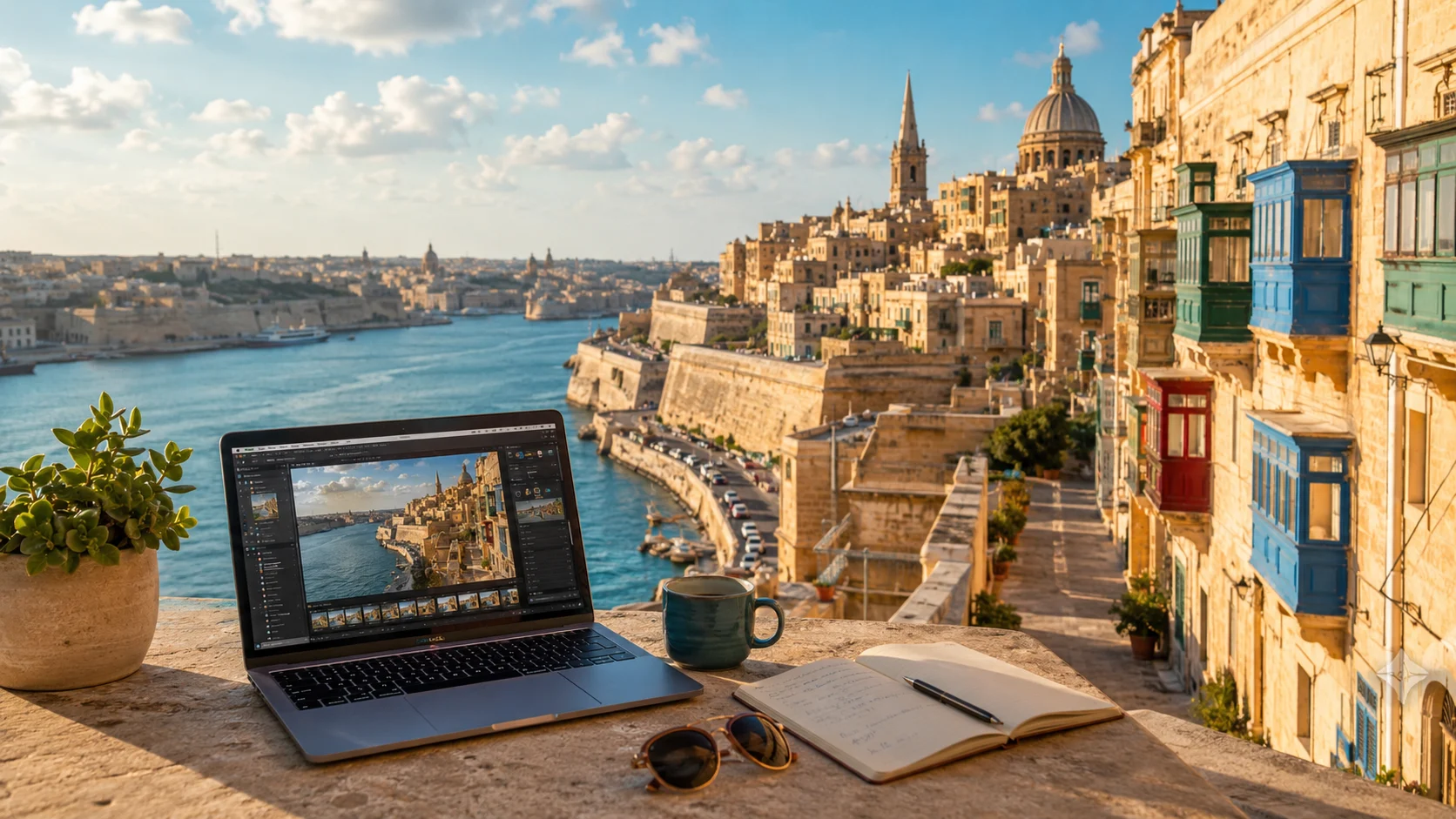
What is the Malta Nomad Residence Permit?
Malta's Nomad Residence Permit (NRP) was launched in June 2021 by Residency Malta Agency, the same body that runs Malta's high-profile permanent residency and citizenship by investment programs. The NRP allows third-country nationals (non-EU, non-EEA, non-Swiss) to live in Malta for up to 1 year while working remotely for a foreign employer, running a business registered abroad, or freelancing for foreign clients. Initial 1-year permits can be renewed up to 3 times, for a maximum of 4 years continuous stay.
Malta is a small archipelago in the central Mediterranean, population 540,000, that joined the EU in 2004 and the Schengen Area in 2007. The country is densely populated (over 1,600 people per square kilometre, the highest in the EU) but offers an unusual combination of EU/Schengen access, English-language environment, low corporate tax (5 percent effective under Malta's full imputation system), and Mediterranean lifestyle. The DN permit is straightforward to administer, with a single online application portal and processing typically in 30 days, much faster than most EU competitors.
Requirements and income threshold
Malta's income threshold is EUR 2,700 per month gross (around USD 2,915), or EUR 3,500 per month for applicants bringing family. This is moderate by EU standards, lower than Portugal (EUR 3,510), Greece (EUR 3,500), or Estonia (EUR 4,500), and similar to Italy and Croatia.
| Requirement | Details |
|---|---|
| Income | EUR 2,700/month minimum (single) or EUR 3,500/month (with family) |
| Savings alternative | Not a formal substitute, but bank balance strengthens application |
| Health insurance | Private health insurance covering Malta for full duration of stay |
| Criminal background | Police clearance from home country, less than 6 months old |
| Proof of remote work | Employment contract OR client contracts OR business registration; cannot be Maltese employer/clients |
| Other | Passport valid 12+ months; CV; accommodation proof; cover letter explaining why Malta |
Malta requires you to show recent bank statements (last 3 to 6 months) demonstrating consistent income at or above the threshold. Accommodation can initially be a 1-month rental contract or hotel booking for the application, but you must upgrade to a longer-term contract before collecting your residence card. Malta does not require a local tax number before applying (unlike Portugal, Italy, Spain, Greece).
Tax treatment
Malta operates on a remittance basis of taxation for non-domiciled residents. As an NRP holder, you are taxed only on Maltese-source income and on foreign income that you actually remit (transfer) into Malta. Foreign income you earn and keep outside Malta (in your home bank account or invested abroad) is not taxed by Malta. This is hugely powerful for nomads who can leave their foreign salary in a non-Maltese bank account.
If you do remit foreign income to Malta (to cover living expenses), it is taxed at a flat 10 percent on remitted income up to EUR 35,000 per year under the Nomad Residence Permit's tax framework (rules clarified in 2024). For most nomads, the practical setup is to receive salary into a foreign bank account, remit only enough each month to cover living expenses in Malta (say EUR 2,000 per month, EUR 24,000 per year), and pay 10 percent on the remitted amount only. So Maltese tax on a EUR 60,000 foreign salary might be only EUR 2,400 (4 percent effective rate), among the lowest in the EU.
Malta has double-tax treaties with 70+ countries including the US, UK, Canada, Australia, and most of Europe. Maltese standard corporate tax is 35 percent but the effective rate drops to 5 percent for non-Maltese-owned trading companies under the full imputation system, which is why Malta is a popular EU corporate base.
How to apply - step by step
Malta's NRP is one of the simplest EU DN visa applications. Everything runs through the Residency Malta Agency online portal. Processing typically takes 30 days. You can apply from outside Malta (at a Maltese consulate) or from inside Malta (after entering as a tourist).
- Visit nomad.residencymalta.gov.mt and create an account.
- Gather documents: passport (valid 12+ months), employment/client contracts, last 3-6 months bank statements showing EUR 2,700+ income, employer letter authorising remote work, criminal background check, private health insurance, CV, motivation letter, accommodation proof (initial 1-month booking is OK).
- Submit the online application and upload scanned documents.
- Pay application fee EUR 300 (per applicant) by bank transfer.
- Wait 30 days for initial review. If approved-in-principle, you receive a Letter of Approval.
- Travel to Malta within 6 months of Letter of Approval (if not already there).
- Upgrade your accommodation to a 12-month rental contract (required before card issuance).
- Attend the biometric appointment at Identity Malta in Valletta to capture fingerprints and photo.
- Receive your Nomad Residence Permit card (valid 1 year). Renew up to 3 times for total 4-year stay.
Cost breakdown
| Item | Cost |
|---|---|
| NRP application fee | EUR 300 (per applicant) |
| Residence card fee | EUR 27.50 |
| Criminal background check | USD 50 - USD 150 |
| Private health insurance (year) | EUR 500 - EUR 1,500 |
| Document translations (if needed) | EUR 100 - EUR 400 |
| Accommodation deposit (1-2 months rent) | EUR 1,000 - EUR 3,000 |
| Lawyer/relocation firm (optional) | EUR 1,000 - EUR 3,500 |
| Total first-year minimum | ~EUR 2,000 (DIY) to EUR 6,000 (full service) |
Cost of living
| Item | Sliema/St Julian's | Gozo (Victoria) |
|---|---|---|
| Rent 1br city centre | EUR 1,200 | EUR 700 |
| Food (groceries + eating out) | EUR 450 | EUR 380 |
| Public transport monthly pass | EUR 26 | EUR 26 |
| Coworking hot desk | EUR 180 | EUR 130 |
| Utilities + internet | EUR 130 | EUR 130 |
| Total per month (single) | ~EUR 1,986 | ~EUR 1,366 |
Malta is small, densely populated, and rents have risen sharply since 2020 due to inbound expats and the gaming industry. Sliema and St Julian's (the central tourist and expat zone) are the most expensive, with central 1-bedroom apartments at EUR 1,100 to EUR 1,500. Valletta (the historic capital) is similar. Quieter alternatives include Gzira, Msida, and Mellieha (north Malta) where rents drop to EUR 800 to EUR 1,000. The island of Gozo (a 25-minute ferry from Malta) offers a much slower pace, lower rents, and a tight expat community in Victoria/Xewkija. Public transport (buses only, no rail) is cheap but slow and crowded.
Family and dependents
Malta allows NRP holders to bring a spouse or registered partner, dependent children under 18 (or under 25 in full-time education), and dependent parents. The combined-family income requirement rises to EUR 3,500 per month (vs EUR 2,700 for solo applicants). Family members must submit their own document packs (passport, criminal check, marriage/birth certificates, health insurance) but pay the same EUR 300 application fee per person.
Family members receive matching 1-year NRP cards with the right to live in Malta but limited work rights (they cannot take Maltese employment). Children attend Maltese state schools free of charge (English-medium with Maltese as a second language, so genuinely bilingual). International schools include Verdala International School (IB curriculum), QSI International School of Malta, and St Edward's College, with fees EUR 7,000 to EUR 15,000 per year (cheaper than most EU international schools). Malta's public healthcare is free for residents and ranks well in OECD comparisons; private insurance is around EUR 80 to EUR 150 per month for a family.
Path to residency
Malta's NRP has a STRICT 4-year maximum stay (1 year initial + 3 renewals). After 4 years you must leave Malta for at least 12 months before applying again. The NRP does NOT count toward Malta's permanent residency requirements, which under standard EU rules require 5 years of long-term residence. So like Croatia and unlike Portugal, Spain, Greece, or Italy, the Malta NRP does not lead to PR.
If you fall in love with Malta and want long-term residency, separate programs exist. The Malta Permanent Residence Programme (MPRP) is an investment-based PR that requires EUR 110,000 to EUR 165,000 plus property purchase/rental commitments; it grants PR for life. The Malta Citizenship by Naturalisation for Exceptional Services (MEIN) is Malta's investor citizenship program (around EUR 750,000+ investment, 12 to 36 month residence required). Standard naturalisation requires 5 years of legal residence on a long-term permit. For nomads who want EU citizenship pathways without large investments, Portugal (7 years) or Italy (10 years) are better fits. See the main guide for citizenship comparisons.
Best cities for digital nomads
Sliema and St Julian's form Malta's central expat/nomad zone, with the highest density of coworking spaces (The Hub Malta, SOHO Office The Strand, Bigbeard), restaurants, gyms, and English-speaking community. Rents are the highest in Malta here. Most nomads base here for the first 6 to 12 months then often move to quieter areas as they learn the island.
Valletta is Malta's historic capital, a UNESCO World Heritage site with stunning Baroque architecture, increasingly popular with nomads who want a quieter atmosphere than St Julian's. Coworking options include The Knotel and SOHO Valletta. Gzira and Msida (near the university) offer lower rents and a more local feel. Gozo, Malta's sister island, is the off-the-beaten-path play: village life, lower rents (EUR 600 to EUR 900 for a 1-bedroom), tight expat community, and excellent diving/hiking. Coworking on Gozo: BOV Centre. Internet speeds across Malta are generally 200 to 500 Mbps with widespread fiber.
Pros and cons
- [+] Only EU country with English as official language
- [+] Schengen + EU access
- [+] Remittance-based taxation: 10% on remitted foreign income, untaxed on non-remitted
- [+] Year-round Mediterranean weather (avg 22C, 300 sunny days)
- [+] Simple online application, 30-day processing
- [+] Public healthcare ranks well in OECD
- [+] Tight expat community on small island
- [+] International schools cheaper than most EU peers
- [-] No path to permanent residency or citizenship via NRP
- [-] Strict 4-year maximum stay
- [-] Densely populated, traffic-clogged
- [-] Rents have risen sharply since 2020
- [-] Limited public transport (buses only, no rail)
- [-] Hot windy summers, can feel claustrophobic on small island
Frequently asked questions
How much income do I need for Malta's Nomad Residence Permit?
EUR 2,700 per month gross (around USD 2,915) for solo applicants, or EUR 3,500 per month for those bringing family. Income must come from a foreign employer, foreign clients, or a foreign-registered business, not Maltese sources.
How does Malta's remittance-based taxation work?
As a non-domiciled Maltese resident, you are taxed only on Maltese-source income and on foreign income you actually transfer (remit) to Malta. Under the NRP framework, remitted foreign income up to EUR 35,000 per year is taxed at a flat 10%. Foreign income you keep outside Malta is not taxed by Malta. This makes effective tax rates very low for most nomads.
Can I bring my family on Malta's NRP?
Yes. Spouse or registered partner, dependent children under 18 (or under 25 in full-time education), and dependent parents qualify. Combined-family income requirement is EUR 3,500/month. Each family member pays the EUR 300 application fee separately. Family members can live in Malta but cannot take Maltese employment.
How long does Malta's NRP take to process?
Typically 30 days from submission to the Letter of Approval. After arrival in Malta and biometrics capture, you receive the physical residence card in another 2 to 4 weeks. Total timeline is usually 6 to 10 weeks, much faster than Portugal or Italy.
Can Malta's NRP lead to permanent residency?
No. The NRP has a strict 4-year maximum (1 year initial + 3 renewals), then you must leave Malta for at least 12 months. It does not count toward the 5 years of long-term residence required for PR. For Maltese PR, look at the separate Malta Permanent Residence Programme (MPRP), which is investment-based.
Can I work for Maltese companies on the NRP?
No. The NRP is strictly for remote work for foreign employers or foreign-source self-employment. If you want to take a Maltese job, you must apply for a single permit (work permit) through your Maltese employer, which is a separate process.
What's the most common reason for Malta NRP rejection?
Top reasons: insufficient income proof (especially for self-employed who have irregular payments), unclear remote-work documentation (employer letter not specific enough), short-term accommodation listed without commitment to upgrade, and incomplete health insurance coverage. Use a Maltese relocation specialist to pre-screen documents.
What are alternatives to Malta's NRP?
For longer EU stays with PR pathway: Portugal (5 years to PR), Spain (5 years), Italy (5 years to PR + 10 to citizenship). For English-speaking but cheaper: Ireland working holiday or UK Skilled Worker if you have a degree. For zero foreign income tax: Croatia. For 7% Italian flat tax in small towns, see the Italy DN visa guide.
Related articles
Use our free tools
Free calculators for Canada CRS, Australia points, UK skilled worker, Germany Opportunity Card, and 34-country salary thresholds.
See all tools