
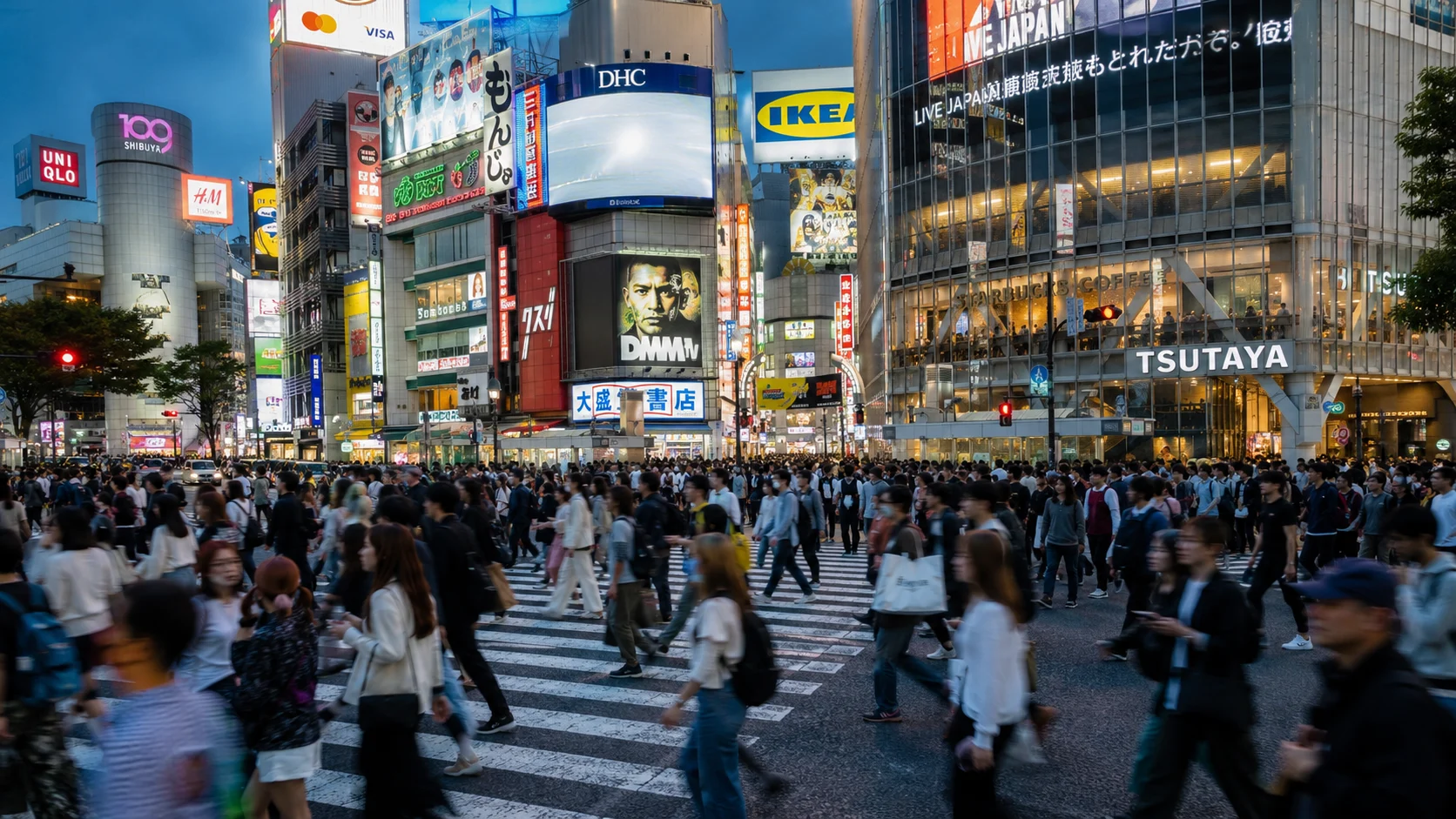
Why move to Japan?
Japan offers stable employment, universal healthcare (with co-pay), low crime, excellent public transport, and a HSP points system that lets top performers reach PR in 1-3 years. Tech, finance, education, and engineering have strong English-only hiring.
2026 challenges: declining population creating labour shortages drives expanded SSW programme. The depreciating yen has cut real expat earnings, but real estate and cost of living remain reasonable outside Tokyo.
Visa options at a glance
| Visa | Who it's for | Employer? | Salary expectation | PR pathway | Processing |
|---|---|---|---|---|---|
| Engineer / Specialist | Tech, science, humanities | Yes | JPY 3-8M (about USD 20K-55K) | 5-10 years standard | 1-3 months |
| Highly Skilled Professional (HSP) | Top earners, advanced degrees | Yes | JPY 5M+ (varies by points) | 1-3 years (HSP fast track) | 1-2 months |
| Specified Skilled Worker (SSW) | Construction, manufacturing, care | Yes | JPY 2-4M | Not direct (SSW-2 only) | 1-2 months |
| Intra-company Transferee | Multinational transfers | Yes (same group) | Local market | Not direct | 1-2 months |
| Business Manager | Entrepreneurs | Self | JPY 5M+ investment | 5-10 years | 1-3 months |
The fastest pathway: Engineer / Specialist + HSP
Most foreign professionals enter on the Engineer/Specialist visa (officially 'Engineer/Specialist in Humanities/International Services'), which covers software, engineering, design, marketing, language teaching, and consulting roles.
If your salary and credentials meet the HSP points threshold (70 = 3-year PR, 80 = 1-year PR), you can apply for the HSP visa directly or convert from Engineer/Specialist.
HSP points come from: age (max 10), salary (max 40), academic background (max 30), professional career (max 25), Japanese language ability (max 15), prior research achievements (max 25).
- Receive a Certificate of Eligibility (COE) from the prospective employer (8-10 weeks).
- Apply for visa at Japanese consulate (3-5 working days once COE in hand).
- Land in Japan, register at city hall within 14 days, get residence card.
- Open bank account, sign up for national health insurance.
- After 5 years on Engineer/Specialist (or 1-3 years on HSP): apply for PR.
Moving without a job offer
Japan is one of the most employer-dependent immigration systems in the OECD. Effectively all routes require an offer except:
- Business Manager - establish a Japanese business with JPY 5M+ capital and office.
- Specified Skilled Worker - sit for the SSW exam in Japan or overseas; some pathways allow direct entry.
- Student visa - enrol in a Japanese language school then job hunt during studies.
Cost of moving
| Item | Cost |
|---|---|
| COE issued by employer (employer covers) | Free for applicant |
| Single-entry visa | JPY 3,000 (USD 20) |
| Multi-entry visa | JPY 6,000 (USD 40) |
| Flight to Japan (one-way) | USD 600-1,500 |
| Tokyo first month rent + key money + deposit | JPY 600,000-1,200,000 (USD 4,000-8,000) |
| Smaller cities (Osaka, Fukuoka) | JPY 250,000-450,000 (USD 1,700-3,000) |
| Health insurance (first year) | JPY 200,000-400,000 (8% of income) |
| Estimated total (first 3 months) | USD 12,000-20,000 |
Tokyo housing has the unique 'key money' (reikin) of 1-2 months non-refundable, plus deposit and agent fees - total upfront 4-6 months rent.
Finding a job from abroad
Top platforms:
- LinkedIn Japan, Daijob, GaijinPot - English-friendly job boards.
- Bizreach - executive/senior roles.
- Doda, Recruit Agent - large Japanese recruiters.
- Top sponsors: Rakuten, Mercari, LINE, Sony, Hitachi, Recruit, MUFG, Nomura, Goldman Sachs Tokyo.
English-only roles concentrated in fintech, software (Rakuten, Mercari), language teaching (ALT/Eikaiwa), academia, and global firms.
Language requirements
Visa applications generally don't require Japanese. Workplace Japanese ranges from N5 (English-only tech roles) to N2 (most professional Japanese companies).
JLPT N1 or N2 adds HSP points (10-15) and is essential for permanent residency naturalisation.
Path to permanent residency
Standard route: 10 years legal residence + 5 years work visa. HSP fast track: 3 years at 70 points, 1 year at 80 points.
Citizenship: 5 years residence, must renounce other citizenship (Japan doesn't allow dual).
Taxes and finances
Income tax: 5-45% progressive. Local inhabitants tax 10%. Total effective rate on a JPY 6M salary about 25-30%.
Social insurance: 14% of salary (pension, health, unemployment). High but covers comprehensive benefits.
Open Japan Post Bank for arrival, then upgrade to MUFG, Mizuho, or Rakuten after 6 months.
Step-by-step action plan
- Identify your visa type: Engineer/Specialist (most), HSP (high earners), SSW (trades).
- Search Japan-specific job boards (Daijob, GaijinPot) and major Japanese recruiters.
- Negotiate salary and confirm employer will file COE.
- Wait 8-10 weeks for COE from Immigration Bureau.
- Apply for visa at consulate with COE in hand (decision in 3-5 days).
- Fly to Japan, register at city hall, collect residence card.
- Open bank account, enrol in national health insurance.
- Score HSP points to fast-track PR; aim for 80 points for 1-year PR.
- Apply for PR at 3 years (70 pts), 1 year (80 pts), or 10 years standard.
Frequently asked questions
Can I move to Japan without speaking Japanese?
Yes, in tech, finance, English teaching, and global multinationals. Most Tokyo fintech, Rakuten, Mercari, Sony, and big-4 consulting hire in English. Outside major cities, Japanese N3+ is usually required.
How does the HSP fast track to PR work?
Score 70+ HSP points = 3 years to PR. Score 80+ = 1 year to PR. Points come from salary, age, education, Japanese language, and career achievements. Many software engineers easily reach 75-80 points.
Is Japan strict about dual citizenship?
Yes - Japan officially does not recognise dual citizenship for adults. Naturalised citizens must renounce other passports. Many keep PR status indefinitely rather than naturalise to avoid this.
What's the SSW visa?
Specified Skilled Worker, introduced 2019 to address labour shortages. Covers 14 sectors (construction, manufacturing, agriculture, care, food service, etc.). SSW-1 is 5-year cap with no family bringing rights; SSW-2 is renewable indefinitely with family.
How much money do I need to move to Japan?
Plan USD 12,000-20,000 for first 3 months in Tokyo. Housing is the biggest upfront cost - traditional Japanese rental includes 1-2 months key money (reikin) plus deposit and agent fees. Smaller cities much cheaper.
Are there English-only jobs in Tokyo?
Yes, especially in fintech (Mercari, Rakuten, PayPay), big-4 consulting, US/EU multinationals (Goldman, JP Morgan, Microsoft, Google Japan), and English teaching. Language schools at JLPT N3 unlock more options.
Related articles
Use our free tools
Free calculators for Canada CRS, Australia points, UK skilled worker, Germany Opportunity Card, and 34-country salary thresholds.
See all tools