
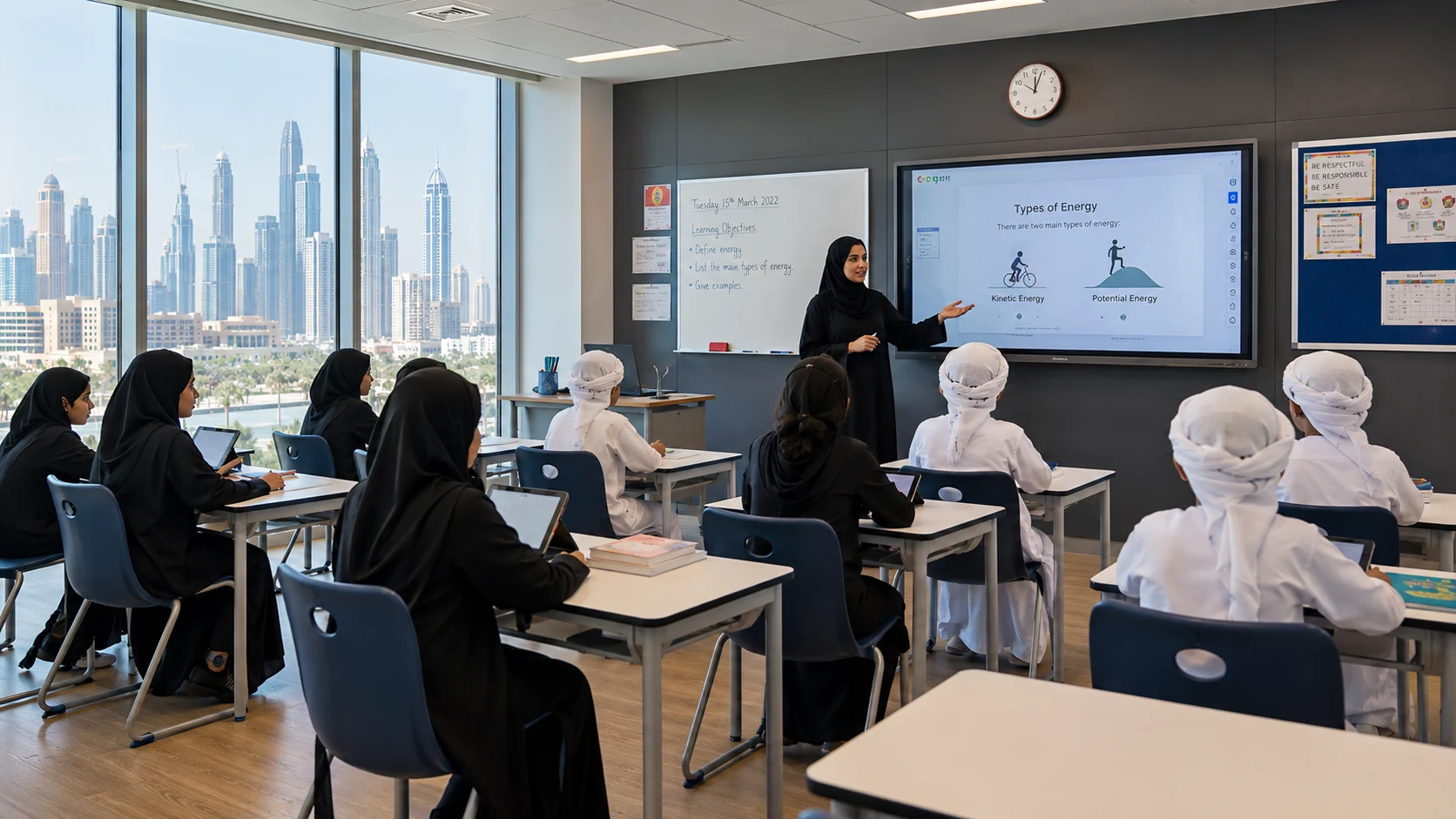
Why UAE pays the most
The United Arab Emirates pays the highest teaching salaries on the planet for one simple reason: the government has made English-medium education a strategic national priority. Under Vision 2030 and the broader Centennial 2071 plan, the UAE is positioning itself as a global hub for finance, tourism, aviation, and technology. Every one of those sectors operates primarily in English. To produce a generation of Emirati graduates who can compete with peers in London, New York, or Singapore, the country needs world-class English teachers in its classrooms today.
Two regulators dominate the landscape. ADEK, the Abu Dhabi Department of Education and Knowledge, oversees Abu Dhabi public schools, charter schools, and private licences in the capital. KHDA, the Knowledge and Human Development Authority in Dubai, regulates Dubai's overwhelmingly private school market. Both bodies set strict qualification floors for foreign teachers and inspect schools annually. Standards are enforced by linking inspection ratings to school fee increases, which means schools have a hard financial incentive to recruit and retain qualified expat teachers.
Petrodollar funding sits behind all of this. The UAE federal budget and the emirate-level budgets in Abu Dhabi and Dubai are flush with hydrocarbon and sovereign wealth fund returns. Education is one of the largest line items. There is no income tax in the UAE, which means a teacher's gross salary is also their net salary. When you add a housing allowance worth roughly $1,500 per month, paid medical insurance, and annual flights home, the package easily competes with $7,000 to $9,000 per month gross in countries with normal tax rates.
Salary breakdown - what tax-free actually means
Tax-free is the most misunderstood phrase in international teaching. Many candidates assume it simply means a slightly bigger pay cheque. In reality, when you stack the UAE package against a comparable teaching role in the UK, Canada, or Australia, the gap is enormous. A new ADEK teacher on AED 15,000 per month (USD 4,080) takes home every fil of that figure. There is no PAYE, no national insurance, no provincial tax, no pension deduction. To match that net income in the UK, a teacher would need a gross salary of around GBP 55,000, well above the typical secondary teacher payband.
| Line item | UAE teacher AED | UAE teacher USD | Notes |
|---|---|---|---|
| Gross monthly salary | AED 13,000-20,000 | USD 3,540-5,440 | ADEK or KHDA mid-tier band |
| Income tax withheld | AED 0 | USD 0 | UAE has no personal income tax |
| Housing allowance | AED 5,500/mo OR unit provided | USD 1,500/mo equivalent | Often a 2-bed apartment |
| Annual return flight | AED 5,500-9,000/yr | USD 1,500-2,500/yr | Economy class, home country |
| Medical insurance | Fully covered | Fully covered | Including dependents at most schools |
| End-of-service gratuity | 21 days salary per year | 21 days salary per year | After 5 years rises to 30 days |
| Effective package value | AED 25,000-35,000/mo | USD 6,800-9,500/mo | Compared to taxed countries |
The end-of-service gratuity is the silent giant. UAE labour law mandates that on completion of your contract, your employer pays out 21 days of your final basic salary for each of your first five years of service, then 30 days per year after that. A teacher who completes a five-year stint at AED 16,000 per month walks away with roughly AED 56,000 (USD 15,250) in gratuity in addition to their final salary and any annual leave payout. This single feature has made the UAE the destination of choice for teachers who want to clear student loans, save for a property deposit, or fund a career change.
Employment visa process
Every UAE teaching role runs on an employer-sponsored work visa. You cannot rock up on a tourist visa, find a job, and convert in country. The school, university, or training provider must lodge the work permit application with the Ministry of Human Resources and Emiratisation before you fly. Below is the standard sequence from job offer to residence stamp. Expect 10 to 16 weeks total from signed offer letter to your Emirates ID being in your hand.
- Secure a job offer through a UAE-licensed recruiter (Teach Away, Search Associates, TIC Recruitment) or by applying directly to schools. Public ADEK schools recruit through annual cycles; KHDA private schools hire year-round.
- Have your degree certificate attested. This is the bottleneck. You will need home country state or national authentication, then the UAE embassy in your home country, then the UAE Ministry of Foreign Affairs after arrival.
- Your employer applies for the work permit and entry visa with the Ministry of Human Resources and Emiratisation. They use your attested degree, passport scan, passport photo, and signed contract.
- You enter the UAE on a pink entry permit (single entry, 60 days). Activate it by passing through Dubai or Abu Dhabi immigration with your printed permit.
- Complete the Emirates ID biometric capture and the mandatory medical fitness test (blood test, chest x-ray) within the first 14 days. Both are booked through the school's PRO.
- The residence visa is stamped into your passport, your Emirates ID is issued within 7 to 10 days, and you can then open a bank account, get a driving licence, and bring dependents under family sponsorship.
Your school's PRO (Public Relations Officer) handles most of the in-country paperwork. Reputable schools cover all government fees, medical fees, Emirates ID fees, and visa printing fees as standard. If a recruiter or school asks you to pay these upfront, treat it as a red flag and verify the school's KHDA or ADEK licence directly on the regulator websites before signing anything.
MOE attestation - the bottleneck
Degree attestation is the single most common reason UAE teaching contracts get delayed or cancelled. The UAE does not accept apostille under the Hague Convention for educational documents. Instead, your degree must travel through a three-step chain of physical stamps before it is considered valid for employment. Most candidates underestimate this step and end up paying expedited fees or losing their start date.
- Step 1 - Home country authentication. In the US this means your degree first goes to your state Secretary of State, then to the US Department of State in Washington DC. In the UK it is the Foreign, Commonwealth and Development Office. In Canada it is Global Affairs Canada plus a provincial step depending on your university.
- Step 2 - UAE embassy in your home country. The UAE embassy or consulate accepts the document with the home country stamps and adds its own legalisation. This step alone takes 5 to 15 working days and costs USD 50 to USD 150 per document.
- Step 3 - UAE Ministry of Foreign Affairs after arrival. Once you land in the UAE your school's PRO submits your attested degree to the MOFA office in Abu Dhabi or Dubai for the final stamp. Costs AED 150 to AED 300.
Total attestation cost runs AED 800 to AED 1,500 (USD 220 to USD 410) depending on country and number of documents. Most teachers also attest their teaching certificate, TEFL, and marriage certificate (if bringing a spouse) through the same chain. Use a specialist attestation service such as Documents4Expats or the official VFS Global service in your country to avoid postal mistakes.
ADEK vs KHDA schools
The UAE has two distinct school markets and they offer very different teaching experiences. ADEK in Abu Dhabi is dominated by government and government-charter schools. KHDA in Dubai is dominated by private international schools running British, American, IB, Indian, and other national curricula. Salary, holiday allowance, contract length, and student demographics all differ meaningfully.
| Feature | ADEK Abu Dhabi | KHDA Dubai |
|---|---|---|
| Dominant sector | Public + charter (Emirati students) | Private international (expat + Emirati) |
| Salary range AED/mo | 12,500-19,000 | 13,000-22,000 |
| Contract length | 2 years standard | 1-3 years, varies by school |
| Working hours | 7am-3pm typical | 7am-4pm or longer |
| Holidays per year | 10-12 weeks | 8-10 weeks |
| End-of-service gratuity | Standard UAE law | Standard UAE law |
| Curriculum | MOE Emirati curriculum in English | British, American, IB, Indian, etc |
| Hiring cycle | Annual (March-June) | Year-round |
| Best for | Career teachers, family postings | Curriculum specialists, flexibility |
Most teachers find ADEK schools easier on work-life balance because hours are shorter and Emirati students follow a single curriculum. KHDA private schools pay slightly more on average but expect more after-hours commitment such as coaching, clubs, parent-teacher meetings, and curriculum committees. KHDA also has higher turnover and a more competitive promotion path. If you have young children, school fee discounts at your own school can swing the calculation significantly. KHDA international schools often offer 50 to 100 percent fee waiver for two teacher dependents.
Required credentials
The UAE has the strictest credential floor of any major TEFL market. KHDA inspections grade schools partly on the percentage of teaching staff with subject-relevant degrees and recognised teaching certifications. ADEK has hard minimums for any teacher in a government school. The list below represents what schools actually require, not just what the visa rules say.
- Bachelor's degree minimum, preferably in Education, English, English Literature, Linguistics, or your subject area. A BA in any field plus a PGCE or state teaching licence is fully acceptable.
- Two or more years of post-graduate classroom teaching experience. Most schools want at least one year in a school broadly comparable to theirs (British curriculum experience for British schools, etc).
- A recognised teaching qualification: PGCE (UK), state teaching licence (US/Canada/Australia), CELTA, DELTA, Trinity TESOL, or accredited 120 hour TEFL with practical teaching component.
- Valid passport with at least 24 months remaining validity at point of visa application.
- Clean criminal background check (FBI for US citizens, DBS Enhanced for UK, RCMP for Canada) issued within the last 6 months.
- IELTS Academic 7.5+ for non-native English speakers, even if you hold qualifications from English-medium universities. Some schools waive this for South African and Filipino teachers but most do not.
- Two professional references from former heads of school or department heads, contactable by email and phone.
- For dependents - marriage certificate, children's birth certificates, all attested through the same MOE chain.
Why UAE compared to Saudi
Many teachers weighing Gulf options end up choosing between the UAE and Saudi Arabia. The financial gap has narrowed dramatically as Saudi rolls out Vision 2030 and the NEOM project, but the lifestyle gap remains meaningful. Read our Saudi teaching visa guide for the full Saudi picture, but here is the short comparison from teachers who have done both.
The UAE is the more liberal Gulf option. Alcohol is legal for non-Muslims with a permit. Single women can rent apartments, drive, and live without a male guardian. Dress code in private spaces is relaxed. The expat community is enormous (around 88 percent of the UAE population) and English is the everyday working language. The trade-off is a higher cost of living, particularly rent in Dubai, and a transient social scene where colleagues come and go on two-year cycles. Saudi Arabia pays slightly less but housing is almost always provided directly and the savings rate often ends up higher.
For workers researching Gulf placement options from sending countries, our Gulf countries for Kenyan workers guide compares all six GCC states across visa rules, cost of living, and remittance corridors. Teaching is a small subset of the broader Gulf expat market but the same recruitment patterns and embassy attestation chains apply across sectors. Before you fly, double check your passport photo meets ICAO standards by reading our visa photo requirements guide. Many teachers also chain the two countries strategically: 3 to 5 years in Saudi to maximise housing-included savings, then 2 to 3 years in Dubai or Abu Dhabi for the lifestyle. The Gulf reciprocity rules mean a strong reference letter from any Saudi public school or KHDA private school carries weight across all GCC states, so your second contract is almost always easier to secure than your first.
Frequently asked questions
How much can I save per month teaching in the UAE?
Most ADEK or KHDA teachers save USD 1,500 to USD 3,000 per month after rent, food, and modest entertainment. A teacher in employer-provided housing with no dependents and conservative spending habits can save USD 3,500 per month or more. Dubai is significantly more expensive than Abu Dhabi for discretionary spending, particularly dining out and short-haul travel.
How long does the full UAE teaching visa process take?
From signed contract to Emirates ID in hand, allow 10 to 16 weeks. The bottleneck is degree attestation in your home country, which alone takes 4 to 12 weeks. Once you arrive in the UAE on the entry permit, the medical, Emirates ID, and residence stamp take a further 2 to 3 weeks.
Can I teach in the UAE without classroom experience?
Officially KHDA and ADEK both require 2+ years of post-graduate classroom experience for licensed teaching roles. In practice, you may find work as a teaching assistant, language coach, or after-school tutor with a degree and TEFL alone, but pay is typically AED 6,000 to AED 9,000 per month, less than half a licensed teacher's package.
What is the most common UAE teaching scam?
The most common scam is fake recruiters charging upfront fees for guaranteed UAE placements. Legitimate recruiters and schools never charge candidates. The second most common is contract bait-and-switch where the offer letter promises one salary or housing allowance but the in-country employment contract specifies less. Always insist on seeing the final Arabic-language employment contract before flying.
Are non-native English speakers eligible to teach in the UAE?
Yes, but with higher hurdles. South African, Indian, Filipino, and European teachers are regularly hired across both ADEK and KHDA, particularly with strong credentials and IELTS 7.5+. The bigger constraint is school preference: many British curriculum schools default to UK passport holders for English subject roles. Maths, science, and primary roles are far more open.
Can I bring my spouse and children on my UAE teaching visa?
Yes. Teachers earning AED 10,000+ per month (which is essentially all qualified teaching roles) can sponsor a spouse and children on family residence visas. Cost is roughly AED 5,000 per dependent for the full process. Many schools offer 50 to 100 percent school fee discounts for teachers' own children, which is a substantial benefit in Dubai where international school fees run AED 50,000 to AED 100,000 per child per year.
What happens to my Emirates ID and gratuity when I leave?
Your Emirates ID and residence visa are cancelled by your employer at end of contract. You then have a 30-day grace period to leave or transfer to a new sponsor. Your end-of-service gratuity (21 days basic salary per year for first 5 years, 30 days per year after) is paid out in full along with your final salary, any pro-rated annual leave, and the value of your return flight if not used.
What is the alternative if I don't have 2 years of teaching experience?
Consider building 2 years of experience in a less competitive Asian market first. Vietnam, Thailand, or China accept fresh TEFL graduates and after 2 years you become competitive for UAE roles. Alternatively, look at UAE private language institutes such as British Council, Berlitz, or Eton Institute which often hire teachers with strong TEFL but limited classroom experience. Pay is lower at AED 8,000 to AED 12,000 per month but it gets you in-country and into the school recruitment circuit.
Related articles
Use our free tools
Free calculators for Canada CRS, Australia points, UK skilled worker, Germany Opportunity Card, and 34-country salary thresholds.
See all tools