
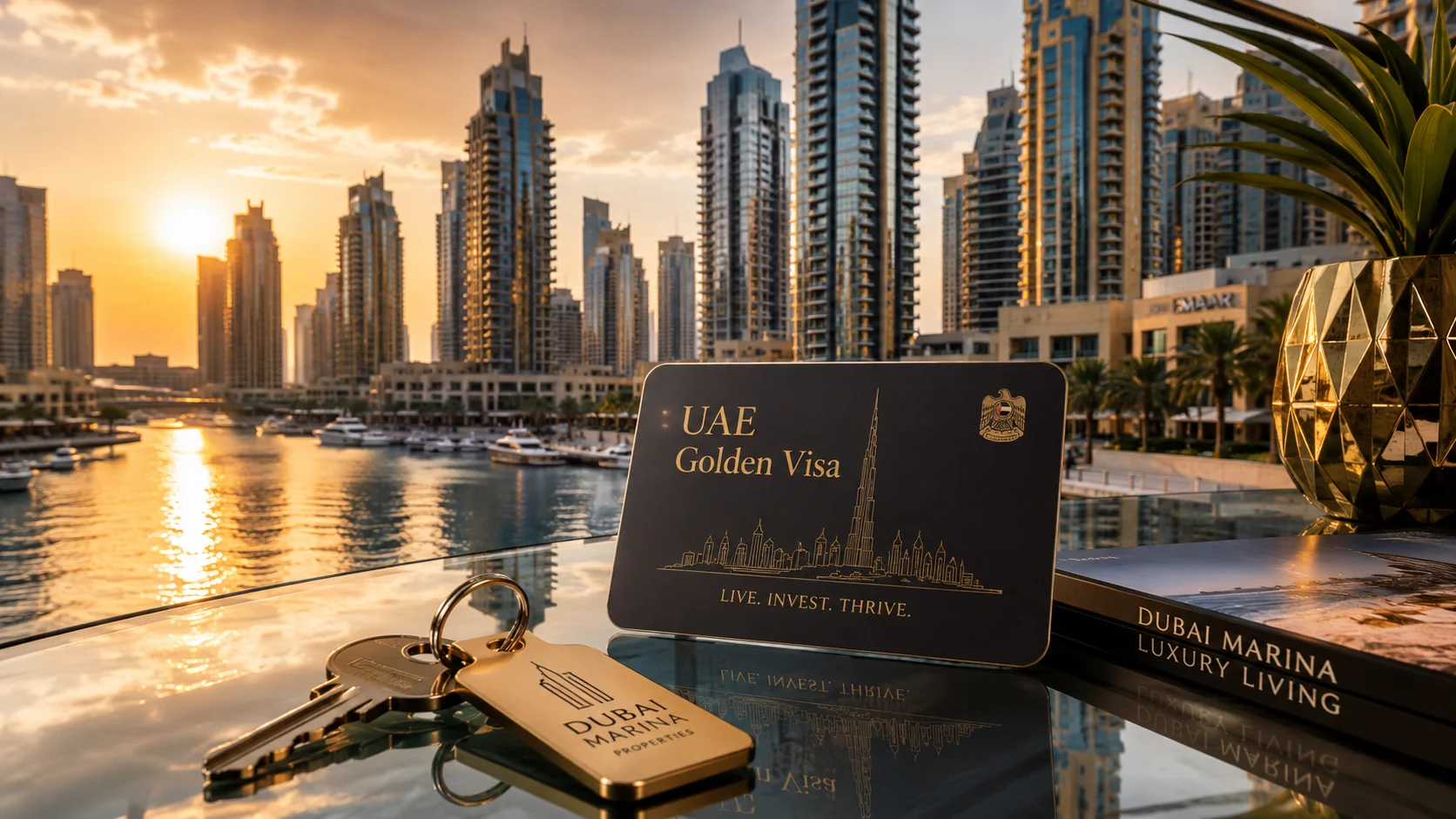
What is the UAE golden visa?
As of 2026, the UAE golden visa is a long-term residency permit that grants foreign nationals the right to live, work, study, and sponsor family in the United Arab Emirates for a renewable period of five or ten years, without needing a local employer or sponsor. Launched in 2019 and progressively expanded since, it replaced the old system under which most expatriates held residency only as long as their employer kept sponsoring them. The golden visa decouples residency from employment, which is the single most important shift for the millions of foreigners who build their lives in cities like Dubai and Abu Dhabi. You can read how it compares against European and Caribbean programs in our golden visa hub.
The program is deliberately broad. The headline route is property investment - buy real estate worth at least AED 2 million (about USD 545,000) and you qualify for a 10-year renewable golden visa. But the UAE also issues golden visas to entrepreneurs, company founders, investors holding public deposits, and to skilled professionals who simply earn a high enough salary in an approved field. That last category, the talent route, requires no property purchase at all and is covered in detail below. There is also significant overlap with specialist tech and AI hiring, which we explore in our piece on the AI specialist visa in the UAE.
The critical thing to understand from the outset is that the UAE golden visa is residency, not citizenship. It is a long-term right to live in the country, renewable indefinitely as long as you continue to meet the conditions, but it does not on its own lead to an Emirati passport. UAE citizenship is extremely rare, granted by decree only, and is not available through any standard investment or residency-by-time pathway. This makes the UAE program fundamentally different from citizenship-by-investment schemes such as Turkey's citizenship by investment or the various Caribbean citizenship programs, which deliver an actual second passport. We unpack that distinction in its own section below.
Investment routes and exact thresholds
There are several distinct qualifying routes into the UAE golden visa, and they carry very different price tags and conditions. The property route is the best known, but for high earners the salary-based talent route can deliver the same 10-year residency at zero capital cost. The table below summarises the main pathways as of 2026. Note that sources vary on some of the lower tiers and that category conditions (such as approved professions or fund types) attach to several routes, so always confirm current criteria with a registered agent before committing.
| Route | Threshold | Residency |
|---|---|---|
| Property investment | AED 2M (~USD 545K) | 10 years |
| Property (lower tier, varies) | AED 750K | 2 years (investor) |
| Public investment / deposit | AED 2M | 10 years |
| Entrepreneur / company capital | AED 500K+ | Up to 10 years |
| Skilled professional (talent) | AED 30K/mo salary + degree | 10 years |
| Specialists / scientists / creatives | Field-based nomination | 10 years |
On the property route, the AED 2 million can be met with a single property or a combination of properties reaching the threshold. Crucially, the property does not have to be paid for entirely in cash: off-plan property and mortgaged property can qualify, provided the equity you hold (or the value of the qualifying property) meets the AED 2 million bar. In practice, some UAE banks require a minimum amount of paid equity before they will support a golden visa application on a mortgaged property, so the exact treatment depends on the lender. Foreigners can only buy in designated freehold zones, which is where almost all golden-visa-eligible property sits.
The AED 750,000 property figure is a genuine but lower-tier option that some applicants use to obtain a shorter 2-year investor residency rather than the full 10-year golden visa. Sources differ on the precise current treatment of this tier, so we present it as a shorter-term option only and recommend confirming it directly. The business and capital routes - company investment or capital of AED 500,000 or more for qualifying entrepreneurs, and public investments or deposits of AED 2 million - carry their own category conditions around the type of entity, the sector, and accreditation by an approved UAE incubator or authority.
The talent route is the standout for salaried professionals. If you earn a basic salary of at least AED 30,000 per month, hold a bachelor's degree, and have a valid employment contract in an approved field, you can qualify for a 10-year golden visa with no property purchase at all. Doctors, scientists, engineers, senior specialists, top-performing students, and recognised creatives in culture and the arts also qualify under talent-based nominations. This is why the program has been so attractive to the highly paid tech and finance workforce concentrated in the DIFC and Dubai Internet City.
Eligibility and requirements
Beyond meeting one of the qualifying routes above, golden visa applicants must satisfy a set of standard requirements. These are generally light compared with European residency-by-investment programs: there is no language test, no minimum physical-presence requirement in the way Schengen programs impose one, and no obligation to give up your existing nationality. The core conditions revolve around clean records, valid documentation, and a medical check.
| Requirement | Detail |
|---|---|
| Valid passport | At least 6 months validity |
| Qualifying route | Property, capital, business, or talent (see above) |
| Medical fitness test | Standard UAE residency medical screening |
| Emirates ID registration | Biometric ID issued to all residents |
| Health insurance | Valid UAE medical insurance required |
| Clean record | No significant adverse security findings |
| Proof of investment / salary | Title deed, bank letter, or attested contract |
For the property route you provide the title deed (or off-plan purchase contract and payment evidence) and a property valuation confirming the AED 2 million threshold. For the talent route you provide an attested employment contract, salary certificate, and your attested degree certificate. For business routes you provide the trade licence, capital documentation, and any required accreditation from an approved authority or incubator. All applicants undergo a standard UAE residency medical fitness test and register for an Emirates ID, which is the biometric identity card every resident carries.
One of the biggest practical advantages over employer-sponsored residency concerns time spent outside the country. A normal UAE residence visa typically lapses if the holder stays outside the Emirates for more than six continuous months. Golden visa holders are exempt from this rule and can remain abroad for longer periods without losing their residency status - a major benefit for globally mobile investors and professionals who split their time across countries. This flexibility is one of the most cited reasons applicants choose the golden visa over a standard work permit.
The talent route: golden visa with no property
For many readers the most relevant route is the talent track, because it delivers the full 10-year golden visa to salaried professionals without requiring any property purchase or capital deposit. The headline condition is a basic monthly salary of at least AED 30,000, combined with a bachelor's degree and a valid employment contract in an approved professional field. At a salary of AED 30,000 per month (roughly USD 8,170), this puts the golden visa within reach of a large slice of Dubai's senior professional workforce in finance, technology, law, medicine, and engineering.
The talent category also extends well beyond the salary threshold. Doctors and medical specialists, scientists and researchers, inventors, senior engineers, and individuals with exceptional talent in culture, art, and sport can all be nominated for golden visas through the relevant UAE authorities, sometimes regardless of the standard salary figure. Outstanding students - both top secondary-school graduates and high-achieving university students - have their own dedicated golden visa stream. The breadth of the talent route is a deliberate policy to retain skilled people who might otherwise leave when they change jobs.
This route overlaps heavily with the surge in AI, data, and specialist tech hiring across Dubai and Abu Dhabi. Employers in the AI and data-centre space increasingly use the golden visa as a retention tool, since it frees the employee from employer sponsorship and signals long-term commitment. If you are coming into the UAE specifically for an AI or advanced-technology role, our companion guide on the AI specialist visa in the UAE covers the field-specific nomination paths and how they interact with the golden visa salary threshold.
How to apply - step by step
The UAE golden visa is notable for how fast it processes. While European programs can take six to eighteen months, the UAE routinely issues golden visas in around two weeks once the file is complete. Applications are typically handled through the Federal Authority for Identity, Citizenship, Customs and Port Security (ICP) portal, through the relevant emirate's residency authority such as the GDRFA in Dubai, or through licensed typing centres and agents. The steps below describe the property route; the talent and business routes follow the same shape but swap the qualifying evidence.
- Confirm your qualifying route and gather evidence. For property, secure a title deed or off-plan contract proving at least AED 2 million in qualifying real estate in a freehold zone. For talent, assemble your attested degree, salary certificate showing AED 30,000+ per month, and employment contract. For business, prepare your trade licence and capital documentation.
- Obtain a property valuation or supporting letters. Property applicants usually need an official valuation certificate confirming the threshold is met; mortgaged-property applicants should obtain a no-objection or equity confirmation letter from the bank, as some lenders require a minimum paid amount.
- Submit the golden visa application. File through the ICP smart services portal, the emirate's residency authority (for example GDRFA Dubai), or an approved agent or typing centre. Pay the application and issuance fees at this stage.
- Receive pre-approval (the entry permit or nomination). For talent-based and specialist routes, this stage may involve nomination by the relevant UAE authority. Approval at this point is typically quick once documents are in order.
- Complete the medical fitness test. All applicants inside the UAE undergo a standard residency medical screening at an approved health centre.
- Register for Emirates ID and biometrics. Provide fingerprints and biometric data; the Emirates ID is the resident identity card you will use for almost everything in the country.
- Receive your golden visa and residency stamp. The 10-year (or relevant tier) residency is issued, usually within roughly two weeks of a complete file, after which you can sponsor family members.
Because the process is so document-driven and fast, the main causes of delay are incomplete attestation of foreign documents (degrees and contracts often need legalisation) and valuation issues on property files. Many applicants use a licensed agent to avoid these snags. If your file is rejected, common reasons mirror those across immigration systems generally - we cover them in our guide to the most common visa rejection reasons and how to avoid them through proper due diligence.
Costs and fees
The dominant cost in the property route is, of course, the AED 2 million property itself, but that is an asset you own rather than a sunk fee. The government and administrative fees layered on top are modest by international investment-migration standards, especially compared with the non-refundable donations required by Caribbean citizenship programs. The figures below are indicative for 2026; exact amounts vary by emirate, route, agent, and whether you apply from inside or outside the UAE.
| Item | Indicative cost |
|---|---|
| Qualifying property (main route) | AED 2M+ (asset, not a fee) |
| Golden visa government fees | Approx AED 2,800 to 4,000 |
| Medical fitness test | Approx AED 300 to 700 |
| Emirates ID (10-year) | Approx AED 1,000+ |
| Property valuation certificate | Approx AED 500 to 4,000 |
| Agent / typing centre service | Varies, AED 2,000 to 6,000+ |
| Document attestation (degree, etc.) | Varies by country |
On the property route you should also budget for the standard real estate transaction costs in Dubai, which typically include a Dubai Land Department transfer fee of around 4% of the property value plus registration and agency fees. These are property-purchase costs rather than golden-visa costs, but they materially affect the total outlay for an AED 2 million purchase. The talent route avoids all property costs entirely, with the applicant facing only the government fees, medical test, Emirates ID, and any document attestation - making it by far the cheapest path to a 10-year UAE residency for those who qualify on salary.
Tax treatment and the 0% income tax draw
The single biggest financial attraction of UAE residency is that the UAE levies 0% personal income tax. There is no tax on salaries, no tax on personal investment income, no capital gains tax on individuals, and no inheritance tax. For a high earner relocating from a high-tax European country, the swing in take-home pay can be enormous, and it is a central reason the golden visa interest has climbed so sharply since 2023. As of 2026 this zero personal-income-tax position remains in place and is one of the defining features of the program.
The UAE did introduce a federal corporate tax of 9% on business profits above AED 375,000, effective from mid-2023. This is important to understand correctly: it is a tax on business profits, not on personal salary. A salaried golden visa holder pays no UAE tax on their employment income. A business owner whose company profits exceed the AED 375,000 threshold will face the 9% corporate rate on the excess, but profits below that threshold remain untaxed, and there is still no personal income tax layered on top. There is also a 5% VAT on most goods and services, which functions as a consumption tax rather than an income tax.
For non-US nationals, the typical pattern is that you must genuinely become non-resident in your home country to enjoy the UAE's 0% rate cleanly. Many countries apply day-count and centre-of-life tests, and some impose exit taxes or trailing tax obligations. The UAE has a wide network of double-tax treaties that can help, and obtaining a UAE Tax Residency Certificate is often part of properly establishing your position. The practical takeaway is that the 0% headline is real and powerful, but it only delivers its full value when you have correctly severed tax residency elsewhere.
Residency vs citizenship: the crucial distinction
It is essential to be clear about what the UAE golden visa is and is not. It is a renewable long-term residency. It is not a path to citizenship, and it does not produce an Emirati passport after any number of years. This is the opposite of how European and Caribbean investment-migration programs work, where the residency or investment is explicitly a step toward naturalisation and a second passport.
UAE citizenship is granted by decree only and is extremely rare for foreigners. A 2021 reform created a narrow route for select investors, doctors, scientists, artists, and other exceptional individuals to be nominated for citizenship, but this is a discretionary, nomination-based process - not an entitlement you can accumulate by living in the country for a set number of years. The overwhelming majority of long-term foreign residents in the UAE, including golden visa holders who have lived there for decades, remain foreign nationals holding renewable residency. You should plan on the golden visa being exactly that: secure, renewable residency with outstanding lifestyle and tax benefits, but not a passport.
This is why the UAE program appeals to a different buyer than citizenship-by-investment. If your goal is a second passport with visa-free travel and the right to pass citizenship to your children, you are looking at a fundamentally different product such as Turkey's citizenship by investment, which grants an actual passport, rather than UAE residency. Many sophisticated investors hold both: a UAE golden visa for the tax residence and lifestyle, and a separate citizenship-by-investment passport for mobility and a Plan B. Understanding this contrast is the most important decision point in choosing between the two.
Family sponsorship and benefits
A major draw of the golden visa is generous family sponsorship. A golden visa holder can sponsor their spouse, children, and - importantly - parents, as well as domestic staff such as a housekeeper or driver, all under the same long-term residency umbrella. The sponsored family members generally receive residency tied to the holder's golden visa term, which means a family can secure long-term stability in one application rather than juggling multiple employer-linked permits. Sponsored sons can typically remain on the family visa for longer than under standard rules, and there is more flexibility for adult children than the older sponsorship system allowed.
Because the golden visa does not require an employer sponsor, the holder is free to change jobs, start a business, or take time off without jeopardising their residency or their family's status. This independence is one of the program's defining benefits and a sharp departure from the traditional UAE model where losing your job often meant losing your visa within a short grace period. Golden visa holders also retain the right to live abroad for extended periods, as noted earlier, without the standard six-month-absence rule cancelling their residency.
Other practical benefits include the ability to own property in Dubai's freehold zones - areas such as Downtown Dubai, Dubai Marina, Palm Jumeirah, Business Bay, and Jumeirah Lakes Towers, where foreigners can hold full freehold title. Golden visa residents also access the UAE's banking system, can obtain local mortgages, enrol children in the UAE's extensive international school system, and benefit from the country's safety, infrastructure, and connectivity. For migrants from major UAE-bound nationalities - our Egypt nationality guide covers one of the largest such communities - the golden visa transforms a previously employer-dependent stay into long-term security. See the full picture in our UAE country hub.
Pros and cons
The UAE golden visa is one of the strongest residency products in the world for the right person, but it is not a fit for everyone - particularly anyone whose real goal is a second citizenship. The summary below weighs the main advantages against the limitations as of 2026.
- [+] 0% personal income tax on salary and personal investment income - the headline financial draw
- [+] 10-year renewable residency, decoupled from any employer or sponsor
- [+] Very fast processing, typically around two weeks for a complete file
- [+] Multiple routes in: AED 2M property, business capital, or AED 30K/month salary with a degree (no property needed)
- [+] Sponsor spouse, children, parents, and domestic staff under one residency
- [+] Mortgaged and off-plan property can qualify, subject to bank equity rules
- [+] No six-month-absence rule - you can live abroad for longer without losing residency
- [+] Property held as a freehold asset you own, not a sunk donation
- [+] World-class infrastructure, safety, schooling, and global connectivity
- [-] Residency only - no path to an Emirati passport; citizenship is by decree and extremely rare
- [-] AED 2M property entry point is high relative to some other golden visas
- [-] 0% UAE tax does not remove US worldwide tax filing or home-country obligations until residency is broken
- [-] 9% corporate tax applies to business profits above AED 375,000
- [-] Foreigners can only buy property in designated freehold zones
- [-] Lower property tiers (e.g. AED 750K) deliver only shorter investor residency, and sources vary on current terms
- [-] Cost of living in prime Dubai areas is high, offsetting some of the tax saving
What is new in 2026
The most striking development is sheer scale. By the first quarter of 2026, the UAE had issued over 250,000 golden visas, and public interest has surged - searches and enquiries are up roughly 340% since 2023. This reflects both the post-2022 expansion of qualifying categories and a broader global trend of high earners and entrepreneurs seeking low-tax bases with strong rule of law and connectivity. The UAE has leaned into this momentum, streamlining digital applications through the ICP portal and keeping processing times remarkably short.
The category mix has also broadened over recent years. The talent route, in particular, has been pushed hard as a retention tool: by letting skilled professionals on AED 30,000-plus salaries secure a 10-year residency independent of their employer, the UAE aims to keep its highest-value workforce even as people change jobs. There has been parallel expansion around specialists, scientists, top students, and creatives, plus targeted nomination streams aligned with national priorities in technology and AI. This is the competitive angle that sets the UAE apart from property-only programs.
At the same time, the global golden visa landscape has been moving in the opposite direction in Europe, where several countries have closed or curtailed their programs - a trend we track in our guide to countries that ended their golden visas. Portugal removed residential real estate from its program, the Netherlands and Ireland scrapped theirs, and Spain ended its golden visa entirely. Against that backdrop, the UAE's program looks unusually stable and expansionary, which is part of why it has absorbed so much of the global demand. For the latest comparison of which programs remain open and on what terms, start with our golden visa hub.
The bottom line as of 2026: the UAE golden visa is a fast, tax-efficient, family-friendly long-term residency available through property, business, or salary, but it is residency rather than citizenship. If a 0% personal income tax base in a stable, well-connected hub is your goal, few programs compete. If you specifically need a second passport, pair it with a citizenship route instead. As always, confirm current thresholds and conditions with a licensed UAE advisor before you transfer any funds.
lead.heading
lead.description
Frequently asked questions
How much property do I need for the UAE golden visa?
You need real estate worth at least AED 2 million (about USD 545,000) to qualify for the 10-year golden visa through the property route, as of 2026. This can be a single property or a combination of qualifying properties reaching the threshold, and it must be located in a designated freehold zone where foreigners are permitted to own. The property does not have to be fully paid in cash - off-plan and mortgaged properties can qualify, though some UAE banks require a minimum amount of paid equity before they will support the application. A separate, lower AED 750,000 tier exists that some applicants use for a shorter 2-year investor residency, but sources vary on its current treatment, so confirm with a registered agent. Always obtain a property valuation confirming the threshold is met before applying.
Does the UAE golden visa lead to citizenship?
No. The UAE golden visa is a long-term, renewable residency - it does not lead to an Emirati passport, no matter how many years you hold it. UAE citizenship is granted by decree only and is extremely rare for foreigners. A 2021 reform created a narrow, discretionary route for select investors, doctors, scientists, artists, and other exceptional individuals to be nominated for citizenship, but this is not an entitlement you can earn through time or investment. If your real goal is a second passport, you should look at citizenship-by-investment programs such as Turkey's or the Caribbean options instead, which grant an actual passport. Many investors hold a UAE golden visa for the tax and lifestyle benefits alongside a separate citizenship for mobility.
Is there income tax in the UAE?
No, the UAE levies 0% personal income tax as of 2026. There is no tax on salaries, no personal capital gains tax, and no inheritance tax, which is the single biggest financial draw of UAE residency. The UAE did introduce a 9% federal corporate tax on business profits above AED 375,000 in 2023, but that applies to company profits, not to personal salary - a salaried golden visa holder pays no UAE tax on their earnings. There is also a 5% VAT on most goods and services, which is a consumption tax rather than an income tax. Importantly, US citizens and Green Card holders remain taxed by the United States on worldwide income regardless of living in Dubai, and citizens of other countries may stay tax-resident at home until they properly break residency, so take cross-border tax advice.
Can I get a UAE golden visa through my salary instead of buying property?
Yes. The talent route grants a 10-year golden visa to skilled professionals without any property purchase. The core condition is a basic salary of at least AED 30,000 per month, combined with a bachelor's degree and a valid employment contract in an approved professional field. This makes it the cheapest path to a 10-year UAE residency for those who qualify on income, since you only pay government fees, the medical test, Emirates ID, and document attestation. The talent category also extends to doctors, scientists, senior engineers, top students, and recognised creatives through field-based nominations, sometimes regardless of the standard salary figure. It is especially relevant to senior professionals in finance, technology, and the growing AI and data sector.
How long does it take to get the UAE golden visa?
Processing is famously fast - typically around two weeks once your file is complete, far quicker than European residency-by-investment programs that can take six to eighteen months. Applications are handled through the federal ICP smart services portal, the relevant emirate's residency authority such as GDRFA in Dubai, or licensed agents and typing centres. The main causes of delay are not government processing but incomplete document attestation (degrees and contracts often need legalisation) and valuation issues on property files. Many applicants use a licensed agent to keep the file clean and avoid these snags. Once approved, you complete a medical fitness test and Emirates ID registration before the residency is issued.
Can I sponsor my family on a UAE golden visa?
Yes, and the sponsorship rights are generous. A golden visa holder can sponsor their spouse, children, and parents, as well as domestic staff such as a housekeeper or driver, all under the same long-term residency. Sponsored family members generally receive residency tied to the holder's golden visa term, giving the whole family long-term stability in a single application. Sons can typically remain on the family visa for longer than under standard sponsorship rules, with more flexibility for adult children. Because the golden visa is not tied to an employer, you can change jobs or start a business without putting your family's residency at risk.
Do I lose my golden visa if I live outside the UAE?
No, and this is a key advantage over standard UAE residence visas. A normal UAE residence visa typically lapses if the holder stays outside the country for more than six continuous months. Golden visa holders are exempt from this six-month-absence rule and can remain abroad for longer periods without losing their residency status. This makes the golden visa particularly attractive to globally mobile investors and professionals who split their time across multiple countries. It is one of the most cited reasons applicants choose the golden visa over an employer-sponsored permit. You should still maintain valid documentation and meet your qualifying conditions throughout the residency period.
Where can foreigners buy property to qualify in Dubai?
Foreigners can only buy property in Dubai's designated freehold zones, which is where almost all golden-visa-eligible real estate is located. Popular freehold areas include Downtown Dubai, Dubai Marina, Palm Jumeirah, Business Bay, and Jumeirah Lakes Towers, among many others. In these zones foreigners can hold full freehold title to their property, including apartments and villas. The AED 2 million threshold can be met with one property or a combination, and off-plan or mortgaged property can count subject to bank equity rules. Beyond the purchase price, budget for transaction costs such as the Dubai Land Department transfer fee of around 4% plus registration and agency fees, which are separate from the golden visa government fees.
Related articles
Use our free tools
Free calculators for Canada CRS, Australia points, UK skilled worker, Germany Opportunity Card, and 34-country salary thresholds.
See all tools