
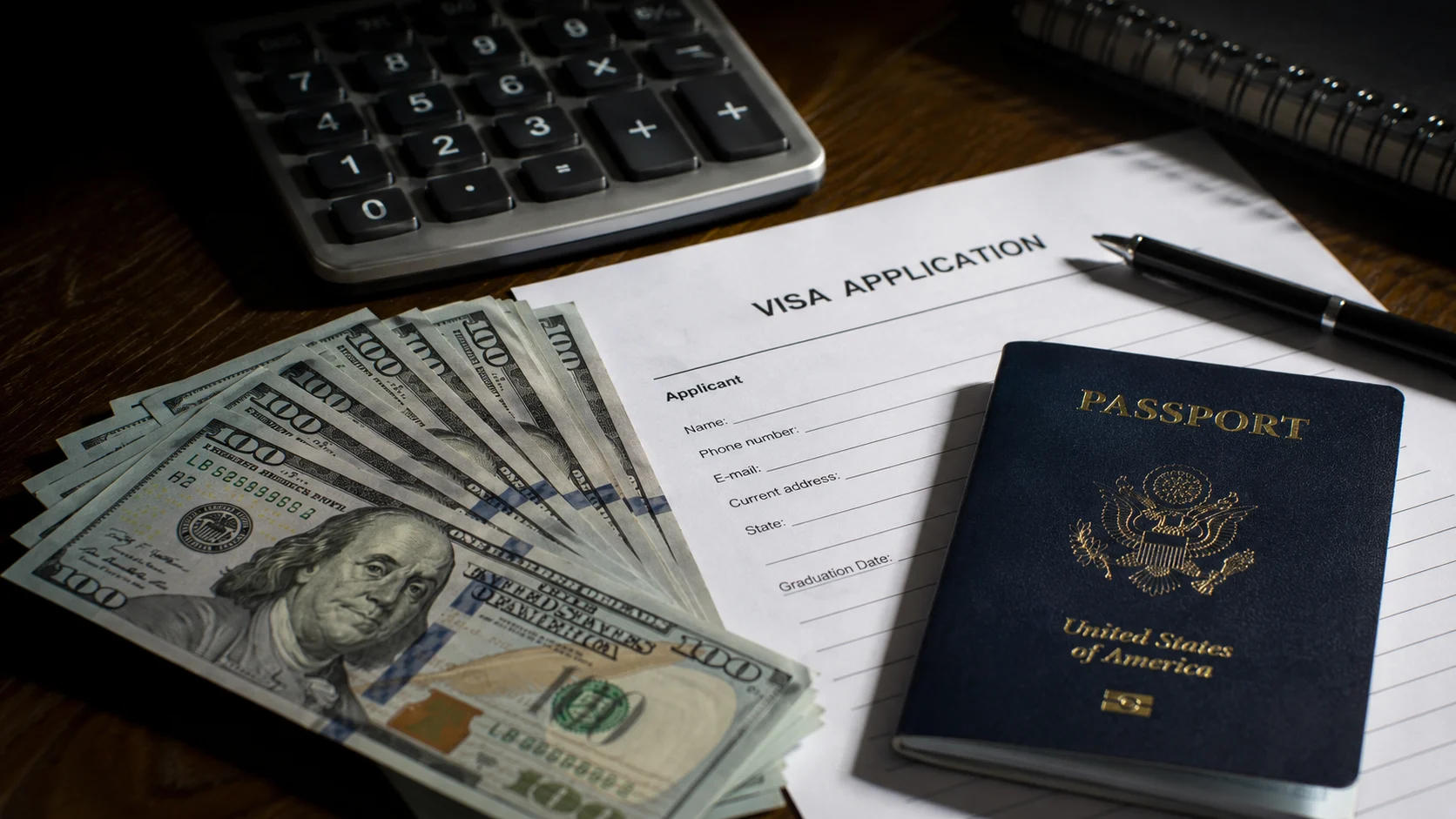
Who pays the $100K fee?
The fee does not apply to every H-1B petition. It is triggered by consular processing - the act of a worker interviewing for and being issued an H-1B visa at a post abroad. The table below works through the most common scenarios.
| Scenario | Fee applies? | Total govt fees |
|---|---|---|
| New H-1B hire abroad, consular processing | Yes | Roughly $112,000-$125,000 |
| Cap-subject lottery selection, worker overseas | Yes | Roughly $112,000-$125,000 |
| H-1B extension for a worker already in the US | No | Roughly $2,000-$5,000 |
| H-1B amendment (same employer, role change) | No | Roughly $2,000-$5,000 |
| H-1B transfer (change of employer, worker in US) | Generally no | Roughly $2,000-$5,000 |
| Change of status from F-1 OPT to H-1B inside the US | No | Roughly $2,000-$5,000 |
| Worker on a pending petition who travels abroad and must process at a consulate | Yes - reclassified | Roughly $112,000-$125,000 |
One principle cuts through the detail: the employer pays the fee, not the worker. US law prohibits passing mandatory H-1B costs to the employee. But that does not make the fee invisible to workers - a $100,000 cost shapes whether an employer is willing to hire from abroad at all, which roles it offers internationally, and how it negotiates salary and relocation. The fee is the employer's bill, but it changes the worker's odds.
The travel trap
The most dangerous misunderstanding about the fee is the assumption that an in-US filing is permanently safe. It is not. A worker with a pending H-1B petition who leaves the United States - even briefly - can find their case reclassified as requiring consular processing, which triggers the $100,000 fee.
- A pending change-of-status petition assumes the worker remains in the US. Departing the country can void the change-of-status request and force consular processing.
- Immigration attorneys are advising H-1B workers and candidates with pending petitions to avoid all non-essential international travel until the petition is approved.
- Where travel is unavoidable, attorneys recommend obtaining a written analysis of the consular-processing risk before booking any trip.
- Employers are being advised to brief sponsored workers explicitly, because a single family emergency abroad can convert a routine filing into a six-figure liability.
Impact on employers and hiring strategy
For an employer hiring a new H-1B worker from abroad, the $100,000 supplemental fee sits on top of an already substantial stack of mandatory government charges. The table below itemises the full cost.
| Fee | Amount |
|---|---|
| H-1B registration fee | $215 |
| Form I-129 base filing fee | $780 |
| Asylum Program Fee | $600 |
| ACWIA training fee | $1,500 |
| Fraud prevention and detection fee | $500 |
| Public Law 114-113 fee (large H-1B-dependent employers) | $4,000 |
| Premium processing (optional) | $2,805 |
| Supplemental Proclamation fee | $100,000 |
| TOTAL | Roughly $112,000-$125,000 |
In response, employers are changing how they hire:
- Prioritising candidates already in the US in F-1 OPT or STEM OPT status, so the H-1B can be filed as a change of status and avoid the fee.
- Shifting net-new hiring to overseas offices, particularly in Canada, the UK, Ireland and India, rather than sponsoring relocation to the US.
- Leaning on intra-company transfer options such as the L-1 visa, and on extraordinary-ability categories such as the O-1, where the $100,000 fee does not apply.
- Reserving US-based H-1B sponsorship for senior, hard-to-replace roles where the six-figure premium is commercially justifiable.
The national interest exemption
The Proclamation includes a national interest exemption that, in theory, allows the fee to be waived where hiring a particular worker serves the interests of the United States. In practice, this exemption is extremely narrow. The administration has described it as applying in cases that are "extraordinarily rare," and there is no streamlined application process for employers to invoke it.
The clear guidance from immigration practitioners is straightforward: do not build a hiring plan around the national interest exemption. Treat the $100,000 fee as a fixed cost of consular-processed H-1B hiring, and pursue the exemption only as a long-shot supplement, never as the foundation of a strategy.
Litigation status
The fee has been challenged in multiple lawsuits brought by business groups, universities and immigration organisations, who argue that imposing a six-figure fee by proclamation exceeds presidential authority and bypasses the normal rulemaking process. As of May 2026, however, no court has issued an injunction halting the fee. It remains fully in force and is being collected on every qualifying petition. Employers and workers should plan their decisions as if the fee will remain in place - a favourable court ruling is possible but cannot be assumed, and timing relief around hypothetical litigation outcomes is not a sound strategy.
H-1B alternatives that avoid the $100K fee
Because the $100,000 fee is specific to consular-processed H-1B petitions, several other visa categories and strategies sidestep it entirely. The table below compares the main options.
| Alternative | Fee required? | Pros | Cons |
|---|---|---|---|
| L-1 intra-company transfer | No | No lottery, no $100K fee, dual-intent friendly | Requires 1 year of qualifying employment abroad with the same group |
| O-1 extraordinary ability | No | No lottery, no annual cap, no $100K fee | High evidentiary bar - must document national or international acclaim |
| E-2 treaty investor / employee | No | Fast processing, renewable, no $100K fee | Limited to treaty-country nationals; not a direct path to a green card |
| TN visa (USMCA professionals) | No | Quick, low-cost, no lottery | Canadian and Mexican citizens only; limited occupation list; non-immigrant intent |
| F-1 to OPT to H-1B inside the US | No | Change of status avoids the consular fee | Still subject to the H-1B lottery; depends on OPT timing |
| Hire the worker in Canada | No | Express Entry and work permits, close time zones | Worker is based outside the US |
| Hire the worker in the UK | No | Skilled Worker route, strong tech sector | Worker is based outside the US |
| Hire the worker in Germany | No | EU Blue Card and Opportunity Card routes | Worker is based outside the US; language can matter |
Each of these routes carries its own eligibility test and trade-offs. For a detailed walk-through of which alternative fits which situation, see our dedicated guide to H-1B alternatives in 2026. Employers shifting hiring north of the border should also review our guide on how to move to Canada in 2026, and individuals can gauge their own options with our immigration eligibility checker.
Impact on Indian H-1B workers
No group is more exposed to the $100,000 fee than Indian nationals, who hold roughly 70 to 75 percent of all H-1B visas. The good news for Indians already in the United States is real: extensions and most transfers are exempt from the fee, so a worker who is already here and switching employers or renewing status is not hit by the $100,000 charge.
The damage falls on new hires coming from India. An Indian engineer selected in the cap lottery while still in India now costs a US employer well over $112,000 in government fees before the worker even arrives. Combined with the new wage-weighted lottery, which favours higher-paid roles, and an employment-based green card backlog that stretches beyond 12 years for Indian nationals, the pipeline from India into the US workforce is being squeezed from three directions at once. For the longer-term green card picture, see our India US green card guide and our explainer on the H-1B to green card process in 2026.
What happens in September 2026?
The Proclamation is currently in force through at least September 2026. What happens at that point is one of the most consequential open questions in US immigration. Employers planning hiring for late 2026 and 2027 should prepare for three broad scenarios.
- The fee is extended or made permanent. The administration renews the Proclamation, or codifies the fee through regulation, and the $100,000 charge becomes a lasting feature of consular-processed H-1B hiring.
- The fee expires and is not renewed. The Proclamation lapses in September 2026, returning H-1B costs to the pre-2025 baseline - a significant relief for employers, though political pressure could revive the fee later.
- The fee is struck down or modified by a court. Ongoing litigation produces a ruling that vacates the fee, narrows its scope, or sends it back for proper rulemaking, changing the picture before the expiry date arrives.
Because all three outcomes remain plausible, the prudent approach is to plan around the fee continuing while staying ready to act quickly if it ends. Our coverage of the FY2027 H-1B lottery results and the proposed End H-1B Visa Abuse Act tracks how the wider H-1B landscape is shifting alongside the fee.
Frequently asked questions
Does the $100,000 fee apply to every H-1B petition?
No. The fee is triggered by consular processing - when a new H-1B worker will interview for a visa at a US embassy abroad. Petitions for workers already inside the US, including extensions, amendments and most transfers filed as a change of status, are generally exempt.
Who actually pays the fee - the employer or the worker?
The employer pays. US law prohibits passing mandatory H-1B costs to the employee. That said, a $100,000 cost heavily influences whether an employer is willing to sponsor a hire from abroad, so it shapes the worker's opportunities even though it is not the worker's bill.
I have a pending H-1B change-of-status petition. Can I travel abroad?
It is risky. Leaving the US while a change-of-status petition is pending can void the change-of-status request and force your case into consular processing, which triggers the $100,000 fee. Always consult your employer's immigration counsel before any international travel.
Can the national interest exemption save my employer the fee?
Almost never. The administration has described the exemption as applying in extraordinarily rare cases, and there is no streamlined process to request it. Practitioners advise treating the $100,000 fee as a fixed cost and never building a hiring plan around the exemption.
What is the total government cost to hire an H-1B worker from abroad now?
Roughly $112,000 to $125,000 in government fees, depending on employer size and whether premium processing is used. This includes the $215 registration fee, $780 base filing fee, the Asylum Program Fee, ACWIA training fee, fraud fee, the possible $4,000 large-employer fee, optional premium processing, and the $100,000 supplemental fee.
Which visa alternatives avoid the $100,000 fee?
Several do, including the L-1 intra-company transfer, the O-1 extraordinary-ability visa, the E-2 treaty investor or employee visa, the TN visa for Canadians and Mexicans, and an in-US change of status from F-1 OPT to H-1B. Hiring the worker in Canada, the UK or Germany also avoids the fee entirely.
Has the fee been blocked in court?
Not as of May 2026. Multiple lawsuits are challenging the fee, but no court has issued an injunction. The fee is fully in force and being collected on every qualifying petition. Employers should plan as though it will stay in place.
Will the fee still exist after September 2026?
It is uncertain. The Proclamation runs through at least September 2026. After that, the fee could be extended or made permanent, allowed to expire, or struck down or modified by a court. The safest approach is to plan around the fee continuing while staying ready to act if it ends.
Related articles
Use our free tools
Free calculators for Canada CRS, Australia points, UK skilled worker, Germany Opportunity Card, and 34-country salary thresholds.
See all tools