
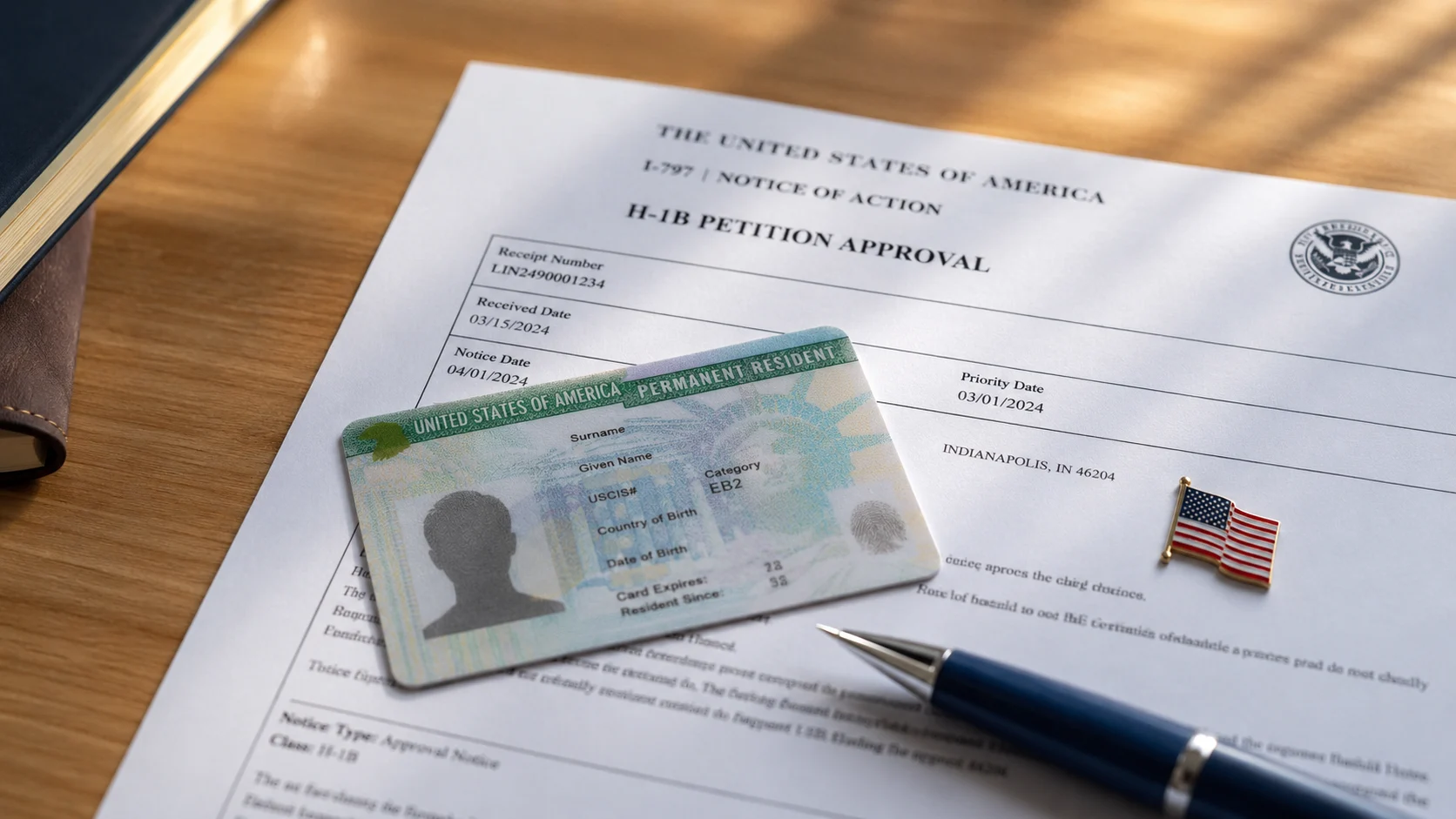
The H-1B to green card pipeline - overview
The standard employment-based pipeline runs in four stages: PERM, I-140, the priority-date wait, and I-485. At each step the employer and the worker have different roles, and at each step the timeline depends heavily on country of birth and on the EB-2 versus EB-3 choice.
| Step | Duration | Who files | Cost |
|---|---|---|---|
| PERM | 501 days (current) | Employer | Employer pays |
| I-140 | 6-12 months (or 45 days premium) | Employer | $715 + $2,965 premium |
| Priority date wait | 0-12+ years (country-dependent) | — | — |
| I-485 | 8-14 months | You (with employer support) | $1,440 |
| Total - non-backlogged | 2-3 years | — | ~$5,000-8,000 |
| Total - India EB-2 | 12-15+ years | — | ~$15,000-25,000 |
The pipeline is designed to take 2 to 3 years. For Indian-born workers it takes 12 to 15+ years because of the 7 percent per-country cap on green cards - the single largest source of inequity in the modern US employment-based system. The full backlog picture is in our green card backlog report.
Step 1 - PERM labor certification (501 days)
PERM is the Department of Labor step that establishes that no minimally qualified US worker is available for the position. The employer runs a recruitment process, requests a prevailing wage determination, and submits the ETA-9089 to DOL. As of mid-2026 the average PERM decision takes approximately 501 days, down from a 512-day peak in February.
PERM is the slowest step and the one you have the least control over. Your employer handles every part of the process. You wait.
The most common reasons PERM applications are denied or delayed:
- Job requirements written too narrowly - appears tailored to a specific candidate.
- Job requirements written too loosely - does not justify foreign-worker need.
- Recruitment process not documented to DOL standards.
- Employer fails to respond to a DOL audit within deadlines.
- Employee changes jobs before PERM is approved, restarting the process.
The three green card categories that skip PERM entirely are EB-1A (extraordinary ability, self-petition), EB-2 NIW (national interest waiver, self-petition), and EB-1C (multinational manager, employer-filed). See our EB-2 NIW guide and our EB-1A extraordinary ability guide for the full picture on self-petition paths.
Step 2 - I-140 immigrant petition
After PERM is approved, the employer files Form I-140 with USCIS. The approved I-140 establishes your priority date - your place in the green card line. The category choice between EB-2 and EB-3 happens at this step.
| Factor | EB-2 | EB-3 |
|---|---|---|
| Required | Master's degree OR Bachelor's + 5 years experience | Bachelor's + 2 years experience |
| Salary | Higher prevailing wage | Lower prevailing wage |
| India backlog | 12+ years | 13+ years |
| Rest of world | Current or 1-2 years | Current or 1-2 years |
| Downgrade option | Not applicable | Can downgrade from EB-2 to EB-3 |
In 2026, EB-3 India has at times moved faster than EB-2 India in priority date advancement. Some attorneys recommend a downgrade from EB-2 to EB-3 for that reason. The current month-by-month status is in our visa bulletin tracker.
Premium Processing is strongly recommended at the I-140 stage. The fee is $2,965 and the response time is 15 business days for EB-1 and 45 business days for EB-2 (including NIW) and EB-3.
The most important rule at this step is I-140 portability. After your I-140 has been approved AND your I-485 has been pending for at least 180 days, you can change employers and keep your priority date. Once that happens, your original employer no longer controls your green card. Many attorneys describe this as the worker's freedom card.
Step 3 - The priority date wait
Your priority date is the date your PERM was filed. You can file the I-485 only when your priority date is current under the State Department's monthly Visa Bulletin. For workers born in countries that exceed the 7 percent per-country cap - currently India and China - this wait is the dominant feature of the entire pipeline.
| Country of birth | EB-2 wait | EB-3 wait |
|---|---|---|
| India | 12+ years | 13+ years |
| China | 4-5 years | 3-4 years |
| Philippines | 2-3 years | 1-2 years |
| Rest of world | Current to 1 year | Current to 1 year |
For an Indian-born worker whose priority date is established in 2026, an EB-2 number is unlikely to be available before 2038. During those years the worker must maintain valid H-1B status (the AC21 extensions beyond the six-year cap exist for this reason), cannot change jobs freely until I-140 portability kicks in, and faces the prospect of US-born children potentially aging out at 21.
- AC21 lets you extend H-1B beyond six years in 1-year or 3-year increments while a green card is pending.
- I-140 portability lets you change employers after I-140 is approved and 180 days have passed on I-485.
- H-4 EAD lets your spouse work if your I-140 is approved. See our EAD work permit delays guide.
- Children risk aging out if they turn 21 before the green card is issued. The CSPA protects some but not all dependents.
Step 4 - I-485 adjustment of status
When your priority date is current, you file Form I-485 to adjust status to lawful permanent resident. Processing typically takes 8 to 14 months for employment-based applicants. There is no Premium Processing for I-485. Concurrent filings of I-765 (EAD) and I-131 (advance parole) are standard - they let you work and travel while the I-485 is pending.
The May 22, 2026 USCIS policy memo treats adjustment of status as 'extraordinary relief,' which is the biggest disruption to this pipeline in decades. Under a partial walk-back issued May 25, 2026, H-1B holders with 'economic benefit' roles may still adjust in country. Other categories may be redirected to consular processing abroad. The detail is in our end of adjustment of status guide and the USCIS H-1B clarification.
After 180 days on I-485, you can change employers under the I-140 portability rule and keep your priority date. After approval, the physical green card is mailed via USPS, typically within two to four weeks.
The $100K H-1B fee and consular processing
For workers redirected to consular processing under the May 2026 memo, three obstacles stack together. First, you must depart the United States and apply at a US embassy in your country of nationality. Second, the September 2025 Presidential Proclamation imposed a $100,000 supplemental fee on new H-1B consular petitions - which the employer pays but which materially changes hiring economics. Third, immigrant visa processing is frozen at 75+ embassies, meaning many applicants have no operational consulate to apply at.
The combination creates a triple trap that the H-1B-to-green-card pipeline was never designed to absorb. The fee detail is in our $100K H-1B fee guide.
Alternatives - skip the pipeline entirely
| Alternative | Skip PERM? | Skip employer? | Timeline |
|---|---|---|---|
| EB-2 NIW | Yes | Yes - self-petition | I-140 12-24 months |
| EB-1A | Yes | Yes - self-petition | I-140 8-16 months |
| EB-1C | Yes | No - employer needed | I-140 6-12 months |
| O-1 then EB-1A | Yes for O-1 | Employer then self | O-1 3-6 months, EB-1A 8-16 months |
| Canada Express Entry | Not applicable | Not applicable | 6 months to PR |
| Germany Blue Card | Not applicable | Not applicable | 21 months to PR |
For Indian-born workers facing a 12+ year wait, parallel-tracking Canada Express Entry or the EU Blue Card is now a default strategy among attorneys. The shortest workable Canadian path through French testing is mapped in our TEF vs TCF French test guide. Germany's eligibility detail is on our Germany country page. For the O-1 entry to EB-1A pathway see our O-1 visa guide.
Complete cost breakdown
| Item | Cost | Who pays |
|---|---|---|
| PERM (attorney + recruitment) | $5,000-10,000 | Employer (by law) |
| I-140 filing fee | $715 | Employer |
| I-140 Premium Processing | $2,965 | Employer or worker |
| I-485 filing fee | $1,440 | Worker |
| I-693 medical exam | $200-500 | Worker |
| I-765 EAD (with I-485) | Included | — |
| I-131 Advance Parole (with I-485) | Included | — |
| Attorney fees (total) | $5,000-15,000 | Split |
| H-1B extensions during the wait | $2,000-4,000 each | Employer |
The total over a 12-year Indian EB-2 wait approaches $25,000 to $40,000 in legal and government fees combined, plus the substantial cost of every H-1B extension along the way. For step-by-step USCIS timing across each form see our USCIS processing times guide.
Frequently asked questions
How long does it take to go from H-1B to green card?
For workers born in countries without a backlog, 2 to 3 years. For workers born in India, 12 to 15+ years currently. The country of birth is the single biggest variable, not the EB-2 vs EB-3 choice.
What is PERM and why does it take 501 days?
PERM is the Department of Labor's labor certification step. The employer must run a recruitment process and prove no qualified US worker is available. It currently takes about 501 days due to DOL backlog. EB-1A, EB-2 NIW, and EB-1C all skip PERM entirely.
Should I choose EB-2 or EB-3?
EB-2 requires a Master's degree or Bachelor's plus 5 years of experience; EB-3 requires a Bachelor's plus 2 years. Indian-born workers should watch the Visa Bulletin closely - in some recent months EB-3 has moved faster than EB-2.
What is I-140 portability?
Once your I-140 is approved and your I-485 has been pending for at least 180 days, you can change employers and keep your original priority date. This rule frees you from dependence on your original sponsoring employer.
How long is the India green card backlog?
EB-2 India and EB-3 India each have priority dates approximately 12 to 13 years behind the current filing date. An Indian-born worker filing in 2026 may not have an immigrant visa available until 2038 or later.
Does the $100K H-1B fee apply to green cards?
It applies to new H-1B consular petitions filed after September 2025. For workers redirected to consular processing under the May 2026 adjustment-of-status policy, the fee can add $100,000+ to the employer's total cost.
Can I change jobs during the green card process?
Before PERM is approved, changing jobs typically restarts the process. After I-140 is approved and 180 days have passed on I-485, you can change to a similar role and keep your priority date under I-140 portability.
What is H-4 EAD and who qualifies?
H-4 EAD is work authorization for the spouse of an H-1B holder whose I-140 has been approved. Approximately 85,000 H-4 EADs were pending in 2026. Processing takes 3-5 months. See our EAD work permit delays guide.
Should I file EB-2 NIW or EB-1A instead?
If you can credibly meet the standards, yes. Both are self-petition categories that skip PERM and employer dependency. EB-1A has higher approval rates (66%) than EB-2 NIW (35-44%) in 2026 but a higher evidence bar.
What happens to my H-1B during the wait?
AC21 lets you extend H-1B beyond the six-year statutory cap in 1-year increments if your PERM has been pending more than 365 days, or in 3-year increments if your I-140 is approved.
Related articles
Use our free tools
Free calculators for Canada CRS, Australia points, UK skilled worker, Germany Opportunity Card, and 34-country salary thresholds.
See all tools