
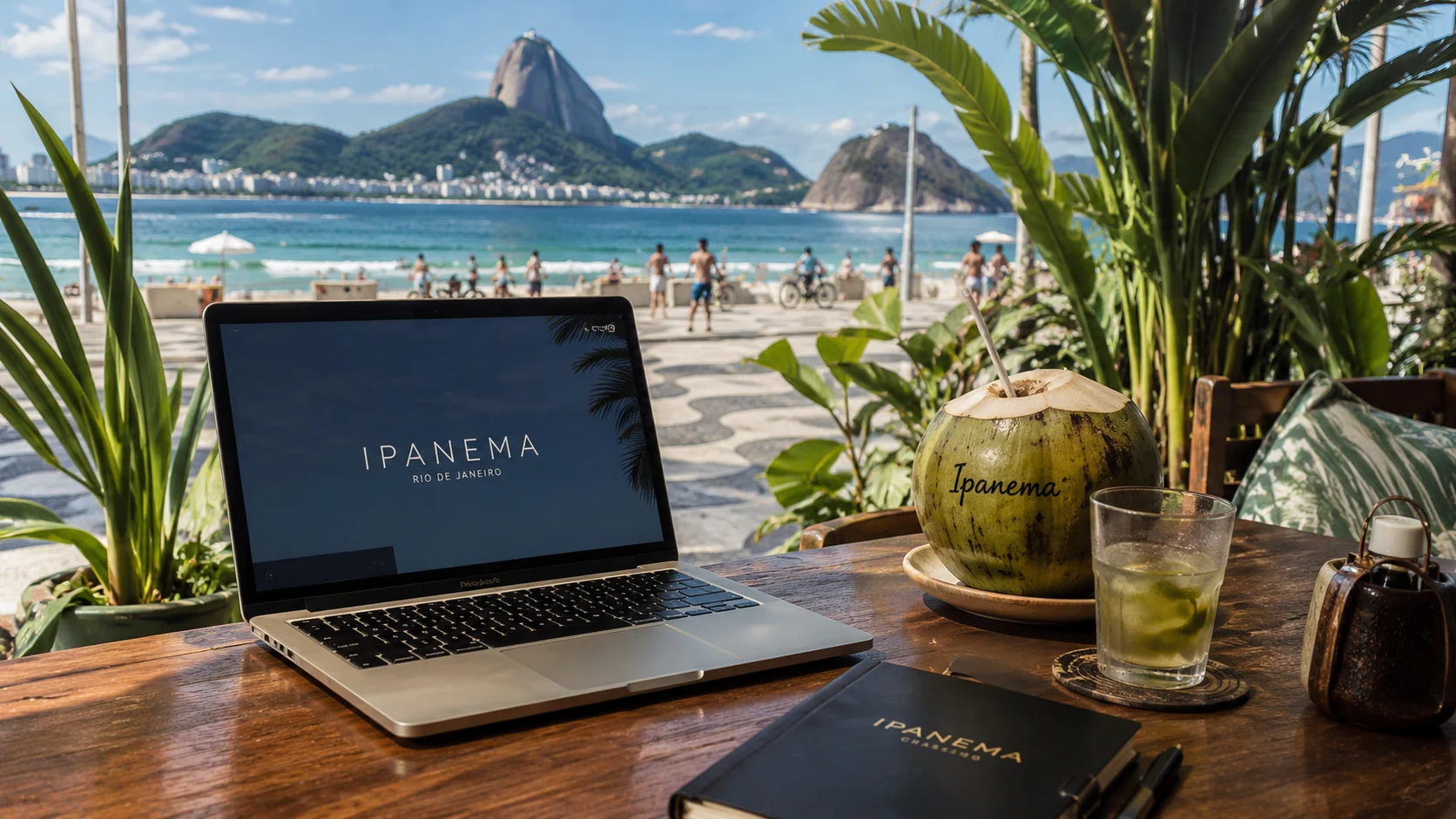
What is the Brazil digital nomad visa?
The Brazil Digital Nomad Visa was created by Resolution 45 of January 9, 2022, issued by the National Immigration Council (Conselho Nacional de Imigracao, CNIg). It is a Temporary Visa under category VITEM XIV in Brazilian immigration law, specifically for remote workers employed by or providing services to a foreign company. The visa is administered by the Ministry of Justice and Public Security via the Federal Police and Brazilian consulates abroad.
The visa is valid for 1 year initially and can be renewed once for an additional year (maximum 2 years total). It grants holders a Cadastro de Pessoas Fisicas (CPF, Brazilian tax ID), the right to open a Brazilian bank account, sign property leases, and access the public healthcare system (SUS). Crucially for nomads, the visa explicitly forbids working for a Brazilian-domiciled employer - your income source must remain abroad throughout the visa period.
Brazil's USD 1,500 per month threshold is intentionally low. The country is the largest economy in Latin America by far, but in dollar terms it remains affordable for most Western remote workers. Brazil's nomad ecosystem is concentrated in Rio de Janeiro (Ipanema, Leblon, Botafogo), Florianopolis (the rising nomad capital of southern Brazil), and Sao Paulo (Vila Madalena, Pinheiros). See the global digital nomad visa hub for how Brazil compares globally.
Requirements and income threshold
Brazil's requirements are short and straightforward. The most common rejection cause is documents not properly apostilled or translated by a Brazilian sworn translator (Tradutor Publico Juramentado).
| Requirement | Detail |
|---|---|
| Minimum income | USD 1,500 per month (gross) |
| Savings alternative | USD 18,000 in bank balance (12 months of minimum income) |
| Health insurance | Valid private health insurance for the full visa period in Brazil |
| Criminal background | Apostilled background check from country of residence (last 6 months) |
| Proof of remote work | Employment contract OR statement of services rendered to a foreign company |
| Other | Valid passport (6+ months), birth certificate, declaration that work will be remote-only |
Income proof comes via the last 3 months of bank statements showing salary or business income deposits averaging USD 1,500 or more per month. The savings alternative accepts any combination of bank deposits, investment accounts, or cash equivalents totaling USD 18,000 or more, held for at least the last 12 months in a single account or jointly. All foreign documents need apostille in the country of origin and translation by a Brazilian sworn translator (juramentado) into Portuguese.
Tax treatment
Brazil taxes worldwide income on residents, which is less favorable than the territorial or zero-tax systems used by Costa Rica, the UAE, or Colombia in year one. You become a Brazilian tax resident if you spend more than 183 days in Brazil within any 12-month period, or if you obtain a permanent or work-purpose visa (including the DN visa). The DN visa specifically triggers tax residency from the start, even before the 183-day threshold.
Brazilian income tax (Imposto de Renda) is progressive: 0 percent on annual income up to roughly BRL 28,560, 7.5 percent up to BRL 33,920, 15 percent up to BRL 45,012, 22.5 percent up to BRL 55,976, and 27.5 percent above that. Most digital nomads earning USD 30,000 to 80,000 per year fall in the 22.5 to 27.5 percent brackets. There are also state and municipal service taxes (ISS) of 2 to 5 percent on self-employed services rendered. Brazil has double-tax treaties with most major economies including the UK, Germany, France, Spain, Japan, China, India, and Canada - but notably NOT with the US.
How to apply - step by step
You can apply for the Brazil DN visa at a Brazilian consulate abroad OR file for an in-country residency permit at the Federal Police if you are already in Brazil on a tourist visa. The consulate route gives you a single-entry visa to enter Brazil; the in-country route converts your tourist permit into a residency permit.
- Gather documents: passport (6+ months), apostilled birth certificate, apostilled criminal background check (last 6 months), 3 months of bank statements showing USD 1,500/month income OR balance proof of USD 18,000, health insurance certificate valid in Brazil, employer letter or service contract.
- Hire a Brazilian sworn translator (Tradutor Publico Juramentado) to translate all foreign documents into Portuguese. List of certified translators available on each state's Junta Comercial website.
- Decide route: file at a Brazilian consulate abroad (consulate selection by your country of residence) OR enter Brazil on a tourist visa (visa-free for most Western nationals, 90 days) and apply at the Federal Police.
- For the consulate route: complete the online VITEM XIV application via the e-Consular system (e-consular.serpro.gov.br), book an appointment, attend the in-person submission. Consular fee approximately USD 100.
- For the in-country route: enter Brazil, complete the online application via the Federal Police portal (servicos.pf.gov.br), book a biometrics appointment at the nearest Federal Police office.
- Submit all original documents at the appointment. Pay the in-country fee of BRL 168 (USD 30) for the migratory registry and BRL 204 (USD 37) for the residency card.
- Wait 30 to 90 days for the decision. Most decisions arrive within 60 days.
- If approved, collect your CRNM (Carteira de Registro Nacional Migratorio, foreign resident ID card) at the Federal Police office. Use it to obtain a CPF (tax ID) at the Receita Federal, open a Brazilian bank account, and access health and lease services.
Cost breakdown
Brazil's visa is one of the cheapest in the world by official fees, but translation costs and (optionally) a despachante (immigration paperwork agent) push the total up. Budget USD 800 to 2,000 total for a single applicant.
| Item | Cost |
|---|---|
| Consular visa fee (if applying abroad) | USD 100 |
| Federal Police migratory registration fee | BRL 168 (~USD 30) |
| CRNM residency card fee | BRL 204 (~USD 37) |
| Sworn Portuguese translation (per doc) | BRL 50 to 150 (~USD 9-27) |
| Document apostille (per doc, home country) | USD 20 to 100 |
| Health insurance (annual, mandatory) | USD 500 to 1,500 |
| Despachante (optional immigration agent) | USD 200 to 800 |
| Total realistic budget (single, year 1) | USD 800 to 2,000 |
Cost of living
Brazil is exceptionally cheap in dollar terms because the Brazilian real has been weak against the dollar for most of the last decade. Rio de Janeiro is the most expensive major nomad city; Florianopolis and the smaller cities of Pernambuco and Bahia are much cheaper. Compare to Colombia and Mexico for the other budget LATAM options.
| Item | Rio de Janeiro (Ipanema) | Florianopolis |
|---|---|---|
| 1 BR apartment (central, furnished) | USD 800 to 1,800/mo | USD 500 to 1,100/mo |
| 1 BR apartment (suburb) | USD 400 to 800/mo | USD 300 to 600/mo |
| Coworking hot desk | USD 120 to 280/mo | USD 90 to 200/mo |
| Meal at mid-range restaurant | USD 10 to 22 | USD 8 to 18 |
| Monthly transport pass | USD 25 (Metro + bus) | USD 30 (bus only) |
| Utilities (1 BR with AC) | USD 80 to 150/mo | USD 60 to 120/mo |
| Gym membership | USD 25 to 80/mo | USD 20 to 60/mo |
| Total realistic monthly budget | USD 1,400 to 2,800 | USD 1,000 to 2,000 |
Family and dependents
The Brazil DN visa allows the primary holder to bring a spouse (married or stable partner with cohabitation evidence) and dependent children under 18 (or under 24 if in full-time education). Dependents apply as family reunification cases under Resolution 36 of 2018. The income threshold does not formally rise for dependents, but consulates and the Federal Police may request demonstration of additional income to support them.
Each dependent files a separate application with their own apostilled birth certificate, marriage certificate (for spouse), and translated documents. Children can attend public schools (Portuguese-language, free) or private/international schools (USD 4,000 to 18,000 per year in Rio or Sao Paulo; cheaper in Florianopolis). Spouses on the family reunification visa have full work rights in Brazil - they can take local jobs without restriction, which is more generous than most other Latin American DN visas.
Path to residency
The Brazil DN visa is valid for 1 year and renewable once (2 years total). It does not have a direct conversion path to permanent residency. After the 2-year maximum, you either leave Brazil, switch to a different visa category (investor, family reunification, work visa, study visa), or return on a tourist visa.
Permanent residency in Brazil is typically obtained via the Investor Visa (BRL 500,000 minimum investment in a Brazilian company, or BRL 700,000 in real estate in priority areas), the Retiree Visa (BRL 6,000+ per month of guaranteed retirement income), family reunification with a Brazilian citizen, or by having a Brazilian child. After 4 years of permanent residency, you can apply for Brazilian citizenship (or 1 year if you have a Brazilian child or spouse). Brazil permits dual citizenship, and the Brazilian passport gives visa-free access to most of Latin America, the EU Schengen Area, the UK, and Russia.
Best cities for digital nomads
Brazil's continental scale means nomad scenes are very localized. Rio is the iconic beach city, Florianopolis is the rising nomad capital of the south, and Sao Paulo is the largest city in the southern hemisphere with the deepest professional and cultural infrastructure.
- Rio de Janeiro (Ipanema, Leblon, Botafogo, Copacabana): the most internationally known Brazilian nomad city. Ipanema and Leblon are the upscale beach neighborhoods (USD 1,200 to 2,500 for a 1BR), Botafogo is the cooler mid-range option with the highest density of nomad-friendly cafes and coworking (WeWork, Templo Coworking, Selina), and Copacabana is the budget beach option. Year-round 22-32°C beach weather, world-class culture, but petty crime requires vigilance.
- Florianopolis (Centro, Lagoa da Conceicao, Jurere): southern Brazil's island capital and the fastest-rising nomad city in Brazil. Lagoa is the central lagoon district with the densest nomad scene, Jurere has the upscale north-shore beach communities, and Centro is the historic downtown. Cooler subtropical climate (15-30°C), surf culture, lower cost than Rio, and a growing tech scene. Selina, Hotelinho, and multiple new coworking spaces opened 2023-25.
- Sao Paulo (Vila Madalena, Pinheiros, Itaim Bibi): South America's largest city and financial capital. Vila Madalena is the bohemian art and bar district, Pinheiros is the foodie hipster zone, and Itaim Bibi is the business district. Better professional networking and corporate opportunities than Rio, but no beach and worse traffic. Best for nomads who need depth of culture, professional networks, or are working in Latin American B2B markets.
Pros and cons
- Pro: Second-lowest income threshold of any DN visa globally at USD 1,500/mo, after only Colombia.
- Pro: Very low cost of living (USD 1,000 to 2,800/mo for comfortable lifestyle in major cities).
- Pro: Rio de Janeiro, Florianopolis, and Sao Paulo offer three completely distinct nomad lifestyles.
- Pro: Spouses on family reunification visa have full Brazilian work rights, unusual generosity for a DN visa.
- Pro: Brazilian Portuguese is one of the most accessible major languages for English speakers, opening LatAm professional opportunities.
- Con: Brazil taxes worldwide income for residents and DN visa explicitly triggers tax residency from day one.
- Con: No US-Brazil double-tax treaty creates complicated tax situation for US citizens.
- Con: Maximum 2 years (1 + 1 renewal); no direct path to permanent residency from the DN visa.
- Con: Crime rates in Rio and Sao Paulo require constant vigilance; safer in Florianopolis and the south.
- Con: Bureaucracy (Federal Police, Receita Federal) is notoriously slow and Portuguese-only outside specific consular services.
Questions fréquemment posées
What is the income threshold for the Brazil digital nomad visa?
USD 1,500 per month, the second-lowest of any digital nomad visa in the world (after Colombia at ~USD 1,000/month). Alternatively, you can show USD 18,000 in savings (equivalent to 12 months of minimum income) held for at least the last 12 months.
How long is the Brazil digital nomad visa valid?
Initially 1 year, renewable once for an additional 1 year (2 years total maximum). After 2 years, you must either leave Brazil or switch to a different visa category (investor, work, family reunification).
Do I pay Brazilian tax on my foreign income as a digital nomad?
Yes. The Brazil DN visa triggers Brazilian tax residency from day one, and Brazil taxes worldwide income at progressive rates of 0 to 27.5 percent. Brazil has double-tax treaties with most major countries, but NOT with the US, which creates complications for US citizen nomads.
Can the Brazil DN visa lead to permanent residency?
No. The DN visa is capped at 2 years total and does not convert directly to PR. To stay long-term, you would need to switch to a different visa category such as Investor (BRL 500,000+ investment), Retiree, or family reunification. After 4 years of PR you can apply for Brazilian citizenship.
Can I work for a Brazilian company on this visa?
No. The Brazil DN visa explicitly forbids working for a Brazilian-domiciled employer. Your income source must remain abroad (foreign employer or foreign-billed self-employment) throughout the visa period. To work for a Brazilian employer, you need a standard work visa sponsored by them.
Can I bring my family on the Brazil DN visa?
Yes. Spouses (including unmarried stable partners with cohabitation evidence) and dependent children under 18 (or 24 if studying) can apply for family reunification visas. Notably, spouses on the family reunification visa have full Brazilian work rights, which is more generous than most other LATAM DN visas.
How long does the Brazil DN visa application take?
Typically 30 to 90 days from full submission to approval, with most decisions arriving within 60 days. You can apply either at a Brazilian consulate abroad or at the Federal Police inside Brazil if you arrived on a tourist visa. The in-country route is often faster for nomads already in Brazil.
Which Brazilian city is best for digital nomads?
Rio de Janeiro (Ipanema, Leblon, Botafogo) for beach culture and international profile; Florianopolis for the fastest-growing nomad scene and southern Brazilian quality of life; Sao Paulo for professional networks and the depth of Latin America's largest city. Most nomads choose Florianopolis for value and Rio for lifestyle. See our digital nomad visa guide for cross-country comparisons.
Articles connexes
Utilisez nos outils gratuits
Calculateurs gratuits pour CRS Canada, points Australie, Skilled Worker UK, Carte Opportunité Allemagne et seuils salariaux de 34 pays.
Voir tous les outils