
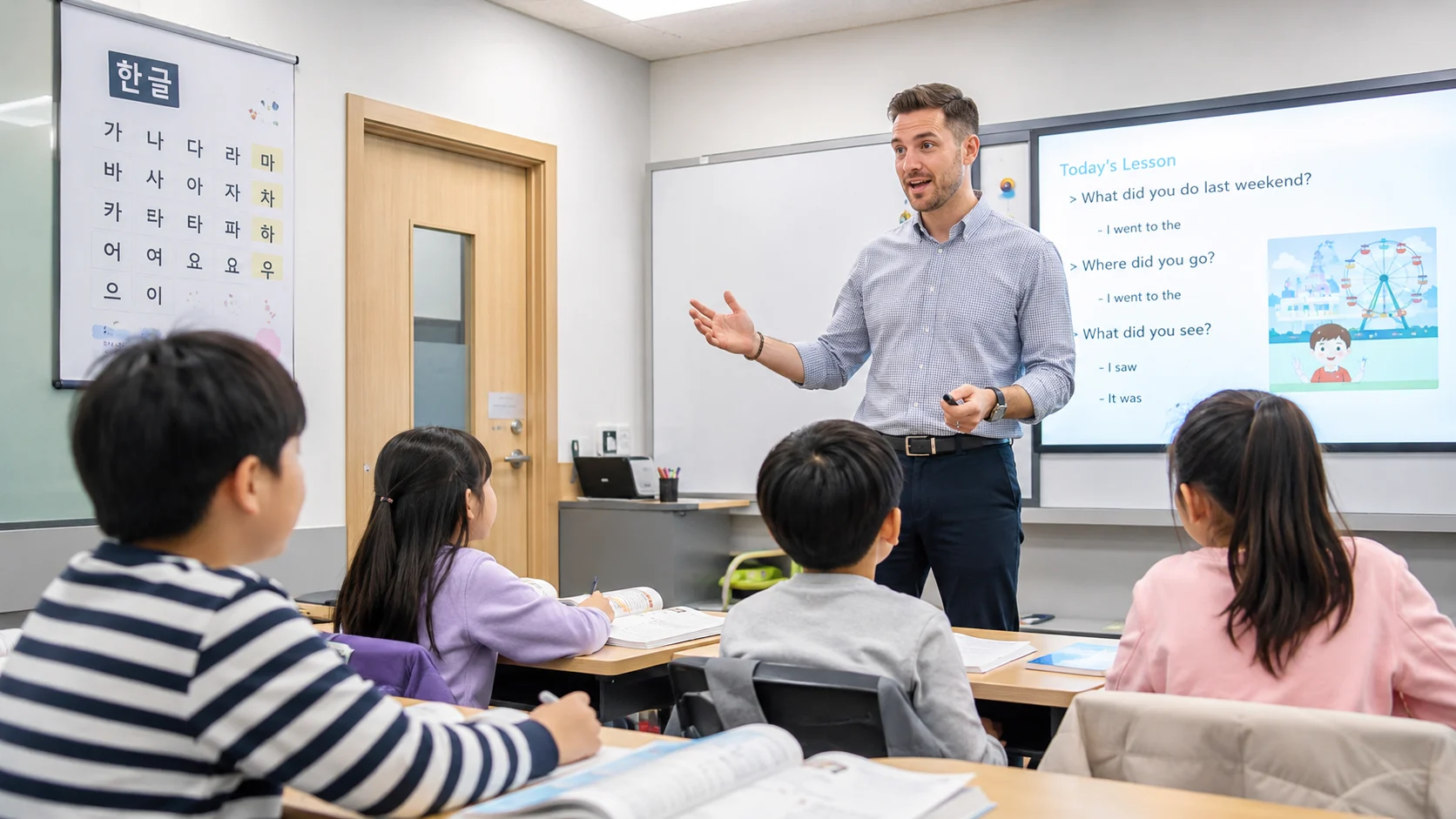
The E-2 Teaching Visa explained
South Korea's E-2 visa is the only visa under which a foreigner may teach a foreign language for pay. It is restricted, by long-standing immigration policy, to citizens of seven countries: the United States, United Kingdom, Canada, Australia, New Zealand, Ireland, and South Africa. These are the countries Korea considers native English speakers. If you hold any other passport, regardless of how perfectly you speak English, you cannot get an E-2.
The visa is initially 13 months (one year contract plus a one-month grace period), renewable annually as long as your employer renews. You must have a Bachelor's degree in any subject from a four-year accredited university. You must have a clean criminal background check, apostilled by your country's apostille authority. You must have at least a 100-hour TEFL or CELTA certificate (Korea formally accepts 100 hours though 120 is more common). You must pass a medical exam in Korea within 90 days of arrival, including a drug screen and HIV test. Failing either means your visa is cancelled and you fly home.
Compared with Japan's two-tier Instructor/Humanities setup, Korea's E-2 is simpler in structure but stricter in eligibility. There is no exception for fluent non-native speakers, no equivalent of Japan's Working Holiday teaching, and no path for those without a four-year degree.
EPIK vs Hagwon
The two big channels are EPIK (English Program In Korea), run by Korea's Ministry of Education to place teachers in public elementary, middle, and high schools, and the hagwon (private after-school academy) market, run by thousands of independent businesses. Each has trade-offs.
| Factor | EPIK (public schools) | Hagwon (private academies) |
|---|---|---|
| Salary | ₩2,000,000-2,700,000/mo (USD 1,500-2,000) | ₩2,100,000-3,000,000/mo (USD 1,580-2,250) |
| Housing | Free, single furnished apartment | Free, often furnished, varies by school |
| Location control | Random allocation by province, limited preferences | You choose the city when you accept the offer |
| Support and HR | Strong: orientation, Korean co-teachers, gov support | Highly variable: some excellent, some abusive |
| Teaching hours | 22 instructional hours/week, deskwarming the rest | 30 teaching hours/week, less deskwarming |
| Vacation | 18-21 days plus all national holidays | 10 days plus national holidays |
| Contract risk | Low: government employer | Medium: research the school carefully |
EPIK has fixed twice-yearly intakes (February and August arrivals) and you apply through gepik.go.kr or via recruiters. Hagwons hire year-round, faster, with offers sometimes in 2-3 weeks. The right choice depends on what you want: EPIK for stability and predictable working conditions, hagwon for higher take-home and city choice. The hagwon market also has the dangerous tail of bad employers, so vet your school through ESL Cafe blacklists, Reddit r/korea threads, and ideally Korean teacher contacts before signing.
Step-by-step E-2 visa process
- Get your apostilled documents ready BEFORE you start applying. This is the single most common reason teachers miss their start date. You need an apostilled degree, apostilled criminal background check, and sealed transcripts. Apostille turnaround is 2-6 weeks depending on country.
- Apply directly to EPIK (deadlines: September for February start, March for August start) or apply through hagwon recruiters such as Korvia, Adventure Teaching, or Teach ESL Korea.
- Interview by Skype or Zoom. EPIK has a structured panel interview; hagwons have a manager phone call. Demonstration lesson is common for hagwons.
- Receive contract and signed offer. Read it three times. Salary, housing, return airfare, severance, and number of teaching hours must all be explicit.
- Send your apostilled documents to your employer in Korea. They submit them to Korean Immigration for the visa issuance number.
- Visa issuance number arrives in 2-4 weeks. Take it plus your passport, application form, and Korean specification photos to the Korean consulate in your country.
- Visa stamped in 3-7 working days. You fly to Korea on a single-entry E-2.
- Within 90 days of arrival, complete your medical exam at an approved hospital and apply for your Alien Registration Card (ARC) at the local immigration office. The ARC converts your single-entry E-2 into multi-entry status valid for the full contract.
Salary and savings breakdown
Korea pays middle-of-the-pack salaries in Asia but the structural benefits boost net savings substantially. Free housing is the single biggest contributor: in Seoul, that benefit alone is worth ₩800,000-1,500,000 monthly. Return airfare is paid at start and end of contract. Severance equal to one month's salary is mandatory after one full year completed, paid as a lump sum.
| Item | Monthly KRW | Monthly USD |
|---|---|---|
| Gross salary (typical EPIK or hagwon) | ₩2,400,000 | ~USD 1,800 |
| Income tax + pension + health insurance | -₩280,000 | -USD 210 |
| Net to bank account | ₩2,120,000 | ~USD 1,590 |
| Rent (free, employer-paid) | ₩0 | 0 |
| Utilities (you pay) | -₩120,000 | -USD 90 |
| Food and groceries | -₩400,000 | -USD 300 |
| Transport | -₩80,000 | -USD 60 |
| Phone + internet | -₩70,000 | -USD 52 |
| Entertainment + extras | -₩300,000 | -USD 225 |
| Realistic monthly savings | ₩1,150,000 | ~USD 860 |
Teachers who live frugally and skip the after-work soju routine can save closer to ₩1,500,000 monthly (~USD 1,125). Combined with the severance lump sum and pension refund (about ₩2,500,000-3,500,000 in your second-to-last paycheck for US, Canadian, and Australian citizens), a one-year contract can produce USD 13,000-16,000 in savings.
Documents - the apostille requirement
Korea requires apostilled documents for the E-2 visa. This is non-negotiable and surprises many first-time applicants. An apostille is a specific form of international document authentication under the 1961 Hague Convention. Korea accepts apostilles only from Hague signatory countries (which conveniently includes all seven E-2-eligible nationalities).
- United States: Apostille issued by your state's Secretary of State office for state documents (like state-issued criminal background checks); for FBI background checks, the apostille comes from the US Department of State in Washington DC.
- United Kingdom: FCDO Legalisation Office (Foreign, Commonwealth and Development Office).
- Canada: Since January 2024, Global Affairs Canada now issues apostilles directly (previously you needed notarisation plus consular authentication, an older path).
- Australia: Department of Foreign Affairs and Trade (DFAT).
- New Zealand: Department of Internal Affairs apostille service.
- Ireland: Department of Foreign Affairs apostille section.
- South Africa: DIRCO (Department of International Relations and Cooperation), Pretoria.
South Africa is on the list - what makes that unusual
South Africa is the only African country on the E-2 eligibility list, and that surprises many applicants and observers. Korea's reasoning: English is one of South Africa's eleven official languages, the South African school system uses English as the primary medium of instruction at most institutions, and the country produces a large pool of fluent English speakers.
South African applicants do face a more sceptical paperwork review. Korean immigration occasionally requests proof that your education was conducted in English: a university transcript clearly marked English-medium, or a letter from your high school or university confirming language of instruction. This is unique to South African applicants and is not asked of US, UK, Canadian, Australian, NZ, or Irish candidates. Pre-empt it by getting that letter at the apostille stage. For broader work-visa context if you are South African and considering other destinations, see the South African work visa guide.
South African teachers are well-represented in Korean public schools and hagwons, particularly in Gyeonggi province (the area around Seoul) and Busan. The pay parity is identical to other nationalities at the contract level: ₩2.2-3.0 million is standard regardless of passport.
Renewal and switching employers
The E-2 visa is tied to your specific employer. You cannot freelance, teach private lessons (illegal under E-2), or take a second job. If you want to switch schools mid-contract, your current employer must issue a release letter (letter of release, LOR) confirming they consent to your departure. Without this letter, immigration will not transfer your sponsorship to a new school. Some hagwons withhold the release letter as leverage, which is a form of unofficial control.
At the end of a one-year contract, renewal is straightforward: same employer, paperwork submitted to immigration, sometimes a one-day re-entry trip to the consulate in Fukuoka (Japan) for stamping. Switching at end of contract is also clean: your old employer's contract ends, the new employer applies for your sponsorship transfer, you complete a fresh medical exam and submit the new contract. No need to leave the country in most cases.
After 5 consecutive years on E-2 with no gaps, some teachers transition to the F-2 long-term residence visa, which removes the employer tie and allows freelancing and self-sponsored business. F-2 points include Korean language proficiency (TOPIK), salary level, age, education, and Korea-tied factors. It is the long game for teachers who plan to stay.
Pension refund, severance, and the year-end windfall
Korea's National Pension Service (NPS) deducts 4.5 percent of your salary each month, and your employer matches that with another 4.5 percent. Total: 9 percent of gross going into a pension fund in your name. The headline benefit: teachers from countries with a totalisation agreement with Korea (US, Canada, Australia, plus a few others) can claim a lump-sum withdrawal when they leave Korea permanently. UK and Irish citizens cannot claim the refund under current agreements because their home pension systems are integrated differently.
On a typical ¥2.4 million monthly salary over a 12-month contract, the pension refund is approximately ¥2.5-3.5 million (USD 1,900-2,650). Add the mandatory severance (toejik geum), which is one full month's salary paid at end of contract, and a contract-completion teacher receives a year-end windfall of approximately USD 3,500-4,500 in their last 6 weeks in Korea. This is on top of normal monthly savings. Plan your departure carefully because cancelling your pension and severance flight booking are both bureaucratic and require the school to file paperwork on time.
Tax brackets in Korea are progressive but generous to teachers: typical net rate is 7-10 percent of gross including health insurance and pension. Many teachers also qualify for the 2-year tax exemption under the US-Korea tax treaty (US citizens specifically), which can reduce taxable income further. File a Korean tax return each May via Hometax or with help from your school's accountant.
Where to live: Seoul vs Busan vs second-tier cities
Seoul has the most jobs, the highest density of foreign teachers, the best entertainment scene, and the highest cost of living. EPIK rarely places in Seoul proper (most Seoul-area placements are in Gyeonggi-do, the surrounding province). For Seoul specifically, hagwons are the realistic route. Districts like Gangnam, Jongno, and Hongdae have hundreds of hagwons. Apartment quality in Seoul (when employer-provided) tends to be small studios called officetels.
Busan is the second city: warmer climate, beaches, slower pace, similar pay to Seoul but cheaper living. Daegu, Gwangju, Daejeon, Incheon, and Ulsan round out the major metropolitan areas. Each has solid hagwon and EPIK presence. Second-tier cities pay 5-10 percent less than Seoul but stretch much further. Jeju Island (the southern volcanic resort island) has a niche international school market with English-only curriculum and strong pay.
For first-time teachers: do not chase Seoul. The cost premium eats your savings and the noise can be exhausting. A typical second-tier city placement (Daegu or Cheongju, for example) lets you save USD 1,200-1,500 monthly, travel back to Seoul on weekends via KTX high-speed rail (2-3 hours), and still enjoy the convenience of Korean infrastructure.
School culture and what your week actually looks like
Korean school culture leans formal and hierarchical, with strong expectations around teacher dress (slacks and a button-down for men, modest professional wear for women), punctuality (arrive 10 minutes early, never late), and respect for senior staff. At EPIK schools you will work alongside a Korean co-teacher who is the main instructor for English classes; your role is the native-speaker co-instructor, focused on pronunciation, conversation, and culture. The co-teacher handles discipline, grading, and Korean-language explanations.
Hagwons run differently. You are typically the sole teacher in your classroom and responsible for lesson planning, grading, parent calls, and student management. Class sizes are 6-15 students, the curriculum is often a fixed textbook provided by the chain, and parents are demanding consumers who expect measurable progress. The pace is faster than EPIK and burnout is a real risk if you do not protect your weekends.
Public holidays in Korea include New Year, Lunar New Year (Seollal, 3 days in late January or February), Independence Movement Day (March 1), Children's Day (May 5), Buddha's Birthday (April or May), Memorial Day (June 6), Liberation Day (August 15), Chuseok (Korean Thanksgiving, 3 days in September or October), National Foundation Day (October 3), Hangul Day (October 9), and Christmas. EPIK teachers get all of these; hagwon teachers get most but not always Chuseok depending on the chain's policy.
ARC, banking, and the first 30 days after arrival
Your first 30 days in Korea are a paperwork marathon. The medical exam must be completed within 90 days of arrival but most teachers do it in the first 2 weeks (the school usually arranges it). Results take 5-7 days. With the medical certificate, the Alien Registration Card (ARC) application is filed at your local immigration office, where you submit passport, lease or housing contract, contract, medical results, and a small fee (KRW 30,000). ARC issuance takes 2-3 weeks. Until your ARC is in hand you cannot open a Korean bank account, get a Korean phone plan, or sign up for many services.
Banking is the next priority. KEB Hana Bank, Woori Bank, and Shinhan Bank have foreigner-friendly branches with English-speaking staff in major cities. You need your ARC, passport, employment contract, and a Korean phone number. The account opens same day. Pair the bank account with KakaoBank for digital payments, KakaoPay or Naver Pay for everyday spending, and the Toss app for transfers and budgeting. Most teachers send money home through Wise (formerly TransferWise) or WireBarley, which charge a fraction of bank wire fees.
Korean phone plans require an ARC; until then, your school may provide a temporary SIM or you can buy a prepaid SIM at the airport (Olleh, SK Telecom, LG U+). Once your ARC arrives, the cheapest postpaid plans run KRW 30,000-50,000 monthly for unlimited LTE. Internet at home is typically KRW 25,000-35,000 monthly via KT, SK Broadband, or LG U+. Subway and bus use a T-money card which you top up at convenience stores. Almost everything works.
Questions fréquemment posées
How much can I realistically save in a year teaching in Korea?
USD 12,000-16,000 is realistic for a frugal teacher on a typical ₩2.3-2.5 million salary, including the pension refund (US, Canada, Australia citizens) and severance. Big-city spenders save closer to USD 8,000-10,000. Rural placements with low spending opportunities can push above USD 18,000.
Do I need to speak Korean?
No, not at all to get hired or for daily teaching duties. EPIK pairs you with a Korean co-teacher, hagwons typically have bilingual staff for parent communications. Conversational Korean (basic TOPIK 1-2 level) makes life dramatically easier for housing, banking, and groceries, but is not a hiring criterion.
Can I teach in Korea without a degree?
No, not on an E-2. The four-year Bachelor's is non-negotiable. Two-year associate degrees do not qualify. Online or remote-only degrees from accredited four-year universities are accepted as long as the diploma is identical to in-person and is apostilled.
What if I am not from one of the 7 countries?
You cannot get an E-2 in Korea. Some non-native English speakers from EU countries or India teach via F-series family visas (married to a Korean national), or work at international schools on E-7 (specialty professional) visas if they have specialised credentials and the international school sponsors. There is no normal teaching path otherwise.
Is TEFL required for Korea?
Yes, in practice. Korean immigration requires 100+ hours of TEFL or CELTA for the E-2 unless you have an education degree. Most recruiters now insist on 120-hour minimum. An online TEFL from a recognised provider (i-to-i, ITTT, The TEFL Academy) is accepted. Cost: USD 200-500.
What scams should I avoid?
Hagwons that demand you pay your own flight upfront (it should be reimbursed or pre-paid). Hagwons that refuse to put housing details in the contract. Recruiters who charge teachers a fee (legit recruiters are paid by schools, not applicants). Schools without a registered business number (sajaeoja deungrok beonho). Cross-check schools on ESL Cafe Korea forum blacklists.
Can my partner or spouse join me?
Yes, on an F-3 dependent visa if you are married. F-3 holders cannot work without separately securing employment that sponsors them onto a work visa. Unmarried partners cannot join you on a dependent status; they would need their own E-2 or another visa category.
What is deskwarming and why do EPIK teachers hate it?
Deskwarming is sitting at your school desk during long vacation periods (especially winter break in January-February) when there are no classes but your contract requires you to be present. It can be 4-6 weeks of nothing to do, with leave only allowed for your 18-21 contractual vacation days. Hagwons do not have deskwarming because they have classes year-round.
Articles connexes
Utilisez nos outils gratuits
Calculateurs gratuits pour CRS Canada, points Australie, Skilled Worker UK, Carte Opportunité Allemagne et seuils salariaux de 34 pays.
Voir tous les outils