
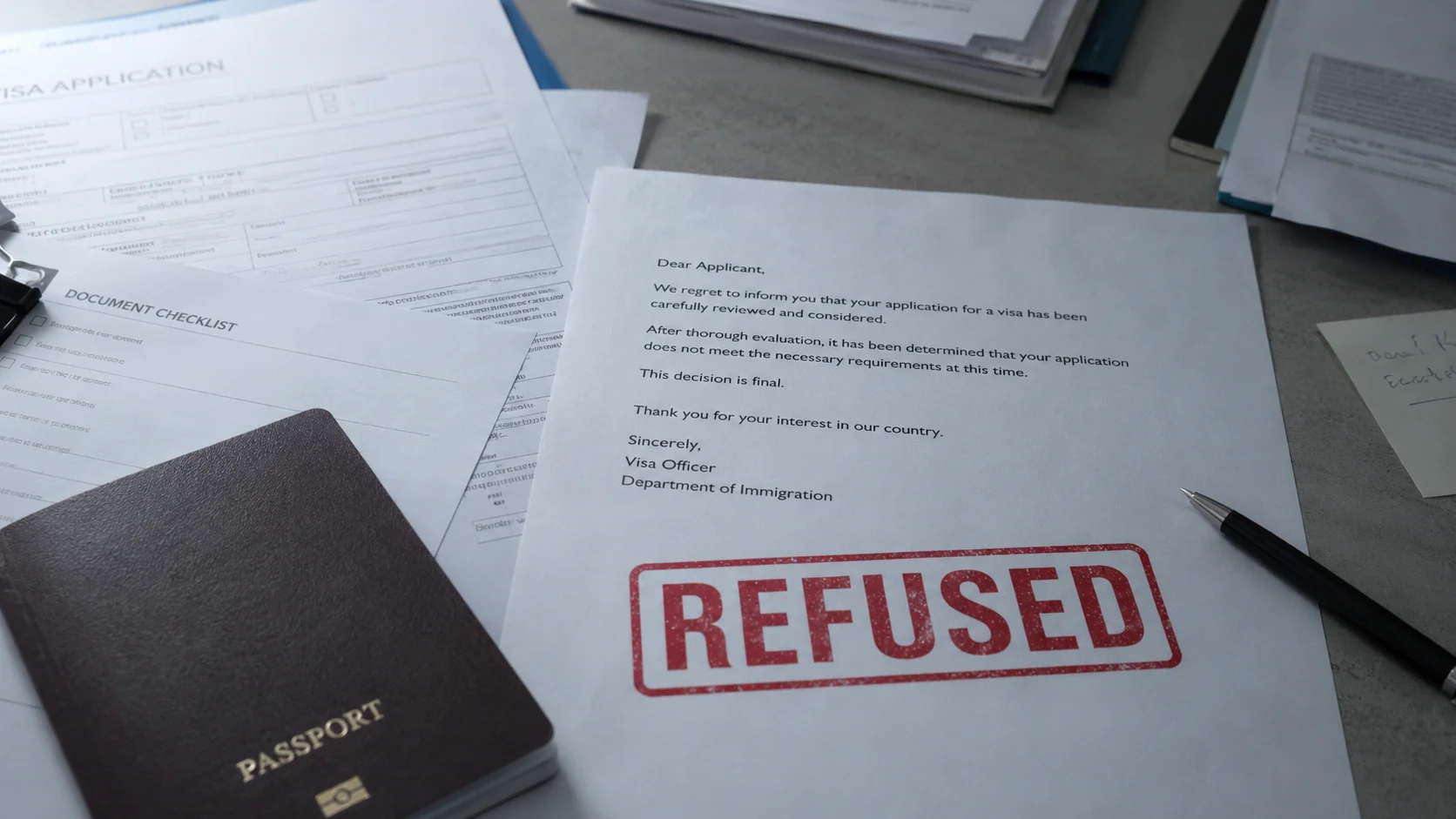
The 74% Indian study permit rejection crisis
Indian applicants represent the single largest national group seeking Canadian study permits. The collapse in approval rates over the last two years is the most consequential change in the Canadian visa system in a decade. In 2023, roughly 68% of Indian study permit applications were approved. By the second half of 2025, that figure had fallen to around 26%. The change is not random; it is the result of three deliberate policy shifts plus a fourth structural factor that compounded all three.
First, IRCC ended the Student Direct Stream (SDS) on 8 November 2024. SDS was a fast-track route for applicants from 14 countries (including India, China, the Philippines, and Pakistan) that offered guaranteed processing in around 20 days if you met specific upfront documentation requirements including a Guaranteed Investment Certificate (GIC), proof of tuition payment, and language test scores. Without SDS, all applicants now go through the standard study permit stream, which is slower, more discretionary, and demonstrably more likely to refuse.
Second, IRCC introduced annual caps on study permit issuance, reducing total approvals by roughly 35% in 2025 compared to 2023. The cap is administered through Provincial Attestation Letters (PALs) and Territorial Attestation Letters (TALs), which the province must issue before IRCC will even consider the file. Caps are allocated by province, so applicants to Ontario and British Columbia face the tightest competition.
Third, the cost-of-living financial threshold doubled. As of January 2024, a single applicant must show C$20,635 in available funds (plus first-year tuition) instead of the previous C$10,000 figure that had stood since the early 2000s. Many applicants who would have qualified in 2023 fall short of the new threshold, and IRCC officers refuse them on financial grounds.
Fourth, the structural factor: Designated Learning Institution (DLI) credibility. IRCC has flagged a number of private career colleges and small institutions as 'low credibility' DLIs whose acceptance letters carry less weight. Applicants to flagged institutions face significantly higher refusal rates regardless of personal profile. The most-cited refusal reasons in current GCMS notes are weak purpose of study, weak ties to home country, and financial questions, in roughly that order. For background on India-specific immigration pathways and the policy context, see our Indian work visa guide.
Top IRCC refusal reasons (2026)
Canadian visa refusal letters follow a templated format. The officer ticks one or more boxes on a standard refusal sheet and adds free-text notes in GCMS. The free-text notes are where the real reasoning lives, but the box ticks tell you which broad category the officer used. The list below covers the six most common refusal categories in 2026, ordered by frequency in our reader data.
Purpose of visit not justified. This is the dominant refusal reason for both visitor visas (TRVs) and study permits. The officer is saying that they could not establish a credible reason for the trip given the documents and explanation provided. For visitor visas, this typically means a thin itinerary, vague reason for travel, and no specific dates. For study permits, it means the chosen program does not align with the applicant's academic background or career plans, the choice of Canada over alternatives was not explained, or the applicant's post-study plan was missing or inconsistent.
Financial insufficiency. Officers check proof of funds against the threshold for the visa category, source of funds (where did the money come from and is it consistent with declared income), and sponsor credibility (if a parent or sibling is funding the trip, does their income and asset profile support it). Sudden deposits, third-party transfers from unrelated individuals, and balance fluctuations during the six months before application all trigger refusal.
Ties to home country weak. Officers want a concrete reason you will return to your home country after your authorised stay. For temporary visa applicants, that means employment, property, family obligations, ongoing business, or other anchoring commitments. Young single applicants without property or dependants face a steeper presumption and need stronger purpose and travel history to compensate.
Genuine student status not established. This applies to study permits and tests whether you are a real student with a coherent academic plan. Officers ask why this program at this institution, how it fits your previous studies, what you will do after graduation, and whether the program choice makes financial sense given the tuition cost versus expected post-study earnings. A mismatch between your background and the program (for example a 15-year experienced engineer applying for a one-year certificate in business management) needs explicit explanation.
Immigration history concerns. Prior overstays in Canada or other countries, previous visa refusals (anywhere) not disclosed, family members with immigration status issues in Canada (a sibling who overstayed, a parent removed), and any prior misrepresentation finding all weigh heavily. The officer can see your full IRCC and GCMS history.
Travel history limited or non-existent. While not a refusal reason on its own, a complete absence of prior international travel makes every other refusal reason easier to apply. Officers find it harder to assess return likelihood for applicants with no prior compliant trips. Building travel history (even short Schengen or UAE trips returned on time) before a Canadian application materially improves outcomes.
GCMS notes - what they reveal and how to get them
GCMS stands for Global Case Management System. It is the database every IRCC officer uses to record their work on your file, including their notes on why they made a particular decision. Unlike US consular officers, who write almost nothing visible to the applicant, Canadian officers leave a paper trail. Anyone refused by IRCC can request a copy of those notes through an Access to Information and Privacy (ATIP) request.
GCMS notes typically contain: the officer's name and signing date, the specific concerns that drove the decision (often phrased as 'I am not satisfied that...'), which documents the officer reviewed and which they considered insufficient, any internal flags raised by the GCMS triage system, and notes from any second officer who reviewed the file. The level of detail varies, but on a typical refused study permit you will see 200-600 words of officer narrative.
The fee is C$5 (paid online by credit card). Processing time is officially 30 days, but realistic ranges in 2026 are 30-90 days depending on backlog. You must be in Canada or have a Canadian citizen, permanent resident, or authorised representative file on your behalf, because ATIP requests are limited to people physically present in Canada. Most refused applicants outside Canada hire a Canadian immigration consultant or lawyer to file the ATIP for an additional fee of C$50-150.
- Decide who files. If you are outside Canada, identify a Canadian friend, family member, or licensed representative who will file on your behalf.
- Complete the ATIP online request form on the IRCC ATIP portal. You will need your UCI number, application number, full name, date of birth, and a signed consent form.
- Pay the C$5 fee by credit card.
- Wait 30-90 days. You can check status through the ATIP portal.
- Receive notes by email as a PDF. Read every word, including the seemingly procedural notes; the most important detail is sometimes buried in a one-line entry.
- Use the notes to draft your reapplication. Address each concern explicitly in your letter of explanation.
Judicial review at Federal Court
Canada offers a legal remedy that the US and most other major destinations do not: judicial review of a visa refusal at the Federal Court of Canada. This is not an appeal in the ordinary sense. It is a request that the court review whether the officer made a procedural or legal error serious enough to warrant sending the file back to IRCC for redetermination.
The deadline is tight. You have 15 days from the date you received the decision to file an Application for Leave and for Judicial Review if you were inside Canada at the time, or 60 days if you were outside. Missing the deadline almost always ends the case unless you can show exceptional circumstances. Legal fees typically run C$3,000-8,000 for a contested matter, depending on the lawyer, the complexity, and whether you settle at the early stage or proceed to a hearing. Success rates hover below 10%, partly because the bar is high and partly because IRCC sometimes settles strong cases early by agreeing to redetermine.
What qualifies as a reviewable error? Procedural fairness issues (the officer ignored evidence you submitted, the officer relied on extrinsic evidence without giving you a chance to respond, the file was decided without the right material in front of the officer), legal errors (the officer applied the wrong legal test or the wrong financial threshold), or unreasonable fact-finding (the officer drew a conclusion no reasonable officer could have reached on the evidence). Judicial review is NOT a chance to re-argue the merits of your case. If the officer correctly weighed your evidence and concluded against you, the court will not interfere.
The right sequence is to order GCMS notes first, review them with a Canadian immigration lawyer, and only file for judicial review if the notes show a clear error. If they do not, reapply with new evidence and a strong letter of explanation. Time saved beats process every time.
Reapplying after a Canadian refusal
There is no mandatory waiting period after an IRCC refusal. You can reapply the same day, although doing so without new evidence almost always produces a second refusal that cites the same concerns. The right sequence for most applicants looks like this.
- Order your GCMS notes immediately after refusal. The 30-90 day processing time is the rate-limiting step in any serious reapplication strategy.
- While waiting, identify the new evidence you need. For purpose-of-visit refusals, that means a detailed itinerary or study plan. For financial refusals, fresh statements showing improved balance and source of funds documentation. For ties refusals, employment letters, property documents, dependant records.
- Once GCMS notes arrive, address EVERY concern explicitly in a Letter of Explanation. Quote the officer's specific wording, then explain the new evidence that responds to it.
- Update your application form (IMM 1294, IMM 1295, or IMM 5257 depending on category) with any new circumstances. Be consistent with your previous application on facts that have not changed.
- Disclose the previous refusal honestly. IRCC will see it; concealing it triggers a 5-year misrepresentation ban.
- Submit through the IRCC portal, pay the fee, and provide updated biometrics if required (biometrics last 10 years).
Our letter of explanation template is built around the structure IRCC officers expect: purpose, ties, finances, response to specific previous concerns. A focused 6-10 page letter that walks the officer through your new evidence outperforms a 30-document data dump every time.
Refusal does NOT bar future PR
A common misconception is that a temporary visa refusal damages your eventual permanent residence pathway. For most applicants, it does not. A visitor visa or study permit refusal does NOT disqualify you from Express Entry, the Provincial Nominee Program, or other PR streams. IRCC's PR adjudicators look at the merits of your PR application against the relevant category criteria, not your prior temporary visa history.
The exception is misrepresentation. If your refusal included a finding that you provided false information or omitted material facts, IRCC issues a 5-year ban under section 40 of the Immigration and Refugee Protection Act (IRPA). The ban applies to ALL visa categories including PR. This is why honest disclosure on every application matters so much, and why a refusal on weak-ties grounds is recoverable while a refusal on misrepresentation grounds is not.
Your Comprehensive Ranking System (CRS) score for Express Entry is unaffected by previous refusals (other than misrepresentation findings). Calculate your current CRS at our CRS score calculator to see where you stand for the next Express Entry draw. For a wider view of Canadian immigration pathways including PR options after temporary visa refusal, the Canada country page covers each stream and current processing timelines.
Refusal patterns by Canadian visa type
Different Canadian visa categories fail for different reasons. Knowing the dominant pattern for your category lets you target evidence rather than scatter documents.
TRV (Temporary Resident Visa / visitor visa). The big three: purpose of visit, ties to home country, finances. Specific dated itinerary, documented employment leave, fresh six-month bank statements, and documented family or property ties at home are the four evidence pillars. Single applicants from high-refusal corridors face stronger presumption and need additional travel history.
Study permit. Genuine student status, finances at the C$20,635 threshold (plus tuition), and program-background fit are the top three concerns in 2026. The PAL or TAL from the province is now a hard prerequisite for most applicants. Letter of explanation should walk through why this program, why this DLI, and what the post-graduation plan looks like.
Work permit (LMIA-based and LMIA-exempt). Refusal patterns split by stream. For LMIA-based work permits, the officer scrutinises the job offer credibility, the LMIA validity (genuineness, advertising compliance, recruitment efforts), and the applicant's qualifications for the role. For LMIA-exempt streams (intra-company transfers, international agreements, public policy categories such as Global Talent Stream), the focus is on whether the applicant meets the specific exemption criteria.
Express Entry post-ITA. After receiving an Invitation to Apply (ITA), refusals are usually procedural rather than substantive: missing police certificates, medical exam not completed in time, employment letter not matching declared NOC duties, or settlement funds not held continuously. These are usually easier to recover by resubmitting in the next round with corrected documents.
Spouse sponsorship. The dominant refusal reasons are genuineness of the relationship (chronological evidence required) and the sponsor's prior immigration status issues (defaulted previous sponsorship undertakings, criminal record, social assistance dependency). Sponsor eligibility is often the silent killer; check the sponsor's full eligibility before the principal applicant gathers documents.
lead.rejectionHeading
lead.rejectionDesc
Frequently asked questions
How do I get my Canadian GCMS notes?
File an Access to Information and Privacy (ATIP) request through the IRCC ATIP online portal. The fee is C$5. Processing takes 30-90 days. You must be a Canadian citizen, permanent resident, or physically present in Canada to file. Refused applicants outside Canada typically use a Canadian friend, family member, or licensed immigration representative to file on their behalf with a signed consent form.
Can I reapply for a Canadian visa the same day I am refused?
Technically yes; there is no mandatory waiting period. In practice, you should wait until your GCMS notes arrive (30-90 days) and you have gathered new evidence that responds to the specific refusal reasons. Same-day reapplications with the same documents almost always produce the same outcome and waste the application fee.
How much did Canadian study permit caps affect approvals?
Significantly. National caps reduced total study permit issuance by roughly 35% in 2025 compared to 2023. Combined with the end of the Student Direct Stream (SDS) in November 2024 and the doubled cost-of-living threshold of C$20,635, refusal rates for Indian applicants more than doubled, from around 32% in 2023 to roughly 74% in 2025. Provincial caps administered through PALs and TALs concentrate the impact in Ontario and British Columbia.
Does a visitor visa refusal hurt my Express Entry PR application?
No, not directly. IRCC's PR adjudicators assess Express Entry applications on their own merits against the relevant criteria. A prior visitor or study permit refusal on grounds of weak ties or insufficient finances does not bar you from PR. The exception is misrepresentation: any refusal that includes a finding under section 40 of IRPA triggers a 5-year ban on ALL Canadian immigration applications including PR.
Is judicial review at the Federal Court worth the cost?
For most applicants, no. Success rates hover below 10%, legal fees run C$3,000-8,000, and the process takes 6-18 months. JR makes sense only when your GCMS notes show a clear procedural or legal error: the officer ignored evidence, applied the wrong test, or made an unreasonable finding on the facts. If the officer correctly weighed your evidence and concluded against you, reapplying with stronger evidence is faster and cheaper.
What counts as a procedural error for judicial review?
Breach of procedural fairness (officer ignored submitted evidence, relied on extrinsic information without giving you a chance to respond, decided the file without the right material), legal errors (wrong financial threshold applied, wrong legal test used), or unreasonable fact-finding (a conclusion no reasonable officer could reach on the evidence). Disagreeing with the officer's weighing of your evidence is NOT a procedural error and will not succeed on judicial review.
Is there a mandatory cooling-off period after a Canadian visa refusal?
No. You can reapply the next day if you choose. Best practice is to wait for GCMS notes (30-90 days), draft a focused letter of explanation that addresses each refusal reason with new evidence, and only then resubmit. Rushed reapplications with the same documents are the single biggest cause of second refusals.
Can I switch to a different Canadian immigration stream after a refusal?
Yes. A study permit refusal does not bar you from applying for a work permit, a visitor visa, or Express Entry PR. Each stream is assessed against its own criteria. Many applicants who are refused study permits pivot to LMIA-supported work permits, intra-company transfers, or direct PR through Express Entry if their CRS score is competitive. Misrepresentation findings are the only refusals that ban you from all streams for five years.
Related articles
Use our free tools
Free calculators for Canada CRS, Australia points, UK skilled worker, Germany Opportunity Card, and 34-country salary thresholds.
See all tools