
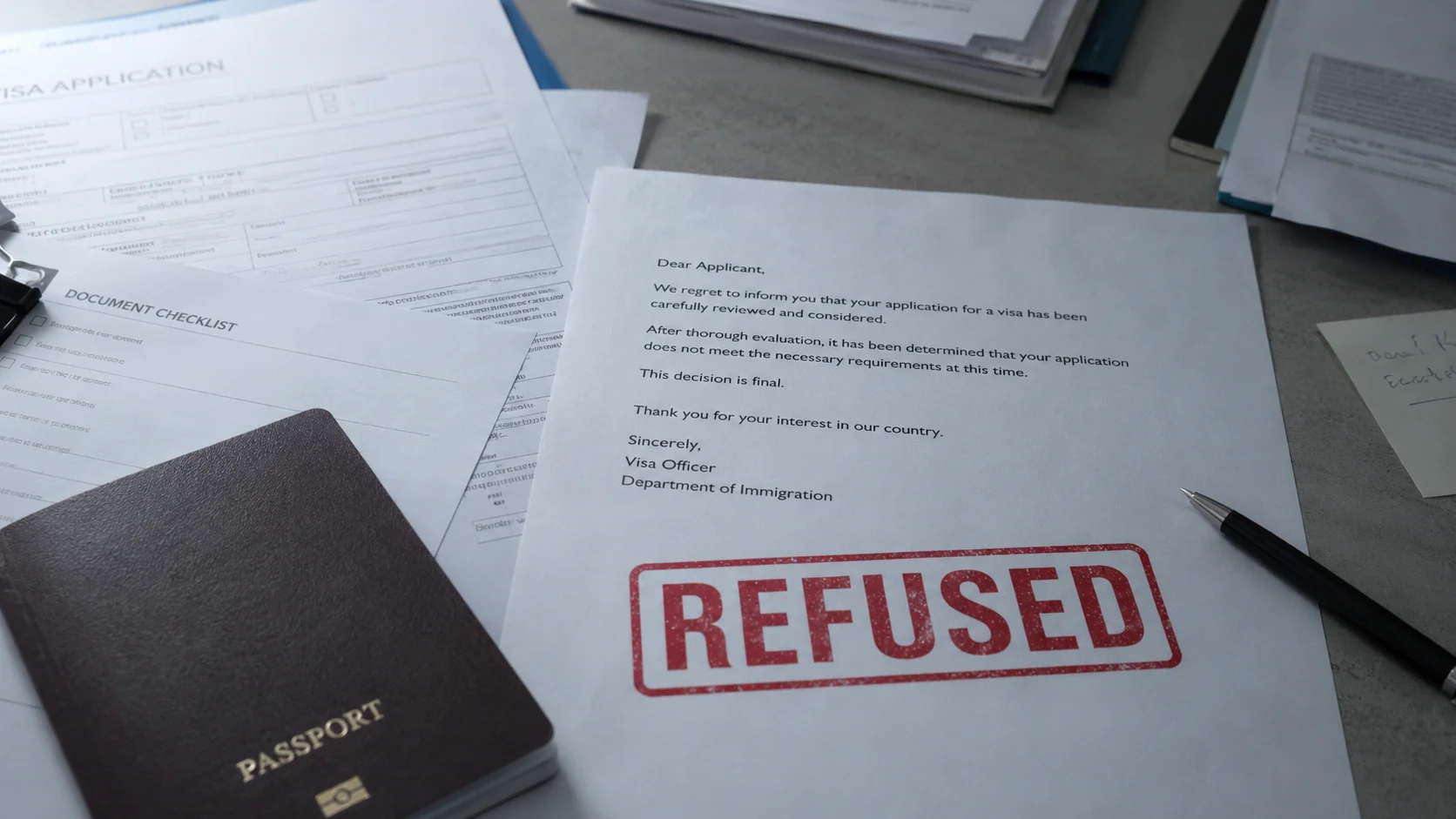
Visa rejection rates by destination - 2024 data
Comparable cross-destination rejection data is surprisingly hard to assemble. The European Council publishes a clean annual breakdown for Schengen, but the US Department of State buries B1/B2 refusal rates in a non-immigrant visa table that mixes 214(b) ineligibilities with administrative processing. Canada's IRCC releases study permit approval ratios only when forced through ATIP requests, and the UK Home Office reports visitor refusal rates in a quarterly migration bulletin that requires manual nationality filtering. The table below reconciles those sources for the most recent full year.
| Destination | Applications | Rejected | Rate | Trend |
|---|---|---|---|---|
| Schengen (all) | 11.7M | 1.7M | 14.8% | Down from 16% (2023) |
| US B1/B2 (global) | - | - | 27-30% | Stable |
| US F-1 (Indians) | - | - | 41% | Up, highest ever |
| Canada study (Indians) | - | - | 74% | Doubled from 2023 |
| UK visitor (global) | - | - | ~9% | Stable |
| UK visitor (high-risk countries) | - | - | 40-45% | Stable |
| Australia (student) | - | - | ~15% | Rising |
What the data actually shows is a tale of two visa systems. Schengen and UK numbers are dominated by visitor and short-stay categories, where the headline refusal rate stays in single digits globally but spikes sharply for a small set of nationalities. The US and Canada figures are dominated by long-stay categories, where the refusal rate is structurally higher because officers are screening for non-immigrant intent and, in Canada's case, a backlog-driven tightening of study permits. If you only remember one thing from this section, it is this: the global average rejection rate for your destination tells you very little. The combination of destination plus nationality plus visa category is what decides your odds.
10 most common reasons visas get rejected
Across more than a thousand refusal letters reviewed in my practice over the past three years, the same ten grounds account for roughly 90 percent of denials. The wording varies by consulate, but the underlying officer concern is almost always one of these.
1. Insufficient financial proof. This is the single most common ground for short-stay refusals. Officers want to see liquid, verifiable funds that cover the entire trip plus a buffer, sitting in your account for at least three to six months. A lump-sum deposit two weeks before application looks like a borrowed balance and is treated as such. The fix is a six-month bank statement with steady salary credits, plus a recent tax return that matches the salary, plus a letter from your employer confirming continued employment and approved leave.
2. Weak ties to home country. The officer's job under EU Visa Code Article 32(b) and US INA 214(b) is to be satisfied you will leave at the end of the trip. Property ownership, dependent children, an active business, a long-tenure job, and a return-dated ticket all count as ties. A single 24 year old with no property, no spouse, and a short employment history has weak ties on paper, regardless of how genuine their intent is. The fix is a structured cover letter that lays out every tie in plain terms, supported by deeds, school records, and employer letters.
3. Incomplete or incorrect documents. Missing pages of a bank statement, an unsigned application form, a passport with under three months validity beyond return, a photo that does not meet the consulate's specification, or a missing translation. These are administrative refusals and they are entirely avoidable. Use a checklist and double-check against the consulate's most recent published requirements. Our cover letter template and the visa photo requirements page cover the two most commonly botched items.
4. Previous immigration violations. An overstay of even one day on a previous Schengen, UK, or US visa shows up in the shared databases consulates query. Removal orders, voluntary departures, and refused entries at the border are all flagged. The fix is disclosure and explanation: a clear narrative of what happened, why it will not recur, and any documentary evidence of compliance since.
5. Inadequate travel insurance. For Schengen specifically, you must show medical travel insurance with at least 30,000 euros of coverage, valid in all Schengen states, for the full duration of the trip. Officers reject for under-coverage, wrong territorial scope, or a policy that excludes pre-existing conditions when the applicant is over 65. Buy a Schengen-compliant policy from a recognised insurer and include the certificate in the original file.
6. Unclear purpose of travel or work. "Tourism" with no itinerary, "business meetings" with no invitation, or "family visit" with no invitation letter from a host with legal status. The officer cannot rubber-stamp a vague purpose. Submit a day-by-day itinerary for tourism, an invitation letter on company letterhead for business, and a host-status proof for family visits.
7. Criminal record or security flags. A spent conviction does not automatically bar entry, but undisclosed convictions almost always lead to refusal and, in the UK and US, to multi-year bans for misrepresentation. For most destinations you must disclose any conviction, however minor, however old. The fix is full disclosure with court documents and, if available, a certificate of good conduct.
8. Wrong visa category. Applying for a Schengen tourist visa to attend a paid conference, a UK Standard Visitor visa to do remote work for a UK client, or a US B1 to start a new job all trigger refusal under the "purpose not justified" ground. Match the category to the activity. If you are unsure, the consulate's own category guide or a brief paid consult with an attorney is cheaper than a second application.
9. Previous rejection not disclosed. Almost every long-form visa application asks whether you have ever been refused a visa by any country. Saying "no" when the truth is "yes" is misrepresentation, and consulates share refusal data through Interpol's I-Checkit, the Five Eyes intelligence sharing arrangement, and bilateral memoranda. The penalty is typically a multi-year ban, not just a refusal.
10. Consulate-specific strictness. Identical files can yield different outcomes at different consulates. Malta refuses 38.5 percent of Schengen applicants on average. Iceland refuses 6.6 percent. Within a single country, individual consulates differ too. Where the Visa Code or equivalent rule gives you a choice of consulate, choose carefully.
Beyond these ten, a smaller set of secondary triggers shows up in roughly one in five refusals: previous Schengen short-stay visas that were never used (the officer questions why you bothered applying), discrepancies between the cover letter narrative and the hotel bookings, multiple applications submitted simultaneously to different Schengen states (a clear consulate-shopping signal), and a photo that does not meet the consulate's biometric specification. None of these is fatal on its own, but they compound. A file with two or three secondary triggers reads as careless and primes the officer to look for a primary ground.
The single most important reframe for applicants from high-refusal corridors is this: the officer is not trying to catch you out. The officer is trying to be satisfied. Every document you submit either increases or decreases the officer's confidence that the trip is genuine and that you will leave at the end. The job of the applicant is to make satisfaction easy, not to argue against suspicion. A file that pre-empts the officer's likely questions (Why this country? Who is paying? What happens to your job while you are away? What brings you back?) wins more often than a file that submits the minimum.
Rejection rates by NATIONALITY - who gets rejected most
The aggregate destination data hides enormous variation by passport. Here are the most recent rates for the major source-country corridors.
| Nationality | Schengen Rate | US B1/B2 | UK Visitor | Canada |
|---|---|---|---|---|
| Bangladesh | 62%+ | High | 40%+ | High |
| Pakistan | 62%+ | High | 35%+ | High |
| Algeria | 35% | - | - | - |
| Nigeria | 30-35% | 30%+ | 35%+ | High |
| Egypt | ~30% | 25%+ | 25%+ | Medium |
| Ghana | ~35% | 25%+ | 40%+ | Medium |
| India | 15% | 27-30% | 9% | 74% (study) |
| China | 4.6% | 15% | Low | Low |
| Philippines | ~15% | 20%+ | 15% | Medium |
Country-specific guides go deeper into the consular history, document conventions, and successful cover-letter framings for high-risk corridors. See the Nigeria nationality guide, the Pakistan guide, the Bangladesh guide, the India guide, the Ghana guide, and the Kenya guide for tailored data. For a fuller comparison across more than 30 passports, read the deep dive by nationality.
The pattern is consistent: nationals of countries with high asylum-claim rates, high overstay rates, or weak diplomatic data-sharing have structurally higher refusal odds across every destination. The only file-level levers that meaningfully move those odds are deep financial documentation, demonstrable home-country ties, and a clean immigration history. Cosmetic fixes (a glossier cover letter, a more expensive insurance policy) do not move the needle for these nationalities. Structural fixes do.
One nuance the table hides: rejection rates for the same nationality vary dramatically between visa categories. An Indian passport holder applying for a UK Standard Visitor visa faces a 9 percent refusal rate. The same passport holder applying for a UK Skilled Worker visa with a valid Certificate of Sponsorship sees a refusal rate under 5 percent. The same passport holder applying for a US F-1 student visa faces a 41 percent refusal rate. The category is doing more work than the passport in many cases. When you compare your odds to the headline number, make sure you are comparing the same category, not just the same destination.
The second nuance is age and gender. Across every destination and every major source country, the highest refusal odds attach to single applicants aged 18 to 30 with no children, no property, and short employment history. The lowest refusal odds attach to married applicants over 35 with dependent children, property ownership, and ten plus years of continuous employment with the same employer. The two profiles can have identical paperwork and identical bank balances; the older profile will be approved roughly twice as often. Officers are not allowed to refuse on age alone, but the ties-to-home-country test correlates strongly with age, and the test is applied through the officer's discretion under Article 32(1)(b) or INA 214(b).
Schengen rejection - the strictest and easiest countries
Within the Schengen area, the rejection rate varies by more than 30 percentage points between the strictest and the most lenient member state. Because applicants often have a legitimate choice of consulate (the main destination, or in the absence of a clear main destination, the country of longest stay or first entry), this matters enormously.
| Country | Rate | Applications | Rejected |
|---|---|---|---|
| Malta | 38.5% | 45,578 | 16,905 |
| Estonia | 27.2% | 12,125 | 3,291 |
| Belgium | 24.6% | 255,564 | 61,724 |
| Slovenia | 24.5% | 18,171 | 4,417 |
| Sweden | 24.0% | 188,623 | 44,576 |
| Denmark | 23.7% | 132,158 | 31,013 |
| Croatia | 19.3% | 42,165 | 8,003 |
| Poland | 17.2% | 111,538 | 19,277 |
| France | 15.8% | 3,072,728 | 485,491 |
| Germany | 13.7% | 1,500,000 | 206,733 |
| Italy | 10.9% | 1,200,000 | 134,303 |
| Iceland | 6.6% | - | - |
Strategic consulate choice is the single most under-used tool in Schengen applications. EU Visa Code Article 5 requires you to apply at the consulate of your main destination, defined as the state where you will spend the most time or which is the primary purpose of the trip. If your itinerary genuinely spreads across multiple states with no clear primary, the rule defaults to the country of first entry. A trip with five nights in Rome and two nights in Valletta is an Italian application, not a Maltese one. A circular tour with three nights in each of four countries can be filed at whichever consulate has appointment availability and the lowest refusal rate, provided you can defend the itinerary if asked.
For the country-level breakdown and the appeal procedure in each Schengen state, see the Schengen rejection deep dive.
What to do after rejection - the 5-step recovery
A rejection is data, not a verdict. Work through these five steps in order before you reapply or appeal.
- Read the refusal letter line by line. Identify the exact ground (Article 32(b), 214(b), paragraph 4.2, etc.) and the specific evidence the officer cites. If the letter is vague, see our decode your refusal letter guide.
- Decide between appeal and reapplication. Appeals are right when the officer made a legal or factual error you can prove. Reapplication is right when you simply need to fix or add evidence. The visa appeal guide walks through the decision tree.
- Fix the underlying weakness, not the symptom. If the refusal was for insufficient funds, do not just add a bigger statement - add three months of payslips, a tax return, and a letter from your employer that together explain the balance.
- Rebuild the file from scratch. Resist the temptation to resubmit your old file with one new document. Officers can see the previous application and they will treat a barely-edited file as evidence that you did not take the refusal seriously.
- Disclose the previous refusal honestly. Every long-form visa application from this point forward will ask about prior refusals. The answer is always yes, with a short factual explanation. Hiding it is a far worse offence than the original refusal.
A note on emotional recovery, because attorneys rarely address it. A visa refusal feels personal. Applicants who have spent months gathering documents, paying fees, attending appointments, and waiting often experience the refusal as a judgement of their character rather than an evidentiary call by a consular officer. That reading is almost always wrong. Officers review hundreds of files a day under time pressure with limited information. The refusal reflects their best judgement on the paperwork in front of them, not a verdict on the applicant. Treat the refusal as data, work the five-step recovery, and reapply with a stronger file. The success rate for fixed-file reapplications is materially higher than the rate for first applications.
If the refusal is your second or third in a row at the same consulate or in the same visa category, the calculation shifts. At that point a paid attorney review is almost always worth the cost, because the issue is likely structural (the immigration history, the home-country profile, the visa category) rather than documentary, and a self-help fix is unlikely to clear it.
Does a rejection affect future applications?
Yes, but not in the way most applicants fear. A visa refusal in itself is rarely a permanent bar. It is a data point the next consular officer will see and weigh. What does cause lasting damage is misrepresentation: claiming on a UK Standard Visitor form that you have never been refused a visa when in fact you were refused a Schengen in 2023 triggers a mandatory 10-year ban under Appendix V of the UK Immigration Rules. The US equivalent is INA 212(a)(6)(C), which carries a lifetime bar that is only liftable through a 212(i) waiver.
Refusal data is also shared more widely than applicants realise. Interpol's I-Checkit lets consulates verify whether a passport has been flagged. The Five Eyes intelligence-sharing partnership (US, UK, Canada, Australia, New Zealand) routinely shares adverse immigration decisions across the five members. The Schengen Information System (SIS II) shares entry-refusal alerts across all 29 participating states. A refusal at one consulate is visible to the next.
For the specific consequences of misrepresentation in the UK system, see the UK 10-year deception ban explained.
The other long-tail effect of refusal is on premium travel programmes. A refusal in your immigration history can disqualify you from US Global Entry, NEXUS (Canada), and similar trusted traveller schemes, all of which require a clean record of admissions and refusals at point of entry. Some employer-sponsored visa categories also weigh prior refusals when assessing security clearance suitability. None of these consequences is automatic, but they are all real, and they all compound the original refusal in ways the applicant does not see at the time. The cleanest immigration history is always the one with no refusal on it, which is why the time and money spent on the first application matter so much.
The cost of rejection - money lost
Visa application fees are never refunded on refusal. They are charged for the processing of the application, not the issuance of the visa. The math at scale is staggering.
| Visa Type | Fee | Refundable? |
|---|---|---|
| Schengen | EUR 90 | No - never |
| US B1/B2 | USD 185 | No - never |
| UK Standard Visitor | GBP 127 | No - never |
| UK Skilled Worker | GBP 719-1,539 | No - never |
| Canada Visitor | CAD 100 | No - never |
| Australia Visitor | AUD 190 | No - never |
Add VFS service charges, courier fees, mandatory travel insurance premiums (which are non-refundable once issued), and flight reservations purchased for the application file, and the true cost of a single refused Schengen application sits around 250 to 400 euros. For an Indian student family applying to multiple Canadian universities, the cumulative fee and SDS exposure can run past 5,000 Canadian dollars per applicant. For the full fee schedule by country and visa class, see full visa fees by country.
The financial cost is only half of the picture. The hidden cost of rejection is opportunity cost: the conference you cannot attend, the wedding you miss, the job offer you cannot accept, the school admission you forfeit. For students, a refused study permit can mean losing a year of enrolment because by the time the reapplication is processed the academic intake has closed. For business travellers, a refused B1 can mean losing a contract that hinged on an in-person meeting. For families, a refused visitor visa can mean missing a funeral or a graduation that will not come around again. Officers do not weigh opportunity cost when they refuse. The applicant carries the whole burden.
There is a third cost that grows over time: the cumulative record of refusals attached to your passport. Each refusal is a data point the next officer sees. Three refusals in a row, even at different consulates for different visa categories, reads as a pattern of inadmissibility regardless of whether the underlying issues were ever the same. The cheapest refusal is the one you avoid by getting the first file right, which usually means a stronger application package, a paid attorney review for high-risk corridors, and the patience to wait until your documentation is genuinely ready rather than rushing the appointment.
Deep dive: rejection by visa type and country
This hub is the starting point. Each cluster article goes deep on a single destination or topic with the country-specific law, appeal forms, and worked examples. Read the Schengen rejection deep dive, the UK visa rejection reasons guide, the US 214(b) denial breakdown, the Canada visa refusal guide, the rejection rates by nationality comparison, the visa appeal guide, and the refusal letter decoder. For live tracking of an application in progress, the VFS application status decoder and the USCIS case status decoder explain what each status code actually means.
lead.rejectionHeading
lead.rejectionDesc
Frequently asked questions
Why was my visa rejected?
The exact ground is always cited on the refusal letter, usually as a code (Article 32(b) for Schengen, INA 214(b) for US B1/B2, paragraph 4.2 for UK visitor). Across all destinations the top causes are insufficient financial proof, weak ties to home country, incomplete documents, and unclear purpose of travel. Read the letter line by line and match the cited ground to the underlying weakness in your file - that is the only thing you can actually fix.
Can I reapply immediately after a visa rejection?
For most visa types yes. Schengen, UK Standard Visitor, US B1/B2, and Canada visitor categories have no mandatory cooling-off period. You can submit a new application the next day. The exception is when the refusal letter cites a specific ban period (for example a 10-year deception ban under UK Appendix V) or when the visa category itself imposes one. Reapplying without fixing the underlying issues is almost always a wasted fee.
Does a rejection in one country affect applications to other countries?
Yes, in two ways. First, almost every long-form visa application asks whether you have been refused a visa by any country, and you must answer truthfully. Second, refusal data is shared across the Schengen Information System, the Five Eyes intelligence partnership, and Interpol's I-Checkit. A Schengen refusal is visible to UK, US, Canadian, and Australian consulates. It does not automatically bar you, but it is a data point the next officer will weigh.
How do I find out the exact reason for my rejection?
The refusal letter cites the legal ground (Article 32(b), 214(b), paragraph 4.2). For Schengen, the standard refusal form has tick boxes for each Article 32(1) ground. For UK and Canada, the letter usually includes a narrative paragraph explaining which evidence the officer found insufficient. The US 214(b) refusal is typically a single sentence that does not specify the weakness, which is why a separate refusal letter decoder is so important.
What is the visa rejection rate for my country?
It depends heavily on both your nationality and the destination. For Schengen, Bangladesh and Pakistan applicants face 62%+ rejection, Nigeria 30-35%, India 15%, and China 4.6%. For Canadian study permits, Indian applicants now face 74% rejection. For US B1/B2 the global average is 27-30% but the Indian F-1 rate has reached 41%. The nationality deep dive in this cluster has the full table.
Can I get my visa fee refunded after rejection?
No. Visa application fees are charged for the processing of the application, not for the issuance of the visa, and they are never refunded on refusal. This rule is the same across Schengen (EUR 90), US (USD 185), UK (GBP 127 minimum), Canada (CAD 100), and Australia (AUD 190). Add VFS service charges, courier fees, and insurance premiums and the true cost of a single refused application sits in the hundreds of dollars.
Should I appeal or reapply after a visa rejection?
Appeal when the officer made a legal or factual error you can prove (for example they ignored evidence you submitted, or applied the wrong rule). Reapply when you simply need to add or strengthen evidence. Schengen appeal success rates sit around 10-20% and the process takes months, so reapplication with a fixed file is usually faster and cheaper. The visa appeal guide in this cluster walks through the decision tree.
Do I need an immigration lawyer after a visa rejection?
For a first short-stay refusal with a clear ground (insufficient funds, missing documents) you can usually fix the file yourself. For a second refusal, a misrepresentation finding, a 214(b) denial, or any case involving a previous immigration violation, a paid attorney consult is worth the money. The cost of a one-hour consult is roughly the cost of a single re-application fee, and the strategy advice usually pays for itself.
Will lying about a previous rejection get me banned?
Almost certainly yes. Misrepresentation triggers a mandatory 10-year ban under UK Appendix V, a lifetime bar under US INA 212(a)(6)(C) that requires a 212(i) waiver to lift, and a 5-year ban under Canada IRPA section 40. Refusal data is shared across the Schengen Information System, Interpol's I-Checkit, and the Five Eyes partnership, so the original refusal is visible to the next officer regardless of what you write on the form. Disclose, explain, and move on.
Which countries have the highest visa rejection rates in 2026?
For Schengen short-stay, Malta tops the list at 38.5%, followed by Estonia (27.2%), Belgium (24.6%), Slovenia (24.5%), and Sweden (24.0%). For US student visas, the Indian F-1 refusal rate has reached 41%. For Canadian study permits, the Indian rate has reached 74%. By nationality, Bangladesh and Pakistan face 62%+ Schengen refusal, the highest of any major source country.
Related articles
Use our free tools
Free calculators for Canada CRS, Australia points, UK skilled worker, Germany Opportunity Card, and 34-country salary thresholds.
See all tools